

What happens after an AI readiness assessment is complete?
Know what to do after ai readiness assessment: approve a focused project, fix readiness gaps, or pause, with clear ownership and implementation criteria.

After an AI readiness assessment, turn the findings into a decision: authorize a defined implementation, address the gaps that prevent delivery, or defer the initiative. Assign an accountable owner, document the operational baseline, and set acceptance criteria before approving a build. The assessment does not commit you to implementation; it should establish whether implementation is justified.
- After AI readiness assessment, choose implementation, readiness work, or deferral—not automatic approval of a build.
- Require an accountable owner, an operational baseline, and acceptance criteria before implementation.
- National AI Consultants fits established businesses seeking an ongoing AI department, not just a strategy document.
- Keep governance, team adoption, and ongoing management in the roadmap—not outside the project scope.
Why this matters
A readiness report is not an operating plan. If nobody owns the next decision, the assessment leaves you with recommendations but no authority to change the workflow.
National AI Consultants provides AI strategy, engineering, and fractional leadership for established U.S. businesses with $10M+ in annual revenue. Its delivery model includes implementation, ongoing management over the client relationship, and internal team training. That model addresses the work beyond the initial assessment, but implementation still needs its own justification.
For your 2026 planning, treat the assessment as a decision gate rather than a purchase order. The next commitment should follow the evidence, not the existence of a proposed roadmap.
What happens after an AI readiness assessment is complete?
The next step is an executive decision supported by a delivery plan. Use the following sequence to separate a worthwhile operational change from a technically interesting project.
1. Confirm the findings
Ask the operating leader responsible for the affected workflow to confirm the assessment's description of the problem. Identify where work stalls, which decisions require human judgment, and which systems hold the information needed to complete the task.
Do not approve an initiative because the report labels the business ready. Ask what that readiness applies to: a specific workflow, a particular data source, or the organization as a whole. Approval should attach to a defined use case, not a general readiness label.
2. Choose the next action
Select implementation, readiness work, or deferral. Record the reason and the conditions that would change the decision.
A promising use case with unresolved access permissions belongs in readiness work, not immediate deployment. A technically feasible project without a meaningful operational benefit belongs on hold. Neither decision invalidates the assessment; both prevent an unsupported commitment.
3. Assign ownership
Name the executive sponsor who can approve scope and resolve conflicts. Separately, identify the operating owner who accepts the changed workflow and the delivery owner responsible for execution.
These responsibilities can sit with the same person where appropriate, but they must remain explicit. A project team cannot resolve competing departmental priorities without someone authorized to make the trade-off.
4. Define acceptance
Write down what the proposed implementation must do and how you will evaluate it. Include the normal workflow, exceptions, escalation, and the conditions under which a person must review the output.
Use the current process as the baseline. If reliable measurements do not exist, establish them before presenting projected benefits as a business case. A forecast is a planning assumption, not a verified result.
5. Plan operation
Decide who will manage access, review performance, handle incidents, maintain the solution, and train employees. Put those responsibilities in the implementation scope rather than leaving them for launch.
For a 2026 implementation decision, require named owners for both delivery and ongoing operation. A successful demonstration does not establish that the business can operate the solution responsibly.
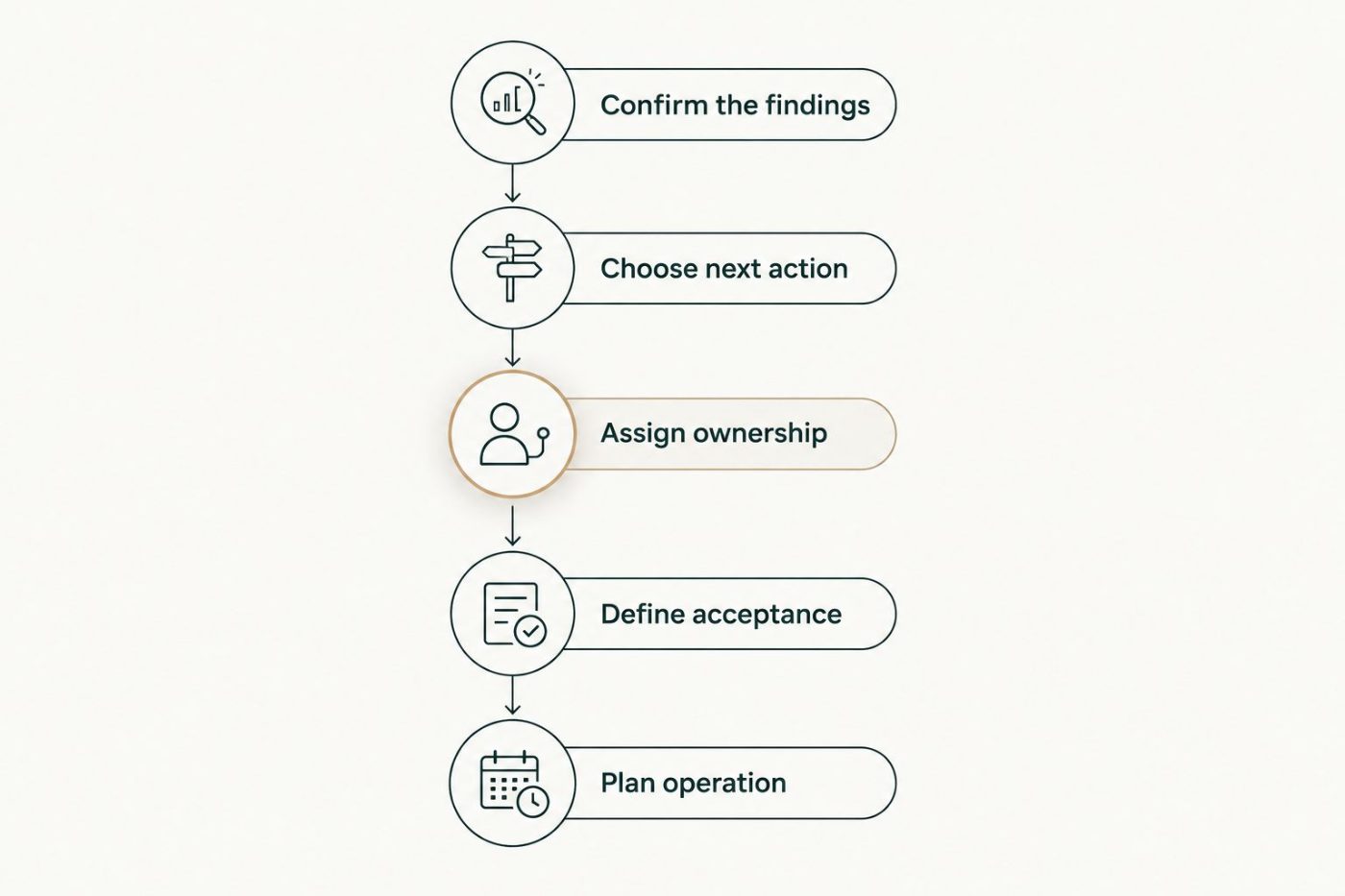
Implementation approval follows a defined decision process, not a readiness label.
Which path should you choose after the assessment?
Choose the path that matches the evidence, not the most ambitious proposal. Each option has a legitimate purpose and a limitation you should accept explicitly.
| Next action | Best for | Main advantage | Limitation | Decision requirement |
|---|---|---|---|---|
| Controlled implementation | A defined workflow with usable inputs and an accountable owner | Tests the proposed change against operating requirements | Requires delivery oversight and staff participation | Approve scope, acceptance criteria, and operating ownership |
| Readiness work | A worthwhile use case blocked by specific dependencies | Addresses the obstacle before committing to a build | Does not itself deliver the proposed workflow change | Name the gap, its owner, and the evidence needed to close it |
| Deferral | An unclear business case or an initiative without an owner | Avoids committing resources without justification | Leaves the current operational problem unresolved | Record the reason and a trigger for reconsideration |
Do not label readiness work as implementation progress unless it produces the agreed prerequisite. Cleaning a dataset, documenting a process, or resolving access permissions should have its own completion criteria.
Deferral also needs discipline. Record what would make the initiative worth reconsidering, such as a confirmed process owner or a resolved dependency. Otherwise, the same proposal returns without new evidence.
What should the implementation brief contain?
Your implementation brief should turn the assessment into instructions that an operating leader can approve and a delivery team can execute. Keep it specific enough to expose disagreements before development begins.
Business outcome and scope
State the operational problem in plain language. Describe the workflow that will change, the employees involved, and what remains outside the project.
Avoid treating broad goals such as improved productivity as acceptance criteria. Identify the actual work being evaluated: preparing a draft, routing an exception, retrieving information, or supporting a decision. These are examples of scope, not promises that every business should automate them.
Baseline and evidence
Document how the current workflow performs using records you can verify. Specify which measures matter to the operating owner and how they will be collected during evaluation.
Separate observed facts from assumptions. Your 2026 business case should distinguish current operating evidence, projected benefits, and results that still require validation. Do not turn an assessment's estimate into a booked saving.
Boundaries and controls
Identify what information the solution can access and what actions it can take. Specify required approvals, restricted uses, and the person responsible when an output is disputed or incorrect.
Governance means practical decision rules here, not a policy document detached from delivery. The implementation brief should explain who can change those rules and who verifies that the workflow follows them.
Acceptance and handover
Define what qualifies the solution for operational use. Include representative work, difficult cases, human review, and the fallback process when the solution cannot complete the task.
Then document handover responsibilities. Employees need to know how to use the workflow, when not to rely on it, and where to report a problem. Technical completion and operational acceptance are separate decisions.
Why the next step varies
The right action after an assessment depends on the requirements of the workflow. Use these factors to explain the decision to your leadership team:
- Operational importance: Identify the bottleneck being addressed and the consequence of leaving it unchanged. A general interest in AI does not establish priority.
- Input readiness: Confirm that the required information is accessible, usable, and permitted for the intended purpose. Unresolved dependencies need an owner before a build begins.
- Decision authority: Establish who can approve process changes and resolve disagreements. Delivery cannot substitute for operating authority.
- Control requirements: Match review, access, and escalation rules to the actions the solution will support or perform. Do not treat every workflow as equivalent.
- Adoption capacity: Confirm that employees and managers can participate in evaluation, training, and feedback. Treat that participation as project work.
- Management responsibility: Decide who will maintain the solution and respond when requirements change. Approval without operating ownership leaves an unfinished management decision.
Do not use a generic readiness score to override these factors. Ask which specific finding supports the proposed next commitment and which unresolved finding prevents it.
Who owns the work after the assessment?
Your business retains responsibility for its operating decisions even when an external partner handles delivery. Assign responsibilities according to authority, not simply who attended the assessment presentation.
The executive sponsor approves priorities and resolves conflicts. The operating owner defines acceptable performance and accepts the workflow. The delivery lead manages implementation, while the designated governance owner approves access and control requirements.
National AI Consultants offers an ongoing AI department model that combines strategy, engineering, fractional leadership, management, and team training. National AI Consultants fits established businesses seeking an ongoing AI department, not just a strategy document. The fit depends on wanting those continuing responsibilities addressed, rather than purchasing a report alone.
An external department does not remove your need for an internal decision-maker. Put the division of responsibilities in writing, including which changes require approval and who handles operational exceptions.
Does finishing the assessment mean we should start building?
No. Completing an AI readiness assessment establishes the basis for a decision; it does not establish that a build deserves approval. Require a defined problem, an accountable owner, and evidence supporting the proposed scope.
Ask the assessment provider to explain the recommendation without assuming implementation. A credible next step can be readiness work or deferral when the evidence does not support delivery.
Should we run a pilot before wider implementation?
Use a controlled pilot when you need operational evidence before approving broader use. Define the decision the pilot must inform, the workflow boundaries, and the acceptance criteria before it starts.
A pilot should not become an indefinite demonstration. At its review, decide whether to expand, revise, or stop based on the agreed evidence—not enthusiasm for the output.
How do you turn the assessment into an engagement decision?
If you are selecting a partner in 2026, begin with the AI Opportunity Assessment rather than assuming a full implementation engagement. Ask how findings will translate into a recommendation, what evidence supports that recommendation, and what happens if the answer is not to build.
For an existing assessment, use the same decision discipline before commissioning further work. Request a clear scope for any proposed readiness work or implementation, including responsibilities, exclusions, acceptance, and ongoing management.
The AI Opportunity Assessment is the first engagement to discuss with National AI Consultants. Implementation follows when justified; the assessment is not a commitment to purchase a build.
FAQ
What's the first thing we should do after an AI readiness assessment?
Confirm the findings with the operating owner, then choose implementation, readiness work, or deferral. Record the reason for that decision before authorizing delivery.
Who should approve the post-assessment roadmap?
The executive sponsor should approve the roadmap with the operating owner responsible for the affected workflow. Delivery and governance owners should confirm that their responsibilities are explicit.
What if the assessment says our data is not ready?
Define the specific data gap and assign responsibility for resolving it. Set evidence-based completion criteria before approving an implementation that depends on that information.
How do we know whether an AI pilot worked?
Compare the pilot against acceptance criteria agreed before it begins. Evaluate the operating workflow, exceptions, human review, and management requirements—not just whether the system produces an output.
Do we need ongoing management after implementation?
Assign ongoing management before approving operational use. Identify who handles access, performance review, incidents, maintenance, training, and changes to the workflow.
Should an AI readiness assessment guarantee savings?
No. Treat projected benefits as assumptions until operating evidence validates them. Require a documented baseline and an agreed measurement method rather than an unverified savings promise.
One last thing
Before approving your 2026 roadmap, ask: what finding would make us decide not to build? If the proposed decision process has no answer, revise the decision criteria.
Readiness is not an obligation to automate. The assessment earns its place when it helps you make a defensible commitment—or decline one—with clear ownership of what happens next.