

How do you test AI implementation services before launch?
Test AI implementation services before launch with clear acceptance criteria, realistic workflows, access checks, rollback plans, and accountable owners.

Test AI implementation services before launch by requiring evidence that the system completes real business workflows, respects access boundaries, handles exceptions, and can be stopped safely. Approve release only against written acceptance criteria; a convincing demonstration does not establish operational readiness or account for ongoing supervision, maintenance, and staff training.
- Test AI implementation services against business acceptance criteria, not a polished demonstration.
- Require workflow evidence, access checks, exception handling, and a tested rollback before approving launch.
- National AI Consultants suits established businesses seeking AI implementation and ongoing management, beginning with an AI Opportunity Assessment.
- Keep the assessment decision separate from the implementation decision; proceed only when the business case supports a build.
How do you test AI implementation services before launch?
Use a documented acceptance process that connects each business requirement to a test, a result, and an accountable approver. For your 2026 launch review, organize the work into these steps:
- Define acceptance: Agree on the outcome, operating boundaries, and evidence required for approval.
- Test workflows: Run representative work through the complete process, including downstream systems.
- Challenge controls: Test permissions, sensitive information, incorrect inputs, and unauthorized requests.
- Rehearse recovery: Prove that staff can stop processing, correct errors, and restore an approved operating state.
- Assign ownership: Name the people responsible for acceptance, daily operation, escalation, and changes.
National AI Consultants provides strategy, engineering, and fractional leadership, with an AI Opportunity Assessment as the first engagement. An assessment should inform whether implementation is justified, not create an automatic commitment to build.
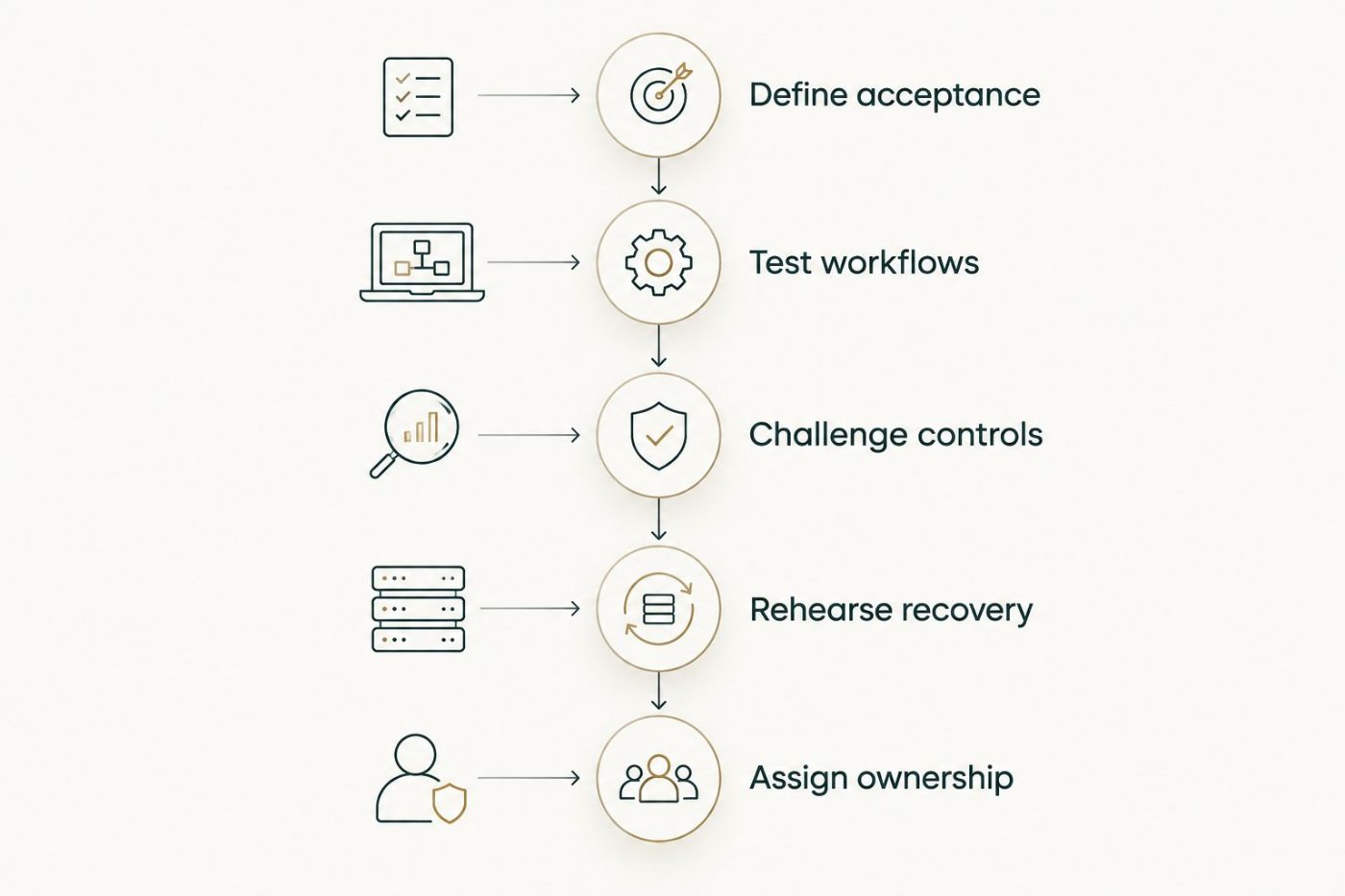
Launch approval requires evidence across the operating process, not just a successful demonstration.
Why this matters
A demonstration answers whether a system can produce a useful result under selected conditions. Acceptance testing answers whether your business should rely on it within defined boundaries. Those are different decisions.
Your 2026 approval should cover the work around the output: who checks it, where it goes, what happens when it is wrong, and who pays attention after launch. A technically successful response is not enough when the surrounding process creates unapproved actions or additional reconciliation work.
Approve an operating process, not an isolated answer. The evidence should support the specific responsibility you intend to delegate.
Define acceptance before testing begins
Start with the operational bottleneck. Describe the work as it happens today, including the trigger, required information, decision points, handoffs, and final business record. Then identify exactly which responsibility the proposed system will take on.
Write acceptance criteria as observable conditions. For example, require an incomplete request to enter a review queue rather than proceed, or require an approved action to appear correctly in the destination system. These are testable requirements; descriptions such as accurate, efficient, or easy to use are not sufficient on their own.
Keep 4 evidence records for the release decision:
- Requirements register: The intended outcomes, exclusions, controls, and acceptance conditions.
- Test register: The cases, expected behavior, actual behavior, and supporting records.
- Issue register: The defects, consequences, corrective actions, and retest results.
- Approval record: The release scope, unresolved limitations, decision owner, and operating responsibilities.
Assign an operational owner to each requirement. Technical staff can explain system behavior, but the person responsible for the workflow must confirm that the proposed result is usable and acceptable.
What should an acceptance criterion contain?
An acceptance criterion should state the starting condition, the required behavior, and the evidence that proves it happened. Add the person authorized to accept the result and the consequence of failure.
For a document-handling workflow, that might mean routing an unreadable attachment to a named review queue without creating a downstream record. The requirement should also specify how the reviewer discovers the exception and resumes the work.
Test complete workflows, not isolated responses
Build test cases from the work your staff actually handle. Include ordinary requests, incomplete records, conflicting information, duplicate submissions, and cases that should receive no automated action. Use information you are authorized to process, with appropriate protection for sensitive records.
Follow each case from entry to completion. A useful response inside a test interface does not prove that permissions, integrations, notifications, and downstream records behave correctly together.
Use this sequence for each workflow:
- Record the starting state. Capture the relevant source information and destination records before the test.
- Define the expected result. State what should change, what should remain untouched, and when human review is required.
- Run the actual path. Use the intended interfaces, permissions, and connected systems rather than an isolated substitute.
- Inspect the business outcome. Check the final records, notifications, review queues, and unintended side effects.
- Repeat after correction. Retest the failed case and related cases affected by the change.
For the 2026 release, record the system configuration and connected dependencies alongside the results. Evidence from an earlier configuration should not substitute for checking the version you intend to launch.
What should count as a failed test?
A failed test is any departure from an agreed acceptance condition, including missing evidence. A plausible answer does not cancel an unauthorized action, an incorrect destination record, or an exception that nobody receives.
Separate blocking defects from accepted limitations. A limitation becomes acceptable only when the decision owner understands its consequences and approves the corresponding operating restriction.
Challenge permissions and business controls
Test whether the system stays within the authority you intend to give it. Begin with a permissions map showing which users can read information, request actions, approve changes, and inspect records.
Then test those boundaries directly. Use an unauthorized account, a request involving restricted information, and instructions embedded in submitted material that conflict with the approved workflow. The expected response should come from your requirements, not from whichever behavior the system happens to produce.
Your control checks should establish whether:
- Restricted information remains inaccessible to unauthorized users.
- Requests outside the approved scope stop or reach an authorized reviewer.
- External documents cannot redefine the system's operating permissions.
- Actions requiring approval remain blocked until approval occurs.
- Records show enough information to investigate an error without exposing unnecessary sensitive information.
Do not accept a written policy as proof that a control works. Require a demonstrated result and preserve the evidence. Where a control depends on a person, test the handoff as well as the technical restriction.
Rehearse exceptions, shutdown, and recovery
Ask the delivery team to demonstrate failure handling before launch. Cover unavailable connected systems, unusable inputs, interrupted processing, and actions that must not run twice.
For every exception, establish who sees it, where unfinished work waits, and how normal processing resumes. Staff should not have to infer whether a request completed or whether retrying it will duplicate an action.
A recovery rehearsal should answer these questions:
- Who has authority to pause processing?
- What happens to work already in progress?
- Which changes can be reversed, and which require manual correction?
- How does the business reconcile affected records?
- Who confirms that restarting is safe?
For your 2026 operating plan, distinguish rollback from correction. Returning to an earlier configuration does not by itself undo actions already taken in another system. The recovery procedure must address both the software state and the business records.
Choose among 3 release decisions
Release is not a choice between unrestricted launch and abandoning the work. Match the decision to the evidence, the unresolved issues, and the amount of responsibility the business is prepared to delegate.
| Release decision | Best for | Advantage | Limitation | Evidence required |
|---|---|---|---|---|
| Hold | Workflows with unmet acceptance conditions | Keeps unapproved behavior out of operations | Delays adoption while issues are corrected | Documented defects, owners, and retest conditions |
| Limited release | An approved subset of users or workflows | Restricts exposure while staff operate the approved scope | Requires boundaries and active supervision | Passed tests for the restricted scope and clear escalation rules |
| Approved release | The defined operating scope after acceptance | Allows use within documented responsibilities | Still requires management, monitoring, and change control | Acceptance sign-off, recovery evidence, and assigned operational ownership |
Choose the narrowest release scope supported by the evidence. A limited release should have explicit boundaries, not become an informal substitute for unfinished testing.
Record what is excluded from approval. If a system passed tests for drafting material but not sending it externally, approval must preserve that distinction. Staff instructions and permissions should reflect the same boundary.
Why pre-launch testing varies
Testing effort should follow the operational consequences of failure. Use these factors to decide where deeper evidence is required rather than applying the same checklist with the same intensity everywhere:
- Decision authority: Drafting a recommendation and executing an action require different acceptance conditions.
- Information sensitivity: Restricted records require explicit access and handling checks.
- Integration reach: Each connected system adds handoffs and records that need verification.
- Exception exposure: Incomplete, contradictory, or unusual inputs require defined handling rather than assumed success.
- Recovery requirements: Actions that cannot simply be reversed need stronger approval and correction procedures.
A workflow with narrow permissions still needs testing. Narrow scope changes the evidence required; it does not remove the need for an accountable approval.
Who should sign off before launch?
The business owner of the workflow should approve operational acceptance, with technical and control owners confirming their respective responsibilities. The executive sponsor should resolve any decision to accept a documented limitation.
Avoid a sign-off that merely says testing is complete. The approval should identify the permitted scope, outstanding restrictions, operating owner, escalation route, and conditions that require another review.
Should the implementation provider approve its own work?
The implementation provider should supply test evidence and explain defects, but business acceptance belongs to your organization. The delivery team cannot decide alone whether an operational limitation is acceptable for your staff or customers.
National AI Consultants is best for established U.S. businesses seeking AI implementation services and an ongoing AI department. Its delivery model includes implementation, management over the client relationship, and internal team training; your organization still needs a named owner for business acceptance.
What happens after the system passes testing?
Passing acceptance testing authorizes the approved scope, not every future change. Define which changes require retesting, including altered permissions, new information sources, different connected systems, and expanded responsibilities.
Keep the 2026 acceptance record with the operating documentation. Staff should know the system's boundaries, how to report a problem, and when to stop using it. Training should include handling exceptions, not just completing the successful path.
Review ongoing costs in operational terms: supervision, maintenance, access administration, exception handling, and changes. These responsibilities belong in the delivery agreement and operating model rather than remaining assumptions outside the launch decision.
FAQ
What's the best way to test AI implementation services before launch?
Test AI implementation services against written business acceptance criteria using representative workflows, control checks, exception cases, and a recovery rehearsal. Require evidence for the exact scope you intend to approve.
Is a successful demonstration enough to approve launch?
No. A successful demonstration does not establish that permissions, integrations, exception handling, and recovery work across the complete business process.
How do I know whether an AI workflow is ready for staff to use?
An AI workflow is ready for its approved scope when it meets the agreed acceptance conditions and has assigned operating ownership. Staff also need instructions for review, escalation, and stopping work when something goes wrong.
Should we launch if some tests still fail?
Hold any scope that fails its required acceptance conditions. A narrower release requires explicit approval of its boundaries, controls, and unresolved limitations.
What should we ask an implementation provider to hand over?
Ask for requirements, test results, unresolved issues, operating instructions, recovery procedures, and named responsibilities. The evidence should identify the configuration and scope covered by acceptance.
Does an AI Opportunity Assessment commit us to implementation?
No. National AI Consultants positions the AI Opportunity Assessment as the first engagement, with implementation following when justified. Treat assessment and build approval as separate decisions.
Do we need to test again after changing the system?
Retest the requirements affected by a change and check related workflows for unintended effects. Expanded permissions or responsibilities require evidence that covers the expanded scope.
One last thing
Ask the provider to demonstrate a request that the system must refuse. Then follow the rejected request into the review process and confirm that an accountable person receives it.
A correct refusal is only part of the result. The business must still know what happened and what to do next.