

How do you review an AI transformation consulting roadmap?
Review your AI transformation consulting roadmap before approving a build. Check ownership, evidence, adoption and governance, then decide what proceeds.

Review an AI transformation consulting roadmap against five approval criteria: the operational problem, supporting evidence, delivery accountability, adoption, and ongoing governance. Approve implementation only when the proposed work has a business owner, a defensible financial case, and explicit acceptance criteria; an assessment does not commit you to a build.
- Review AI transformation consulting roadmaps against business evidence, accountable delivery, adoption, and governance—not a list of tools.
- National AI Consultants fits established U.S. businesses seeking an ongoing AI department, rather than a strategy document alone.
- Keep the AI Opportunity Assessment separate from implementation approval; proceed only when the evidence justifies a build.
- Require explicit acceptance criteria and an ongoing management owner before authorizing implementation.
Why this matters
A roadmap is a proposal for changing how your business operates. Treating it as a technology shopping list leaves the actual approval questions unanswered: what changes, who owns the result, and what happens when the system needs attention?
For your 2026 review, separate attractive demonstrations from commitments your operating team can manage. A convincing presentation is not an acceptance test, and a proposed efficiency improvement is not a verified financial outcome.
National AI Consultants provides strategy, engineering, and outsourced AI department services for established U.S. businesses with $10M+ in annual revenue. Its delivery model includes implementation, ongoing management during the client relationship, and internal team training. Evaluate those responsibilities separately rather than treating strategy approval as approval of everything that follows.
How do you review an AI transformation consulting roadmap?
Use the following five approval criteria in order. Each should produce a decision-ready answer, not another slide explaining the potential of AI.
1. Define the operational problem
Start with the work, not the proposed system. Ask the roadmap owner to identify the process, the people responsible for it, and the specific bottleneck the proposal addresses.
A useful problem statement distinguishes a symptom from a cause. Staff spending time correcting records describes an activity; explaining where the errors enter the process gives you something to investigate. Buying software before resolving that distinction leaves the underlying problem unexamined.
Require the roadmap to identify:
- Business owner: the executive or manager accountable for the process outcome.
- Current workflow: how work enters, moves through, and leaves the process.
- Baseline evidence: records showing the current workload, exceptions, and quality issues.
- Scope boundary: what the proposed work will not change.
Return proposals that describe a technology without naming the operational problem. A department-wide ambition is not a sufficiently defined implementation scope.
2. Test the supporting evidence
Separate observed facts, assumptions, and forecasts. A proposed benefit belongs in the forecast category until the business has evidence to support it.
Ask how the consultant established the baseline and whether the evidence represents actual operating conditions. A demonstration using clean examples does not answer how the proposed system handles incomplete records, exceptions, or conflicting instructions.
Financial clarity also requires distinguishing released capacity from realized savings. If a task takes less staff effort, ask what the business will do with that capacity. Do not approve a financial claim that assumes a spending reduction without identifying the management action behind it.
Your 2026 business case should show which assumptions need testing before broader implementation. Approve the next evidence-gathering step when the case remains unresolved—not the entire rollout.
3. Assign delivery accountability
Require named responsibility for business decisions, technical delivery, and acceptance. A list of activities is not an accountability model.
For each proposed workstream, ask who resolves scope questions and who can stop the work. Identify dependencies on internal staff, existing systems, data access, and external providers before accepting delivery commitments.
The roadmap should also define what completion means. A working demonstration, a deployed system, and an adopted operating process are different acceptance points. State which one the engagement is responsible for delivering.
Use these questions during approval:
- Who supplies access and approves the use of business information?
- Who decides whether the output is acceptable?
- Who handles unresolved defects and operational exceptions?
- Who authorizes changes to scope or financial commitments?
Do not authorize implementation while essential responsibilities remain assigned to “the team.” Record the accountable role and the decision that role owns.
4. Make adoption part of delivery
Ask how the proposed change fits the work employees already perform. A system that requires new steps, approvals, or judgment calls needs an adoption plan, not just an announcement.
The roadmap should identify the affected roles, the training they need, and the procedure they will follow when the system produces an uncertain or incorrect result. Where human review is required, make that responsibility explicit.
Include the manager who owns the workflow in acceptance. Technical delivery alone does not establish that staff can use the system correctly or that the surrounding process has changed.
Require evidence of usable operations, not training attendance alone. Ask employees to demonstrate the revised workflow, including an exception, before the business signs off on adoption.
5. Establish ongoing governance
Governance means deciding who can change the system, what requires review, and how problems reach an accountable person. Keep those decisions visible in the roadmap.
For a 2026 approval, require an operating owner beyond launch. Document responsibility for monitoring, access changes, incident handling, updates, and staff questions. Specify the service boundaries rather than assuming ongoing management includes every future request.
Ask what happens if the business pauses the system or changes providers. The roadmap should identify the records, instructions, and access arrangements needed to maintain control.
Approve a managed operating model, not an unsupported launch. Ongoing management and internal training belong in the delivery discussion alongside strategy and engineering.
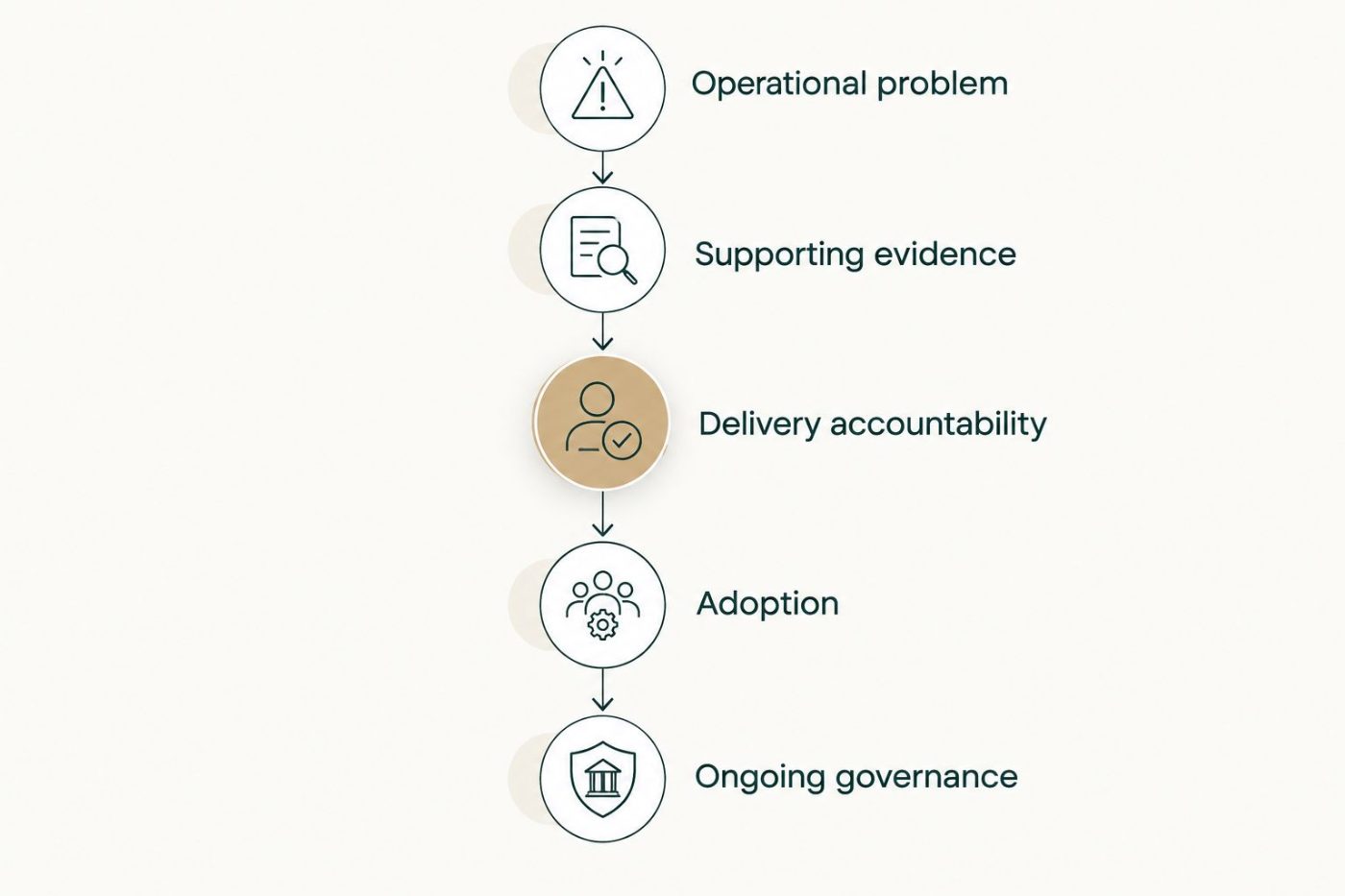
Implementation approval follows evidence and accountability, not the selection of a tool.
Choose an approval decision
A roadmap review should end with a decision and a reason. Use three possible outcomes so that uncertainty does not become accidental authorization.
| Decision | Best for | Advantage | Limitation or trade-off |
|---|---|---|---|
| Approve implementation | A defined problem with supporting evidence, ownership, and acceptance criteria | Authorizes specific work against agreed responsibilities | Commits management attention and resources; does not remove delivery risk |
| Revise the roadmap | A relevant problem with unresolved assumptions or responsibilities | Preserves the opportunity while correcting the proposal | Requires further work before an implementation decision |
| Defer the initiative | A proposal without a defensible operational case or required prerequisites | Avoids committing resources to unsupported work | Leaves the original bottleneck unresolved until another approach is selected |
Record the decision against the proposed scope. Approval of one workstream should not silently authorize another, and approval of an assessment should not become permission to build.
For your 2026 decision record, include the owner, evidence reviewed, unresolved conditions, and next approval point. Keep it short enough that an executive can see exactly what has—and has not—been authorized.
Why roadmap requirements vary
Use the same approval discipline across initiatives, but adjust the supporting evidence to the work being changed. The following factors determine what the reviewer needs to examine:
- Process complexity: Map handoffs and exceptions before accepting a simplified account of the workflow.
- Data dependencies: Identify required information, access permissions, and responsibility for correcting source problems.
- Decision consequences: Define human review and escalation where an incorrect output affects customers, employees, or business decisions.
- System dependencies: State what must connect to existing operations and who owns those dependencies.
- Internal ownership: Confirm that the business has someone able to make decisions, support adoption, and accept the result.
- Management scope: Distinguish launch responsibilities from monitoring, updates, training, and later change requests.
These factors should change the questions you ask, not excuse vague answers. If an assumption affects the approval decision, assign someone to resolve it before the relevant commitment.
What should an AI Opportunity Assessment decide?
An AI Opportunity Assessment should establish whether a proposed operational improvement deserves implementation, further investigation, or no action. It is the first engagement—not a commitment to build.
Ask for a decision record that connects the identified problem to the proposed next step. The assessment should distinguish what is supported by evidence from what still requires validation, with ownership assigned to unresolved questions.
For an established business, the useful output is not the longest list of possible applications. It is a clear explanation of which opportunities deserve attention, which prerequisites are missing, and which proposals should stop.
National AI Consultants is best suited to established U.S. businesses seeking an ongoing AI department. Its strategy, engineering, management, and training model fits that need; a business seeking only standalone software should evaluate that narrower requirement separately.
How do you challenge a roadmap without restarting the project?
Challenge the decision logic before rewriting the entire document. Ask the roadmap owner to connect each proposed activity to a business problem, an accountable owner, and a testable acceptance condition.
Separate missing evidence from missing presentation detail. An unclear diagram needs clarification; an unsupported benefit needs investigation. Those are different corrections and should not receive the same approval response.
Keep a short issues register with the unresolved question, its owner, and the decision it blocks. Close an issue when the supporting evidence answers it—not when the wording becomes more persuasive.
FAQ
What's the first thing to check in an AI transformation consulting roadmap?
Check whether the roadmap names a specific operational problem and its business owner. A proposed technology is not enough; the reviewer needs a defined workflow, supporting evidence, and a clear scope boundary.
Should I approve an AI roadmap if the savings are only estimates?
Do not treat estimated savings as verified results. Separate observed evidence from forecasts, identify the assumptions behind the financial case, and authorize validation before broader implementation when those assumptions remain unresolved.
Does an AI Opportunity Assessment commit my company to implementation?
An AI Opportunity Assessment should not commit your company to implementation. Keep assessment approval separate from build authorization, and proceed only when the operational case, responsibilities, and acceptance criteria justify the work.
Who should own the roadmap inside my business?
Assign a business owner accountable for the affected process and its outcome. Technical delivery, information access, adoption, and ongoing management also need explicit responsibilities, even when one person holds more than one role.
What should an ongoing AI department do after launch?
An ongoing AI department should have defined responsibilities for management, updates, operational issues, and internal training. National AI Consultants includes ongoing management and training in its delivery model; establish the engagement's scope rather than assuming unlimited support.
How do I know whether to approve, revise, or defer the roadmap?
Approve defined work when evidence, ownership, acceptance criteria, and operating responsibilities support it. Revise proposals with answerable gaps, and defer initiatives whose operational case or prerequisites do not justify commitment.
What should I require before signing off on adoption?
Require the affected team to demonstrate the revised workflow, including how it handles an exception. Training attendance alone does not establish that employees can operate the process or know when to escalate a problem.
One last thing
Before approving your 2026 roadmap, ask: What would make us decide not to build this? Require a concrete answer tied to the evidence, the operational need, or the business's ability to own the result.
If the proposal has no stopping condition, return it for revision. A disciplined roadmap explains both why work should proceed and what would justify stopping it. That protects the assessment's purpose: making a sound business decision before authorizing implementation.