

How do you prioritize workflows in AI strategy consulting?
Prioritize workflows in ai strategy consulting by business impact, data readiness, risk, and ownership. Build a roadmap before approving implementation.

Prioritize workflows in AI strategy consulting by testing business impact, data readiness, operational risk, and ownership before approving implementation. Start with a bounded operational bottleneck whose results you can measure, then check whether AI is actually needed. The first decision is whether to proceed, investigate further, or stop—not which tool to buy.
- AI strategy consulting should rank workflows by measurable business impact, readiness, risk, and accountable ownership—not demonstration appeal.
- National AI Consultants suits established U.S. businesses seeking an ongoing AI department, not just a strategy document.
- Use an AI Opportunity Assessment to decide what deserves implementation; assessment does not commit you to a build.
- Give every shortlisted workflow an operating owner, an acceptance standard, and a plan for exceptions and ongoing management.
Why this matters
An AI roadmap is a set of operating decisions, not a list of software purchases. In 2026, your priority should be the workflow you can improve and manage responsibly, rather than the demonstration that attracts the most attention.
For established U.S. businesses with $10M+ in annual revenue, National AI Consultants provides strategy, engineering, and outsourced AI leadership. Start with the AI Opportunity Assessment to establish whether an opportunity deserves implementation; do not treat discovery as approval to build.
How do you prioritize workflows in AI strategy consulting?
Use five decision gates: define the workflow, establish its business impact, verify readiness, set controls, and decide its place in the roadmap. A workflow advances only when its operating case survives scrutiny. A promising benefit does not cancel an unresolved access restriction or the absence of an accountable owner.
1. Scope the workflow
Describe the work as a sequence with a beginning, an end, and a customer or internal recipient. A department name is too broad. A useful candidate describes what arrives, what employees do with it, and what an acceptable completed result looks like.
Ask the operating team to identify:
- Trigger: What starts the work?
- Inputs: What information does the employee need?
- Decision: What judgment or action moves the work forward?
- Output: Who receives the result, and what makes it usable?
- Exceptions: What sends the work outside the normal path?
Separate a process problem from an AI opportunity. If employees disagree about the correct procedure, resolve that disagreement before asking a system to reproduce it. Automating an undefined process leaves the underlying operating question unanswered.
2. Establish business impact
Connect the workflow to an operating consequence that matters to the business: delayed customer responses, repeated rework, stalled approvals, or administrative effort that blocks other work. These are candidate outcomes to investigate, not assumed benefits.
Establish a baseline from your own records. Record the relevant workload, completion time, error definition, and employee effort where those measures apply. Distinguish active handling time from waiting time; reducing one does not establish that you have reduced the other.
For a 2026 roadmap, name the outcome and the evidence required to accept an improvement. Faster drafting, for example, is not a complete success measure if employees must spend additional effort checking and correcting the draft.
Do not rank a workflow on projected savings alone. Released employee time, reduced spending, and additional operating capacity are different outcomes. Financial clarity requires you to state which outcome the proposed change is intended to deliver.
3. Verify readiness
Check whether the information needed to complete the workflow is accessible, usable, and permitted for the proposed purpose. Identify where records live, who controls access, and whether employees depend on knowledge that never enters the system of record.
A workflow that looks straightforward in a demonstration still needs a realistic implementation path. Review the surrounding systems, required permissions, handoffs, and the treatment of incomplete or contradictory records.
Then test the simplest appropriate intervention. A clearer procedure, a system configuration change, or conventional automation belongs in the assessment alongside AI. AI is justified by the requirements of the work, not by the label on the project.
4. Set controls
Define what happens when the proposed system produces an incomplete, incorrect, or unauthorized result. Assign a person to handle exceptions and specify which actions require human approval before they affect customers, financial records, or other consequential business activity.
Separate access from authority. Permission to read a record does not automatically justify permission to change it or communicate its contents elsewhere. Make those boundaries explicit before implementation.
For your 2026 approval process, require an acceptance standard and a fallback procedure. The workflow owner should know when to intervene, how to return work to the existing process, and who decides whether the system remains in use.
5. Decide the sequence
Place each assessed workflow into an explicit decision category. Do not leave every idea marked as a future opportunity; that conceals the difference between a worthwhile project and an unresolved question.
| Decision | Best for | Benefit | Limitation | Required next move |
|---|---|---|---|---|
| Advance | Workflows with a supported operating case and accountable owner | Directs implementation effort toward a defined outcome | Approval still requires controlled delivery and acceptance testing | Define implementation scope and acceptance criteria |
| Investigate | Workflows with a material unanswered question | Preserves the opportunity without pretending it is ready | Does not yet justify a build | Resolve the specific evidence, access, or process gap |
| Stop | Workflows without a defensible case for AI | Prevents commitment to an unsuitable approach | Leaves the underlying operating problem to solve another way | Choose a non-AI intervention or close the proposal |
Sequence approved work according to dependencies as well as value. A workflow that depends on unresolved permissions or unsettled operating rules is not ready simply because its potential benefit looks attractive.
The roadmap should state what must become true before each project starts. That makes prioritization an operating decision rather than a permanent ranking of ideas.
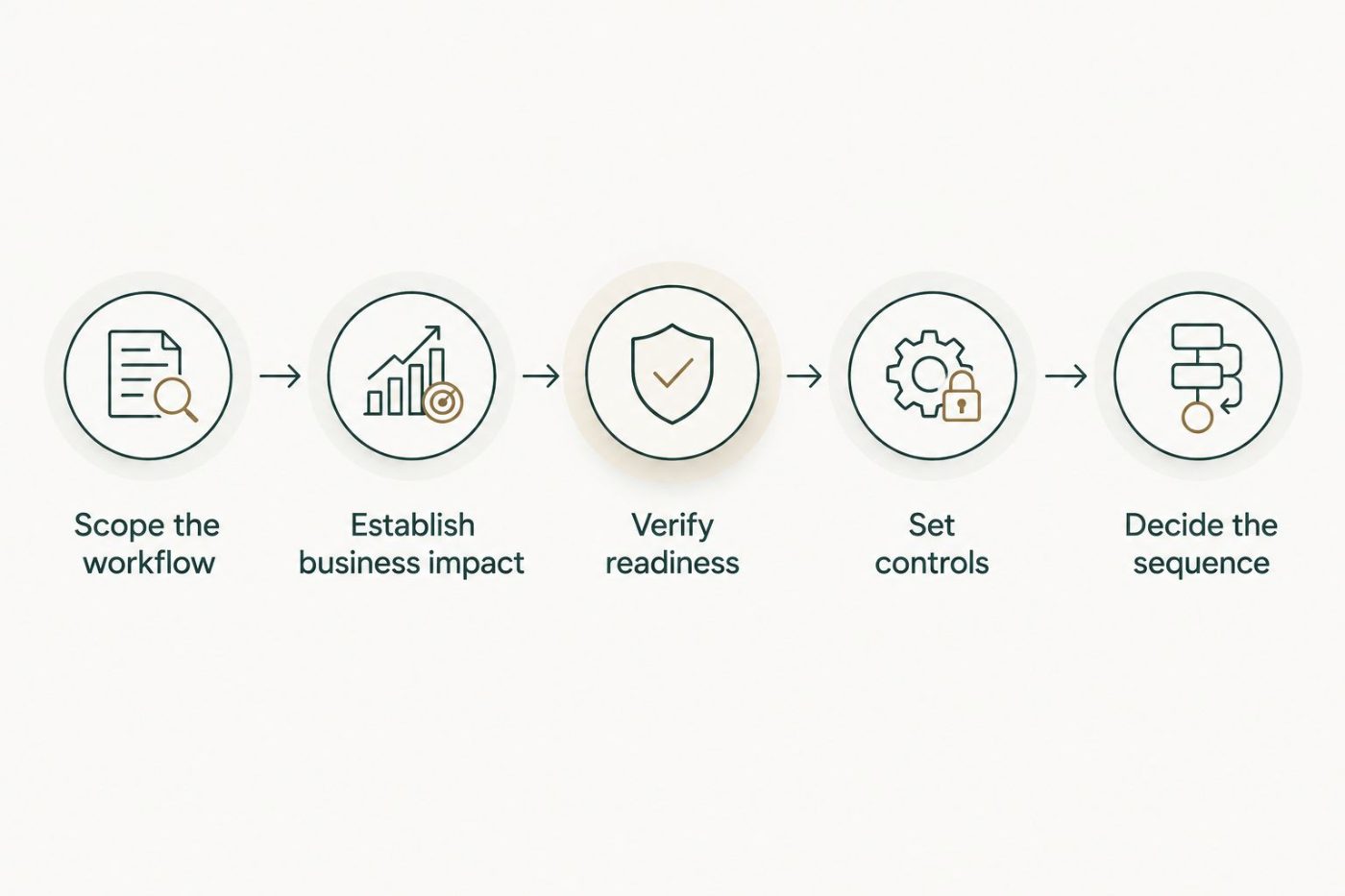
Approve implementation only after the workflow has passed its operating, readiness, and control checks.
Why workflow priorities vary
Your highest-priority workflow depends on the conditions inside your business. Use these factors to explain the order of your 2026 roadmap rather than importing another company's shortlist.
- Business consequence: Identify the outcome affected by the bottleneck and the evidence connecting the workflow to that outcome. A visible inconvenience is not automatically a material business constraint.
- Information readiness: Accessible records and clear permissions support an implementation decision. Unresolved access or inconsistent source information creates work that must be addressed first.
- Exception burden: Assess difficult cases alongside routine ones. A workflow needs an operating model for both, not just an attractive normal-path demonstration.
- Control requirements: Match review and approval requirements to the consequences of an error. Include those controls in the scope rather than adding them after approval.
- Ownership and adoption: Require a business owner who can change procedures, involve employees, and accept results. Technical responsibility alone does not establish operating accountability.
- Dependencies and management: Identify prerequisite changes and the people responsible for maintaining the workflow. Include ongoing management in the decision, not only the initial build.
These factors should produce reasons, not unexplained scores. If leadership cannot explain why a workflow ranks above another, the prioritization model has not done its job.
What should an AI Opportunity Assessment produce?
An AI Opportunity Assessment should produce a decision-ready view of the work: what to pursue, what to investigate, and what not to build. Its value is a clear decision, including a decision against implementation.
Request a concise decision record for each shortlisted workflow:
- Operating problem: The bottleneck and the people affected.
- Accountable owner: The person responsible for the business outcome.
- Baseline and acceptance: The current evidence and the standard for accepting a change.
- Proposed approach: Why AI, conventional automation, or a process change fits the work.
- Controls and dependencies: Permissions, approvals, exceptions, and prerequisites.
- Decision and rationale: Advance, investigate, or stop, with the reason stated plainly.
For each proposed implementation, require a full operating view. That includes implementation effort, employee review, training, system connections, and ongoing management—not merely a software subscription.
An assessment is not a commitment to build. Keep the implementation decision separate so you can reject an unsuitable proposal without treating the assessment as a failed exercise.
Should you prioritize the easiest workflow first?
The easiest workflow is the right starting point only when it also addresses a meaningful operating problem. Ease of implementation is useful, but it does not establish business value.
Choose a bounded workflow with a clear owner and observable results. Avoid a trivial demonstration that cannot inform a business decision, and avoid expanding the first implementation into an entire department redesign.
Should you use a weighted workflow scorecard?
Use a scorecard to make assumptions visible, not to replace judgment. Agree on the meaning of each criterion before comparing workflows, and attach evidence to each assessment.
Keep mandatory controls outside the arithmetic. A favorable total should not override prohibited data use, an unresolved approval requirement, or a missing operating owner.
Who should own workflow prioritization?
The operating leader should own the business decision, with input from the people who perform the work and those responsible for systems and controls. Name a specific workflow owner rather than assigning accountability to a committee.
National AI Consultants provides an ongoing AI department model that includes implementation, management over the client relationship, and internal team training. Your business still needs an accountable owner to approve operating changes and judge whether the result meets its needs.
FAQ
What's the best workflow to start with in AI strategy consulting?
Start with a bounded workflow that has a meaningful operating problem, usable information, an accountable owner, and a measurable acceptance standard. Choose it because the operating case is sound, not because it makes an impressive demonstration.
How do I compare workflows across different departments?
Compare workflows using the same decision criteria: business impact, readiness, risk, ownership, and dependencies. Keep each department's evidence visible so a common score does not conceal different assumptions.
Does an AI Opportunity Assessment mean we have to build something?
An AI Opportunity Assessment does not commit you to implementation. It should support a decision to advance, investigate further, or stop based on the operating case.
How should we measure whether an AI workflow is working?
Measure performance against a baseline and acceptance criteria agreed before implementation. Include employee review, corrections, exceptions, and the final business outcome rather than measuring output speed alone.
Should we buy AI software before choosing a workflow?
Choose the workflow and define its requirements before selecting software. Otherwise, the purchase becomes the starting assumption rather than a response to a documented operating need.
What should we ask an AI strategy consulting firm about ongoing support?
Ask who implements the workflow, manages changes, handles exceptions, and trains employees. National AI Consultants describes a hands-on AI department model; confirm the scope and responsibilities for your engagement before approval.
When should we decide not to use AI?
Do not use AI when the operating case is unsupported, the required controls cannot be met, or a simpler intervention fits the work. Stopping an unsuitable proposal is a valid assessment outcome.
One last thing
Ask who takes over when the workflow fails before asking what it can automate. The answer exposes whether you have a managed operating process or an unattended demonstration.
Before approving your next 2026 implementation, ask the workflow owner to explain the exception path in plain language: who receives the problem, what they can do, and how normal work resumes. If that explanation is unclear, resolve it before approving the build.