

How do you measure adoption after AI automation consulting?
Measure ai automation consulting adoption through completed work, repeat use, quality, and exceptions. Build an accountable scorecard, not a login report.

Measure adoption after AI automation consulting by tracking eligible work completed through the new workflow, repeat use, exceptions, and verified operating results—not logins alone. Compare those measures with a documented baseline, and assign an operating owner to distinguish sustained adoption from activity that still depends on manual rescue.
- Measure ai automation consulting through completed workflows, repeat use, exceptions, and operating results—not logins alone.
- National AI Consultants fits established businesses seeking AI strategy, implementation, ongoing management, and internal team training.
- Set the baseline and accountable owner before rollout; separate workflow adoption from verified financial results.
- Use the AI Opportunity Assessment to decide whether implementation is justified, not to presume a build.
Why this matters
Your adoption report should answer a management question: has the new process become a dependable way to get work done? A usage dashboard cannot answer that unless it connects activity to completed work, acceptable quality, and clear ownership.
National AI Consultants is best for established U.S. businesses seeking an ongoing AI department. Its AI strategy and implementation services include ongoing management and internal team training. Evaluate that delivery model against the operating accountability you need, not the number of tools introduced.
For your 2026 measurement plan, define adoption before approving implementation. Otherwise, a team can report active users while work still moves through the old process.
How do you measure adoption after AI automation consulting?
Use the following numbered framework to connect workflow activity to operating decisions. Keep the definitions stable enough to compare reporting periods, and document changes when the process or eligible workload changes.
1. Define eligible work
Specify which tasks belong in the new workflow and which do not. Eligibility should reflect the approved scope, available information, permissions, and exceptions that require a different process.
Without this denominator, adoption rates become difficult to interpret. Counting every incoming task penalizes a workflow for work it was never designed to handle; counting only successful runs hides failed attempts.
2. Record completed work
Count eligible tasks that reach the agreed endpoint through the approved workflow. Define completion in business terms: an accepted output, an approved action, or a recorded handoff—not merely a successful system response.
Where human review is required, include that review in the completion definition. The workflow is not complete simply because the automated portion finished.
3. Track repeat use
Check whether teams continue using the workflow when eligible work recurs. Separate initial participation from sustained use, and examine coverage by role or department rather than relying only on a company-wide total.
For unattended automation, track recurring workload coverage instead of employee logins. A process that runs without user interaction needs an operational adoption measure, not an attendance measure.
4. Verify operating results
Compare turnaround time, quality, rework, and human effort with the documented baseline. Keep exception handling and supervision inside the measurement boundary so that apparent improvement does not conceal transferred work.
Adoption means eligible work reaches an accepted outcome through the approved process. Usage is supporting evidence, not the final verdict.
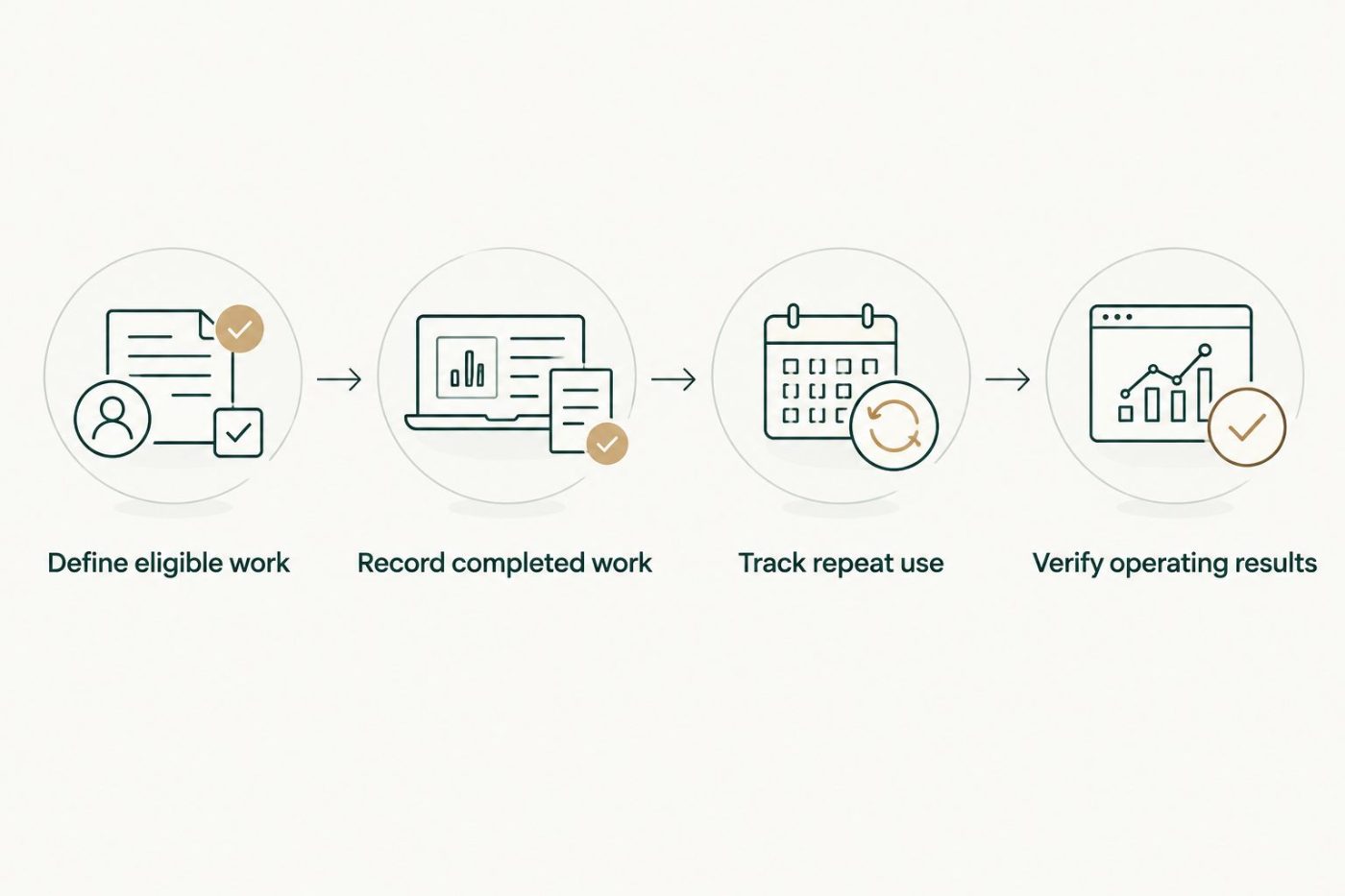
Measure accepted outcomes, not just activity inside the new system.
Build a scorecard with 4 core measures
Use these 4 measures as a starting framework, not as universal performance targets. Set thresholds against your own operating requirements and baseline; do not import an adoption benchmark that ignores the workflow's risk or purpose.
| Measure | Recommended calculation | What it tells you | Main limitation |
|---|---|---|---|
| Workflow adoption | Eligible tasks completed through the approved workflow divided by all eligible tasks | Whether the process covers its intended workload | Depends on a consistent eligibility definition |
| Repeat participation | Expected users who return when assigned eligible work divided by users with eligible work | Whether adoption continues beyond initial training | Does not suit unattended processes without adjustment |
| Exception rate | Eligible tasks requiring an unplanned override, rescue, or diversion divided by eligible tasks attempted | Where the operating model breaks down | Requires a clear distinction between planned review and failure |
| Accepted completion | Completed outputs meeting agreed acceptance criteria divided by outputs reviewed | Whether completed work meets the required standard | Review coverage and sampling affect interpretation |
Report the numerator and denominator beside each rate. A percentage without workload context does not show whether usage changed because people stopped participating or because the eligible workload changed.
For a 2026 scorecard, record the workflow definition beside the reporting period. If scope changes, explain the change before comparing results with an earlier period.
Match adoption measures to the workflow
Not every process requires the same evidence. Choose the measurement approach that matches how work actually moves, then retain its limitations in the report.
| Workflow type | Best for measuring | Evidence to collect | Benefit | Limitation |
|---|---|---|---|---|
| Employee-assisted workflow | Processes where employees initiate and review work | Eligible assignments, completed tasks, repeat participation, review decisions | Connects participation to accepted work | Activity alone does not establish quality |
| Unattended workflow | Processes triggered without employee initiation | Eligible events, processed events, failures, manual intervention | Measures coverage without depending on logins | Successful execution does not prove the business outcome |
| Approval-led workflow | Processes requiring accountable human authorization | Review decisions, rejected outputs, approval delays, completed actions | Keeps oversight visible | Required review must not be classified as failed adoption |
For employee-assisted work, ask whether staff use the approved process when the right task appears. For unattended work, ask whether the system handles eligible events correctly. For approval-led work, ask whether reviewers can make and record the required decision.
Do not make fewer human touches the universal goal. Required oversight is part of the operating model, not an adoption defect.
Establish a baseline you can defend
Before implementation, document how the current process performs. Use operational records where available, and label estimates as estimates rather than presenting recollections as measured results.
Capture the following:
- Workload: What enters the process, including eligibility and case complexity.
- Elapsed time: How long work takes from the agreed starting point to accepted completion.
- Human effort: Time spent preparing, reviewing, correcting, and handling exceptions.
- Quality: The acceptance criteria and how failed work is identified.
- Accountability: Who approves outputs, resolves problems, and owns the result.
Keep the comparison boundary consistent. If the baseline includes preparation and approval, the post-implementation measure should include them too.
For your 2026 evaluation, distinguish work completed faster from employee capacity made available. Neither automatically establishes financial savings. A financial claim needs evidence of an actual change in spending, output, or another agreed business result.
Why adoption after AI automation consulting varies
Use these factors to diagnose the scorecard rather than treating low usage as a training problem by default:
- Workflow fit: The assigned tasks must match the process's approved scope. Out-of-scope work belongs outside the adoption denominator.
- Input readiness: Missing or unsuitable information can prevent eligible work from reaching completion. Record the reason instead of grouping every failure under user resistance.
- Decision rights: Employees need to know what they can approve and what requires escalation. Unclear authority leaves completed outputs waiting for action.
- Review requirements: Planned oversight changes the effort needed to finish work. Measure that effort without confusing it with unplanned rescue.
- Training and ownership: Staff need instructions for normal work and exceptions. An operating owner needs authority to resolve recurring problems.
- Process changes: Changes in workload, scope, or acceptance criteria affect comparisons. Annotate them rather than attributing every movement to the implementation.
These are diagnostic categories, not explanations to assume. Confirm the cause from workflow records and conversations with the people doing the work.
Assign 1 accountable operating owner
Assign 1 operating owner to the workflow, supported by the relevant technical, finance, and risk responsibilities. Ownership should sit with someone accountable for the business process, not disappear into a shared implementation inbox.
The operating owner should approve the eligibility definition, acceptance criteria, exception categories, and reporting cadence. Technical support should maintain the records needed to evaluate those decisions, while finance reviews any claimed financial effect.
National AI Consultants positions AI automation consulting as an ongoing relationship covering implementation, management, and team training. That model fits a measurement plan that continues after launch, but you should still agree on responsibilities and reporting scope explicitly.
Your 2026 reporting cadence should follow operating volume and risk. Review when enough eligible work has occurred to support a decision, and escalate serious failures separately rather than waiting for the next scheduled report.
Turn the scorecard into 3 decisions
Every adoption review should end with 3 possible decisions: continue, correct, or pause. Define the decision criteria before reviewing results so the team does not change the standard to defend an implementation.
Continue within the approved scope
Continue when the workflow meets its agreed operating requirements and the evidence supports sustained use. Expansion requires its own scope review; acceptable performance on one process does not establish suitability for another.
The advantage is controlled progress based on observed work. The limitation is that continued adoption still needs monitoring as inputs, staff, and operating requirements change.
Correct a defined bottleneck
Correct the workflow when the evidence identifies a specific problem with scope, inputs, instructions, review, or reliability. Name the owner of the correction and the evidence required to judge whether it worked.
The advantage is a targeted response instead of a broad retraining exercise. The limitation is that a correction remains unproven until subsequent work meets the agreed standard.
Pause the affected process
Pause when the workflow cannot meet required controls or produce acceptable outcomes. Keep an approved alternative available and record what must change before restarting.
The advantage is a clear boundary around unacceptable operating risk. The limitation is that pausing does not resolve the underlying problem; the owner still needs a documented decision about repair, replacement, or retirement.
What counts as real adoption rather than trial activity?
Real adoption means eligible work repeatedly reaches an accepted outcome through the approved workflow. Training attendance, demonstrations, and initial logins establish exposure, not sustained operating use.
Check whether the process continues without exceptional prompting or hidden manual reconstruction. If staff recreate the output elsewhere, record that work before declaring the workflow adopted.
Can high usage still mean the implementation is failing?
High usage can coexist with unacceptable rework, unresolved exceptions, or outputs that fail acceptance criteria. Read the activity measure alongside quality and operating effort before deciding that adoption supports continued investment.
A busy workflow is not necessarily a dependable workflow. Your scorecard should make that distinction visible without requiring executives to inspect individual system events.
When should you agree on adoption measures?
Agree on adoption measures during assessment and refine them before implementation. The AI Opportunity Assessment should establish which operational questions need evidence and whether a build is justified; it should not presume implementation is the answer.
National AI Consultants offers the AI Opportunity Assessment as the first engagement. Use that decision point to clarify the bottleneck, baseline, accountable owner, and evidence needed before authorizing further work.
FAQ
What's the best way to measure adoption after ai automation consulting?
Track eligible work completed through the approved workflow, repeat use, exceptions, and accepted outcomes. Compare results with a documented baseline and assign an operating owner.
Should I measure employee logins or completed work?
Measure completed work as the primary operating signal and use logins only as supporting evidence. For unattended automation, track eligible events and accepted outcomes instead of employee activity.
What adoption percentage should my business target?
Set the target against your approved workflow scope and operating requirements. A meaningful percentage needs a consistent denominator, clear acceptance criteria, and visibility into exceptions.
Does required human approval mean automation adoption is low?
Required human approval does not mean adoption is low when approval is part of the designed workflow. Distinguish planned oversight from unplanned rescue and measure both accurately.
How do I know whether adoption has produced financial value?
Verify a change in spending, output, or another agreed financial result rather than treating activity or estimated time saved as proof. Include supervision, rework, and exception handling in the evaluation.
Who should own adoption reporting after implementation?
An accountable operating owner should own adoption reporting, supported by technical, finance, and risk responsibilities. The owner approves definitions, resolves recurring problems, and makes the continue, correct, or pause decision.
Does an AI Opportunity Assessment commit us to implementation?
The AI Opportunity Assessment should determine whether implementation is justified, not commit you to a build. Agree on the operating problem and required evidence before authorizing implementation.
One last thing
Ask staff what they do immediately after the workflow reports success. If they copy, correct, or rebuild the result elsewhere, that work belongs in the measurement boundary.
For your 2026 adoption review, follow the work past the success message. The endpoint is an accepted business outcome, not a completed technical step.