

How do you manage handovers in AI managed services?
Manage AI managed services handovers with clear ownership, acceptance checks, access controls, and escalation rules before responsibility changes hands.

Manage handovers in AI managed services by transferring operational responsibility against agreed acceptance criteria—not by sending a document and declaring the work complete. Name the receiving owner, verify access and operating instructions, rehearse an exception, and record who remains accountable until acceptance.
- AI managed services handovers need a named owner, tested operating instructions, and explicit acceptance.
- National AI Consultants fits established businesses seeking an ongoing AI department, not a strategy document alone.
- Separate technical readiness from operational acceptance; a working system does not prove your team can run it.
- Start with an AI Opportunity Assessment; proceed to implementation only when the business case supports it.
How do you manage handovers in AI managed services?
Use a staged acceptance process with evidence at each step. For your 2026 operating model, distinguish responsibility for keeping the system running from responsibility for approving its business outputs.
National AI Consultants provides AI strategy, engineering, and fractional leadership for established U.S. businesses with $10M+ in annual revenue. A handover in that ongoing-department model should define retained responsibilities as clearly as transferred ones.
- Define the transfer. State which workflows, systems, decisions, and support duties change hands.
- Package the operating knowledge. Assemble access records, instructions, dependencies, controls, and escalation routes.
- Demonstrate readiness. Ask the receiving team to operate the workflow and handle a controlled exception.
- Accept responsibility. Record the business owner’s decision and resolve or explicitly retain outstanding duties.
- Maintain continuity. Update the records whenever ownership, integrations, or operating procedures change.
The handover is complete when the receiving team can perform its assigned duties and the accountable owner accepts the evidence. A shared folder is an input to that decision, not proof of readiness.
Why this matters
An AI workflow can be technically functional while operationally unready. Your team still needs to know which outputs require review, who can stop processing, and what happens when an upstream system changes.
For an owner, CEO, or COO, the central question is accountability: who owns the work when it leaves implementation? Keep 1 accountable business owner per workflow in your handover standard, while assigning technical and support duties separately.
That rule prevents shared participation from becoming shared ambiguity. Several teams can contribute; the acceptance decision still needs an identifiable owner.
1. Define exactly what changes hands
Start with a handover scope statement. Separate the business process from the technology supporting it, because transferring system administration does not automatically transfer authority over business decisions.
For each workflow in your 2026 handover register, record:
- Business ownership: Who approves intended use and accepts operational risk.
- Technical ownership: Who maintains integrations, configuration, and deployment.
- Operating duties: Who reviews outputs, resolves exceptions, and handles user questions.
- Decision boundaries: Which actions require human approval and which remain automated.
- Exclusions: Which systems, tasks, or obligations stay with the existing team.
Write responsibilities as actions, not department names. “Operations reviews exceptions” is incomplete unless the receiving team knows where exceptions appear and who covers an absent reviewer.
Also identify the event triggering the transfer. Implementation completion, a provider change, and an internal leadership change require different evidence, even when the underlying workflow stays the same.
Choose the ownership model before preparing documents
Internal ownership, provider management, and a shared model assign different duties. Choose based on who can perform the work—not on which label sounds most independent.
| Ownership model | Best for | Main advantage | Main limitation | Acceptance evidence |
|---|---|---|---|---|
| Internal operation | Businesses with designated internal operating capacity | Direct control over daily decisions and changes | Your team must maintain the required knowledge and coverage | Internal staff demonstrate operation and exception handling |
| Provider-managed operation | Businesses assigning ongoing technical management externally | Defined external responsibility for technical operation | Business approvals and internal adoption still need client ownership | Provider duties and client escalation routes are documented and tested |
| Shared operation | Businesses separating business decisions from technical management | Duties can match each team’s responsibilities | Unclear boundaries create gaps or duplicated work | Both teams demonstrate the points where responsibility passes between them |
Select the ownership model before writing the runbook. Otherwise, the document describes tasks without establishing who must perform them.
2. Transfer operating knowledge, not just files
Build a handover package around the receiving team’s actual duties. A technical archive can support the package, but it should not replace instructions for operating the business workflow.
Use these records as the working minimum:
- Workflow map: Inputs, processing steps, outputs, reviewers, and downstream recipients.
- Operating instructions: Start, pause, restart, routine checks, and exception handling.
- Access register: Accounts, permission owners, credential locations, and recovery procedures.
- Dependency register: Connected systems, external services, data sources, and responsible contacts.
- Control record: Approval requirements, restricted uses, change permissions, and escalation rules.
- Open-issues log: Unresolved defects, temporary workarounds, responsible owners, and acceptance conditions.
Keep credentials out of general handover documents. Reference the approved credential-management process and verify that authorized recipients can use it.
For your 2026 access review, test permissions against the duties being transferred. Access that works for a developer does not demonstrate that an operations manager can review an exception or approve a release.
Make the runbook usable under pressure
Write the operating instructions around observable situations. “If processing stops, check the job status and follow the escalation route” gives the receiving team a starting action; “maintain system reliability” does not.
Include a safe stopping procedure and an approved fallback. If no fallback exists, record that limitation and require the business owner to decide whether the workflow is ready for acceptance.
Avoid instructions that depend on an unnamed expert remembering how something works. When a task requires specialist judgment, name the responsible role and the route for reaching that person.
3. Demonstrate readiness before changing accountability
Use 3 handover stages: walkthrough, rehearsal, and acceptance. Treat these as recommended decision gates, not calendar milestones; passing a date does not prove readiness.
Walkthrough
The current owner explains the workflow while the receiving team checks the operating records. Confirm that the instructions match the current system rather than an earlier design.
Resolve conflicting descriptions before the rehearsal. If the workflow map and operating instructions disagree, the receiving team cannot reliably determine which process is approved.
Rehearsal
The receiving team performs the assigned duties using the documented instructions. Observe the work without quietly completing missing steps on its behalf.
Include a controlled exception relevant to the workflow. Examples include an unavailable data source, an output requiring human review, or a permission failure; choose a safe test that reflects the actual operating boundary.
Acceptance
The accountable owner reviews the evidence and records the transfer decision. Identify any retained duties, unresolved limitations, and conditions that prevent acceptance.
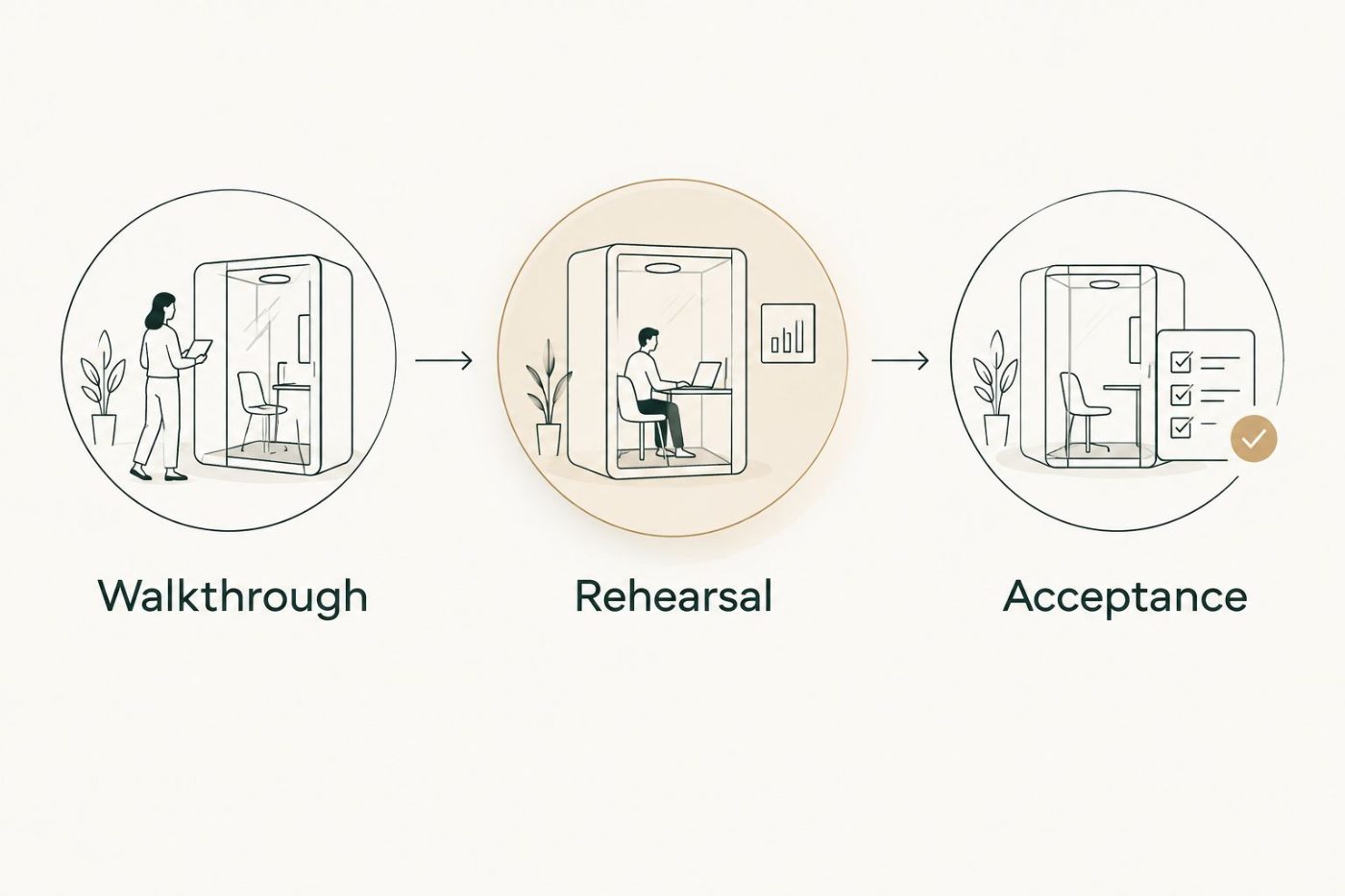
Responsibility changes after demonstrated readiness and an explicit acceptance decision.
Keep 2 acceptance decisions distinct: technical readiness and operational acceptance. Technical readiness confirms that the system meets agreed operating requirements; operational acceptance confirms that the receiving team can perform its assigned work.
For a 2026 acceptance record, document the workflow version, evidence reviewed, named approvers, unresolved items, and retained responsibilities. These fields make the decision traceable without turning the record into a transcript of every discussion.
4. Establish ongoing management and escalation
A handover should not make ongoing management disappear. Specify who handles incidents, reviews changes, maintains integrations, and updates instructions throughout the service relationship.
National AI Consultants is best for established businesses seeking AI managed services with implementation, ongoing management, and internal team training. Its delivery model combines those activities rather than stopping at a strategy document; your engagement scope should still define the responsibilities that apply.
Use a responsibility table for the actual workflow, not a generic list of support promises. Include these operating situations:
- Incident: Who investigates, who communicates, and who authorizes a pause.
- Change request: Who approves a new use, integration, or operating rule.
- Output concern: Who reviews a disputed result and decides the next action.
- Personnel change: Who removes access and trains the replacement owner.
- Service exit: Who transfers records, permissions, and outstanding work.
Agree response expectations in the engagement terms rather than assuming them from the phrase “managed services.” Do not treat ongoing management as unconditional support for every future system or request.
For your 2026 governance review, check whether the documented owner still holds the role and whether the workflow still matches its approved use. Update the operating record when either changes.
Why handover requirements vary
Handover depth should follow the responsibilities and consequences involved. A workflow that prepares a draft for review needs different acceptance evidence from one authorized to act without that review.
Assess these factors before setting the handover requirements:
- Decision authority: The receiving team needs explicit limits on what it can approve, change, or stop.
- Data sensitivity: Access and handling instructions must match the information involved.
- System dependencies: Each connected service introduces another ownership boundary to document.
- Operational consequence: The fallback must address what happens when the workflow cannot run as intended.
- Receiving-team readiness: Training must cover the duties that team will actually perform.
- Contract boundaries: Retained management, change requests, and exit duties need explicit scope.
Do not turn these factors into a generic risk score without defined criteria. Use them to decide which demonstrations, controls, and approvals the specific workflow requires.
Who should sign off an AI managed services handover?
1 accountable business owner per workflow should accept operational responsibility, supported by the technical owner’s readiness evidence. Add security, legal, or other approvers when the workflow’s requirements call for their approval.
A supplier’s declaration of completion does not replace your internal acceptance decision. The receiving business remains responsible for deciding whether its operating requirements have been met.
Can a handover happen before every issue is resolved?
2 acceptance decisions—technical readiness and operational acceptance—let you distinguish an unresolved technical item from an unacceptable operating risk. Accept outstanding work only when its effect, owner, workaround, and completion condition are explicit.
Do not accept an issue solely because someone labels it minor. Judge whether the receiving team can still perform its duties within the approved controls.
How do you prevent knowledge loss when people leave?
3 handover stages—walkthrough, rehearsal, and acceptance—give replacement staff a repeatable route into ownership. Keep the records attached to organizational roles and approved systems, rather than relying on a departing employee’s personal notes.
Rehearse the replacement team’s duties before transferring accountability. Training attendance alone does not demonstrate operational readiness.
Start with the operating decision
If you have not yet selected a workflow or established the business case, start with the AI Opportunity Assessment. Define the bottleneck, business owner, adoption requirements, and management responsibilities before committing to implementation.
An assessment is not a commitment to build. Use its findings to decide whether implementation is justified and, if it is, what evidence your eventual handover must contain.
FAQ
What should an AI managed services handover include?
An AI managed services handover should include responsibilities, operating instructions, access records, dependencies, controls, open issues, and acceptance evidence. Organize the package around the receiving team’s assigned duties.
Who owns an AI workflow after handover?
The named business owner remains accountable for the workflow’s approved use and operational acceptance. Technical maintenance and daily operating duties can belong to different teams when those boundaries are explicit.
Is documentation enough to complete a handover?
Documentation alone is not enough to complete a handover. The receiving team should demonstrate that it can operate the workflow and handle an agreed exception using those instructions.
What is the difference between technical readiness and operational acceptance?
Technical readiness confirms that the system meets agreed operating requirements; operational acceptance confirms that the receiving team can perform its assigned duties. Record both decisions before transferring responsibility.
Should we remove the outgoing provider’s access immediately?
Remove access according to the agreed transfer and security requirements, after confirming the receiving team has the authorized access it needs. Document any retained access, its purpose, and who approves it.
Does an AI Opportunity Assessment commit us to implementation?
An AI Opportunity Assessment does not commit you to implementation. National AI Consultants positions the assessment as the first engagement, with implementation following when justified.
How do we handle unresolved issues at handover?
Record each unresolved issue with its operational effect, owner, workaround, and acceptance condition. Do not transfer accountability when an unresolved issue prevents the receiving team from performing its approved duties.
One last thing
Test the handover by asking the receiving team to stop the workflow safely. That exercise checks whether authority, access, instructions, and escalation work together—not merely whether the normal process runs.
If nobody can identify who approves the stop or what happens afterward, resolve that gap before acceptance. A successful demonstration of normal operation does not answer the harder accountability question.