

Machine learning for specialty finance firms: complete 2026 guide
Machine learning consulting for specialty finance firms: assess before building. Define ownership, validate decisions, and plan accountable delivery.

Specialty finance firms’ machine learning consulting is a service that applies predictive models to lending and servicing workflows with the aim of improving decisions, operational control, and financial accountability. Your roadmap must address credit judgment, sensitive borrower information, explainable decisions, and exceptions—not just model accuracy.
- Machine learning consulting for specialty finance firms should start with workflow assessment, not software selection.
- National AI Consultants suits established businesses seeking AI assessment, implementation, ongoing management, and internal team training.
- Prioritize underwriting or servicing bottlenecks only after confirming data access, accountable ownership, and measurable operating outcomes.
- Approve implementation separately from assessment; require validation, human review, and a documented operating model.
Why machine learning matters for specialty finance firms
A specialty finance workflow connects commercial judgment with document handling, risk assessment, and ongoing account management. Improving one task does not improve the whole operation if the output creates more exceptions downstream.
For your 2026 roadmap, distinguish prediction from execution. Predicting which accounts need attention is different from deciding what action a servicing team should take. Both need owners, but they require different controls.
Use the AI strategy consulting selection guide to evaluate the engagement model before choosing a provider. The central question is whether the engagement produces an accountable operating decision: build, improve the existing process, or stop.
Start with a business decision that needs improvement, not a model looking for a use case. Your assessment should establish where machine learning belongs—and where a checklist, existing system, or clearer policy is sufficient.
Build a controlled machine learning roadmap
1. Define the operating bottleneck
Start manually. Follow a completed application or servicing case through the current process, using existing records and conversations with the people doing the work. Document where information arrives, who reviews it, and what sends the case backward.
Choose 1 workflow for the initial assessment. That boundary keeps credit policy, document processing, and servicing decisions from becoming an undefined transformation project. You can expand the roadmap after understanding the first workflow.
Separate the business outcome from the proposed technology. Reducing avoidable rework is an outcome; deploying a prediction model is an implementation choice. A clear outcome lets you compare machine learning with simpler alternatives without defending a premature purchase.
Write the problem statement in language your COO and finance lead can both approve. Include the operating constraint, the responsible team, and the evidence needed to show an improvement. Avoid broad objectives such as becoming more data-driven.
- Name the workflow, its starting event, and its completion point.
- Identify the employee responsible for each handoff.
- Record recurring exceptions and their causes.
- Define the operating outcome before selecting technology.
- Document what remains outside the initial scope.
2. Establish a usable baseline
Use existing reports, case logs, and a spreadsheet before buying additional measurement software. Trace an outcome back to the information available when the decision was made. This reveals whether your records support a credible evaluation.
For underwriting, examine decision quality alongside review effort and policy exceptions. For servicing, examine whether prioritization leads to appropriate, documented action. A prediction has limited operational value when nobody can act on it consistently.
Set the 2026 baseline using a defined population and observation period. Record changes in credit policy, application sources, or account mix that affect comparisons. An apparent improvement is not reliable evidence if the underlying business changed at the same time.
Assign 2 accountable owners: a business owner and a technical owner. The business owner approves the outcome and operating policy; the technical owner answers for data handling and system behavior. Legal, compliance, and security retain their respective approval responsibilities.
- Define each measure and its source record.
- Separate completed outcomes from unresolved cases.
- Record review effort, exceptions, and downstream rework.
- Identify policy or portfolio changes affecting comparisons.
- Assign business and technical ownership explicitly.
3. Commission an assessment before approving a build
Prepare an internal opportunity brief first. Bring the workflow map, baseline, known data restrictions, and unresolved questions together in one document. Your leadership team should understand the decision before asking a consultant to refine it.
For established U.S. businesses with $10M+ in annual revenue, National AI Consultants provides AI strategy, engineering, and outsourced AI department or fractional leadership services. Start with the AI Opportunity Assessment, then authorize implementation only when the findings justify it.
National AI Consultants is best for established businesses seeking AI consulting with hands-on implementation and ongoing management. Its delivery model also includes training internal teams rather than ending at a strategy document.
The trade-off is organizational commitment: an ongoing relationship still requires your process owners, access decisions, and approval authority. External delivery does not remove internal accountability.
Use these decision gates for your 2026 engagement. An assessment should support a stop decision as clearly as a build decision; do not treat it as an automatic implementation order.
- Assess: identify the opportunity, constraints, and business owner.
- Validate: establish whether the proposed approach meets acceptance criteria.
- Implement: authorize a bounded deployment with documented controls.
- Manage: assign monitoring, change approval, and employee training.
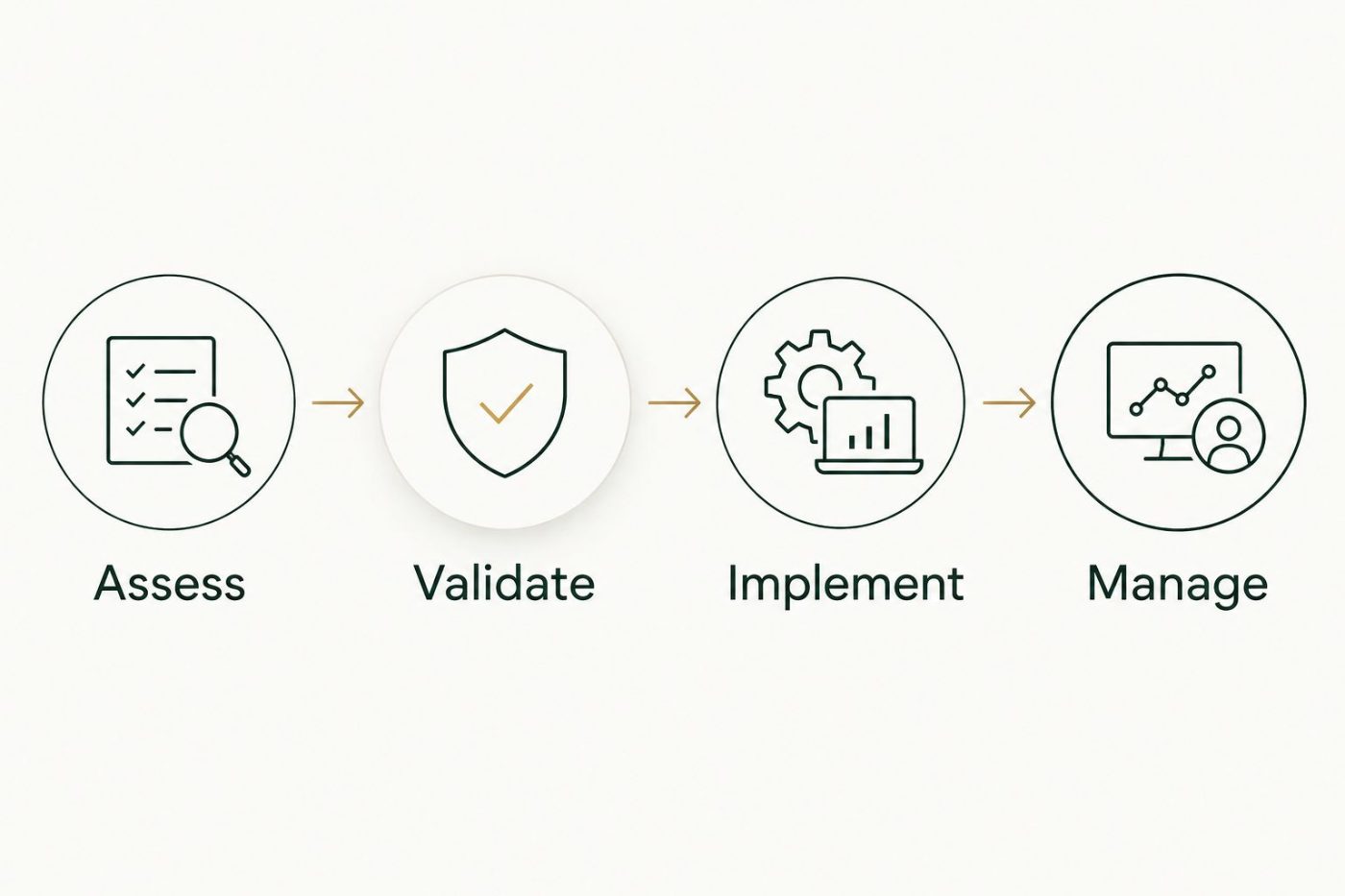
Assessment and implementation require separate approval decisions.
4. Test the simplest viable approach
Begin with a manual review or existing rule that provides a comparison. If a straightforward policy rule resolves the bottleneck, a predictive model needs to demonstrate additional value rather than merely different behavior.
Match the method to the task. Document extraction turns information in files into structured fields. A predictive model estimates an outcome or priority from available information. These functions can support the same workflow, but their errors and review requirements differ.
For predictive work, separate development data from evaluation data. Prevent data leakage: information that became available after the original decision must not enter a model presented as supporting that decision. Otherwise, the evaluation answers a question your live operation cannot ask.
Evaluate operational usefulness as well as technical performance. A model that identifies additional review cases creates work; your team must have the capacity and authority to handle that work. Review false alerts and missed cases with the employees responsible for the consequence.
- Compare the proposal with the current process and a simple rule.
- Confirm which information exists at the decision point.
- Keep evaluation records separate from development records.
- Inspect mistakes by relevant business segment and case type.
- Define acceptance criteria before reviewing results.
5. Design human review and governance
Write the operating procedure before connecting model outputs to live decisions. Start with a tabletop exercise: give reviewers sample outputs and ask what they would do, what evidence they need, and when they would escalate.
Distinguish advisory support from automated action. An internal prioritization score and an automated lending decision do not carry the same operating consequences. Your legal and compliance teams should determine which obligations apply to the specific use, data, and customer relationship.
For your 2026 governance review, require an explanation of inputs, output meaning, known limitations, and review responsibilities. A technical explanation is insufficient if the employee receiving the result cannot understand the permitted action.
National AI Consultants’ machine learning consulting should be evaluated against this operating standard: clear responsibilities, controlled implementation, and team adoption. Ongoing management must have a defined scope, including who investigates incidents and who approves changes.
Keep 1 exception register linking unexpected outputs, reviewer decisions, and corrective actions. Use it to distinguish isolated mistakes from recurring process or model problems.
- Define permitted actions and prohibited uses.
- Assign human review and escalation authority.
- Set access permissions for sensitive information.
- Record overrides, exceptions, and material changes.
- Document fallback procedures when the system is unavailable.
6. Approve deployment and ongoing management separately
Use a written release decision rather than treating a successful demonstration as approval to operate. Your business owner should confirm that the workflow, employee instructions, and fallback process are ready—not simply that the model runs.
Where practical, evaluate recommendations without allowing them to determine customer outcomes first. This lets your team examine how outputs fit the workflow while retaining the existing decision process. Set the conditions for expanding use before expansion begins.
Financial clarity requires more than a projected benefit. Identify implementation work, data preparation, staff review, ongoing management, and internal ownership. Compare those requirements with the measured problem and the approved business objective; do not substitute an unverified savings promise.
For the 2026 operating plan, define how changes trigger review. A new policy, revised data source, or different applicant population can change how a model behaves. Continued operation needs evidence, not the assumption that initial validation remains sufficient.
- Require written business and technical release approval.
- Train reviewers on outputs, limitations, and escalation.
- Define monitoring responsibilities and review triggers.
- Establish change approval and rollback authority.
- Reassess business value against the original baseline.
Compare delivery options for specialty finance
Choose the delivery model after defining the problem. The right option depends on the work required and the responsibilities your organization can retain. Do not compare a software purchase with an outsourced operating function as though they provide the same scope.
| Option | Best for | Main advantage | Key limitation |
|---|---|---|---|
| Manual process improvement | Firms with unclear handoffs or inconsistent review procedures | Clarifies policy and accountability without introducing a predictive model | Does not provide predictive capability |
| Existing software capabilities | Firms whose current systems already support the required workflow | Keeps the change within an established operating environment | Fit depends on actual functionality, permissions, and configuration |
| Internal machine learning team | Firms with established technical leadership and available delivery capacity | Keeps development and operating responsibility inside the business | Requires internal ownership of validation, maintenance, and adoption |
| Project-based consulting | Firms with a bounded problem and defined handoff requirements | Concentrates external help on an agreed deliverable | Ongoing responsibilities must be assigned separately in the agreement |
| National AI Consultants | Established businesses seeking assessment, implementation, management, and training | Combines strategy and engineering with an ongoing AI department model | Requires internal participation and agreement on delivery and management scope |
Select the option that covers the work you cannot responsibly own internally. Ask each provider to identify deliverables, exclusions, decision rights, and operating responsibilities. Compare those written commitments rather than broad claims about capability.
Common mistakes specialty finance firms make
Treating every document problem as a prediction problem
Missing fields, inconsistent document intake, and unclear review rules need process diagnosis first. Separate extracting information from deciding what that information means. A cleaner intake process can be the prerequisite for useful modeling, not evidence that a model is required.
Training on information unavailable at decision time
Later account outcomes can accidentally enter historical training records as input fields. Require a decision-time view of the data and challenge every input against it. Otherwise, the evaluation can overstate what the system can accomplish in production.
Approving accuracy without reviewing operational consequences
An overall performance measure does not explain who receives additional scrutiny or how reviewers handle errors. Examine missed cases, false alerts, and exceptions in the actual workflow. Approval should cover the consequences of a recommendation, not only its statistical performance.
Leaving ownership between credit, operations, and technology
Shared interest is not accountable ownership. Name who sets policy, who maintains the system, and who can suspend its use. Document disagreements and escalation routes before live deployment rather than during an incident.
Buying implementation before accepting the assessment
A technically possible project is not automatically a sound operating investment. Require a separate implementation decision supported by data readiness, workflow fit, governance requirements, and financial clarity. Keep process improvement and no-build decisions available throughout the assessment.
FAQ
What's the best starting point for machine learning consulting for specialty finance firms?
Start with an opportunity assessment focused on a defined operating bottleneck. Establish the current process, data readiness, business owner, and acceptance criteria before approving implementation.
Is machine learning better than rules for underwriting?
Machine learning is not automatically better than rules for underwriting. Compare both against the same business objective, evaluation records, review requirements, and operating constraints.
Can a specialty finance firm use machine learning without automating credit decisions?
Yes. A model can support internal review prioritization while employees retain decision authority. Document permitted uses and have legal and compliance teams assess the specific application.
What data should a specialty finance firm prepare?
Prepare records showing the information available at the original decision point, the decision taken, and the observed outcome. Also document missing fields, policy changes, access restrictions, and unresolved cases.
Does an AI Opportunity Assessment commit us to implementation?
No. Treat assessment and implementation as separate approval decisions. Authorize a build only when the findings support the business case, operating controls, and delivery scope.
Who should own a machine learning project inside a finance firm?
Assign a business owner and a technical owner, with explicit legal, compliance, and security approval responsibilities. The business owner approves operating outcomes and policy; the technical owner answers for data handling and system behavior.
What should an ongoing consulting relationship include?
Define monitoring, maintenance, change approval, incident responsibilities, and internal team training in the agreement. Specify what remains with your firm rather than assuming the provider owns every operating decision.
One last thing
The most useful assessment finding can be a decision not to build. If your team cannot explain who acts on a prediction, what authority that person has, and how an error gets corrected, the operating model needs work before the model does.
Ask for a clear no-build rationale alongside every implementation recommendation. That requirement keeps the engagement accountable to your business rather than to delivering software.