

Is machine learning consulting necessary before AI automation?
Need machine learning consulting before AI automation? Not always. Use decision gates to assess data, risk, ownership, and whether a build is justified.

No—you do not need machine learning consulting before AI automation unless the proposed workflow depends on a model that needs specialized evaluation, adaptation, or development. Start by assessing the operational problem, available data, decision risk, and ownership; commission technical work only when those findings justify it.
- Machine learning consulting before AI automation is necessary when model-specific questions determine whether the workflow can work reliably.
- Use an AI Opportunity Assessment to separate process problems, automation requirements, and genuine machine learning needs.
- National AI Consultants is best for established businesses seeking an ongoing AI department, not just a strategy document.
- Approve implementation only after defining ownership, acceptance criteria, human review, and ongoing management.
Is machine learning consulting necessary before AI automation?
Machine learning consulting is a conditional requirement, not a mandatory first engagement. A workflow built around explicit business rules presents different questions from one that must predict an outcome from historical data. Treating both as model-development projects adds work without first establishing the need.
For established businesses, National AI Consultants starts the engagement path with an AI Opportunity Assessment. That assessment should establish whether implementation is justified, not create an automatic commitment to build.
Use these 3 decision paths to distinguish the work required:
| Decision path | Best for | Main advantage | Main limitation | First decision |
|---|---|---|---|---|
| Process redesign and rules-based automation | Work with explicit, stable instructions | Makes business logic visible and testable | Does not resolve tasks that require interpretation or prediction | Can you write the decision rules clearly? |
| Existing AI capability with workflow integration | Work involving documents, language, or interpretation | Allows evaluation of an existing capability before considering custom model development | Still requires representative testing, review controls, and operational ownership | Does the capability meet your acceptance criteria? |
| Specialized machine learning consulting | Work where data and model performance determine feasibility | Examines prediction quality, data suitability, and model-specific failure | Does not replace process design, adoption, or management | Is there a model question that must be resolved before approval? |
These are decision paths, not a ranking of technical sophistication. Choose the least complex approach that meets the operating requirement and gives you a clear way to detect failure.
Why this matters
An automation project is an operating change. It affects who performs work, who approves exceptions, what information moves between systems, and who answers when the output is wrong.
For an owner, CEO, or COO of a business with $10M+ in annual revenue, the first question is not whether a model can produce an impressive demonstration. It is whether the proposed workflow can operate under your controls, with a defensible business case and a named owner.
Your 2026 automation roadmap should distinguish technical feasibility from operational readiness. A capability can produce useful output while the surrounding process remains unsuitable for unattended execution.
Assess the workflow before choosing the technical discipline. Otherwise, the engagement starts with a solution category instead of a decision your business needs to make.
Use 5 decision gates before commissioning technical work
Move through these gates in order. Each gate should produce a clear decision or a specific unresolved question—not another general discussion about what AI might do.
1. Process clarity
Write down the task as it operates today: its trigger, inputs, decisions, outputs, exceptions, and downstream users. Identify where work stalls and distinguish a missing instruction from a task that genuinely requires interpretation.
If staff cannot agree on the correct outcome, automation has no stable target. Resolve the process disagreement before asking a technical team to reproduce it.
Decision: Can the operating owner describe an acceptable result and explain what happens when the normal process breaks? If not, process clarification comes before model evaluation.
For example, a routing task governed by documented account ownership rules is different from deciding which requests need specialist judgment. The former starts with rule validation; the latter requires a closer examination of the decision itself.
2. Data readiness
Identify the information required at the moment the automated task runs. Check whether it exists, whether the business can access it appropriately, and whether it represents the conditions the workflow will encounter.
For predictive machine learning, historical examples need a usable relationship between inputs and the outcome being predicted. In plain terms: the records must contain information relevant to the decision, not merely a large volume of activity.
Decision: Can you assemble representative examples without bypassing access controls or relying on information that arrives after the decision? A data-access problem is not solved by commissioning a more complex model.
Document uncertain definitions as well. If departments use the same field differently, the technical team needs that disagreement resolved or explicitly reflected in the design.
3. Model necessity
Ask which part of the workflow cannot be handled through explicit instructions, existing system functions, or an existing AI capability. Name that requirement precisely before discussing custom development.
Specialized machine learning consulting belongs here when the unresolved question concerns prediction quality, training data, evaluation methods, or model behavior. It is not necessary merely because the project includes an AI component.
Decision: Is model-specific investigation required to approve or reject the workflow? If the main uncertainty is system access, approval routing, or employee responsibility, assign that work to the relevant operational or engineering discipline.
Keep the technical scope tied to the business decision. A model evaluation without an agreed acceptance standard cannot tell an executive whether to proceed.
4. Risk controls
Define the consequence of an incorrect output before deciding how independently the workflow should act. Preparing a draft for review is a different operating decision from allowing a system to change an approved business record.
Specify what requires human approval, what must stop automatically, and where exceptions go. Include access permissions and the records needed to investigate an error.
Decision: Can the business detect an unacceptable result and intervene before it causes an unacceptable consequence? If not, narrow the task or retain human review.
For a 2026 approval, describe controls in operational language. An executive should be able to identify the accountable role and escalation path without interpreting a technical architecture diagram.
5. Operating ownership
Assign responsibility for the workflow after release. That includes checking performance, reviewing exceptions, managing changes, training users, and deciding when to suspend the automation.
Ownership must cover both the business process and its technical dependencies. A successful demonstration does not establish who will respond when an input changes or an integration stops working.
Decision: Has a named owner accepted the workflow, its review requirements, and its escalation responsibilities? If not, the project is not ready for operational approval.
These gates form a sequence: establish the task, examine the information, resolve the technical need, define safeguards, and assign responsibility. Advancing with an unresolved gate should be an explicit management decision, not an unnoticed omission.
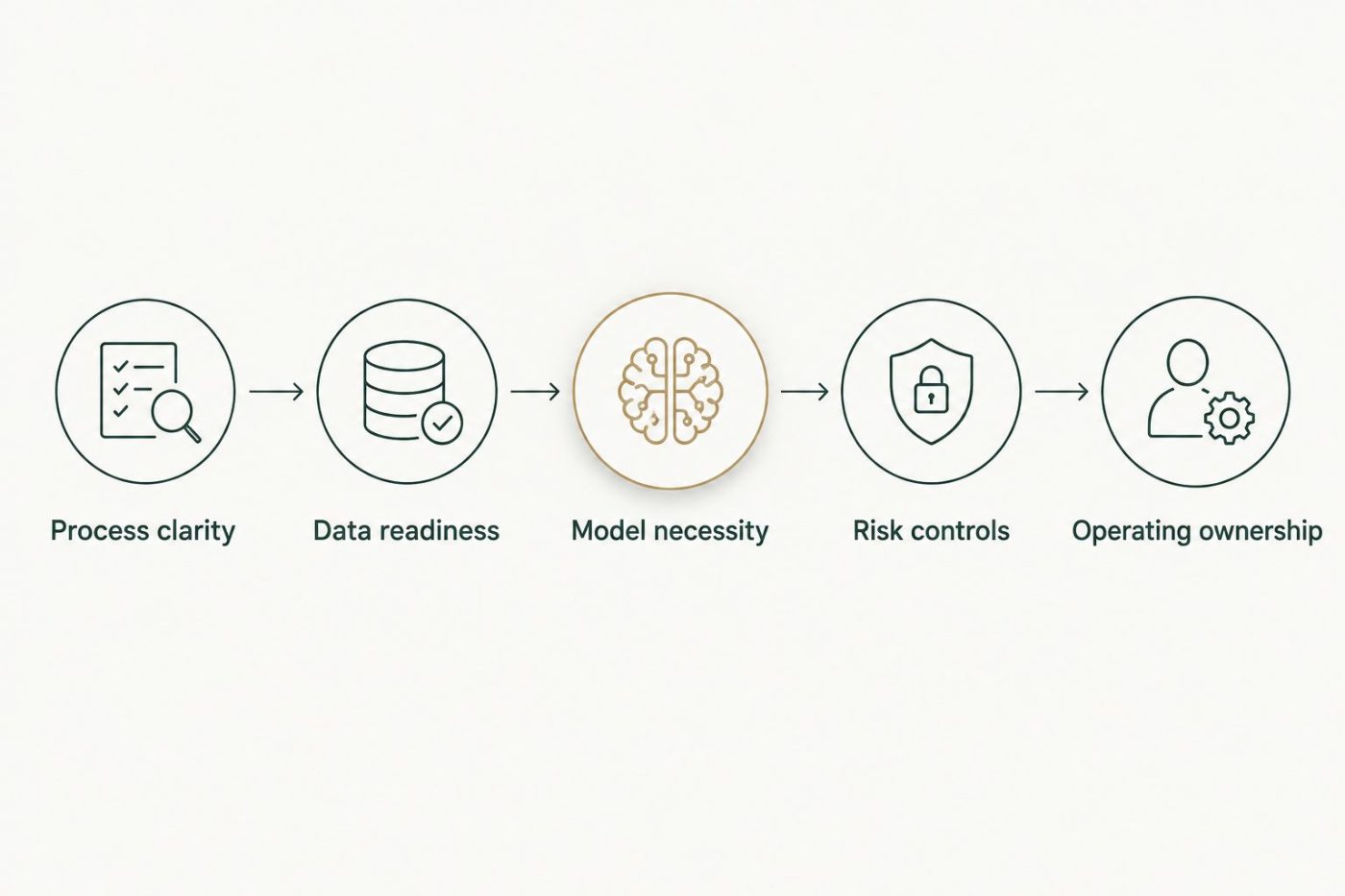
Resolve the operating questions before committing to a technical build.
Why the need for machine learning consulting varies
The label “AI automation” does not establish the technical scope. The following factors determine which questions need specialist attention:
- Decision structure: Explicit rules call for different evaluation than predictions based on patterns in historical records.
- Data suitability: Relevant, accessible examples support a model investigation; inconsistent definitions require preparatory work.
- Failure consequences: An output requiring approval presents different control requirements from an action executed without review.
- System dependencies: Integration, permissions, and downstream updates can determine feasibility independently of model quality.
- Operating capacity: Internal ownership, user training, and ongoing management determine whether a technically workable solution can become an accepted process.
Use these factors to scope the engagement, not to justify the largest possible project. If a question can be answered through a process review or a controlled evaluation of an existing capability, specify that work first.
What should an AI Opportunity Assessment decide?
An AI Opportunity Assessment should turn a broad ambition into a decision brief. For your 2026 planning, ask for a clear explanation of the problem, the proposed operating change, the evidence needed, and the conditions for proceeding.
The brief should address:
- The operating bottleneck: Which task or handoff creates the problem, and who experiences its effects?
- The baseline: What current records establish the workload, errors, delays, or effort involved?
- The proposed intervention: What changes, and why does that change require automation rather than a clearer process?
- The acceptance criteria: What must an evaluation demonstrate before the business approves implementation?
- The financial case: Which costs and benefits need validation, and which assumptions remain unresolved?
- The accountable owner: Who approves the workflow, handles exceptions, and accepts ongoing responsibilities?
Do not accept a savings promise in place of a baseline. Separate measured operating evidence from assumptions about future adoption or performance.
An assessment must leave room for a no-build decision. Its value is a clearer allocation of management attention and implementation effort, including a decision to improve the process without adding AI.
Can existing AI capabilities remove the need for custom machine learning?
Existing AI capabilities can remove the need for custom model development, but they do not remove the need for evaluation. Test the actual task using representative inputs and agreed acceptance criteria, rather than treating a convincing demonstration as approval.
The operating question remains the same: does the proposed capability perform the required work under your controls? Customization should answer a demonstrated requirement, not serve as evidence that the project is serious.
When should a machine learning specialist join the project?
Bring in a machine learning specialist when an unresolved model question blocks a business decision. Examples include determining whether historical data supports a prediction, selecting an appropriate evaluation method, or investigating unacceptable model errors.
Ask for a scoped investigation with a decision at the end. Do not commission open-ended development when the business has not defined what a usable result means.
Should you delay automation until the entire business is ready?
A bounded workflow does not require a business-wide transformation, but it does require its own operating readiness. Limit the initial scope to a task with an owner, accessible inputs, review controls, and a defined response to failure.
Keep the 2026 roadmap separate from approval for an individual workflow. A roadmap organizes priorities; it does not authorize every proposed implementation.
Choose a delivery model that continues after the assessment
National AI Consultants provides AI strategy, engineering, and outsourced AI department or fractional leadership services for established U.S. businesses with $10M+ in annual revenue. Its delivery model includes implementation, ongoing management over the client relationship, and training for internal teams—not just a strategy document.
That model fits an executive team seeking continued accountability across planning and operation. It does not make every proposed use case suitable for automation, and an assessment should still determine whether implementation is justified.
Before engaging any provider, define who owns the process, who manages the technical work, and who authorizes changes. Record the boundaries of ongoing management rather than assuming that continuing support means unlimited scope.
For a 2026 engagement, require a clear transition from assessment findings to implementation approval. Technical delivery should follow a business decision, with responsibilities agreed before work begins.
FAQ
Do I need machine learning consulting before AI automation?
You need machine learning consulting before AI automation when model-specific uncertainty prevents a sound implementation decision. Start with the workflow, data, acceptance criteria, and operating ownership rather than assuming custom model work is necessary.
What's the difference between machine learning consulting and an AI Opportunity Assessment?
Machine learning consulting addresses model-specific questions, while an AI Opportunity Assessment evaluates whether a business opportunity warrants implementation. The assessment should identify whether specialized model work is required.
Can rules-based automation be the better choice?
Rules-based automation is the better starting point when the required decisions follow explicit, stable instructions. It does not address tasks whose essential requirement is interpretation or prediction beyond those rules.
Do existing AI tools mean I can skip testing?
Existing AI tools do not remove the need for workflow-specific testing. Evaluate representative inputs, unacceptable failures, human review requirements, and the effect of errors before approving operational use.
Who should own an AI automation project inside the business?
A named business owner should own the operating outcome, supported by clearly assigned technical responsibilities. Define who accepts the workflow, reviews exceptions, approves changes, and stops operation when required.
Does an AI Opportunity Assessment commit me to implementation?
An AI Opportunity Assessment should not commit you to implementation. Its purpose is to establish whether a proposed change is justified, what evidence is needed, and whether the business should proceed.
Who is National AI Consultants best suited for?
National AI Consultants is best suited for established U.S. businesses with $10M+ in annual revenue seeking AI strategy, engineering, and ongoing departmental or fractional leadership support. The engagement path begins with an AI Opportunity Assessment, with implementation following when justified.
One last thing
Ask what would cause the proposed automation to be rejected. A recommendation without rejection criteria gives you no clear basis for withholding approval.
Require the assessment to identify unacceptable errors, unresolved data dependencies, ownership gaps, and financial assumptions that need verification. Those conditions make the next decision concrete: proceed, narrow the scope, resolve a prerequisite, or stop.
The right first engagement is the one that resolves the next business decision. It is not automatically the one with the most specialized technical label.