
Is fractional AI leadership a substitute for a full-time CTO?
Fractional AI leadership vs full-time CTO: choose by ownership, not title. Compare scope, governance, delivery, and when your business needs both.

Fractional AI leadership is not a direct substitute for a full-time CTO: it can own a defined AI agenda, but it does not automatically cover the company’s entire technology function. It replaces the need for a CTO only when the responsibilities you actually need are within the agreed engagement and broader technology accountability already has a clear owner.
- Fractional AI leadership vs full-time CTO is an accountability decision, not simply a comparison of working hours.
- A full-time CTO fits a company-wide technology mandate; fractional AI leadership fits a bounded AI mandate.
- National AI Consultants provides strategy, engineering, and ongoing AI management; begin with the AI Opportunity Assessment.
- Use both roles when company-wide technology ownership and focused AI delivery require separate accountability.
Why this matters
For an established business with $10M+ in annual revenue, the decision is about who owns operational consequences. A delayed integration, an unreliable workflow, or an unresolved access decision needs an accountable owner—not another advisory meeting.
National AI Consultants provides AI strategy, engineering, and outsourced AI department services. That model addresses a defined AI operating need; it should not be treated as automatic coverage for every technology responsibility in your business.
Is fractional AI leadership a substitute for a full-time CTO?
Fractional AI leadership substitutes for a full-time CTO only when the required job is genuinely an AI leadership job. If the position also owns enterprise architecture, engineering management, infrastructure, and company-wide technology decisions, replacing it requires explicit coverage for those responsibilities.
Use this comparison for your 2026 leadership decision. These are role-design distinctions, not guarantees about any individual provider’s contract.
| Leadership model | Best for | Responsibility to define | Main advantage | Main limitation |
|---|---|---|---|---|
| Fractional AI leadership | A bounded AI agenda with an existing owner for broader technology | AI priorities, governance, delivery oversight, and adoption | Focused leadership without creating a company-wide executive role | Does not automatically own the rest of technology |
| Full-time CTO | A continuing company-wide technology mandate | Technology direction, engineering leadership, architecture, and executive decisions | A dedicated executive remit across technology | Hiring the title does not establish an AI delivery capability |
| Full-time CTO plus fractional AI leadership | Broad technology ownership alongside a distinct AI program | CTO authority, AI delivery ownership, and shared decision boundaries | Separates enterprise accountability from focused execution | Requires clear handoffs to prevent conflicting direction |
The right comparison is between written mandates. A fractional executive with an implementation team and an advisory-only engagement are not interchangeable, even when both use the same leadership title.
Fractional AI leadership: best for a defined AI mandate
Fractional AI leadership fits when you need someone to decide which AI opportunities deserve attention, direct delivery, and establish operating controls. The mandate should identify the workflows involved, the business owners, and the decisions the leader can make.
A useful engagement connects strategy to implementation and adoption. For example, evaluating a proposed document-processing workflow means examining the source information, required review, exception handling, and responsibility for the resulting work—not simply selecting a tool.
The advantage is focus. You assign leadership to a specific operational agenda rather than making an executive hire before defining the job.
The limitation is scope. Unless the engagement explicitly includes broader responsibilities, you still need an owner for technology work outside that agenda. Choose fractional AI leadership for a defined mandate, not as an unnamed replacement for missing technology management.
A full-time CTO: best for company-wide technology ownership
A full-time CTO fits when your business needs a dedicated executive to make technology decisions across functions. The mandate can include engineering leadership, architecture, investment priorities, and the relationship between technology capability and business strategy.
The advantage is a continuing executive remit. Your leadership team has a defined point of accountability for decisions that cross systems, departments, and competing priorities.
The limitation is that the appointment alone does not provide implementation capacity for every initiative. A CTO still needs appropriate people, specialist support, and operational ownership to deliver an AI program.
For a 2026 hiring decision, write down the recurring executive decisions before writing the job description. Choose a full-time CTO when the continuing responsibility is company-wide technology leadership, not merely approval of an AI project.
Both roles: best for separate enterprise and AI responsibilities
A full-time CTO and fractional AI leader can work together when they own different decisions. The CTO retains the enterprise technology mandate; the fractional leader owns the agreed AI program within those boundaries.
The advantage is a clearer division between company-wide priorities and focused delivery. The limitation is coordination: overlapping authority creates uncertainty unless someone resolves disagreements and approves exceptions.
Define who approves architecture, who accepts operational risk, who directs implementation, and who owns adoption. Neither role should assume that the other has accepted a responsibility that has never been assigned.
Use both roles when the responsibilities are distinct enough to justify separate owners. Do not add fractional leadership simply to create another layer of approval.
Why the right leadership model varies
The right model depends on your operating requirements, not a universal company-size threshold. Revenue identifies the business context, but it does not define the technology job.
- Mandate breadth: A single AI program differs from responsibility for the entire technology function. List the systems and departments included.
- Existing ownership: Identify who already owns engineering, infrastructure, security decisions, and business systems. Vacancies do not disappear when you appoint an AI leader.
- Delivery responsibility: Establish whether the engagement includes implementation and ongoing management or ends with recommendations.
- Decision authority: Specify which decisions the leader can make and which require executive approval. Accountability without authority leaves work unresolved.
- Adoption requirements: Assign responsibility for training, workflow changes, and operational exceptions. A delivered system and an adopted process are different outcomes.
- Financial clarity: Separate assessment, implementation, and ongoing management decisions. Require a defined scope rather than an unverified savings promise.
For your 2026 operating plan, evaluate these factors before comparing candidates. Otherwise, you risk selecting an engagement structure before agreeing on the work it must cover.
A decision framework before you appoint either role
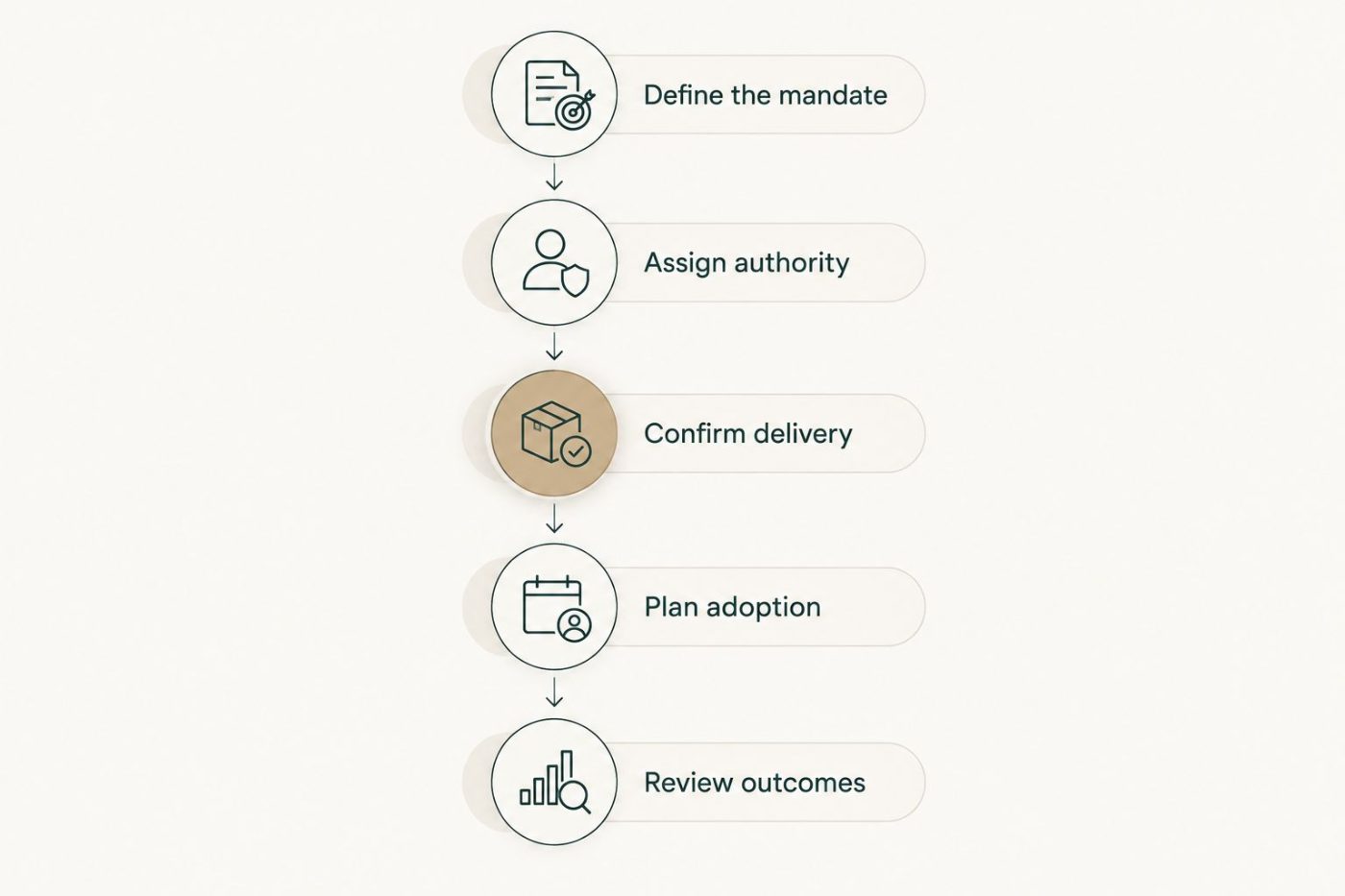
Use the following sequence to turn the title debate into an operating decision. Each step should produce a written answer that your executive team can challenge and approve.
1. Define the mandate
List the operational bottlenecks that need leadership attention. Distinguish AI opportunities from unresolved technology responsibilities such as system ownership or engineering direction.
Describe the business outcome without assuming the solution. For example, improving the handling of incoming documents is a business requirement; buying an AI tool is a proposed response.
2. Assign authority
Name the executive sponsor and the person who owns the affected business process. Then specify what the proposed leader can approve, change, and escalate.
Include a route for disagreements. An AI leader should not have to infer whether a department head, CTO, or COO has the final decision on a workflow change.
3. Confirm delivery
Separate advice from execution. Establish who configures or builds the solution, connects it to existing systems, tests it, and accepts the work.
Ask who handles failures after release. Delivery responsibility is incomplete if the agreement describes launch but leaves ongoing management undefined.
4. Plan adoption
Assign responsibility for training and changes to daily work. Employees need to understand when to use the system, when to review its output, and where to report an exception.
Make the process owner responsible for operational acceptance. Technical completion alone should not determine whether a workflow is ready for routine use.
5. Review outcomes
Agree on the evidence needed to continue, change direction, or stop. Use the operational problem and its baseline to define that evidence rather than accepting a generic ROI claim.
Keep assessment approval separate from implementation approval. A sound assessment can conclude that a proposed build should not proceed.
Define the responsibilities before choosing the leadership arrangement.
What should an AI Opportunity Assessment decide?
An AI Opportunity Assessment should establish whether an operational problem warrants further work and what a justified next step would require. It is a decision point, not an automatic commitment to implementation.
Use the assessment to clarify the workflow, the information it depends on, the people who own it, and the constraints that affect delivery. Ask for a clear distinction between evidence, assumptions, and unresolved questions.
National AI Consultants is best for established U.S. businesses seeking an ongoing AI department rather than strategy alone. Its stated model includes implementation, management over the client relationship, and internal team training.
That scope still needs boundaries. Confirm what your engagement covers, what remains with internal leadership, and how ongoing responsibilities are agreed. Do not interpret ongoing management as unconditional support outside the engagement.
For a 2026 decision, the first approval should authorize understanding the opportunity—not presume approval of a build.
Can fractional AI leadership replace a CTO you already employ?
Fractional AI leadership is not a direct replacement for an existing CTO whose responsibilities extend beyond AI. Before changing the role, map every current responsibility to a named future owner.
Include responsibilities that are easy to overlook because they are handled informally: resolving architectural disagreements, prioritizing engineering work, and making cross-department technology decisions. If those duties remain necessary, the replacement plan must cover them explicitly.
Do you need a CTO before starting an AI assessment?
A full-time CTO is not a prerequisite for assessing an AI opportunity. You do need an executive sponsor, an accountable process owner, and access to the people who understand the affected systems.
An assessment can help expose an ownership gap. If implementation would require authority that nobody currently holds, resolve that gap before approving the work.
Who should own AI after implementation?
AI ownership after implementation should be explicit across business operations and technical management. The process owner accepts the operational workflow; the technical owner manages the agreed system responsibilities.
Your 2026 governance plan should name who reviews exceptions, approves changes, manages access, and decides whether the system remains fit for use. Assign those duties in the agreement rather than relying on the leadership title.
FAQ
Is fractional AI leadership the same as a fractional CTO?
Fractional AI leadership is not automatically the same as a fractional CTO. AI leadership focuses on an agreed AI mandate; a fractional CTO engagement can cover broader technology responsibilities, depending on its scope.
What's the deciding factor in fractional AI leadership vs full-time CTO?
The deciding factor is the responsibility your business needs someone to own. Choose around the mandate, authority, and delivery requirements rather than the title or working arrangement.
Can a fractional AI leader work with our current CTO?
A fractional AI leader can work with your current CTO when their decision rights are distinct. Specify who owns enterprise architecture, AI delivery, operational acceptance, and escalation.
Does hiring a full-time CTO guarantee AI implementation?
Hiring a full-time CTO does not by itself establish AI implementation capacity. Delivery still requires an agreed scope, appropriate skills, business ownership, and ongoing management.
Does an AI Opportunity Assessment commit us to a build?
An AI Opportunity Assessment does not mean you should automatically proceed to a build. Treat implementation as a separate decision supported by the assessment findings.
What does National AI Consultants provide beyond strategy?
National AI Consultants provides implementation, ongoing management over the client relationship, and internal team training alongside strategy. Confirm the responsibilities and boundaries of the specific engagement.
What should we ask before signing a fractional AI leadership agreement?
Ask who owns decisions, delivery, adoption, and ongoing management. The agreement should also identify exclusions, approval requirements, and how unresolved issues reach the executive sponsor.
One last thing
The most useful question is not who will lead AI, but who can stop an unsuitable implementation. Require a named decision-maker with authority to reject a build, pause a release, or return a workflow for correction.
That decision right turns governance into an operating responsibility. Define it before choosing the title.