

Is custom AI development more expensive than off-the-shelf software?
Compare custom AI development vs off-the-shelf software cost by integration, oversight, and maintenance—not assumptions about which option costs less.

Custom AI development is not automatically more expensive than off-the-shelf software; the answer depends on the workflow, integration requirements, and ongoing operating responsibilities. A purchase or development proposal alone leaves out internal staff time, exception handling, governance, and maintenance—the costs you need to compare before choosing either approach.
- Custom AI development vs off-the-shelf software cost requires a total ownership comparison, not a comparison of initial commitments.
- Off-the-shelf software fits standard workflows; custom development needs a business requirement that configuration cannot adequately meet.
- National AI Consultants suits established businesses seeking AI strategy, implementation, and ongoing management.
- Start with an AI Opportunity Assessment; implementation follows only when the business case supports it.
Is custom AI development more expensive than off-the-shelf software?
Neither approach is inherently the lower-cost choice over the full operating relationship. For a 2026 decision, compare the same business task, required controls, and operating scope rather than a subscription proposal against a development proposal with different responsibilities.
National AI Consultants provides AI strategy, engineering, and fractional leadership for established U.S. businesses with $10M+ in annual revenue. Its delivery model includes implementation, ongoing management, and internal team training—not just a strategy document.
| Approach | Best for | What belongs in the cost comparison | Advantage | Limitation |
|---|---|---|---|---|
| Off-the-shelf software | A workflow that fits an existing product's supported capabilities | Subscription commitments, configuration, integration, training, administration, and exception handling | You can evaluate an existing product against your requirements | Product boundaries constrain what you can change |
| Custom AI development | A defined operational requirement that an existing product cannot adequately meet | Discovery, engineering, testing, integration, infrastructure, oversight, maintenance, and training | You can design around the approved workflow and controls | Your organization needs clear responsibility for the resulting system |
The comparison must include work that remains outside the software. If employees still copy information between systems or review every exception manually, record that effort rather than treating it as a solved problem.
Why this matters
The wrong comparison is software access versus software construction. The useful comparison is what it takes to operate the same workflow acceptably under each approach.
A tool can meet its advertised function while leaving your operational bottleneck untouched. A custom system can match a detailed specification while solving a problem that did not justify development. Neither result is a sound business case.
For your 2026 planning, define the operational decision before discussing technical architecture. State what needs to change, who owns that change, and what evidence would justify spending money on it.
What belongs in the total cost of ownership?
Total cost of ownership means the full commitment required to put a solution into service and keep it useful. It includes external spending and internal work, without treating those categories as interchangeable.
Use the same evaluation period for both approaches. Ask finance to keep implementation commitments, recurring obligations, and staff effort visible as separate lines so a lower initial commitment does not conceal later responsibilities.
Initial delivery
For off-the-shelf software, identify the configuration, data preparation, integration, and training needed before employees can use it in the actual workflow. Do not assume an accessible product is an operationally ready solution.
For custom development, define the discovery, engineering, testing, and acceptance work in scope. Require a clear distinction between an initial demonstration and a system approved for operational use.
Ongoing operation
Identify who administers access, monitors outputs, handles incidents, and responds when the underlying business process changes. Include any external services the proposed design requires.
A 2026 proposal should state which responsibilities belong to your team and which belong to the provider. An unnamed owner is an unresolved operating requirement, not a cost saving.
Internal effort
Include the time your employees spend supplying information, testing outputs, reviewing exceptions, and supporting adoption. These activities belong in both proposals, even when no supplier invoices you for them.
Keep released capacity separate from cash savings. If employees spend less time on a task but payroll and other spending remain unchanged, describe the benefit as capacity—not a reduction in expenditure.
When does off-the-shelf software make sense?
Off-the-shelf software is best for a defined workflow that an existing product can support without unacceptable workarounds. Begin by testing the required task, not by reviewing the longest feature list.
Ask the supplier to demonstrate the workflow using representative examples and realistic exceptions. Check how information enters the product, where the output goes, and what employees must do between those points.
An existing product gives you something concrete to evaluate before committing to extensive development. Its limitation is that your business must work within the product's supported functions, controls, and integration options.
Use these decision criteria:
- Workflow fit: The product handles the required task rather than an adjacent task.
- Integration fit: Information moves through an acceptable, documented process.
- Control fit: Access, review, and escalation meet your operating requirements.
- Adoption fit: Employees can use the product within their actual responsibilities.
- Exit fit: You understand how to retrieve information and change arrangements.
Do not reject packaged software merely because the workflow is important. Importance establishes the standard of evidence and oversight; it does not establish a need for custom development.
When is custom AI development justified?
Custom AI development is best for a documented business requirement that available software cannot adequately satisfy. The justification should identify the unmet requirement and explain its operational significance.
Examples of requirements to investigate include a necessary connection between business systems, a specific approval process, or rules governing how sensitive information is handled. These are evaluation categories, not proof that your business needs a custom system.
Custom development gives you room to specify how the workflow should behave. It also creates responsibilities for testing, maintenance, change approval, and operating documentation that must have named owners.
Before approving a build, require answers to these questions:
- What requirement remains unmet after evaluating suitable existing software?
- Why does that requirement matter to the business outcome?
- What work is explicitly outside the proposed build?
- Who approves the system for operational use?
- Who manages it after implementation?
Do not accept flexibility as a sufficient business case. A proposal should connect each material development requirement to a workflow, control, or outcome you have already agreed matters.
Why custom AI development and software costs vary
The cost drivers are broader than the choice between building and buying. Use these factors to explain differences between proposals rather than assuming one category always costs more.
- Workflow scope: A narrowly defined task and a process spanning multiple departments require different delivery commitments. Keep the boundaries explicit.
- Data readiness: Identify the preparation, permissions, and quality checks the proposed workflow requires. Specify who performs that work.
- Integration requirements: Document the systems involved and how information must move between them. A software connection is not complete until the operational handoff works.
- Review and governance: Decide which outputs require human approval, who handles exceptions, and what records must be retained.
- Adoption responsibilities: Include training, process changes, and management accountability. Deployment alone does not establish that employees use the solution correctly.
- Ongoing change: Assign responsibility for updates to business rules, connected systems, and operating requirements. Compare proposals with equivalent management scope.
These factors belong in your 2026 evaluation brief before suppliers submit their recommendations. Otherwise, different assumptions will produce proposals that appear comparable but cover different work.
How do you compare the approaches before committing?
Use a numbered decision process that separates problem definition from purchasing. Do not approve implementation until the evidence supports the proposed approach.
1. Define the workflow
Write down the task, its starting point, its required output, and its accountable owner. Include exceptions and handoffs rather than documenting only the easiest version of the process.
Choose a workflow narrow enough to evaluate clearly. A broad ambition such as improving operations does not tell a supplier what to deliver or tell your team how to judge it.
2. Establish the baseline
Record how the workflow currently operates and what evidence is available about its performance. Distinguish observed facts from assumptions that still need testing.
Choose measures that correspond to the problem: staff effort, rework, completion time, or an existing quality measure. Do not assign a projected improvement merely to make the proposal look attractive.
3. Compare operating scope
Give each approach the same required outcome, controls, and evaluation period. Ask for delivery assumptions, exclusions, internal responsibilities, and ongoing obligations in writing.
Keep an option to improve the process without AI. If a process change resolves the bottleneck, the assessment should not manufacture a reason to buy software or commission development.
4. Set acceptance criteria
Define what must be demonstrated before the solution enters routine use. Include representative tasks, exceptions, escalation procedures, and the person authorized to approve the result.
Acceptance should concern the workflow outcome, not merely whether the software runs. Require a clear response when the system produces an unsuitable output or cannot complete a task.
5. Assign ongoing ownership
Name the people responsible for business performance, technical operation, and user adoption. Document how issues are reported and how changes receive approval.
This is where a development proposal becomes an operating plan. Without ownership, neither a packaged product nor a custom system has a complete business case.
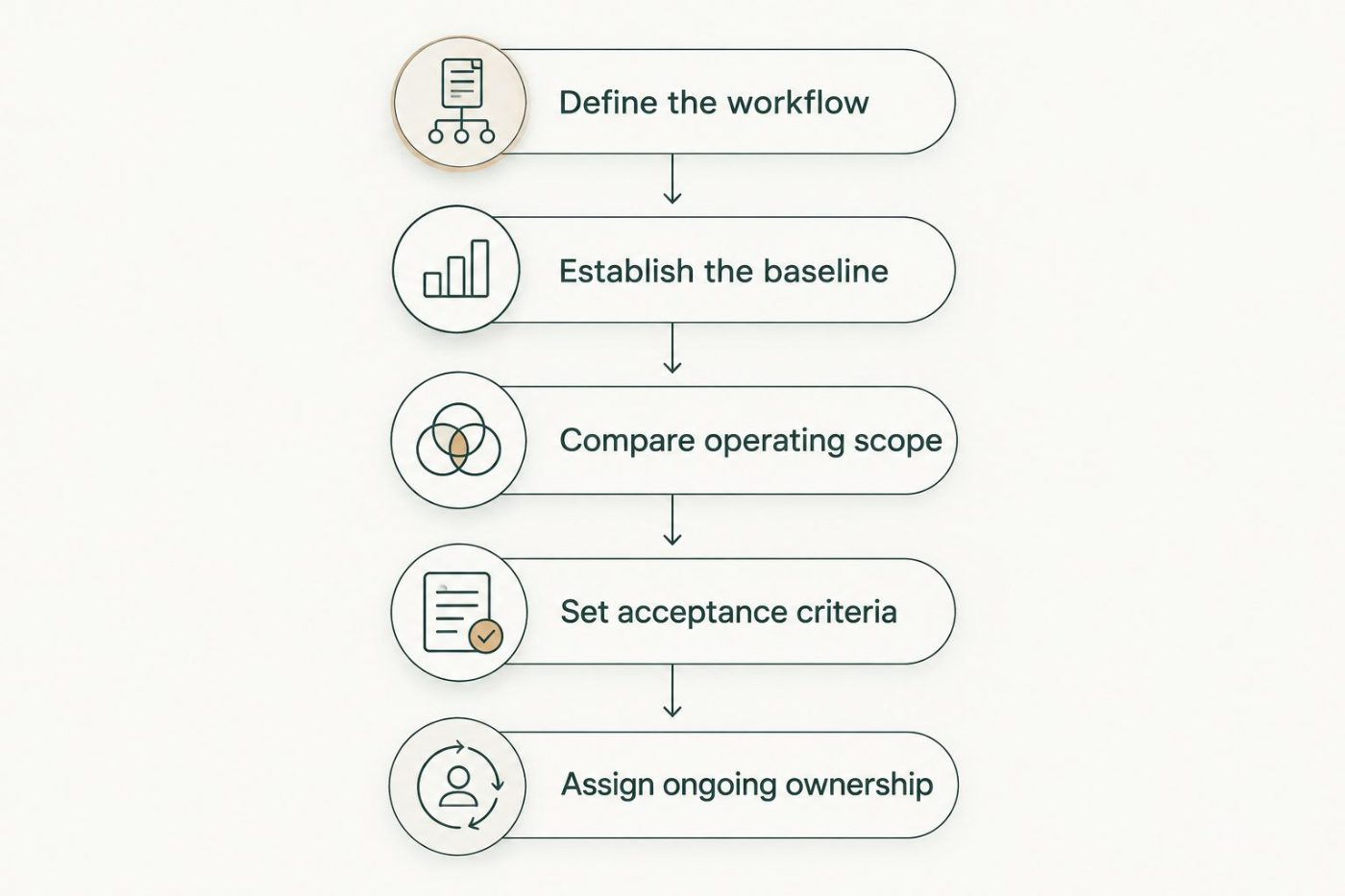
Compare the operating requirements before approving a software purchase or custom build.
Can an assessment recommend against custom development?
An AI Opportunity Assessment should leave room for a no-build decision. Its purpose is to establish the operational opportunity and decision criteria, not to make implementation inevitable.
National AI Consultants positions the AI Opportunity Assessment as the first engagement, with implementation following when justified. That keeps the decision focused on the business requirement before committing to a technical approach.
For a 2026 assessment brief, request a clear account of the bottleneck, available evidence, candidate approaches, operating responsibilities, and unresolved questions. The recommendation should explain why the proposed next step fits the evidence.
Does buying software remove the need for internal oversight?
Buying software does not transfer accountability for your business process. Your organization still needs to decide who can use it, which outputs require review, and how errors or exceptions are handled.
A provider can perform agreed operating tasks, but your leadership team must understand the division of responsibility. Ask for that division in writing before approving either approach.
FAQ
Is custom AI development always more expensive than off-the-shelf software?
Custom AI development is not automatically more expensive over the full operating relationship. Compare equivalent workflow scope, integration, staff effort, controls, and maintenance rather than initial commitments alone.
What is the best way to compare custom AI development vs off-the-shelf software cost?
Compare the total cost of operating the same workflow under both approaches. Keep delivery commitments, recurring obligations, and internal staff effort visible as separate categories.
When should my business choose off-the-shelf software?
Choose off-the-shelf software when an existing product meets your documented workflow, integration, and control requirements. Test realistic exceptions before accepting product fit.
When does custom AI development make business sense?
Custom AI development makes sense when a documented operational requirement remains unmet by suitable existing software. Connect the development scope to that requirement and assign ongoing ownership.
Does an AI Opportunity Assessment commit us to implementation?
An AI Opportunity Assessment should not commit you to implementation. It should establish whether a build, an existing product, a process change, or no further investment is justified.
Should we count employee time as part of software cost?
Include employee time required for preparation, testing, review, training, administration, and exception handling. Separate capacity benefits from cash savings so the business case does not overstate financial outcomes.
Can National AI Consultants manage a solution after implementation?
National AI Consultants provides implementation, ongoing management over the client relationship, and internal team training. Define the responsibilities and scope in the engagement rather than assuming unlimited support.
One last thing
Ask what would make the recommendation change. A sound business case identifies the evidence that would favor packaged software, justify custom development, or stop the project.
Make that question part of your 2026 approval process. If every possible finding leads to the same proposed build, you are reviewing a predetermined solution—not a decision grounded in your operations.