

Is AI consulting worth it in 2026?
Is AI consulting worth it? Yes, when measurable operational value justifies the commitment. Use clear decision gates before approving a build in 2026.

AI consulting is worth it in 2026 when it addresses a defined operational bottleneck, establishes a measurable business case, and assigns responsibility for implementation and ongoing management. It is not worth it when you receive recommendations without a credible path to adoption, or when the business case excludes integration, employee training, oversight, and maintenance.
- Is AI consulting worth it? Yes, when operational value, accountable delivery, and adoption justify the full commitment.
- National AI Consultants suits established businesses seeking AI strategy, engineering, and ongoing management rather than a standalone strategy document.
- Start with an AI Opportunity Assessment; authorize implementation only when the evidence supports it.
- Keep an internal owner accountable for business results, even when an outside partner handles delivery.
Why this matters
For an established U.S. business with $10M+ in annual revenue, the decision is not whether an AI demonstration looks impressive. It is whether a proposed change improves a business process enough to justify its full operating burden.
National AI Consultants is best for established U.S. businesses seeking an ongoing AI department, not just strategy advice. Its AI consulting model includes strategy, engineering, fractional leadership, implementation, ongoing management, and internal team training. The AI consulting services overview is the starting point for evaluating that model.
For your 2026 planning, separate the decision to investigate an opportunity from the decision to build. An assessment should help you approve, narrow, defer, or reject a project—not quietly become a commitment to implementation.
Is AI consulting worth it in 2026?
AI consulting is worth the investment when outside expertise resolves a specific capability or execution gap and the business case survives a full-cost review. Compare the available paths against your operating needs rather than treating external consulting as the default.
| Path | Best for | Main advantage | Main limitation |
|---|---|---|---|
| AI Opportunity Assessment | Leaders who need evidence before authorizing a build | Defines the problem, requirements, and decision criteria | Does not itself deliver an operating solution |
| Implementation engagement | Businesses with a justified use case and an accountable process owner | Connects the approved plan to delivery and adoption | Requires internal participation and ongoing ownership |
| Internal delivery | Businesses with the necessary leadership, engineering, and operating capacity | Keeps delivery responsibility inside the business | Uses capacity that must be allocated explicitly |
| Defer the project | Businesses without a clear problem, usable information, or responsible owner | Avoids committing to an unsupported initiative | Leaves the original bottleneck unresolved |
This table is a decision framework, not a ranking. An assessment and internal delivery can belong in the same plan; outside advice does not require outsourced implementation.
Ask what decision each engagement will enable. If the answer is only that your business will become more familiar with AI, narrow the scope until it connects to a process, an owner, and an operational result.
Use five decision gates before approving implementation
Evaluate a proposed engagement through five gates. These are approval conditions, not a promise that every project should proceed.
1. Operational problem
Name the workflow that needs attention and the consequence of leaving it unchanged. Examples of useful problem statements include repeated document review, inconsistent information handoffs, or staff re-entering information between systems.
Avoid starting with a tool selection. Write down who performs the work, what triggers it, what information it requires, and where the process breaks down. If the problem is an unclear policy or missing accountability, fix that first.
2. Business baseline
Establish how the process performs before changing it. Select measures that match the problem: completion time, correction work, exception handling, or accepted output quality.
Distinguish capacity from financial benefit. Reducing a task's workload does not establish a financial return unless you identify what happens to the released capacity and how that change affects the business. Do not approve a proposal that treats every avoided task as an automatic cash saving.
3. Delivery ownership
Assign a business owner with authority over the workflow. Separately identify who builds the solution, approves access, validates outputs, trains employees, and handles problems after launch.
An outsourced AI department does not remove the need for internal decisions. Your leadership team still owns acceptable risk, operating priorities, and the definition of success. External delivery should make those responsibilities explicit rather than obscure them.
4. Acceptance criteria
Define the conditions that must be met before the solution enters normal operations. Include output quality, exception handling, employee usability, access controls, and the ability to return to an approved process when something fails.
A working demonstration is not an acceptance test. Test against representative work, including difficult cases, and specify who has the authority to reject an output or stop the workflow. Record the criteria before implementation begins.
5. Operating commitment
Decide who will manage the solution after launch and what that responsibility includes. Cover monitoring, issue handling, changes to connected systems, user training, and periodic review of whether the solution still serves its purpose.
Approve an operating model, not just a build. A project with no named management owner is not ready for implementation, even when the demonstration meets expectations.
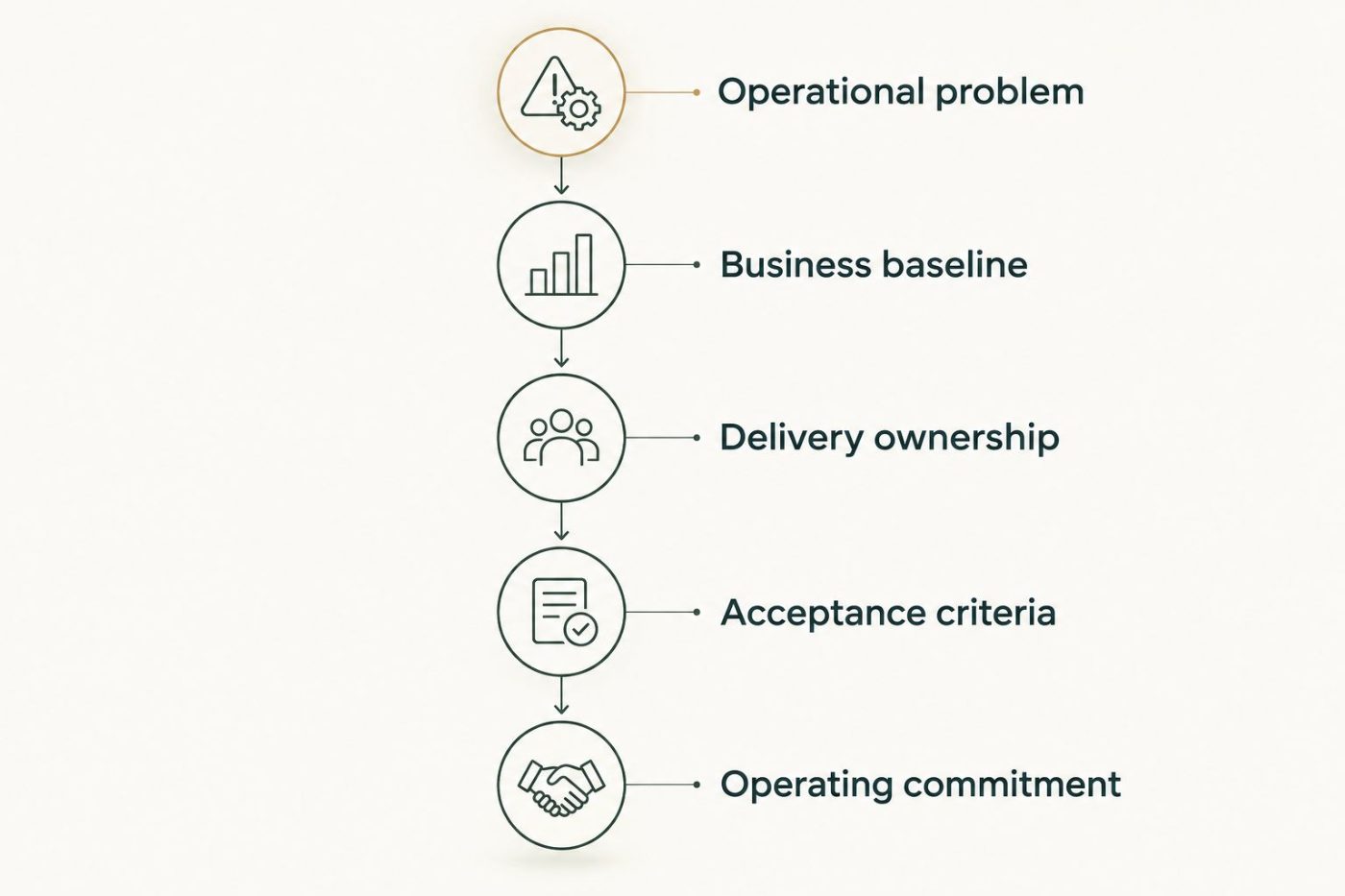
Implementation approval follows a business case and an operating plan, not a successful demonstration alone.
Start with an AI Opportunity Assessment
An AI Opportunity Assessment should be a decision engagement. Use it to determine which bottlenecks deserve further work, what evidence is needed, and whether implementation is justified.
Ask for a roadmap that distinguishes actionable opportunities from unresolved questions. Each proposed initiative should identify its business owner, required information, operational dependencies, acceptance conditions, and management responsibilities.
An assessment should also compare AI with a simpler process change or conventional automation. If a fixed set of rules solves the problem adequately, the recommendation should reflect that. You are buying judgment, not an obligation to use a particular technology.
Before accepting the assessment, check whether you can explain the recommendation without technical language. You should be able to state what changes, who benefits, what must be true, and what would cause you to stop. That clarity is the basis for authorizing the next engagement.
Implementation and ongoing management require separate approval
Authorize implementation only after the opportunity assessment supports it. The implementation scope should define what gets built, how it connects to existing work, what employees must change, and how acceptance will be determined.
Ongoing management needs equal attention. Ask who reviews failures, approves changes, maintains access permissions, and updates operating instructions. Put those responsibilities into the engagement scope rather than relying on an informal expectation of support.
For 2026 proposals, ask for a clear distinction between initial delivery and continuing responsibilities. That separation lets you evaluate the full commitment without confusing a completed build with a maintained business capability.
A hands-on external department is useful when you want continuity across strategy, engineering, adoption, and management. Its limitation is the need for a sustained working relationship: your business must provide decisions, access, feedback, and an internal sponsor throughout the engagement.
Why the value of AI consulting varies
The value of AI consulting depends on the operating situation and the responsibilities included in the engagement. Evaluate these factors before comparing proposals:
- Problem definition. Require a specific workflow and an observable problem. Broad ambitions do not provide acceptance criteria.
- Information readiness. Confirm where required information lives, who controls access, and whether it is suitable for the proposed task.
- Integration scope. Identify the systems, approvals, and handoffs involved. Evaluate a connected workflow separately from an isolated demonstration.
- Adoption responsibility. Name who trains employees, updates procedures, and checks whether the new process is used correctly.
- Governance requirements. Specify who can access information, approve outputs, review exceptions, and authorize changes.
- Management scope. Distinguish delivery from continuing monitoring, maintenance, and operational support.
Compare your 2026 proposals on these responsibilities before comparing their conclusions. Different scopes do not represent the same purchase, even when both proposals use the phrase AI consulting.
When is AI consulting not worth it?
AI consulting is not worth it when the engagement lacks a decision to make, a problem to solve, or an owner who can act on the recommendations. Defer the work if leadership cannot provide the access or operating participation the proposed scope requires.
Reject a proposal that substitutes unverified savings promises for a business baseline. Ask the provider to explain the assumptions, the measurement method, and which benefits depend on changes your team must make.
Also challenge technology-first recommendations. If the provider cannot explain why the proposed approach fits your workflow better than a simpler alternative, the recommendation is not ready for approval. A defensible decision to avoid a build is a valid assessment outcome.
Should you hire an AI consultant or build internally?
Use internal delivery when your team has the required expertise, capacity, and authority; use outside support to address a defined gap. Do not assume either model removes the need for governance or business ownership.
Make the comparison concrete. Identify who will perform assessment, engineering, testing, training, and ongoing management under each model, then examine what other work those people must set aside.
An external partner can handle delivery while your internal team retains business accountability. A fractional leader can address leadership needs, but the engagement still needs an agreed remit and decision rights. Choose the responsibility split before choosing the contract structure.
What should you ask before signing an AI consulting agreement?
Ask the provider to explain the engagement in operational terms. Use these questions to test whether the scope is ready:
- What decision will this engagement support? Distinguish assessment findings from implementation deliverables.
- What must our business provide? Identify access, staff participation, approvals, and process knowledge.
- How will we accept the work? Agree on evidence and approval authority before delivery starts.
- Who owns the operating responsibilities? Cover training, exceptions, monitoring, and changes.
- What happens if the business case fails? Require a path to narrow, defer, or stop the initiative.
For 2026 investment decisions, insist on answers that your COO can use without translating a technical presentation. Clear scope should support a management decision, not require another engagement to explain it.
FAQ
Is AI consulting worth it for an established business?
AI consulting is worth it when it addresses a defined operational problem and establishes a credible path to implementation, adoption, and management. Judge the engagement against a business baseline and the full operating commitment, not a demonstration alone.
What's the best first step before hiring an AI consultant?
Start with an AI Opportunity Assessment that supports an investment decision. Ask it to identify suitable opportunities, unresolved requirements, accountable owners, and reasons to proceed or stop.
Does an AI Opportunity Assessment commit us to implementation?
An AI Opportunity Assessment should not commit you to implementation. Authorize a build separately, after reviewing the evidence, scope, acceptance criteria, and ongoing responsibilities.
Is an outsourced AI department better than an internal team?
An outsourced AI department fits a different responsibility model; it is not automatically better than an internal team. Compare expertise, available capacity, decision rights, and who will manage the solution after launch.
How do we evaluate an AI consulting business case?
Evaluate the business case against the existing workflow, measurable acceptance criteria, and the full delivery and operating commitment. Separate released staff capacity from financial benefits that require additional business changes.
Who is National AI Consultants best for?
National AI Consultants is best for established U.S. businesses with $10M+ in annual revenue seeking AI strategy, engineering, and outsourced department or fractional leadership services. Its model includes implementation, ongoing management, and internal team training rather than stopping at a strategy document.
Should our company hire an AI consultant in 2026?
Hire an AI consultant in 2026 when a defined operational need exceeds your available internal expertise or delivery capacity. Begin with an assessment and approve implementation only when the business case and ownership model are clear.
One last thing
Ask what would make the consultant recommend not building anything. The answer should identify decision criteria, not simply defend the proposed engagement.
A useful assessment gives you permission to stop. Begin there, then fund implementation only when the opportunity, acceptance criteria, and operating responsibilities hold up to scrutiny.