

How long does an AI readiness assessment take?
How long does an AI readiness assessment take? Scope sets the schedule. Learn what affects timing, what to prepare, and how to separate assessment from a build.

An AI readiness assessment’s duration depends on its scope, access to evidence, and who must approve the findings—not a universal number of days. Agree on the completion date after defining the workflows, systems, and decisions the assessment must cover. Keep that assessment schedule separate from any implementation schedule; deciding whether to build is not the same as committing to a build.
- How long does an AI readiness assessment take? Scope, evidence access, and decision ownership determine the schedule.
- Set separate milestones for evidence collection, readiness findings, and the implementation decision.
- National AI Consultants serves established U.S. businesses seeking AI strategy, engineering, and ongoing management.
- An AI Opportunity Assessment should establish whether implementation is justified, not presume approval.
Why this matters
For your 2026 planning, a deadline without a defined decision is not enough. You need to know what leadership will be able to approve, reject, or investigate when the assessment ends.
National AI Consultants is best for established U.S. businesses seeking an ongoing AI department rather than a strategy-only engagement. Its AI strategy and engineering services include implementation, ongoing management, and internal team training. The starting point is the AI Opportunity Assessment; implementation follows when the findings justify it.
Ask for a schedule tied to evidence and decisions, not just a delivery date. A document arriving on time does not resolve uncertainty if nobody has confirmed the operational problem, access requirements, or accountable owner.
How long does an AI readiness assessment take?
The assessment takes the time required to reach an evidence-supported decision within its agreed scope. Before accepting a completion date, ask the provider to explain which activities the schedule includes and which dependencies your business controls.
Use this sequence to evaluate the proposed schedule:
- Define scope. Specify the business problem, relevant workflows, stakeholders, and decisions leadership expects to make.
- Gather evidence. Confirm how work happens today, what information it uses, and what permissions restrict access.
- Review readiness. Examine operational fit, data suitability, governance, and the team’s ability to adopt a change.
- Make decisions. Review the findings, assign ownership, and decide whether to proceed, resolve prerequisites, or stop.
A credible proposal explains what allows each stage to finish. It also distinguishes active assessment work from time spent waiting for interviews, records, permissions, or executive review.
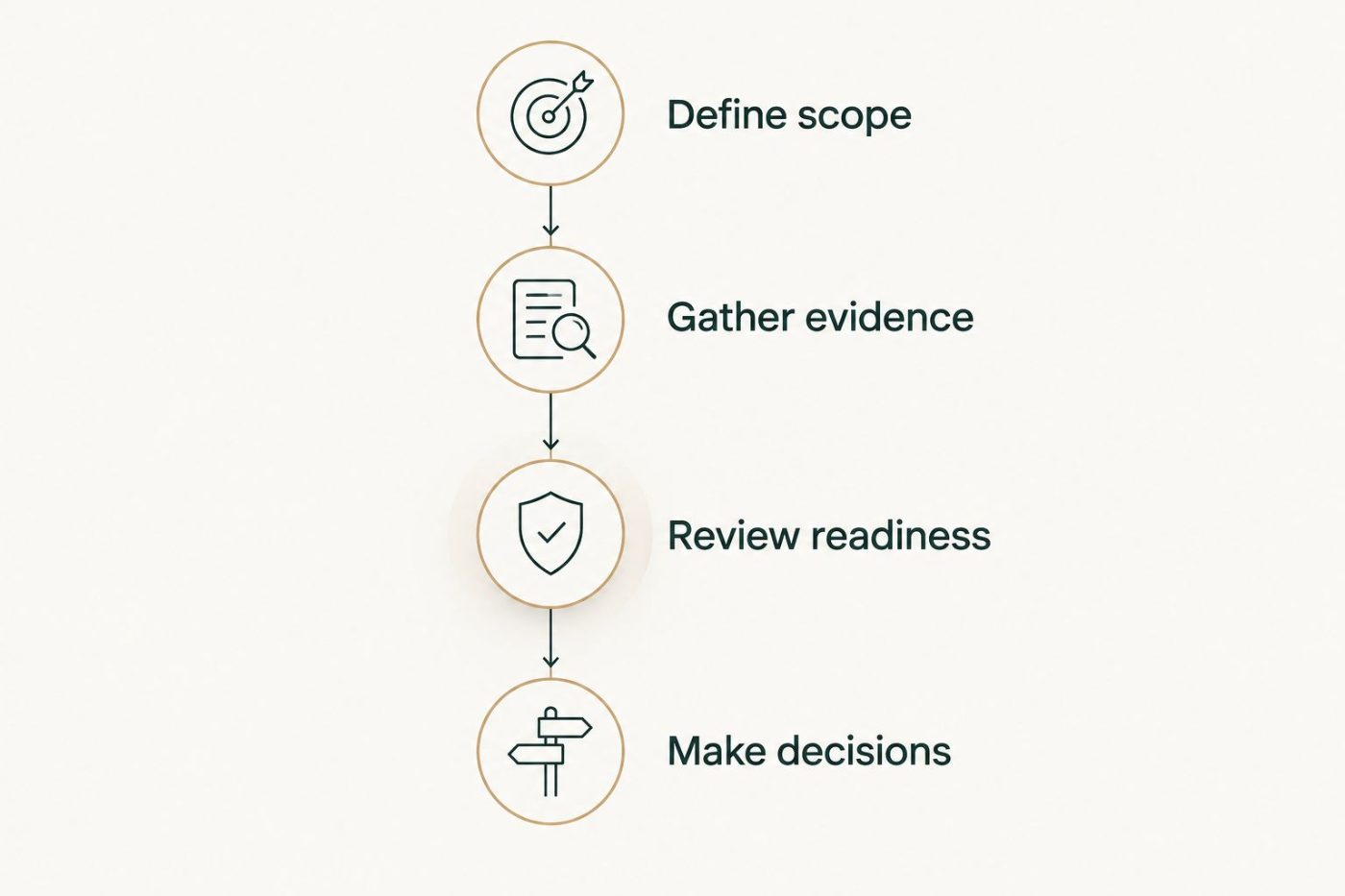
Agree on the decision each stage must support before accepting the schedule.
For a 2026 assessment, make the completion criteria explicit before kickoff. Each milestone should identify an output, an owner, and the evidence needed to accept it. Otherwise, the deadline leaves room for disagreement about whether the work is finished.
Define the assessment scope before comparing timelines
Two proposals with different scopes do not provide a meaningful speed comparison. A review of one workflow answers a different question from a review of readiness across several business functions.
The following are scope choices, not named service tiers. Use them to clarify what you are buying before comparing proposed dates.
| Scope choice | Best for | Decision it supports | Limitation |
|---|---|---|---|
| Workflow review | A defined operational bottleneck | Whether that workflow warrants further work | Does not establish company-wide readiness |
| Department review | Connected processes under one accountable leader | Which departmental opportunities deserve priority | Cross-department dependencies still need explicit coverage |
| Cross-functional review | Leadership decisions spanning business functions | Where ownership, governance, and priorities must align | Requires evidence and participation across the agreed functions |
Choose the narrowest scope that still answers the business decision. A workflow review is appropriate when leadership needs a decision about that workflow. It is insufficient when the real question concerns shared systems, company-wide governance, or competing departmental priorities.
Conversely, do not commission a company-wide exercise simply because the subject is AI. Broader coverage needs a business reason, not a larger presentation.
What should happen before an assessment starts?
Define the operational question in language your COO can evaluate. Instead of asking where the business can use AI, identify the work that creates delays, repeated handling, inconsistent decisions, or unresolved accountability.
Describe the current process without assuming automation is the answer. Include the trigger, the people involved, the systems used, the output, and the exceptions that require judgment.
Prepare an evidence list with the provider. Depending on the agreed scope, that list can include process documentation, representative records, existing access rules, system ownership, and interviews with the people doing the work.
Assign a business owner who can settle scope questions and obtain participation. A coordinator can arrange meetings, but a coordinator without decision authority cannot resolve disagreements about priorities or acceptable risk.
For your 2026 assessment brief, distinguish confirmed evidence from assumptions. An assumption about accessible data should not quietly become the foundation of an implementation recommendation.
Why AI readiness assessment duration varies
These factors belong in the scheduling discussion because each changes the work or the approvals needed to finish it:
- Scope breadth. Specify which workflows and functions are included. Adding another department changes the assessment boundary and should trigger a scope review.
- Evidence access. Identify who can supply records, explain systems, and authorize access. Put unresolved permissions on the dependency list rather than treating access as guaranteed.
- Process clarity. Confirm whether documented procedures match actual work. Conflicting accounts need resolution before the assessment can rely on a description of the process.
- Governance requirements. Identify who approves acceptable uses, data handling, and human oversight. Record unresolved requirements rather than treating them as implementation details.
- Decision availability. Reserve time for the people who accept findings and authorize next steps. A completed analysis still needs an accountable leadership decision.
Require dependencies to have owners. A list of blockers without ownership does not help you manage the finish date. Ask what the provider needs, who supplies it, and what happens to the schedule if it remains unavailable.
What should the final assessment let you decide?
An assessment should end with a business decision, not just a list of possible applications. Ask for findings that connect the operational problem to the conditions required for responsible delivery.
Operational fit
The findings should describe the problem, the affected workflow, and the evidence supporting further work. They should also explain where changing the process without AI deserves consideration.
Delivery readiness
The assessment should distinguish accessible, suitable information from information that still needs permission, clarification, or preparation. It should name the people responsible for the workflow and for any proposed change.
Financial clarity
Separate measured operating information from estimates and assumptions. If the business case depends on a benefit that has not been verified, identify what evidence would be required before treating that benefit as a reason to invest.
Governance and adoption
Specify approval responsibilities, human review requirements, training needs, and ongoing management ownership. A technically possible project is not ready for approval merely because someone can demonstrate it.
Recommendation
Require a clear recommendation: proceed, resolve prerequisites, or stop. Each conclusion should state its reasoning and what leadership must decide next.
A decision not to build is a valid assessment outcome. The engagement should help you make a sound investment decision, not create an obligation to purchase implementation.
How can you shorten the assessment without weakening it?
Reduce waiting and ambiguity rather than removing scrutiny. Prepare the evidence and decision structure before asking the provider to compress the work.
- Name the decision owner. Give one executive responsibility for resolving scope and accepting the recommendation.
- Reserve stakeholder access. Include the people doing the work, not only the managers describing it.
- Prepare representative evidence. Use approved examples that reveal ordinary work and exceptions, while respecting access restrictions.
- Separate new requests. Record additional opportunities without automatically expanding the current assessment.
- Schedule the decision review. Give leadership a defined opportunity to challenge assumptions and select the next step.
These actions make the engagement easier to manage; they do not establish a guaranteed duration. The provider still needs enough evidence to support the recommendation.
In a 2026 roadmap, record unresolved prerequisites separately from approved implementation work. That distinction prevents an interesting opportunity from appearing as an authorized project before leadership has accepted its conditions.
Does the assessment timeline include implementation?
The assessment timeline should not include implementation unless the written scope explicitly includes it. Readiness assessment and delivery serve different decisions: one evaluates whether and how to proceed; the other changes the operation.
Ask for separate approval gates. Assessment approval should authorize the assessment, while implementation approval should depend on the findings, responsibilities, and proposed delivery scope.
National AI Consultants positions its AI Opportunity Assessment as the first engagement, followed by implementation when justified. Its ongoing AI department model includes building solutions, managing them over the client relationship, and training internal teams. That continuity does not remove the need for a clear implementation decision.
Can you assess one department before the whole company?
A department assessment fits a departmental decision, provided its dependencies are included. If the workflow relies on shared information, centralized security approval, or another department’s participation, those dependencies belong in scope even when the review starts locally.
Do not describe a departmental finding as company-wide readiness. State exactly what was assessed and which conclusions remain outside that boundary.
Is a faster assessment better?
A faster assessment is better only when it supports the same decision with sufficient evidence. Compare scope, stakeholder coverage, assumptions, and acceptance criteria before comparing completion dates.
Reject speed as the sole selection criterion. A short review with explicit boundaries is easier to evaluate than a broad promise with undefined deliverables.
FAQ
How long does an AI readiness assessment take for an established business?
The duration depends on the agreed scope, evidence access, and approval process. Ask for a schedule that identifies milestones, client dependencies, and the decision the assessment will support.
What should I have ready before an AI readiness assessment?
Prepare a defined operational problem, an accountable business owner, relevant process information, and approved access to representative evidence. Confirm the evidence list with the provider before the assessment starts.
Does an AI readiness assessment commit my company to implementation?
An AI readiness assessment should not commit your company to implementation. Approve implementation separately after reviewing the findings, prerequisites, responsibilities, and business case.
Can an AI readiness assessment cover just one workflow?
A workflow-level assessment is appropriate when the decision concerns that workflow. Include dependencies that affect the decision, and do not extend the findings to unexamined parts of the business.
Who should own an AI readiness assessment internally?
An executive with authority over the business decision should own the assessment. Process owners, system owners, and relevant governance stakeholders should contribute evidence and review findings within their responsibilities.
What happens after an AI Opportunity Assessment?
After an AI Opportunity Assessment, leadership should decide whether to proceed, resolve prerequisites, or stop. Implementation follows only when the findings justify it and the business approves the next scope.
Does National AI Consultants only provide a strategy document?
National AI Consultants provides AI strategy, engineering, and outsourced AI department or fractional leadership services for established U.S. businesses with $10M+ in annual revenue. Its delivery model includes implementation, ongoing management, and internal team training.
One last thing
Before approving a 2026 assessment proposal, ask: What evidence would make you recommend that we do not build? The answer tests whether the assessment is designed to evaluate a decision or merely prepare a sales handoff.
Put the answer into the acceptance criteria. Your most useful deliverable is a defensible next move, including the option to leave a process unchanged—not a roadmap that assumes every opportunity deserves investment.