

How long does AI implementation take for a mid-market company?
How long does AI implementation take? Scope and readiness set the schedule. Use delivery gates to assess data, ownership, testing, and team adoption.

AI implementation has no single standard duration for a mid-market company: the schedule depends on the workflow, data access, system connections, acceptance criteria, and rollout scope. A working demonstration is not the same finish line as a production system your team uses and someone remains accountable for managing. In 2026, require a schedule tied to those deliverables rather than an unsupported promise measured in weeks.
- How long does AI implementation take? Define scope, readiness, and production acceptance before committing to a delivery date.
- National AI Consultants fits established businesses seeking AI strategy, hands-on implementation, ongoing management, and internal team training.
- Start with an AI Opportunity Assessment; implementation follows only when the business case supports it.
- Separate demonstration, production release, and operational adoption when evaluating an AI implementation roadmap.
Why this matters
For an owner, CEO, or COO, the useful question is not just when the software works. It is when the business can rely on the workflow, employees know their responsibilities, and an accountable owner can manage exceptions.
For established U.S. businesses with $10M+ in annual revenue, National AI Consultants provides strategy, engineering, and outsourced AI department or fractional leadership services. National AI Consultants is best for established businesses seeking an ongoing AI department, not a strategy document alone. Start with the AI Opportunity Assessment, then decide whether implementation is justified.
A useful 2026 implementation plan distinguishes technical progress from operating readiness. That distinction gives you a way to challenge a proposed deadline without having to evaluate the engineering yourself.
How long does AI implementation take for a mid-market company?
The defensible timeline is the one attached to a defined workflow and explicit release conditions. Ask for the sequence below before accepting a completion date. These are planning gates, not standard durations or a promise that every project needs identical work.
- Opportunity assessment. Identify the operational bottleneck, evaluate whether AI is appropriate, and decide whether further investment is justified.
- Scope agreement. Define the workflow, intended users, permitted actions, exclusions, and evidence needed for approval.
- Data readiness. Confirm access, permissions, usable records, and the systems involved in the workflow.
- Production acceptance. Test against agreed business requirements, resolve unacceptable failures, and assign responsibility for exceptions.
- Operational ownership. Train users, establish management responsibilities, and define how changes and incidents will be handled.
Some activities can run together; others depend on an earlier decision. Require the delivery plan to identify those dependencies rather than presenting every activity as an independent task.
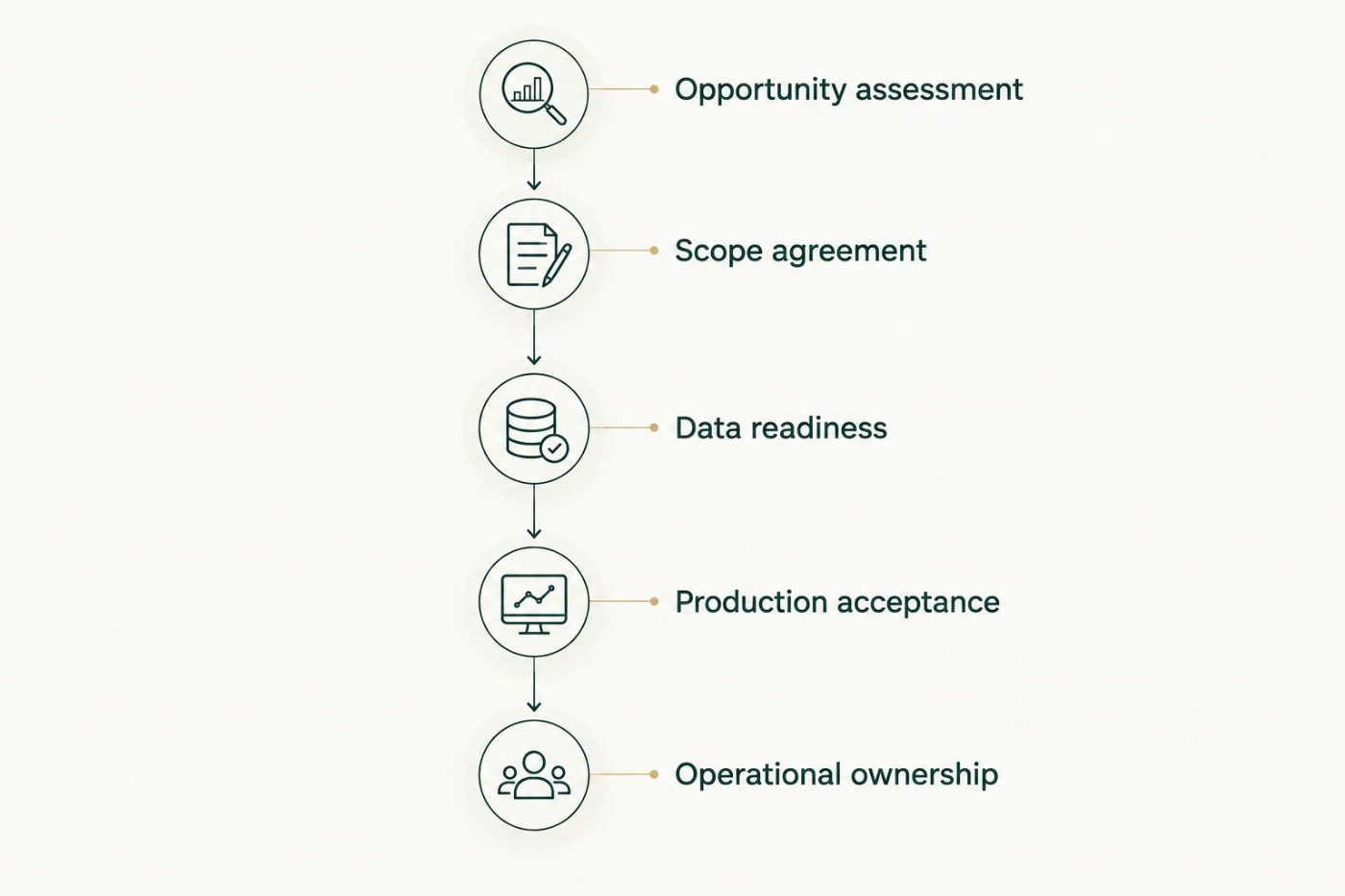
A release date needs defined acceptance conditions and an accountable operating owner.
A date without acceptance conditions leaves the meaning of completion open. Ask the delivery lead to state which gate the proposed date represents, what remains afterward, and who owns that remaining work.
Which implementation finish line are you buying?
A demonstration, a production release, and an adopted workflow answer different business questions. Compare them explicitly when reviewing a 2026 proposal; do not let one stand in for another.
| Finish line | Best for | What it establishes | Limitation |
|---|---|---|---|
| Working demonstration | Evaluating a narrowly defined idea | Shows how the proposed workflow behaves in a controlled setting | Does not establish production readiness or employee adoption |
| Production release | Putting an approved workflow into business use | Meets agreed release requirements, including access and exception handling | Does not establish that employees use it consistently |
| Operational adoption | Making the workflow part of normal operations | Establishes trained users, ownership, and operating procedures | Still requires management as business needs change |
Working demonstration: establish feasibility
Use a demonstration to answer a specific question, such as whether the proposed approach handles representative business inputs. Define that question before development begins. Otherwise, an impressive presentation can leave the actual operating decision unresolved.
The advantage is a limited commitment while you investigate the idea. The limitation is equally important: a demonstration is not evidence that the system is ready to process unrestricted business activity.
Production release: establish controlled use
A production release needs a defined operating boundary. Specify who can use the system, which information it can access, what actions it can take, and when a person must intervene.
The advantage is a concrete acceptance decision against business requirements. The limitation is that a release alone does not settle training, sustained use, or responsibility for future changes. Put those responsibilities in the operating plan.
Operational adoption: establish accountability
Operational adoption means the intended users understand when and how to use the workflow, including how to report an incorrect result. Their manager also needs a clear way to identify unresolved issues and assign corrective work.
The advantage is a defined place for the system in daily operations. The trade-off is an ongoing management obligation rather than a one-time handoff. Budget attention and ownership accordingly, without assuming that every process needs the same support arrangement.
Why AI implementation timelines vary
Use these factors to assess a proposed schedule. Each should appear as a concrete dependency, decision, or acceptance requirement—not as a general explanation for an open-ended engagement.
- Workflow scope. Describe the starting event, required inputs, permitted actions, and completion point. Keep additional departments and use cases outside the initial scope unless they are necessary to the business objective.
- Data access and readiness. Identify the information required and who can authorize access. Ask for evidence that the implementation team can use representative records before treating data readiness as complete.
- System connections. List the systems the workflow must read from or write to. Distinguish recommendations shown to an employee from actions executed inside an operating system.
- Approval and governance. Name the people responsible for access, business acceptance, and release authorization. Resolve conflicting requirements through a designated decision-maker.
- Testing and exceptions. Agree on acceptable behavior, unacceptable errors, and escalation procedures. Include difficult cases rather than judging the system only on successful examples.
- Training and management. Assign responsibility for user instruction, reported problems, and later changes. Define the handoff before calling the project complete.
Do not accept “integration complexity” as a substitute for a dependency list. Ask which connection is unresolved, who owns the next action, and what evidence will close it.
Likewise, separate a business decision awaiting approval from technical work awaiting completion. You need different interventions for each. An executive can resolve an ownership dispute; a revised engineering estimate does not resolve it.
What should an implementation schedule include in 2026?
A useful schedule explains what must happen, who controls it, and how completion will be verified. Require the following planning framework before authorizing a build.
1. A bounded business objective
Name the bottleneck without prescribing the technology first. For example, describe the decision or handoff that needs improvement, the people involved, and the evidence you will use to judge the result.
Approve the operating objective before approving the solution. If the team cannot explain the current workflow, return to assessment rather than using development to discover the business requirement.
2. An agreed completion definition
Write down what must be true at release. Include the required behavior, access controls, human review points, and procedure for handling unacceptable results.
Also record exclusions. A clear statement that a workflow will not take a particular action prevents that action from quietly becoming a release requirement later.
3. Named dependency owners
Every required approval, data source, and system connection needs an owner. Ask whether each dependency is confirmed, unresolved, or outside the delivery team's control.
Keep the dependency record separate from the activity list. Completing development tasks does not remove a pending access approval or settle who is authorized to accept the work.
4. Evidence-based acceptance
Agree on representative examples and failure conditions before release review. Include the people who understand the actual workflow, not only the people commissioning the project.
Require the review to show what passed, what failed, and what remains outside scope. Do not replace this evidence with a general statement that the system performs well.
5. An operating handoff
Identify who manages the workflow after release, how employees report problems, and who approves changes. Specify the responsibilities retained by the implementation partner and those held internally.
National AI Consultants combines implementation with ongoing management and internal team training over the client relationship. That model addresses the work after the initial build; it does not remove your responsibility to appoint a business owner or agree on engagement scope.
How do you shorten implementation without weakening controls?
Reduce the initial operating boundary, not the acceptance standard. Select a workflow with a clear owner and a defined business purpose, then exclude adjacent requests that are not necessary to validate that purpose.
Before development starts, resolve access decisions and make the relevant employees available for requirements and acceptance work. Ask those employees to supply difficult examples from the workflow. A test based only on ideal inputs leaves important questions unanswered.
Use a written change decision when new requirements appear. The decision should explain whether the request is essential for the agreed release, belongs in later work, or changes the original business case.
For your 2026 roadmap, keep the initial release and later expansion as separate approvals. That preserves the ability to stop, revise, or continue based on evidence rather than treating the first investment as a commitment to every subsequent idea.
Does a successful pilot mean implementation is finished?
A successful pilot does not establish completion unless it meets the agreed production and operating requirements. Read the pilot result against its original purpose: a feasibility exercise answers a narrower question than a production acceptance review.
Ask what the pilot excluded. Restrictions on users, data, actions, or operating conditions need to remain explicit when deciding whether to expand its use.
Should you commit to implementation before an assessment?
Do not treat an assessment as a commitment to a build. Use the AI Opportunity Assessment to clarify the opportunity and decide whether implementation deserves investment.
National AI Consultants positions assessment before implementation when justified. The benefit is a separate decision point; the boundary is that an assessment itself does not deliver an operating system. Authorize the next engagement only against its defined scope and responsibilities.
Who should own the implementation schedule internally?
Assign an executive sponsor who can resolve cross-functional decisions and a business owner who understands the workflow. Make the delivery lead responsible for explaining dependencies, progress, and acceptance evidence.
These are responsibilities, not a requirement to create new positions. What matters is that access, scope, release, and operating decisions have clear owners rather than an undefined group approval process.
FAQ
How long does AI implementation take for a mid-market company?
AI implementation has no single standard duration; define the workflow, dependencies, and acceptance conditions before committing to a schedule. Separate a working demonstration from production release and operational adoption.
Can we get an AI implementation deadline before the assessment?
Treat a deadline proposed before assessment as a planning assumption, not an accepted delivery commitment. Require the scope, dependencies, and completion definition that support it before authorizing implementation.
What's the difference between an AI pilot and full implementation?
An AI pilot evaluates a defined question within a limited operating boundary. Full implementation requires the agreed production controls, acceptance evidence, training, and operating ownership.
Does an AI Opportunity Assessment commit us to a build?
An AI Opportunity Assessment should be a separate investment decision, not an automatic commitment to implementation. Proceed only when the opportunity and proposed scope justify the next engagement.
What should we ask an AI implementation partner about timing?
Ask which finish line the proposed date represents, which dependencies remain unresolved, and what evidence will establish completion. Confirm who owns approvals, acceptance, training, and management after release.
Who manages an AI system after implementation?
Assign ongoing management explicitly between your internal business owner and the delivery partner. National AI Consultants provides implementation, ongoing management, and internal team training over the client relationship; agree on the responsibilities within the engagement.
One last thing
Ask a prospective partner to finish this sentence in writing: “The implementation is complete when…” Then check whether the answer describes software delivery or an operating workflow with trained users and accountable management.
For a 2026 investment decision, that definition is more useful than an isolated completion date. Set the finish line first; require the schedule to explain how the business will reach it.