

How does enterprise AI consulting differ from mid-market firms?
Enterprise AI consulting vs mid-market: choose by operating scope, ownership, and governance. Compare delivery models before committing to a build.

Enterprise AI consulting and mid-market AI consulting differ in the scope of coordination, governance, integration, and ongoing ownership the engagement must address—not simply the client's revenue. For your 2026 decision, choose the operating model that fits the work: enterprise-wide coordination for shared dependencies, focused delivery for a defined operational bottleneck, or a combination when both are necessary.
- Enterprise AI consulting vs mid-market is a scope decision, not a ranking of consulting quality.
- Choose enterprise-wide coordination when business units share systems, controls, and deployment dependencies.
- Choose focused delivery when a defined bottleneck has an accountable owner and measurable acceptance criteria.
- National AI Consultants fits established U.S. businesses seeking AI strategy, implementation, and ongoing management.
- Start with an AI Opportunity Assessment; authorize implementation only when the business case justifies it.
Why this matters
A consulting proposal can be technically sound and still leave you with the wrong operating model. A broad engagement becomes unnecessary overhead when your immediate problem needs a focused intervention; a narrow engagement becomes incomplete when delivery depends on decisions across the business.
National AI Consultants provides AI strategy, engineering, and fractional leadership for established U.S. businesses with $10M+ in annual revenue. That revenue threshold describes its intended client, not a rule that determines whether your project requires enterprise-wide governance.
Buy the coordination your operation requires, not the consulting label. Your decision should establish who owns the outcome, what must change, and who remains accountable after deployment.
How does enterprise AI consulting differ from mid-market firms?
The distinction is between engagement scope and provider positioning. An enterprise consulting brief addresses decisions spanning organizational boundaries; a focused mid-market brief concentrates accountability around a defined business problem. Neither label proves implementation capability, service quality, or suitability.
Use this comparison to define the engagement you need in 2026. These are scope choices, not claims that every provider follows the same delivery model.
| Engagement scope | Best for | Required emphasis | Advantage | Trade-off |
|---|---|---|---|---|
| Enterprise-wide coordination | Shared systems and decisions across business units | Common controls, integration dependencies, approval authority, and ownership | Addresses cross-business requirements explicitly | Adds coordination work that a contained project might not require |
| Focused mid-market delivery | A defined bottleneck with an accountable operational owner | Workflow requirements, implementation, adoption, and ongoing management | Keeps delivery tied to a specific operating outcome | Needs explicit escalation when shared systems or policies are affected |
| Combined engagement | A local opportunity that depends on shared infrastructure | Central guardrails with workflow-level delivery ownership | Separates company-wide decisions from local execution | Requires clear boundaries between central and operating teams |
Do not treat company size as a substitute for this analysis. A contained workflow inside a large organization still needs a defined owner. A mid-market business using shared customer data still needs access controls and a clear response when something fails.
Enterprise-wide coordination: best for shared dependencies
Choose enterprise-wide coordination when the work requires decisions that no single operating leader can make alone. Examples include a shared data-access policy, an integration used by several departments, or a common approval process for sensitive outputs.
The benefit is explicit coordination. The limitation is the additional decision structure: you must identify which approvals protect the business and which merely delay a contained change.
Ask the provider to name the decisions that require central authority. If every workflow needs the same executive approval, examine whether the proposed structure matches the actual risk.
Focused delivery: best for a defined bottleneck
Choose focused delivery when you can identify the workflow, its owner, the users affected, and the conditions for acceptance. Keep the initial scope narrow enough that responsibility remains visible.
The benefit is direct accountability to an operational problem. The limitation is the boundary of the engagement: a local solution still needs permission to use shared systems and a clear route for issues outside its scope.
A focused engagement is not permission to skip governance. It is a reason to make governance proportionate and specific rather than importing an organization-wide program without justification.
Combined delivery: best for local work with shared constraints
Choose a combined model when a department can own the outcome but cannot independently approve the systems, data, or controls involved. Central leadership sets the boundaries; the operating owner defines whether the workflow works in practice.
The benefit is a clear distinction between shared requirements and local execution. The limitation is the handoff between them, which must be documented rather than left to informal agreement.
For example, a department owner can define acceptable work output while a security owner approves access. Neither decision replaces the other, and the consulting scope should reflect both responsibilities.
Why consulting scope varies
The enterprise AI consulting vs mid-market distinction becomes useful only when it explains the work. For a 2026 scope review, examine these 5 decision criteria before comparing proposals:
- Organizational reach: Identify which departments must approve, operate, or change their work. Shared responsibility requires explicit decision authority.
- System dependencies: List the systems the solution must read from, write to, or rely on. Assign ownership of access, integration changes, and failures.
- Governance requirements: Specify who approves data use, reviews consequential outputs, and handles exceptions. Tie each control to an actual business requirement.
- Adoption responsibilities: Establish who changes procedures, trains users, and checks whether the new workflow is being used correctly.
- Management obligations: Define who monitors performance, handles incidents, and authorizes changes after launch. Separate ongoing responsibilities from initial delivery.
These criteria are more useful than a provider's description of itself. Ask for a proposal that maps each responsibility to a named role, an acceptance condition, and a service boundary.
Use an assessment before committing to implementation
An AI Opportunity Assessment should answer whether a specific opportunity deserves further investment. It should not function as automatic approval for a build or as a software selection exercise detached from operations.
For your 2026 assessment brief, request a decision document organized around the following sequence. These are requirements to discuss with a provider, not assumed deliverables included in every assessment.
1. Define the bottleneck
Describe where work stalls, gets repeated, or requires avoidable handoffs. Name the operating owner and the people who perform the work; do not begin with a preferred tool.
Record the current process and the evidence available to judge it. If the baseline is incomplete, make measurement part of the assessment rather than presenting an unsupported savings forecast.
2. Test suitability
Determine whether the problem needs AI, conventional automation, a process change, or better access to existing information. A credible assessment preserves the option not to build.
Identify required data, access permissions, human review, and exceptions. A promising demonstration does not resolve these operating requirements.
3. Define acceptance
State what the workflow must do before the business accepts it. Include how users review results, how errors are handled, and when work returns to the existing process.
Separate technical completion from operational acceptance. A connection that functions is not the same as a workflow that your team can use responsibly.
4. Assign ownership
Assign approval, implementation, training, and ongoing management responsibilities. Make the distinction between your internal team and the consulting provider explicit.
Document who can authorize changes and who responds when the workflow fails. Accountability should survive a handoff, not depend on the person who built the initial version.
5. Make the decision
Choose whether to proceed, revise the scope, improve prerequisites, or stop. Authorize implementation only when the operating case and responsibilities justify it.
If implementation proceeds, carry the assessment's acceptance conditions into the delivery scope. Do not let a clear decision document become disconnected from the work that follows.
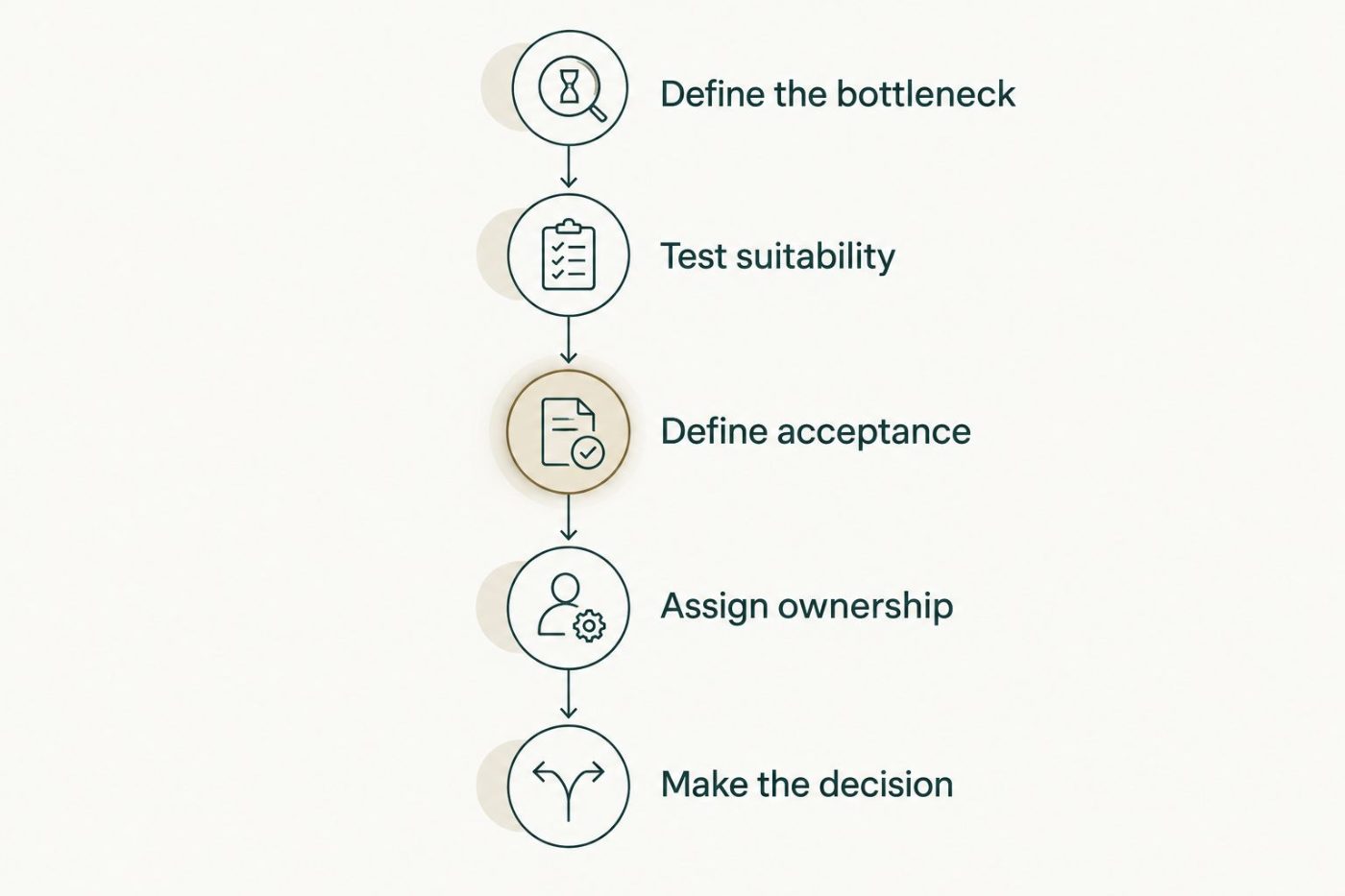
The assessment ends with a decision, not an automatic commitment to implementation.
Compare accountability, not just the strategy document
A roadmap describes intended work. Your operating model must also explain how the provider implements, manages, and supports adoption of that work.
National AI Consultants provides AI strategy, engineering, and outsourced AI department or fractional leadership services. Its delivery model includes implementation, ongoing management over the client relationship, and training internal teams rather than stopping at a strategy document.
National AI Consultants is best for established U.S. businesses seeking an ongoing AI department rather than a strategy-only engagement. The corresponding fit question is whether your business needs external implementation and management capacity, not simply whether it wants advice.
The trade-off requires attention: an ongoing relationship still needs defined responsibilities, internal ownership, and agreed service boundaries. Do not assume every activity belongs in the engagement or that ongoing management removes your team's obligation to approve business decisions.
Start the discussion with the AI Opportunity Assessment. Treat any subsequent implementation as a separate decision supported by the assessment, not a commitment embedded in the opening conversation.
What should you ask before signing a consulting proposal?
Ask the provider to explain accountability using a workflow your team recognizes. A presentation about capabilities does not establish who owns access approval, business acceptance, training, or changes after deployment.
For a 2026 proposal review, use these questions to expose unclear boundaries:
- Who has authority to approve the workflow and accept the result?
- Which systems and data sources are inside the proposed scope?
- What happens when the output needs human review or correction?
- Who changes procedures and trains the internal team?
- What management responsibilities continue after deployment?
- Which dependencies require a separate decision or agreement?
Request written answers tied to the proposed work. If a provider describes an ongoing service, ask which responsibilities it assumes and which remain with your business.
Reject unverified savings promises as a substitute for an operating case. Financial clarity starts with a documented baseline, explicit assumptions, and a defined way to evaluate the result.
Does a mid-market business need enterprise-level governance?
A mid-market business needs governance that matches its data, decisions, and operating exposure—not governance selected by revenue alone. Define access authority, human review, exception handling, and change approval wherever the workflow requires them.
Keep the controls connected to the work. If a requirement has no identified owner or purpose, clarify it before adding another approval stage.
Is a larger consulting firm better for implementation?
A larger consulting firm is not automatically better for your implementation; provider size does not establish fit. Evaluate the proposed delivery team, responsibilities, acceptance conditions, training, and management scope.
Ask every candidate to explain the same workflow from assessment through ongoing operation. Comparable questions produce a more useful decision than comparing broad service labels.
Can you start small without creating a disconnected pilot?
You can start with a focused workflow while defining shared requirements before the build. Establish the system boundaries, business owner, acceptance conditions, and management responsibilities in the initial scope.
A small engagement becomes disconnected when those responsibilities remain unresolved. Keep the scope contained, but do not postpone decisions that determine whether the workflow can enter normal operation.
FAQ
What's the main difference between enterprise AI consulting and mid-market consulting?
The main difference to evaluate is engagement scope: enterprise-wide coordination versus focused operational delivery. Compare shared dependencies, approval authority, implementation responsibility, and ongoing management rather than assuming the labels establish quality.
Does my company's revenue determine which AI consultant I need?
Revenue alone does not determine the consulting model you need. Use the workflow's organizational reach, system dependencies, governance requirements, and ownership needs to define the engagement.
Is National AI Consultants a software vendor or a consulting service?
National AI Consultants provides AI strategy, engineering, and outsourced AI department or fractional leadership services for established U.S. businesses with $10M+ in annual revenue. Its model includes implementation, ongoing management over the client relationship, and internal team training.
Should an AI assessment commit us to implementation?
An AI assessment should not commit you to implementation. Use it to decide whether to proceed, revise the scope, improve prerequisites, or stop.
Can a mid-market company use enterprise-level controls?
A mid-market company can apply enterprise-level controls when its operating requirements justify them. Select controls for data access, consequential decisions, review, and change approval rather than copying a broad program without a defined purpose.
What should remain our responsibility when we outsource AI delivery?
Your business should retain clear authority over business priorities, acceptable outcomes, and operating decisions. The agreement should distinguish those responsibilities from the provider's implementation and management obligations.
How do we compare AI consulting proposals without relying on savings claims?
Compare proposals against the same workflow, baseline, acceptance conditions, ownership requirements, and service boundaries. Require evidence and explicit assumptions for any claimed financial outcome.
One last thing
Before approving a build, ask who has authority to turn it off. That question exposes whether the proposal has addressed ownership, fallback procedures, and operational responsibility—not just the demonstration.
Make the answer part of your acceptance criteria. A workflow is not ready for normal operation merely because it produces a convincing result; your team must also know how to handle failure.