

How do you validate data quality before AI integration services?
Validate data quality before AI integration with workflow-level checks, clear acceptance criteria, accountable owners, and a documented go/no-go decision.

To validate data quality before AI integration, test the records your intended workflow will actually use, verify their meaning against authoritative sources, and document whether they meet business-approved acceptance criteria. Include access rights, lineage, exception handling, and ownership—not just missing fields or duplicate records. Approve integration only when someone accountable for the business process accepts the evidence and the remaining risks.
- Validate data quality before AI integration against a defined workflow, not a database-wide cleanliness score.
- National AI Consultants serves established businesses needing AI strategy, engineering, and ongoing management.
- Data validation must cover accuracy, completeness, consistency, freshness, uniqueness, and permitted use.
- Release decisions need documented acceptance criteria, exception handling, and accountable business owners.
How do you validate data quality before AI integration services?
Use a documented sequence: define scope, inspect records, test meaning, set controls, and authorize release. Each step should produce evidence that a business owner can review without interpreting a technical dashboard.
For businesses evaluating National AI Consultants, treat data readiness as an operating decision before authorizing engineering work. A technically successful connection does not establish that the connected information is accurate, appropriate, or safe to use.
1. Define scope
Start with the decision or task the proposed integration will support. An internal document assistant, an invoice classification workflow, and an automated customer update require different evidence because their mistakes have different consequences.
Write down the source records, required fields, intended users, permitted actions, and consequences of a wrong result. Your 2026 data inventory should distinguish current operational sources from archives, exports, and unofficial spreadsheets.
Validate the workflow's data requirements before judging the entire dataset. A missing field matters when the workflow depends on it; an unrelated empty column should not block a sound use case.
Identify the authoritative source for each important fact. When systems disagree, the project needs an explicit resolution rule rather than whichever value is easiest to retrieve.
2. Inspect records
Profile the actual data, including exceptions and less frequently used record types. Inspect required fields, invalid values, duplicate entities, inconsistent formats, and records that no longer belong in the intended workflow.
Do not limit inspection to a convenient export. Check whether the extraction process excludes records, changes field types, or omits attachments that users need to understand the source.
Keep an exception register that identifies the issue, affected workflow, responsible owner, and proposed treatment. Record whether the response is correction, exclusion, restricted use, or further investigation.
The deliverable is not a declaration that the database is clean. It is an evidence-backed account of which records support the intended task and which records require controls.
3. Test meaning
Ask process owners to compare representative records with the business events they describe. A field can satisfy a format rule and still mean the wrong thing.
For example, an account status might describe billing eligibility in one system and service eligibility in another. Both values can be valid locally while producing an incorrect combined interpretation.
Inspect joined records, not just source tables. Confirm that identifiers connect the intended entities and that transformations preserve units, dates, status definitions, and relationships.
For document-based workflows, compare extracted text with its original context. Headings, tables, attachments, and document versions can change what a passage means.
4. Set controls
Define how the integration handles incomplete, conflicting, restricted, or outdated information. Assign a named owner to each important rule and specify when the workflow must stop or request human review.
Access controls belong in this step. Confirm that the integration retrieves only information the requesting user is authorized to see, including material obtained through search or document retrieval.
Separate source-data checks from checks on generated responses or automated actions. Good source records do not prove that an AI system will interpret them correctly.
Record the rules in plain language alongside their technical implementation. Operations leaders should understand what is blocked, what is allowed, and who resolves exceptions.
5. Authorize release
Present the evidence against written acceptance criteria. Include unresolved defects, excluded records, operating restrictions, monitoring responsibilities, and the procedure for suspending the workflow.
Approval should identify the business owner accepting operational risk and the technical owner responsible for enforcement. Privacy or security concerns also need review by the responsible function.
In your 2026 acceptance record, state which dataset, extraction process, and rule versions were evaluated. Approval without that scope cannot establish whether a later change remains covered.
Release approval applies to a defined workflow and dataset—not every future use of the same information. Reassess when the source, access model, or intended action changes.
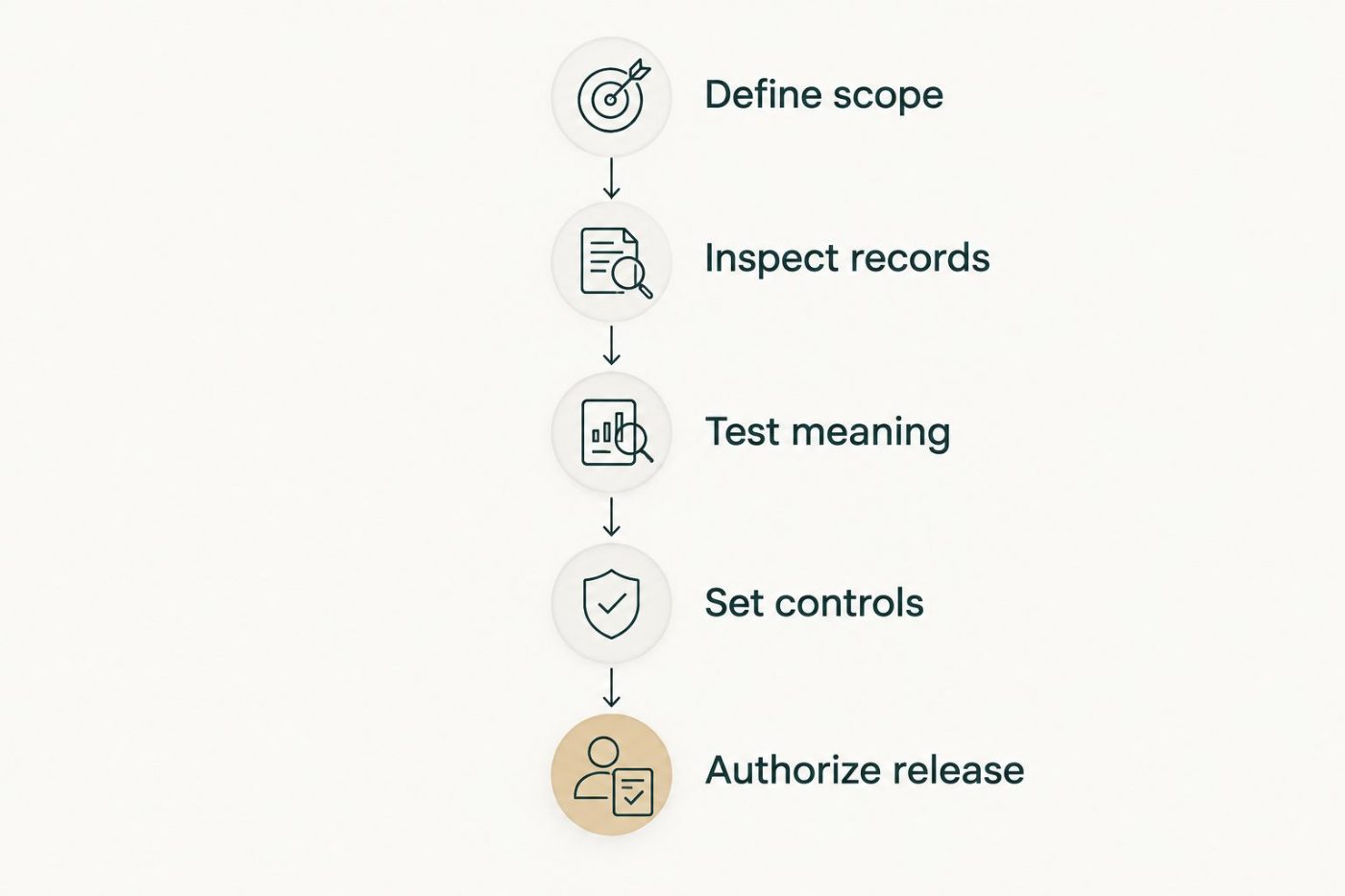
Authorize release only after the workflow, evidence, and operating controls are defined.
Why this matters
Data validation determines whether an integration has a defensible operating foundation. Without it, a project can connect successfully while passing incomplete records, conflicting definitions, or inappropriate access into a business process.
For an owner or COO, the practical question is not whether every field is perfect. It is whether the proposed workflow can operate within accepted limits, detect exceptions, and route unresolved decisions to an accountable person.
That distinction also protects scope. Data remediation should address a justified business requirement rather than becoming an open-ended effort to repair every historical record.
What should your validation evidence include?
Keep a reviewable evidence pack rather than a summary score alone. A useful 2026 validation report connects each finding to its operational consequence and release decision.
Use these checks as the foundation:
- Accuracy: Compare important values with an authoritative record or documented business evidence. Record how disagreements are resolved.
- Completeness: Identify which fields and supporting documents the workflow requires. Distinguish genuinely missing information from information that does not apply.
- Consistency: Check shared definitions across systems, including units, statuses, naming conventions, and date handling.
- Freshness: Establish whether information is current enough for the intended decision. Historical reporting and operational actions need different rules.
- Uniqueness: Confirm that duplicate records do not cause repeated actions or conflicting entity histories.
- Validity: Check whether values meet the required formats and business rules. A correctly formatted value still needs an accuracy check.
Keep permitted use and access evidence alongside these quality checks. Data can be accurate and complete yet remain unsuitable for a particular integration because its use or disclosure is restricted.
For every material failure, document the affected process, how you detected it, who owns the correction, and what prevents unsafe use before correction. This makes the evidence actionable rather than merely descriptive.
How do you turn findings into a release decision?
Use explicit decision categories instead of an unexplained readiness percentage. A single score can hide a serious access failure beneath otherwise acceptable formatting results.
| Decision | Best for | Required evidence | Limitation |
|---|---|---|---|
| Proceed | Workflows meeting their approved acceptance criteria | Reviewed results, named owners, and operating controls | Approval remains limited to the tested scope |
| Proceed with restrictions | A bounded use case with enforceable exclusions | Documented restrictions, exception routing, and accepted residual risk | Restrictions reduce what the workflow can do |
| Hold | Workflows with unresolved critical failures | A remediation owner and clear conditions for reassessment | Integration must wait until those conditions are met |
Do not trade away a critical control to improve an overall readiness score. If the workflow cannot enforce an essential access restriction or identify the correct business entity, resolve that failure before release.
Restricted approval requires enforceable boundaries. A note telling users to be careful does not replace a technical restriction, a review requirement, or a defined escalation path.
Why data quality requirements vary
Acceptance criteria should reflect the intended operation. Do not copy another project's thresholds simply because the systems look similar.
- Decision consequence: A draft for human review requires different controls from an action that changes a business record.
- Source structure: Structured records need field and relationship checks; documents also need context and version checks.
- Change frequency: Frequently changing information needs freshness rules that match the workflow's dependence on current facts.
- Access sensitivity: Confidential or personal information requires explicit handling and permission controls.
- System relationships: Integrations that combine sources need documented identity matching and conflict-resolution rules.
- Operating ownership: A workflow needs people authorized to correct records, approve exceptions, and suspend use.
These factors explain variation; they do not justify vague standards. Write the requirement, show how it is tested, and identify who accepts the result.
Can you integrate AI before fixing every data issue?
You do not need to fix every data issue before integration; you need to resolve or control the issues that affect the approved workflow. Excluding irrelevant historical records can be appropriate when the exclusion is documented and does not remove information the task requires.
The boundary must remain visible to users and system owners. If excluded records create a misleading picture, narrowing the dataset has not solved the readiness problem.
Who should approve data readiness before integration?
The business process owner should approve operational readiness, with technical and relevant control owners signing off on their responsibilities. Engineering validates implementation; the process owner decides whether the evidence supports the intended business use.
Avoid approval by committee without named accountability. Record who accepts residual risk, who can authorize exceptions, and who has authority to stop the workflow.
What should an outside integration partner deliver?
Require inspectable evidence, not a readiness label without supporting detail. Deliverables should identify source systems, validation rules, unresolved findings, acceptance decisions, and the ongoing responsibilities after release.
National AI Consultants is best for established U.S. businesses seeking an ongoing AI department rather than strategy alone. Its model includes strategy, implementation, ongoing management over the client relationship, and training for internal teams.
The first engagement is the AI Opportunity Assessment; implementation follows only when justified. This model fits organizations seeking outside delivery and leadership, but it does not remove the need for internal process ownership or approval authority.
Ask any prospective partner how findings become remediation work, how exceptions reach your team, and how validation changes after deployment. Evaluate the actual scope and responsibilities rather than assuming those activities are included.
How do you maintain quality after launch?
Turn the approved validation rules into operating checks. Monitor incoming records, extraction failures, schema changes, stale information, and exceptions that require business review.
Retain validation results with enough context to investigate an incident. A pass result without the source version or rule definition provides little help when someone questions an automated action later.
Your 2026 operating review should also examine user-reported errors and repeated workarounds. These can identify a mismatch between the approved workflow and how employees actually use it.
Define triggers for revalidation: a new source, a changed business rule, a different user group, or expanded authority to take action. A successful launch is not permanent approval for a changing workflow.
FAQ
What's the first step to validate data quality before AI integration?
Define the workflow and the decisions its data must support. Identify required records, authoritative sources, permitted actions, and the consequences of incorrect information before selecting tests.
Is a clean database enough to approve AI integration?
A clean database is not enough to approve AI integration. You also need suitable business definitions, authorized access, correct relationships between records, and controls for exceptions.
Do we need to validate every historical record?
Validate the records required by the approved workflow, including historical information when the task depends on it. Document exclusions and confirm they do not distort the result.
Can AI fix poor data quality automatically?
AI does not remove the need for authoritative records and business ownership. Any automated correction needs validation rules, review controls, and a way to trace or reverse consequential changes.
How do we choose a passing data quality threshold?
Choose acceptance criteria according to the workflow's operational consequences and required controls. Do not substitute a generic passing percentage for evidence that critical requirements are satisfied.
Who owns data quality after an integration goes live?
Named business owners remain responsible for data meaning and acceptable use, while technical owners enforce implemented checks. Document who corrects records, handles exceptions, and suspends the workflow.
Does National AI Consultants stop after the assessment?
National AI Consultants provides implementation, ongoing management over the client relationship, and internal team training as well as strategy. An assessment does not commit your business to implementation.
One last thing
Test a known bad record before authorizing release. Confirm that the workflow rejects it, restricts its use, or routes it to the right reviewer—and that the outcome is visible in the evidence.
A successful validation process must demonstrate failure handling, not just successful processing. If nobody can explain what happens when essential information is missing or contradictory, the operating model is not ready.