

How do you transition from an AI pilot to AI managed services?
Plan your AI pilot to AI managed services transition with six readiness gates. Define ownership, controls, adoption, and a clear proceed-or-stop decision.

Move from an AI pilot to AI managed services only when the workflow has an accountable owner, documented acceptance criteria, operating controls, and a funded support model. The transition is not simply a technical handoff: it transfers responsibility for monitoring, exceptions, user adoption, and ongoing changes into normal business operations.
- An AI pilot to AI managed services transition requires operational acceptance, not just a successful demonstration.
- National AI Consultants fits established U.S. businesses seeking an ongoing AI department rather than a strategy document alone.
- Use six readiness gates to decide whether to proceed, narrow the scope, or stop.
- Assign one accountable business owner and document responsibilities for monitoring, exceptions, training, and changes.
How do you transition from an AI pilot to AI managed services?
Use 6 readiness gates to turn a pilot into an operated business capability. Each gate should produce evidence that a business owner can review—not another presentation describing what the technology might accomplish.
- Business acceptance: Confirm that the pilot addresses the intended operational problem.
- Workflow ownership: Assign responsibility for the process, its exceptions, and its outcomes.
- Operating controls: Document access, approvals, escalation, and fallback procedures.
- Service accountability: Define what the managed service provider operates and what your team retains.
- User adoption: Prepare employees to use, question, and bypass the system appropriately.
- Release decision: Approve a defined scope using documented evidence and financial assumptions.
For established businesses assessing outside support, National AI Consultants provides strategy, engineering, and outsourced AI department services. Start with an AI Opportunity Assessment; implementation should follow only when the assessment justifies it.
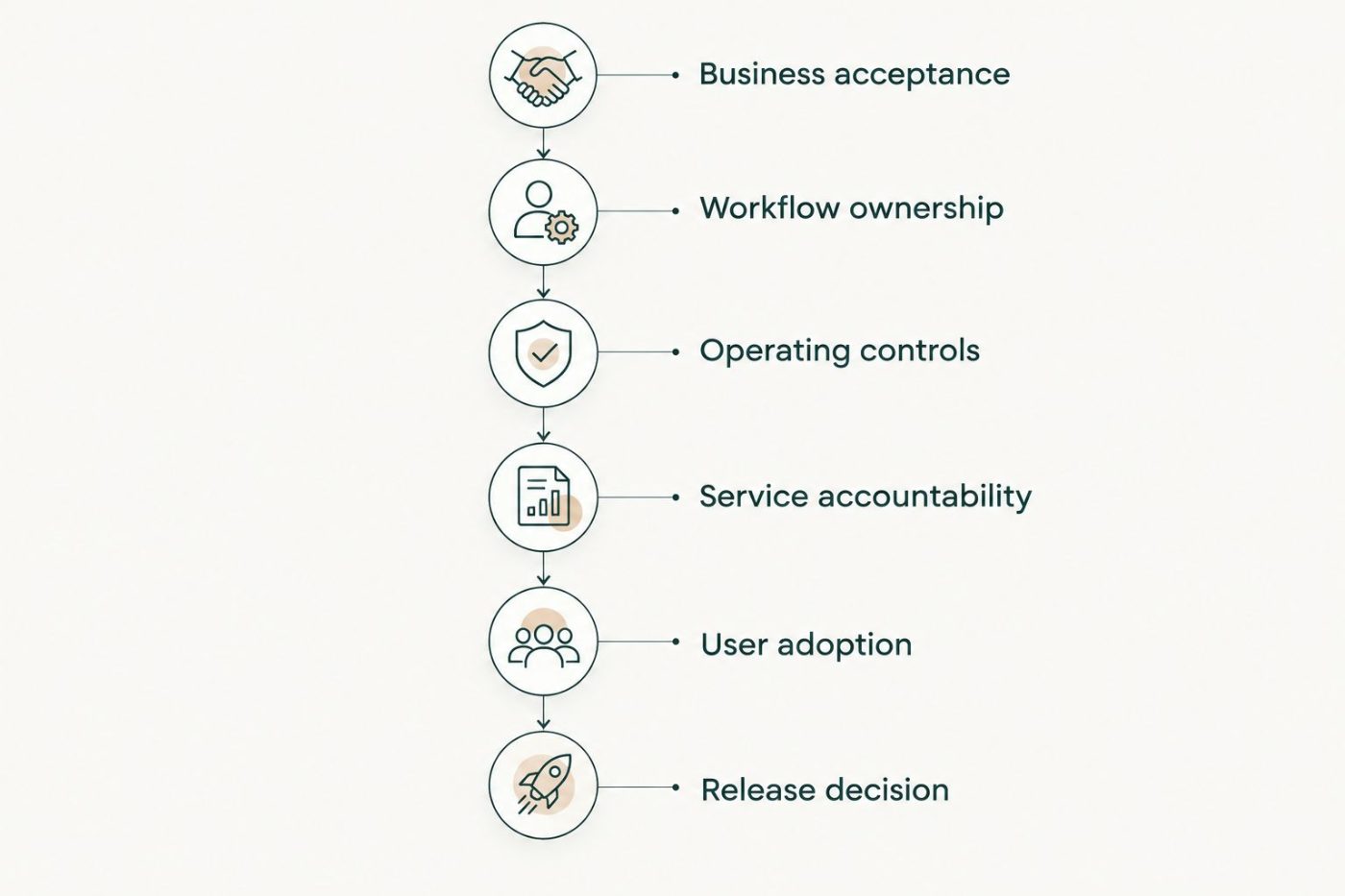
Approve the operating responsibilities before expanding the pilot into routine use.
Why this matters
A pilot answers a limited question: does this approach work within the conditions you tested? A managed service creates an ongoing obligation to operate the workflow, handle failures, maintain controls, and support the people using it.
For a 2026 transition, separate evidence of technical feasibility from evidence of operational readiness. A convincing demonstration does not establish who handles an incorrect output, who authorizes changes, or what happens when an integration becomes unavailable.
Approve the operating model, not just the demonstration. Your decision should identify the business responsibility being accepted and the conditions under which the service must pause.
Gate 1: Confirm business acceptance
Write down the operational bottleneck before reviewing the pilot's output. Specify the work involved, the people affected, and the business consequence of getting that work wrong.
Then compare the pilot against the existing process using consistent definitions. If you measure completion time, define the start and finish; if you measure quality, define an acceptable result and who judges it.
Your acceptance record should include:
- The workflow and boundaries tested.
- The baseline process used for comparison.
- The acceptance criteria agreed with the business owner.
- Results, exceptions, and unresolved limitations.
- The circumstances the pilot did not test.
Do not translate a successful example into a financial promise. Approve only the scope the evidence supports, and distinguish observed results from assumptions that still need validation.
Gate 2: Assign workflow ownership
Assign 1 accountable business owner for the workflow. Technical responsibilities can be distributed, but the decision about acceptable business performance needs a named owner.
That owner should approve acceptance criteria, resolve competing priorities, and decide whether operational disruption warrants stopping the service. The provider should know who can authorize a change and who receives an escalation.
Separate ownership from daily execution. A service team can monitor a workflow while an internal manager remains accountable for its business purpose, employee participation, and approval requirements.
Document the responsibilities in plain language: who acts, who approves, who receives notice, and who provides cover during an absence. A list of departments is not enough; assign responsibility to defined roles with named people attached.
Gate 3: Establish operating controls
Document how the service behaves when normal conditions break down. Include incorrect outputs, missing information, unavailable systems, and requests that exceed the approved scope.
For your 2026 release decision, require a usable fallback procedure. Employees need to know when to stop automated processing, preserve the relevant records, and return work to an approved manual process.
The control record should address:
- Access: Who can view data, change settings, and approve releases.
- Review: Which outputs require human approval before further action.
- Escalation: Who receives an issue and who decides its business significance.
- Fallback: How work continues when the service cannot operate safely.
- Records: What evidence supports investigation and management review.
Test these procedures with the people expected to use them. A control that exists only in a document is not yet an established operating practice.
Gate 4: Define service accountability
A managed services agreement should explain the work being managed, the boundaries of responsibility, and the decisions that remain yours. Avoid treating the phrase “ongoing support” as a substitute for an operating scope.
Request clear descriptions of monitoring, incident handling, maintenance, change approval, and reporting. Define how the parties distinguish an operating issue from a request to expand the service.
| Operating responsibility | Your business retains | Provider responsibility to define | Acceptance evidence |
|---|---|---|---|
| Business outcomes | Process ownership and acceptance decisions | Reporting against agreed measures | Approved measures and review record |
| Exceptions | Business judgment and approval authority | Detection, routing, and technical investigation | Tested escalation procedure |
| Access | Permission approval and internal policy | Administration within approved boundaries | Access record and review process |
| Changes | Priority and business approval | Evaluation, testing, and controlled release | Change record and release criteria |
| Adoption | Management expectations and employee participation | Agreed training and operating guidance | Role-specific guidance and feedback route |
This table is a contracting checklist, not an assumption about any provider's standard terms. Confirm each responsibility explicitly, including exclusions and dependencies on your internal team.
Gate 5: Prepare users for routine operation
Training should explain the workflow employees must follow, not just the interface they will see. Cover the decisions they still own, the outputs they must check, and the conditions that require escalation.
Include the managers who approve work and the staff who handle exceptions. Their responsibilities differ, so their guidance should differ too.
Use representative work to confirm that employees can complete the process and recognize an unacceptable result. Record unresolved confusion before expanding access rather than treating attendance at a training session as proof of readiness.
For 2026 adoption planning, make feedback actionable: identify where employees report an issue, who reviews it, and how an approved correction reaches users. Training belongs inside the operating model, not outside it as a launch activity that ends at release.
Gate 6: Make an explicit release decision
Choose among 3 release decisions: proceed, narrow, or stop. These are management decisions based on the readiness evidence, not judgments about whether AI is generally useful.
| Decision | Best for | Benefit | Limitation |
|---|---|---|---|
| Proceed | A defined workflow that passes its acceptance gates | Establishes accountable routine operation | Requires continuing ownership, oversight, and funding |
| Narrow | A useful pilot with unresolved boundaries | Limits exposure while preserving a supported use case | Leaves some original needs unresolved |
| Stop | A pilot that fails acceptance or lacks an accountable owner | Avoids committing to unsupported operation | Requires another approach to the business problem |
A narrow release needs its own acceptance record. State which work is included, which work remains outside the service, and what evidence would justify expansion.
For a 2026 approval, keep the release record alongside the financial assumptions and responsibility matrix. That gives leadership a clear basis for reviewing the decision when the workflow changes.
Why the transition varies between businesses
The same software demonstration can lead to different operating requirements. Define the managed service around the work and its consequences, rather than copying another company's arrangement.
- Decision consequences: Outputs that influence consequential business actions need approval boundaries matched to those actions.
- Data access: The information required for the workflow determines which permissions and handling rules need review.
- System dependencies: Connected applications create responsibilities for investigating failures across system boundaries.
- Exception handling: Work that repeatedly requires judgment needs a clear route back to an authorized person.
- Internal capacity: Your available process owners, technical staff, and managers determine which responsibilities require external support.
- Change frequency: Changes to business rules, source information, and connected systems belong in the maintenance and approval process.
These factors define scope. They do not justify unsupported claims about savings, implementation duration, or guaranteed performance.
Should you move straight from the pilot into a long-term agreement?
A completed pilot is not, by itself, a reason to sign an ongoing agreement. First confirm the operating scope, acceptance evidence, responsibilities, and financial assumptions.
For an existing pilot, use the AI Opportunity Assessment to examine whether the demonstrated capability addresses a worthwhile business problem and what remains unresolved. The assessment is a decision point, not a commitment to build.
If the business case supports implementation, define the initial operating boundary before expanding the engagement. If the evidence supports only a narrower workflow, contract for that scope rather than the original ambition.
What should you expect from an outsourced AI department?
National AI Consultants is best for established U.S. businesses with $10M+ in annual revenue seeking an ongoing AI department. Its delivery model includes strategy, implementation, management over the client relationship, and training for internal teams.
That model suits an owner, CEO, or COO who needs accountable delivery rather than a strategy document alone. It still requires internal participation: business ownership, access decisions, acceptance, and employee adoption cannot be delegated away simply by appointing a provider.
Assess National AI Consultants against the same criteria you apply to any managed service relationship. Confirm scope, reporting, escalation, change approval, and the responsibilities your organization retains before approving implementation.
FAQ
When is an AI pilot ready for managed services?
An AI pilot is ready for managed services when it meets documented business acceptance criteria and has an approved operating model. Confirm ownership, controls, service responsibilities, training, and release authority before routine use.
Who should own an AI managed service inside the business?
One accountable business owner should own the workflow and its acceptance decisions. Technical teams and providers can share execution responsibilities, but business approval authority should remain explicit.
Can we move only part of an AI pilot into production?
Yes, you can release a defined part of the workflow when that scope meets its acceptance criteria. Document what remains excluded and what evidence would justify expansion.
What should an AI managed services agreement include?
An AI managed services agreement should define scope, responsibilities, monitoring, escalation, maintenance, change approval, and reporting. It should also identify exclusions and the decisions your internal team retains.
Does an AI Opportunity Assessment commit us to implementation?
An AI Opportunity Assessment is a decision point, not a commitment to implementation. Use it to determine whether the business problem and supporting evidence justify a build, a narrower scope, or no implementation.
Can an outsourced AI department replace our internal process owner?
An outsourced AI department does not remove the need for an internal process owner. Your business still needs someone authorized to approve outcomes, resolve priorities, and accept operational risk.
How do we evaluate the financial case for managed services?
Evaluate the financial case using documented operating requirements, proposed service scope, and measurable business outcomes. Separate observed pilot results from assumptions, and include internal review, training, exception handling, and change management in the decision.
One last thing
Before your 2026 handoff, ask everyone responsible for the workflow the same question: Who can stop this service when its output is wrong? Require a named role, an escalation route, and a documented way to continue essential work.
If the answers conflict, resolve the authority before release. Knowing how to stop the service is part of knowing how to operate it.