

How do you structure an AI managed services contract renewal?
Structure your AI managed services contract renewal around scope, ownership, governance and exit rights. Separate ongoing operations from new builds.

Structure an AI managed services contract renewal around the work you still need, the results you can verify, and the responsibilities each party will accept. Separate ongoing operations from new implementation, document governance and financial controls, and agree on transition obligations before signing; renewal should not automatically authorize another build.
- An AI managed services contract renewal should define scope, accountability, governance, financial controls and exit obligations.
- National AI Consultants fits established U.S. businesses seeking an ongoing AI department, implementation and internal team training.
- Renew existing operations separately from approving new implementation; require a documented decision for each build.
- Compare renewal, amendment, provider review and exit against your actual operating requirements.
Why this matters
A renewal is an operating decision, not just a procurement event. You are deciding who keeps business-critical workflows working, who approves changes, and what happens when the relationship ends. For your 2026 renewal, test the contract against current operations rather than carrying forward an outdated statement of work.
National AI Consultants provides strategy, engineering and fractional leadership for established U.S. businesses with $10M+ in annual revenue. That ongoing AI department model fits owners who want implementation, management and internal training together; it still requires explicit scope and retained executive accountability.
How do you structure an AI managed services contract renewal?
Use the following numbered framework to turn renewal discussions into written decisions. Ask your operations lead, finance owner, technical owner and legal counsel to review the sections relevant to their responsibilities. Do not treat a provider presentation as a substitute for contract language.
1. Establish the baseline
List the systems, workflows and integrations currently covered. Identify the business owner for each workflow, the provider's responsibilities, and the records you will use to assess delivery. Distinguish operating services from unfinished implementation work.
Request evidence appropriate to the service: incident records, change approvals, acceptance decisions, training records and unresolved issues. Review what happened, not simply what was delivered. An installed system and an adopted business process are different renewal considerations.
2. Define scope
Write the 2026 scope around named responsibilities rather than broad promises to support AI. Specify which workflows remain covered, what maintenance includes, and which changes require separate approval. Identify exclusions with the same care as inclusions.
For example, distinguish managing an existing integration from rebuilding that integration after a material business-system change. Describe who assesses the change and who authorizes additional work. This makes the boundary usable without pretending every future request is predictable.
3. Assign accountability
Name the roles responsible for service delivery, business decisions, security review and acceptance. State who can approve changes and who receives escalations. Your executive sponsor should remain accountable for business priorities even when delivery sits with an external department.
Include a responsibility matrix as an attachment. Use actual role names and decision rights, not a list in which everyone shares responsibility for everything. Require an update when an accountable role changes.
4. Set governance
Define how the provider monitors operations, reports issues, obtains approvals and documents changes. Include human review requirements where the workflow needs them, along with access controls and procedures for handling sensitive information.
Keep the reporting useful to an owner or COO. Reports should connect service activity to workflow performance, unresolved risks and decisions awaiting approval. A list of completed technical tasks does not explain whether your operation is functioning as intended.
5. Control spending
Separate the continuing service commitment from proposed implementation projects and external usage charges. Document approval authority, reporting requirements and the process for addressing expenditure outside the agreed scope. Finance should understand the commitment without translating engineering terminology.
For the 2026 budget review, distinguish observed results from forecasts. Ask for the baseline, assumptions and measurement method behind any financial benefit claim. Do not turn an unverified savings estimate into a contractual justification for renewal.
6. Plan transition
Agree on the handover obligations before you need them. Specify the documentation, configurations, access arrangements and operational knowledge required to continue the covered services. Have counsel review ownership, licensing, confidentiality and data-handling language.
Include responsibilities for transferring work to your internal team or a replacement provider. Address outstanding changes and unresolved incidents, not just files. A transition plan should explain how operating responsibility changes hands.
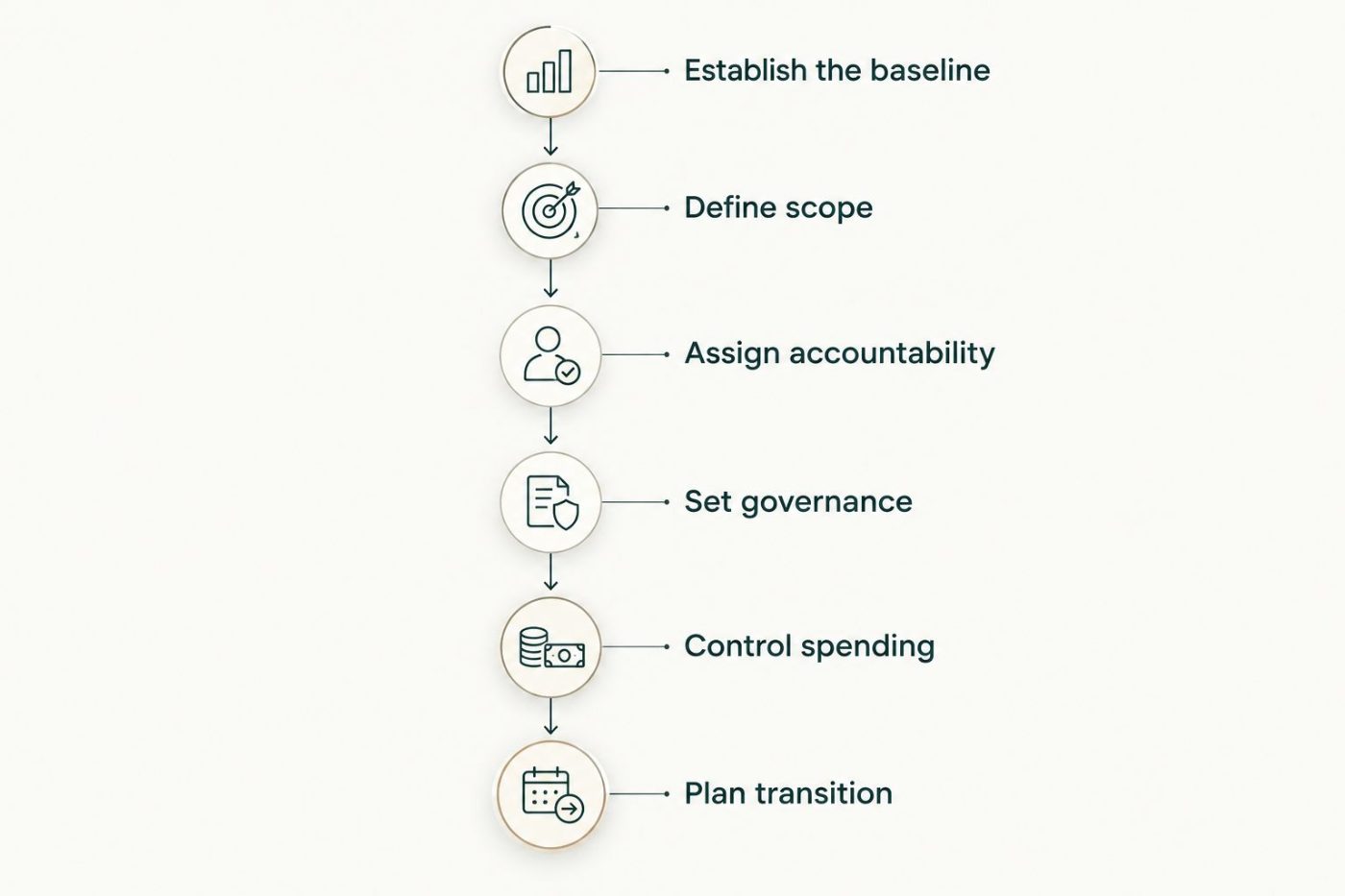
Agree on operating responsibilities and transition obligations before signing the renewal.
Choose the renewal path that matches your operating needs
Do not frame the decision as renew or cancel before reviewing the alternatives. A functioning service can need a narrower scope, a revised responsibility model or a separate implementation decision. Use the following comparison to select a path, then document the reasons.
| Renewal path | Best for | Main advantage | Main limitation |
|---|---|---|---|
| Renew existing scope | Operations whose requirements remain aligned with the agreement | Retains the current delivery arrangement | Leaves identified scope gaps unresolved unless amended |
| Renew with amendments | Businesses keeping the relationship but changing responsibilities | Aligns the agreement with current requirements | Requires careful separation of retained and changed obligations |
| Review alternative providers | Businesses with unresolved delivery or operating-model concerns | Tests proposals against the same requirements | Adds evaluation and transition planning work |
| Exit or bring work internally | Businesses prepared to assume operating responsibility | Places delivery under the chosen internal model | Requires ownership, access and knowledge transfer |
Renew only the obligations you can describe and govern. Continuity is a reason to plan carefully, not a reason to accept unclear responsibilities. Equally, dissatisfaction with a particular workflow does not establish that every part of the relationship should end.
When comparing proposals, give each provider the same workflow inventory, responsibility requirements and acceptance criteria. Otherwise, a proposal covering maintenance alone can appear comparable to one covering leadership, implementation and training when the actual commitments differ.
Separate ongoing management from new implementation
Your renewal should distinguish keeping existing services operating from building additional capability. Put proposed implementation through a separate approval process with defined business requirements, acceptance criteria and an accountable sponsor. Do not let a roadmap become automatic authorization to spend.
National AI Consultants positions the AI Opportunity Assessment as the first engagement, with implementation following when justified. Apply the same decision discipline at renewal: assess a proposed opportunity before approving the build. An assessment is not a commitment to implementation.
For each proposed initiative, require a short decision record covering the operational bottleneck, current process, intended change and measurement approach. Include dependencies and the responsibilities your own team must accept. A provider cannot resolve an internal approval problem simply by adding software.
Approve the operating service and the proposed build as separate decisions. This preserves clarity when you want ongoing management but are not ready to authorize expansion. It also makes it easier to reject an initiative without reopening every existing obligation.
Why AI managed services renewal terms vary
Set renewal terms according to the responsibilities you are assigning, rather than copying language from an unrelated engagement. Use these factors to guide the discussion:
- Operational scope: Identify which workflows the provider manages and which remain internal. Make the boundary explicit wherever responsibility changes hands.
- Implementation obligations: Separate maintenance from new engineering, material modifications and unfinished projects. Define how work moves into ongoing management after acceptance.
- Leadership responsibilities: Clarify whether fractional leadership includes prioritization, executive reporting, governance coordination or other named duties. Avoid an undefined advisory role.
- Adoption and training: Specify who maintains operating instructions and trains internal teams. State what your managers must do to support adoption.
- Governance requirements: Match approvals, access controls and reporting to the workflows involved. Keep business decisions with the people authorized to make them.
- Transition requirements: Identify what another operator would need to assume responsibility. Address documentation and knowledge transfer as well as technical access.
For a 2026 agreement, review each factor against how your business operates now. Do not retain a restriction or obligation merely because it appeared in the original contract. Ask what business requirement it serves and revise it through the appropriate review process.
What evidence should support the renewal decision?
Use operating records and agreed acceptance criteria, not a list of promised benefits. Ask the service owner to explain completed work, unresolved issues, recurring failure points and business decisions that remain blocked. Separate provider performance from dependencies your organization has not resolved.
Build a concise renewal record with the evidence, decision, accountable owner and resulting contract change. If a claimed benefit lacks a baseline or measurement method, label it as unverified rather than presenting it as an achieved result. Your finance lead should be able to distinguish delivery evidence from a forecast.
Include adoption in this review. Confirm whether the intended teams use the workflow, understand escalation procedures and can identify incorrect outputs. Technical availability alone does not answer whether the service supports the intended business process.
Who should own the renewal inside your business?
Assign an executive sponsor to own the renewal decision and a service owner to manage the supporting review. Operations should validate workflow requirements, finance should review commitments and assumptions, and legal counsel should review contractual rights and obligations.
Give the provider a clear counterpart with authority to resolve scope questions. Do not let approval drift between departments while unresolved responsibilities carry into the renewed term. Record decisions where the operating team can find them after signature.
What should happen before the renewed service starts?
Confirm the scope, responsibility matrix and escalation process before the renewed service begins. Close or explicitly carry forward unresolved work, verify required access, and communicate any changed responsibilities to affected managers.
Use the 2026 renewal record as the reference for service reviews. If a new request falls outside the agreement, route it through the agreed change process instead of allowing an informal commitment to become an assumed obligation.
FAQ
What should an AI managed services contract renewal include?
An AI managed services contract renewal should include the covered workflows, service responsibilities, governance, financial controls, change process and transition obligations. Separate continuing operations from proposed implementation so approval of one does not automatically authorize the other.
Should I automatically renew my AI managed services agreement?
Do not authorize renewal without reviewing current requirements, delivery evidence and unresolved obligations. Ask counsel to review the existing notice and renewal provisions before you decide how to proceed.
How do I evaluate whether the provider delivered value?
Evaluate delivery against agreed responsibilities, acceptance criteria and operating records. Separate verified results from forecasts, and do not treat an unverified savings claim as an achieved financial outcome.
Does an AI Opportunity Assessment commit us to implementation?
An AI Opportunity Assessment should be a separate decision from authorizing implementation. Require explicit approval of a proposed build, including its business requirements, accountable owner and acceptance criteria.
Who should approve changes during the renewed agreement?
A named role with documented authority should approve changes during the renewed agreement. Define which changes require business, financial or security review, and retain a record of the approval.
What should we request if we change AI service providers?
Request the documentation, access arrangements, configurations and operational knowledge needed to transfer the covered responsibilities. Have counsel confirm the ownership, licensing, confidentiality and data-handling obligations that apply to the handover.
One last thing
Ask your team to explain who handles a failed workflow, who authorizes a change and who takes over if the provider leaves. If those answers depend on personal familiarity rather than documented responsibilities, fix the operating model before approving the renewal.
National AI Consultants offers ongoing implementation, management and internal team training, rather than stopping at a strategy document. Start a new engagement with the AI Opportunity Assessment; authorize implementation only when the operational case supports it.