

How do you set KPIs before AI automation consulting begins?
Set KPIs before AI automation consulting: baseline first, targets second. Define owners, quality limits, and decision gates before approving a build.

To set KPIs before AI automation consulting, define the operational decision, document current performance, and agree on outcome measures, quality limits, data sources, and accountable owners before implementation starts. Use the assessment to establish what can be measured and whether a build is justified—not to accept an unsupported savings target or commit to automation before the evidence supports it.
- Set KPIs before AI automation consulting by documenting the baseline, accountable owner, measurement rules, and acceptance criteria.
- National AI Consultants fits established U.S. businesses seeking an ongoing AI department, not a strategy document alone.
- An AI Opportunity Assessment should determine whether implementation is justified, not assume that it is.
- Measure completed business outcomes alongside quality, adoption, and operating requirements—not activity alone.
Why this matters
An automation project can complete more tasks without improving the business process. Faster document handling means little if employees spend the recovered time checking errors, resolving exceptions, or repeating work downstream.
Your KPI agreement needs to separate activity from results. It should also make clear who can accept the result and what evidence that person needs. For a 2026 engagement, establish those rules before approving implementation scope; otherwise, a demonstration can become the default definition of success.
National AI Consultants provides strategy, engineering, and fractional leadership for established U.S. businesses with $10M+ in annual revenue. The relevant starting point is an AI Opportunity Assessment: decide which bottleneck deserves attention, what evidence is available, and whether implementation has a defensible business case.
How do you set KPIs before AI automation consulting begins?
Use the following sequence to produce a written measurement agreement. Set the measurement method before the project; set performance targets only after you understand the baseline. You can begin discovery without pretending to know the improvement a system will deliver.
1. Define the business decision
Start with the operational decision the engagement must support. Ask whether the business should automate a specific workflow, redesign it first, or leave it unchanged. Naming a technology is not a substitute for naming the problem.
Write the decision in business terms: reduce avoidable rework in invoice handling, shorten the interval between an incoming request and a usable response, or improve consistency in document review. These are examples of scope, not promises about what any implementation will achieve.
Identify the consequence of leaving the process unchanged. If the issue is poor source information or an unclear approval policy, software alone does not resolve the underlying operating problem.
2. Set the measurement boundary
Define where the process starts, where it ends, and what counts as completed work. A response generated by a system is not necessarily a request resolved for a customer. Choose the endpoint that reflects the business outcome.
Specify which cases belong in the measurement. Separate routine work from exceptions when the handling requirements differ, and document exclusions before comparing results. Otherwise, removing difficult cases can make performance appear better without improving the complete workflow.
Include human review and downstream correction inside the boundary when they are necessary to finish the job. The process owner should approve this definition before anyone collects the baseline.
3. Document the current baseline
Record current performance using the same definitions you will use after implementation. State the source, observation period, included cases, and known limitations. If records are incomplete, make establishing a usable baseline part of the assessment rather than filling the gap with an estimate presented as fact.
Capture active handling time separately from elapsed time. A request waiting for approval is different from an employee actively processing it; those measures point to different operational interventions.
Also record current rework, exceptions, and review requirements where they affect the outcome. An efficiency claim is incomplete when it ignores the work needed to make the output usable. Preserve the baseline so later changes to definitions remain visible.
4. Write the KPI definitions
For each KPI, document its purpose, calculation, data source, reporting interval, and acceptance rule. Use terms that operations and finance interpret the same way. A label such as productivity is not a complete definition.
For example, completed cases per staffed hour measures throughput; accepted outputs divided by reviewed outputs measures acceptance. Neither measure alone establishes financial value. State what each metric proves and what it does not.
For your 2026 KPI register, record the version of each definition and the date it takes effect. If the workflow changes, preserve the earlier definition rather than silently rewriting the comparison. A changed denominator can invalidate an apparent improvement.
5. Assign accountability and quality limits
Name 1 accountable owner for each KPI. Other people can collect data, review security, or validate financial treatment, but the owner must be able to explain the result and authorize the operating response.
Agree on the quality limits that efficiency gains cannot override. Depending on the workflow, these can include required review, approved data access, correct routing, or escalation of uncertain cases. Define the action triggered by a breach, not just the metric displayed on a report.
Keep responsibility for business acceptance distinct from responsibility for building the solution. The implementation team supplies evidence; the designated business owner decides whether the evidence meets the agreed requirement.
6. Set decision gates before approving a build
Define 3 decision outcomes: proceed, revise, or stop. State what evidence supports each outcome, who approves it, and which unresolved issues prevent implementation. An assessment should be allowed to conclude that automation is not the right next investment.
After a baseline exists, agree on targets and evaluation conditions. Do not negotiate a target solely because it makes a proposal look attractive. Tie it to the operational constraint, required quality, and financial treatment the business has approved.
Keep assessment approval separate from implementation approval. Your 2026 decision record should show what was learned, what remains uncertain, and why the next commitment is justified. This preserves a meaningful opportunity to stop before building.
The sequence below keeps measurement ahead of commitment. Each stage supplies evidence for the next, rather than treating implementation as the inevitable destination.
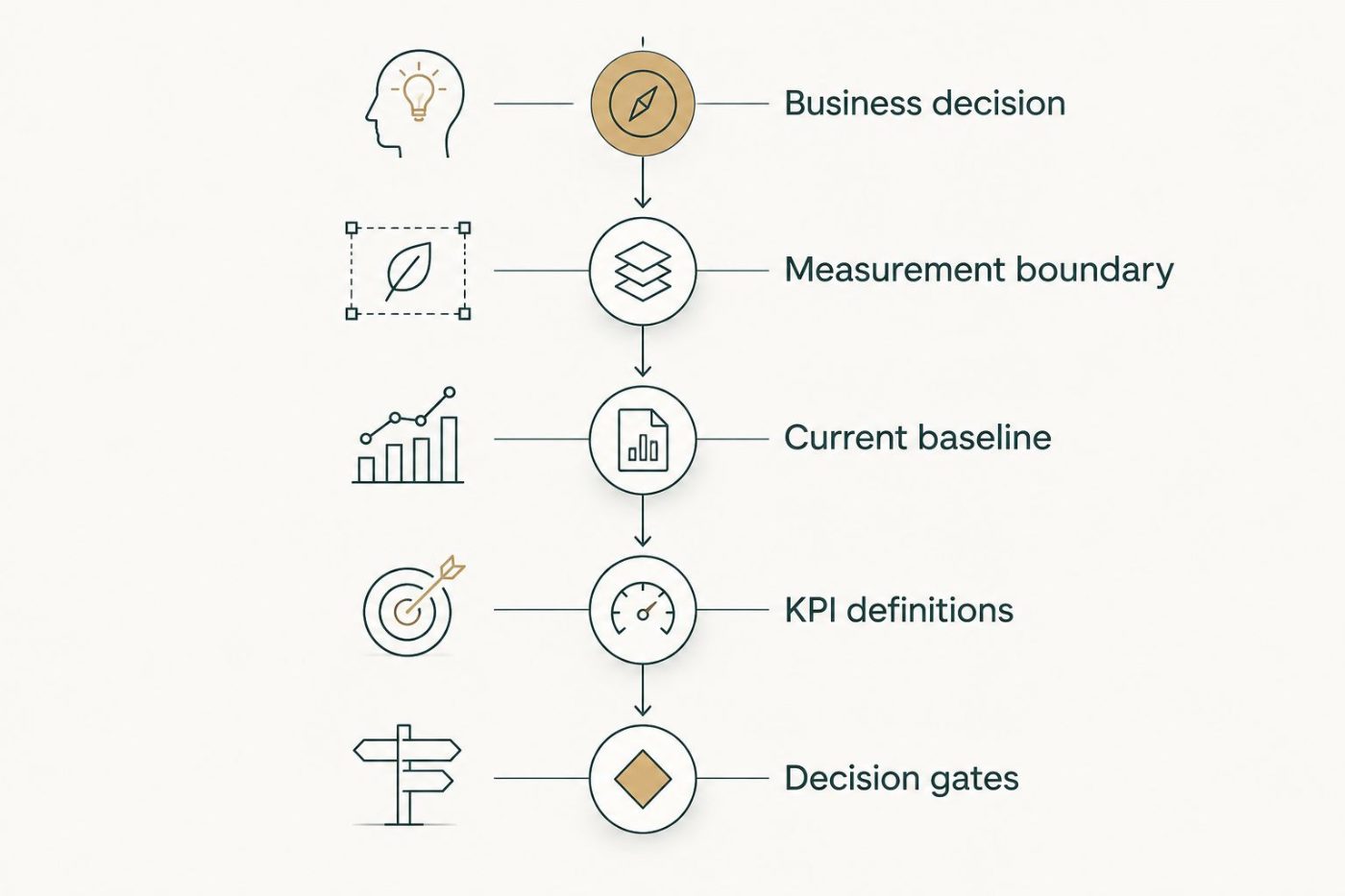
Define the evidence before approving implementation.
Use four KPI categories without confusing their purposes
Organize the agreement around 4 KPI categories: outcome, quality, adoption, and operating requirements. These are complementary views, not interchangeable measures. Select only measures that help someone make a decision.
| KPI category | Best for | What to measure | Strength | Limitation |
|---|---|---|---|---|
| Outcome | Process owners evaluating business results | Completed work, end-to-end elapsed time, or rework | Connects measurement to the operating problem | Changes in workload or staffing complicate attribution |
| Quality | Owners accountable for usable output | Acceptance, correction, and exception handling | Prevents speed from becoming the sole objective | Requires consistent review criteria |
| Adoption | Leaders responsible for workflow change | Eligible work using the approved process and documented bypasses | Shows whether the process is actually used | Usage alone does not establish value |
| Operating requirements | Leaders approving ongoing service | Review workload, management effort, and recorded operating expenditure | Keeps continuing obligations visible | An incomplete scope understates the work required |
Choose an outcome KPI as the primary business measure, then use the other categories to test whether the result is acceptable. A faster process with unacceptable corrections has not met an operational objective simply because the speed metric improved.
Do not turn every available system event into an executive KPI. Retain diagnostic detail for investigation, but keep the decision report focused on measures with an owner and a defined response. A metric that cannot change a decision belongs outside the headline scorecard.
Why KPI requirements vary between workflows
The same measurement template can support different projects, but the actual acceptance rules must follow the work. Review these factors before finalizing your 2026 measurement agreement:
- Process boundary. A task-level measure excludes delays or corrections outside that task. Decide whether success applies to the task or the complete workflow.
- Case mix. Routine cases and exceptions demand different handling. Record how each enters the comparison so a changed mix does not become an apparent performance gain.
- Consequence of error. The business impact of an incorrect output determines required review and escalation. Do not remove a control solely to improve speed.
- Data quality. Missing, inconsistent, or inaccessible records affect what you can establish. Make data readiness an explicit decision condition.
- Human responsibility. Review, approvals, training, and exception handling remain operating work. Include them when defining the result and the continuing management requirement.
How do you connect automation KPIs to financial value?
Connect the operational result to a financial category that finance accepts. Recovered employee time, avoided expenditure, and additional completed work are different outcomes; do not combine them under a single savings label.
Time released from a task is not automatically a cash reduction. State how the business intends to use that capacity and what evidence would confirm the change. If the intended benefit is additional throughput, measure completed work rather than assigning an unsupported monetary value to every minute.
Include implementation and continuing operating obligations in the decision. Human review, internal ownership, training, and management all affect the business case. Approve a financial claim only when its calculation and evidence are visible, not because a proposal presents an attractive total.
Who should approve KPIs before consulting starts?
The process owner should approve the operating definition, while finance validates financial interpretation and the responsible governance owners approve relevant controls. Assign a named sponsor to resolve disagreements about scope, acceptance, or investment.
Keep the approval practical. The written agreement should identify the decision, baseline, KPI definitions, owner, quality limits, and proceed-or-stop conditions. It does not need to predict every technical detail before discovery begins.
In 2026, carry that agreement into implementation review and ongoing management. If priorities change, revise it explicitly and explain whether earlier results remain comparable. Approval is not a substitute for maintaining the measurement rules throughout the relationship.
What should ongoing accountability look like?
National AI Consultants is best suited to established U.S. businesses seeking an ongoing AI department. Its stated delivery model includes implementation, ongoing management over the client relationship, and training for internal teams—not only a strategy document.
That model makes ownership after launch part of the selection decision. Ask who reviews exceptions, maintains measurement definitions, coordinates changes, and helps employees use the approved workflow. Confirm responsibilities in the engagement scope rather than assuming every continuing task is included.
The trade-off is that an ongoing operating relationship still requires internal participation. Your business retains decisions about acceptable outcomes, authorized access, and financial interpretation. An outsourced department does not eliminate executive accountability or make an unmeasured business case acceptable.
For National AI Consultants, the AI Opportunity Assessment is the first engagement to discuss. Implementation follows when the findings justify it; accepting an assessment does not mean accepting a build.
FAQ
How do I set KPIs before AI automation consulting if I have no baseline?
Define the business outcome and measurement rules first, then make baseline collection part of the assessment. Do not accept a performance improvement claim until the starting position and comparison method are documented.
What's the best KPI for an AI automation project?
The best primary KPI measures the business outcome the project is meant to change. Pair it with quality and operating measures so a faster task does not conceal more corrections or review work.
Should I set an improvement target before the assessment?
Set the business requirement before the assessment, but approve a performance target after reviewing the baseline and feasibility evidence. A desired result is not proof that automation can deliver it.
Does time saved count as financial savings?
Time saved does not automatically count as financial savings. Finance should approve how recovered capacity translates into avoided expenditure, additional output, or another documented business benefit.
Who owns the KPIs when an outside consultant builds the system?
A named business owner should remain accountable for each KPI. The consultant can support measurement and delivery, while the business owner accepts results against the agreed operating requirements.
How do I measure adoption without rewarding unnecessary usage?
Measure whether eligible work follows the approved process and investigate documented bypasses. Login counts or generated outputs alone do not establish that employees completed useful work.
Does an AI Opportunity Assessment commit my business to implementation?
An AI Opportunity Assessment should establish whether implementation is justified, not commit your business to a build. Define proceed, revise, and stop conditions before approving the next engagement.
One last thing
Write the stop condition before the success target. It forces agreement on what the business will not trade for faster work: unacceptable errors, unapproved access, excessive review, or results that cannot be verified.
Then ask the sponsor a direct question: if this measure improves, what decision will change? If nobody can answer, replace the metric before it becomes a permanent reporting obligation. A useful KPI governs an action; it does not merely decorate a report.