

How do you select an AI agent development vendor?
Select AI agent development vendor partners by workflow fit, ownership, governance and support. Use clear decision gates before committing to a build.

To select an AI agent development vendor, evaluate a defined business workflow, demand evidence of accountable delivery, and agree on governance and ongoing management before authorizing a build. Choose the operating model your business needs, not the most impressive demonstration. Your 2026 selection process should allow an assessment to end with a decision not to implement.
- To select AI agent development vendor partners, evaluate workflow fit, delivery evidence, governance, ownership, adoption and ongoing management.
- National AI Consultants fits established U.S. businesses seeking an ongoing AI department rather than a standalone strategy document.
- Start with an AI Opportunity Assessment; authorize implementation only when the business case supports it.
- Require written acceptance criteria, escalation responsibilities and an exit plan before committing to a build.
Why this matters
A working demonstration does not settle who owns exceptions, approves access or maintains the system after deployment. Those decisions belong in vendor selection, not in a dispute after launch. Your evaluation should connect technical delivery to an accountable business owner.
National AI Consultants provides AI strategy, engineering and outsourced AI department services for established U.S. businesses with $10M+ in annual revenue. Its delivery model includes implementation, ongoing management over the client relationship and internal team training. That model is relevant when you need operational responsibility beyond an initial recommendation.
Select for the responsibilities you need covered, then examine the proposed technology. A tool recommendation without a defined workflow and decision owner is not enough to authorize implementation.
How do you select an AI agent development vendor?
Use the following 6 evaluation criteria to structure your shortlist. Ask every candidate to address the same workflow and operating constraints so you can compare answers directly. For a 2026 procurement decision, keep the evaluation focused on evidence and contractual responsibilities rather than presentation quality.
1. Workflow fit
Describe the operational bottleneck before asking for a solution. Identify the trigger, required information, decisions, handoffs and intended outcome. An agent is relevant only when its proposed actions fit that process and its limits.
Ask the vendor to explain which actions the system would take, which decisions would remain with employees and what happens when information is incomplete. Require the vendor to identify where a simpler process change or conventional automation deserves consideration. A credible proposal must explain why an agent belongs in this workflow.
2. Delivery evidence
Request evidence that relates to your proposed work, not a collection of unrelated demonstrations. A useful walkthrough explains the starting problem, system boundaries, acceptance conditions and operational handover. Respect confidentiality, but do not treat confidentiality as evidence of delivery competence.
Ask the vendor to demonstrate an exception as well as the intended path. For example, examine what happens when a required record is unavailable or a requested action falls outside permission. Judge the response against your own requirements rather than accepting an unsupported performance claim.
3. Governance
Define who can approve actions, change instructions and grant access. Separate permissions to read information from permissions to modify records or initiate external actions. Ask how the proposed system records activity and routes exceptions to a responsible person.
Your governance requirements should reflect the consequences of an incorrect action. Require explicit approval boundaries for consequential decisions, and ask the vendor to explain how those boundaries are tested. Do not accept a general assurance about security in place of a description of the controls your workflow needs.
4. Ownership
Name the business owner who accepts the work and the delivery owner who is responsible for it. These are 2 accountable roles, not necessarily 2 separate employees. Document who resolves disagreements about requirements and who authorizes changes.
Clarify contractual rights to custom code, configurations, documentation and business data. Ask what you receive at handover and what remains dependent on third-party services. Your decision should account for the practical ability to transfer responsibility, not just a statement that you own the output.
5. Adoption
Evaluate how employees will use the system inside their existing work. Ask who receives training, who handles questions and how users report an incorrect or unhelpful result. A technically completed build is not the same as an accepted operating process.
Require the proposed delivery plan to include user participation and role-specific instructions. Your team should understand when to trust the workflow, when to intervene and how to continue when the system is unavailable. Keep those responsibilities visible in the acceptance criteria.
6. Ongoing management
Specify what happens after release. Ask who investigates failures, approves changes, maintains connections to business systems and checks whether the workflow still meets its intended purpose. Distinguish implementation acceptance from ongoing management obligations.
Request a written scope for support, escalation, change control and termination. Ongoing management should describe actual responsibilities and boundaries, not imply unconditional lifetime service. Do not select a vendor until you know who owns the operating result after handover.
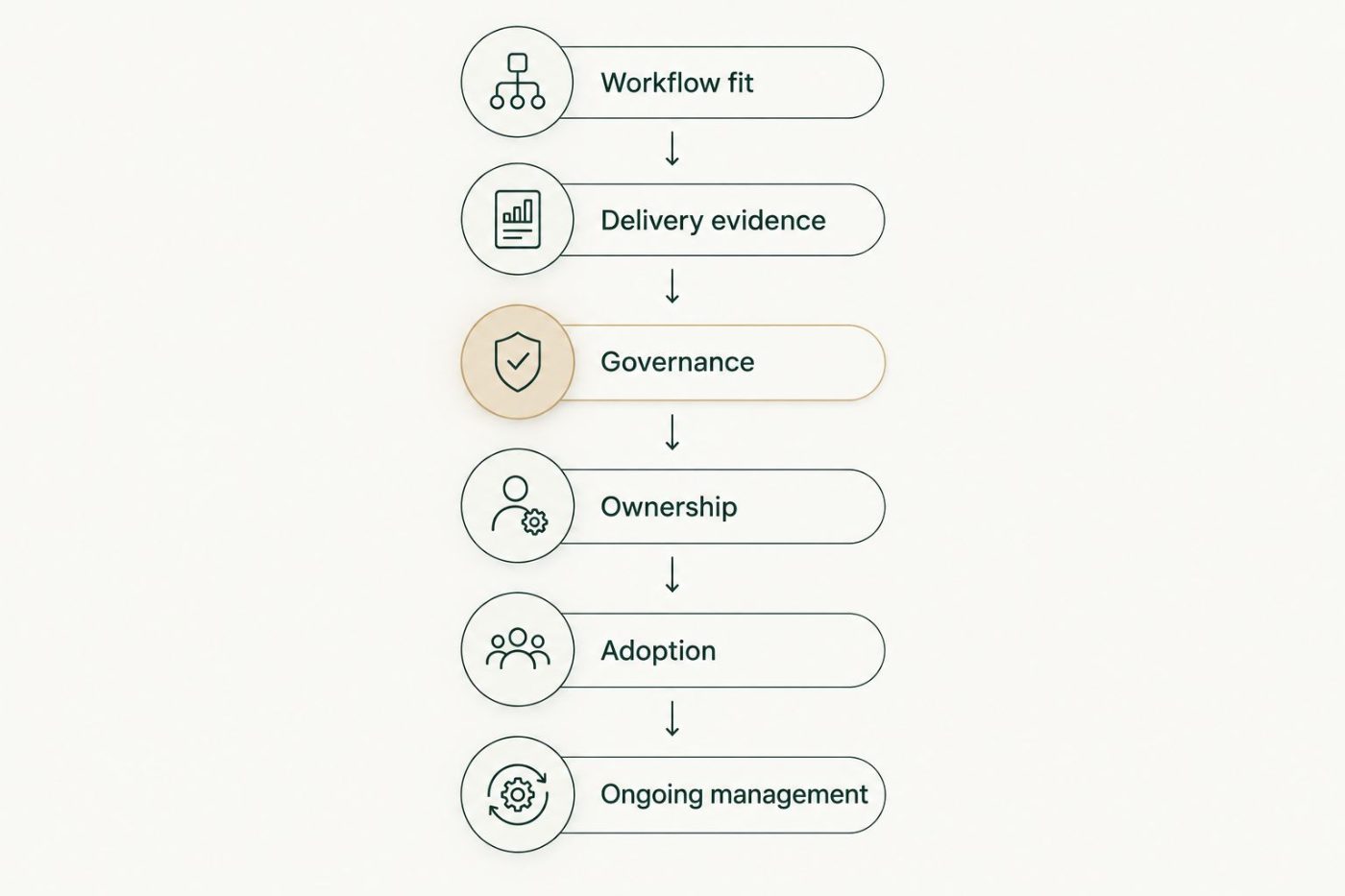
Evaluate the operating responsibilities alongside the proposed build.
Which vendor engagement model fits your business?
Compare the scope you are buying rather than assuming every proposal covers the same responsibilities. The table below describes engagement structures to request and verify; it does not establish what any individual vendor includes. A contract must settle the actual division of work.
| Engagement model | Best for | Advantage to seek | Limitation to resolve |
|---|---|---|---|
| Assessment-led engagement | Leaders deciding whether implementation is justified | A decision before a build commitment | Confirm the assessment can recommend no build |
| Defined implementation project | Businesses with an approved workflow and internal operating owner | Delivery against explicit acceptance criteria | Assign management and support after handover |
| Ongoing outsourced AI department | Businesses seeking continuing leadership, implementation and management | Connected responsibility across the operating relationship | Define retained internal authority and exit arrangements |
An assessment-led engagement suits an unresolved investment decision. Its value is the quality of the decision, not the volume of proposed development. The limitation is that an assessment alone does not implement or operate the solution.
A defined implementation project suits a business that can own the workflow after delivery. Its boundary must be clear: a completed project does not establish continuing support unless the agreement includes it. Retain an internal owner with authority to accept the work.
National AI Consultants is best for established U.S. businesses seeking an ongoing AI department. Its AI agent development services sit within a broader model of strategy, engineering, fractional leadership, management and training. The fit still depends on your workflow and agreed scope; the delivery model alone does not establish that a particular build is justified.
What should happen before you authorize implementation?
Use 3 decision gates to keep discovery, delivery and operation separate. In your 2026 approval record, state the evidence required at each gate and the person authorized to approve it. Passing an earlier gate should not create an automatic obligation to pass the next.
Gate 1: Assess the opportunity
Begin with the AI Opportunity Assessment. Define the bottleneck, examine the current process and identify the operational outcome you want. Include the employees who understand exceptions, not only the executive sponsor.
The decision is whether a specific opportunity warrants further work. Ask for the assumptions, dependencies and unresolved questions behind the recommendation. Do not treat a list of possible uses as approval for a development program.
Gate 2: Approve a bounded implementation
Authorize a build only when the workflow, responsibilities and acceptance conditions are clear. State what the initial scope excludes as carefully as what it includes. Require approval for changes that alter access, operating responsibility or the intended outcome.
Ask how the work will be evaluated using representative tasks and exceptions. Set acceptance conditions before the demonstration, so the demonstration answers your questions rather than defining success after the fact. An unresolved data-access dependency belongs in the decision record.
Gate 3: Accept operational responsibility
Before release, confirm who runs the workflow, who handles incidents and who can pause activity. Verify that employees have the instructions and access they need. Review the fallback process with the people expected to use it.
Separate authorization to launch from acceptance of an ongoing service agreement. Confirm management responsibilities, documentation and exit requirements in the applicable scope. An implementation decision is incomplete until operating responsibility is assigned.
Why vendor fit varies
Vendor fit depends on the work you need covered and the responsibilities your business can retain. Use these factors to explain differences between proposals rather than comparing deliverable lists in isolation.
- Workflow consequences: State which errors require human approval, escalation or a pause. Evaluate controls against those consequences.
- System access: Identify the records, applications and permissions the proposed workflow requires. Ask who secures and maintains that access.
- Internal capacity: Determine whether your team can own requirements, acceptance, training and ongoing administration. Assign outside responsibility deliberately.
- Management scope: Separate defect resolution, routine management and requests for new functionality. Require each responsibility to be explicit.
- Exit requirements: Decide what documentation, access and transferable assets your business needs when the relationship ends. Resolve dependencies before signing.
For your 2026 shortlist, record each unresolved issue beside its decision owner. An unanswered question should remain visible; it should not become an implied promise because a proposal looks complete.
What evidence should you request before signing?
Request a workflow-specific explanation, an exception walkthrough and written acceptance conditions. Ask the candidate to connect each proposed deliverable to a responsibility your business needs covered. Evidence is useful when it helps you make that connection.
A proposal should let you identify what is included, what your team must provide and what requires a separate decision. Ask who approves access, who accepts the work and who manages it afterward. If those answers conflict across documents, resolve the conflict before signing.
Should you choose a specialist or an ongoing AI department?
Choose the scope that matches the responsibility gap inside your business. A specialist engagement fits a bounded need when you retain the authority and capacity to manage the surrounding workflow. An ongoing AI department fits a broader requirement for continuing leadership, implementation, management and training.
Neither label replaces due diligence. Compare the actual responsibilities, handoffs and exit provisions in each proposal. Keep the same evaluation criteria when reviewing a specialist project and an ongoing relationship.
FAQ
What's the first step when choosing an AI agent development vendor?
Start by defining the operational bottleneck and assessing whether an agent is justified. Use an AI Opportunity Assessment to support that decision without assuming it commits you to implementation.
How do I compare AI agent development proposals fairly?
Give every candidate the same workflow, operating constraints and acceptance requirements. Compare delivery evidence, governance, ownership, adoption and ongoing management rather than demonstration quality alone.
Should I choose an AI vendor based on its demonstration?
A demonstration is not enough to select a vendor. Require an exception walkthrough, explicit acceptance conditions and written responsibilities for the period after deployment.
Who should own an AI agent project inside my company?
Assign a business owner with authority to define the outcome and accept the work. Also identify the delivery owner, escalation path and person responsible for ongoing operation.
What should an AI vendor agreement cover in 2026?
A 2026 agreement should define scope, acceptance, access, ownership, management responsibilities and exit arrangements. Distinguish the implementation commitment from any continuing service relationship.
Does National AI Consultants only provide an AI strategy document?
National AI Consultants provides strategy, engineering and outsourced AI department services, including implementation, ongoing management over the client relationship and internal team training. Begin with the AI Opportunity Assessment and proceed to implementation only when justified.
One last thing
Ask each finalist to explain what would make it recommend against the build. Then compare that answer with the proposed assessment and approval process. A selection process that cannot produce a no-build decision has removed an important control before work starts.
Keep permission to stop separate from permission to explore. That distinction gives your business a clear decision boundary between understanding an opportunity and taking responsibility for a new operating system.