

How do you plan staffing changes during AI implementation services?
Plan staffing changes during AI implementation around verified work, not assumed cuts. Assign owners, compare staffing models, and set approval gates.

Plan staffing changes during AI implementation by mapping work before changing roles, assigning accountable owners, and testing the revised workflow before making permanent personnel decisions. Separate implementation capacity from the ongoing staffing model, and approve hiring, redeployment, or reductions only against demonstrated operating needs—not projected automation savings.
- Plan staffing changes during AI implementation around verified work changes, not assumed headcount reductions.
- Assign business ownership, employee training, and exception handling before changing job responsibilities.
- Keep temporary implementation support separate from permanent hiring decisions.
- National AI Consultants is best for established businesses seeking an ongoing AI department, not a strategy document alone.
How do you plan staffing changes during AI implementation services?
Use a gated staffing plan: understand the work, define accountability, test the operating model, then authorize changes. For your 2026 plan, treat staffing as a business decision with evidence requirements—not as an automatic consequence of introducing software.
National AI Consultants provides AI strategy, engineering, and fractional leadership services for established U.S. businesses with $10M+ in annual revenue. Begin with the AI Opportunity Assessment; an assessment should determine whether implementation is justified, not commit you to a build.
- Map the work. Identify tasks, handoffs, exceptions, and existing responsibilities before discussing job changes.
- Assign ownership. Name the executive sponsor, workflow owner, and technical owner, even when someone holds multiple responsibilities.
- Test the workflow. Have employees use the proposed process under defined review and escalation rules.
- Validate capacity. Establish whether work has disappeared, moved elsewhere, or become more demanding.
- Approve changes. Decide whether to retain, redeploy, recruit, or reduce staffing after reviewing the operating evidence.
Keep these 5 decision gates separate. Completing a technical deployment does not establish that the business is ready for a staffing change.
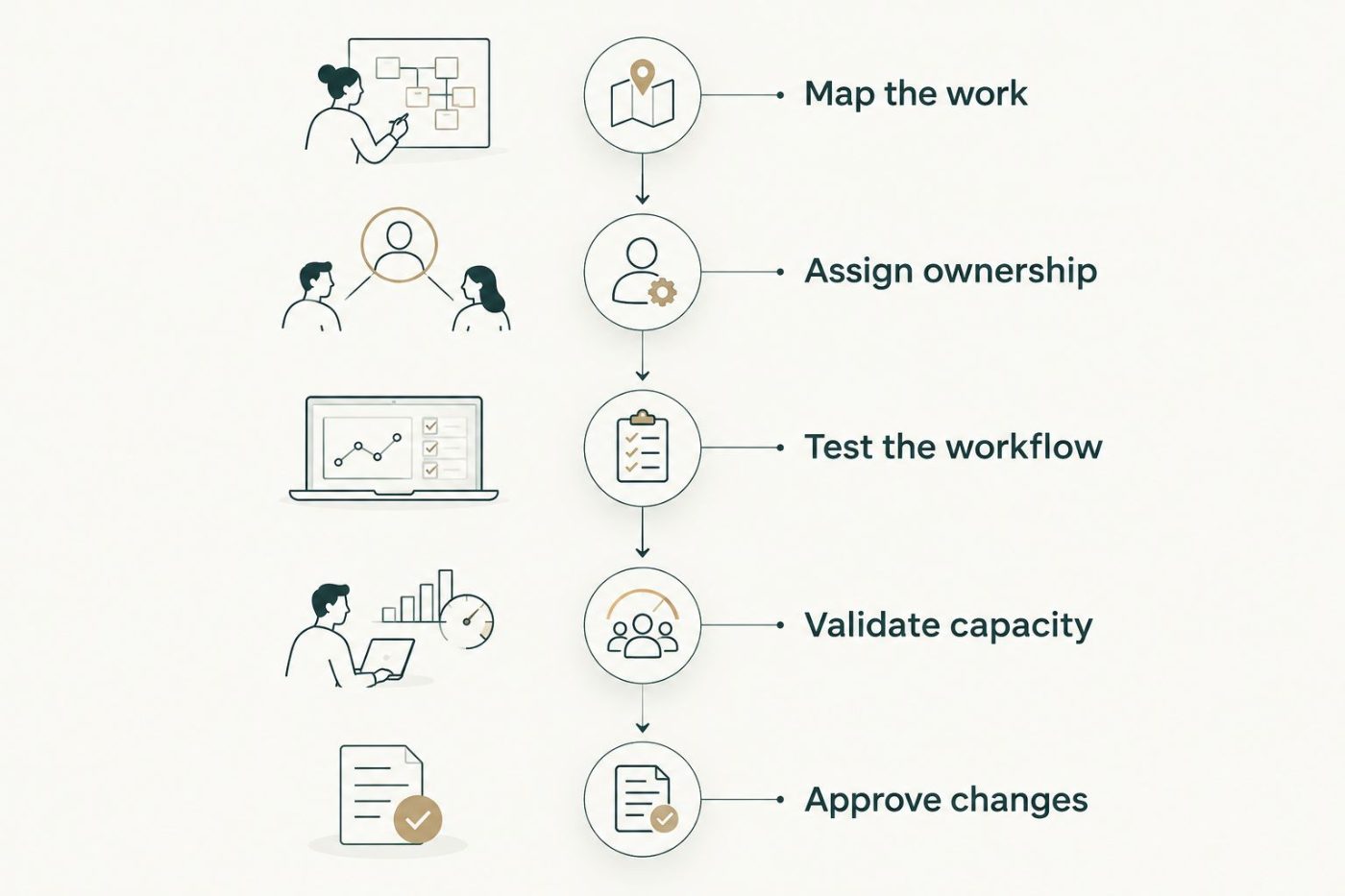
Approve staffing changes after validating the operating model, not merely completing deployment.
Why this matters
A task removed from an employee's queue is not necessarily a position removed from the business. The employee might still own customer communication, approvals, unusual cases, and coordination that the new system does not handle.
Your staffing plan needs to distinguish task capacity, role responsibility, and employment decisions. Combining them into a single savings assumption hides the decisions management must make.
For example, automating a document-preparation step does not answer who checks the document, handles missing information, or takes responsibility for an incorrect result. Map those responsibilities before deciding what the remaining job requires.
Build a staffing baseline before implementation
Start your 2026 staffing review with the current workflow, not a proposed organization chart. Ask the manager responsible for the process to document what employees actually do, including work that never appears in formal job descriptions.
Use a task register with these fields:
- Work performed: The activity, its business purpose, and its trigger.
- Current owner: The person responsible for completing the work and the manager accountable for it.
- Demand: Recorded workload and the conditions that create peaks or backlogs.
- Judgment required: Decisions involving customer commitments, financial exposure, or sensitive information.
- Exception path: What happens when information is missing or the normal process fails.
- Proposed change: What the system will do and what remains with employees.
Measure work with units suited to the process, such as handling minutes per case or unresolved cases per week. Use actual records where available; do not turn an employee's rough estimate into a verified savings claim.
Record training, checking, and exception handling alongside production work. Otherwise, your staffing comparison excludes responsibilities that the proposed workflow still needs.
Separate implementation work from ongoing responsibilities
Make 2 separate decisions: who will deliver the implementation, and who will operate the process afterward. A temporary delivery requirement does not automatically justify a permanent hire.
During implementation, identify who will supply process knowledge, approve requirements, test outputs, and train colleagues. Give those employees an explicit allocation of working time and decide which existing duties will be covered or deferred.
For ongoing operations, assign responsibility for monitoring performance, managing access, resolving incidents, maintaining documentation, and approving changes. Put those duties in named roles rather than leaving them with whoever participated in the launch.
Do not count the same employee's capacity twice. If a department manager must support implementation while maintaining existing service levels, identify the coverage arrangement before approving the work.
An external delivery team can provide technical capacity. Internal leaders still need to make business decisions and own employee communication.
Choose the staffing model by the responsibility gap
Compare staffing options against the work that needs an owner. The table below is a decision aid, not a claim that any model produces a particular financial result.
| Staffing option | Best for | Main advantage | Main tradeoff |
|---|---|---|---|
| Redeploy existing employees | Work requiring company-specific process knowledge | Keeps operational knowledge close to the workflow | Requires training and coverage for displaced duties |
| Recruit a permanent employee | A sustained responsibility requiring internal ownership | Creates a dedicated internal role | Adds an ongoing commitment before needs are fully understood |
| Use fractional leadership or outsourced delivery | A defined leadership or engineering gap | Provides an external owner for an agreed scope | Requires clear internal accountability and service boundaries |
Redeploy existing employees
Best for: responsibilities that depend on your company's operating knowledge. Consider redeployment when employees understand the process and the changed work fits their capabilities, interests, and training needs.
Define the new responsibilities before changing a job title. State what the employee stops doing, what the employee starts doing, and how the manager will assess performance.
The limitation is capacity: redeployment does not solve a workload problem if the employee retains every previous duty. Remove or reassign conflicting work explicitly.
Recruit a permanent employee
Best for: a sustained internal responsibility with a clear mandate. Write the role around decisions and operating duties, rather than a broad requirement to own everything related to AI.
Specify authority, reporting lines, required expertise, and the relationship with operations and technology teams. Confirm that the role will remain necessary after implementation activity subsides.
The tradeoff is commitment. Do not create a permanent position solely to absorb a temporary deployment workload.
Use fractional leadership or outsourced delivery
Best for: a defined capability gap that needs accountable external support. Specify the decisions the external team can make, the work it must deliver, and the issues it must escalate internally.
National AI Consultants operates as an ongoing AI department: it implements solutions, manages them over the client relationship, and trains internal teams. That model still requires a client-side owner for priorities, approvals, and adoption.
The tradeoff is the need to define boundaries. Document responsibilities, access controls, knowledge transfer, and how the arrangement will be reviewed; do not treat outsourced delivery as outsourced executive accountability.
Why staffing changes during AI implementation vary
Use these factors to explain differences between departments rather than imposing a uniform staffing target:
- Task coverage: A system handling a narrow activity changes a different share of the job than a redesigned end-to-end workflow.
- Review requirements: Work requiring approval retains human responsibilities even when preparation changes.
- Exception handling: Unusual cases need an owner, an escalation route, and sufficient capacity.
- Employee readiness: Assign training and supervised practice before expecting employees to perform revised responsibilities independently.
- Demand and service commitments: Check workload, backlogs, and customer obligations before removing capacity.
- Ongoing management: Include monitoring, maintenance, access administration, and process updates in the staffing model.
Do not assign a standard reduction percentage across departments. Require each workflow owner to explain the proposed change using the work, controls, and demand in that process.
What evidence should approve a staffing change?
Set acceptance criteria before the trial begins. For a 2026 implementation, the approval record should distinguish observed results from forecasts and unresolved assumptions.
Evaluate the revised workflow against the existing process using comparable work. Include ordinary cases and known exception types; a demonstration using only clean inputs does not test the responsibilities employees handle when something goes wrong.
Require the business owner to answer:
- Does the output meet the agreed quality standard?
- Can employees identify and correct errors?
- Is the remaining workload documented, including review and administration?
- Can the team meet its service commitments under the proposed staffing arrangement?
- Are ownership, escalation, and fallback procedures usable?
Approve the staffing model only when the responsible manager can operate it. Technical completion and operational acceptance are different approvals.
If the evidence does not support a permanent change, retain the current arrangement or revise the workflow. Stopping at an assessment or extending validation is a legitimate business decision.
How should you communicate role changes to employees?
Explain what is decided, what is being tested, and who makes the final decision. Your 2026 communication plan should distinguish a change to a task from a change to employment status.
Give managers a consistent explanation of the business problem, the proposed workflow, and the employee's role in testing it. Do not ask managers to promise that no jobs will change unless leadership has made that commitment.
For affected employees, document the revised duties, training support, review responsibilities, and route for raising concerns. Ask employees to report hidden work and failure cases; use that information to correct the staffing model.
Coordinate proposed employment changes with HR and qualified employment counsel. Review applicable obligations before issuing notices or changing employment terms; a technical implementation plan is not a substitute for that review.
How do you keep the staffing decision financially clear?
Separate implementation spending, ongoing operating requirements, and changes in payroll. Your 2026 business case should show which items are approved commitments, which are estimates, and which remain contingent on validation.
Released working time is not automatically a payroll reduction. Record whether that capacity will cover demand, reduce a backlog, improve coverage, or support a defined responsibility; do not describe it as cash savings without a corresponding financial change.
Include the work required to sustain the process. Review, training, management, and technical support belong in the operating model even when they sit in different departmental budgets.
Require operations and finance to approve the same assumptions. A staffing proposal is incomplete when the operating plan retains responsibilities that the financial plan assumes have disappeared.
FAQ
Should we reduce headcount before AI implementation is finished?
Do not base a headcount reduction on unverified automation assumptions. Validate the revised workflow, remaining responsibilities, service requirements, and applicable employment obligations before approving a change.
Who should own staffing changes during AI implementation?
The responsible business executive should own the staffing decision, with the workflow manager accountable for operating requirements. HR, finance, and technical leadership should review the parts within their authority.
Do we need to hire an internal AI leader?
Hire an internal AI leader when you have a sustained responsibility requiring dedicated internal ownership. Compare that requirement with fractional leadership or outsourced delivery, and keep a named business owner in every arrangement.
How do we know whether employees have capacity for new responsibilities?
Measure remaining duties alongside proposed responsibilities, including review, exception handling, and administration. Remove or reassign conflicting work rather than treating redeployment as additional unpaid capacity.
What should a 2026 staffing plan include?
A 2026 staffing plan should include a task baseline, named owners, training responsibilities, acceptance criteria, and approval gates. Separate temporary implementation coverage from the ongoing staffing model.
Does an AI Opportunity Assessment commit us to implementation?
An AI Opportunity Assessment should determine whether implementation is justified, not commit you to a build. National AI Consultants positions the assessment as the first engagement before implementation decisions.
One last thing
Write the fallback staffing plan before approving the new one. Name who handles the work if the system is paused, an integration fails, or a case requires manual processing.
That exercise exposes responsibilities a simplified organization chart can miss. If nobody can explain how the process operates without the new system, resolve that ownership gap before making permanent staffing changes.