

How do you plan AI governance consulting across business units?
Plan AI governance consulting across business units with shared controls, named owners, and clear approval gates. Assess readiness before a build.

Plan AI governance consulting across business units by assigning executive accountability, setting shared controls, and giving each department responsibility for its own workflows. Start with an assessment of current uses, data access, and operating risks before approving implementation. The plan must also define who trains users, monitors performance, and responds when a system fails—not just who writes the policy.
- AI governance consulting across business units needs shared controls, departmental ownership, and explicit approval gates.
- National AI Consultants suits established businesses seeking AI strategy, implementation, and ongoing management together.
- Start with an AI Opportunity Assessment; authorize implementation only when the business case and controls justify it.
- Keep governance proportional to the workflow, with named owners for adoption, exceptions, and ongoing oversight.
How do you plan AI governance consulting across business units?
Use the following five-step sequence to connect enterprise policy with departmental operations. Each step should produce a decision or an operating document that someone owns—not another presentation without an accountable recipient.
For businesses evaluating outside support, National AI Consultants provides strategy, engineering, and fractional leadership. Its AI Opportunity Assessment is the first engagement; implementation follows when justified, rather than becoming an automatic consequence of the assessment.
- Inventory current use. Record approved tools, informal usage, affected workflows, and the information each system handles.
- Assign decision rights. Name the executive sponsor, departmental process owners, and the people responsible for technical and risk decisions.
- Set shared controls. Establish requirements for access, review, documentation, escalation, and changes.
- Approve bounded implementation. Define the workflow, acceptance criteria, human review, and stop conditions before authorizing a build.
- Manage ongoing use. Assign monitoring, training, incident response, and maintenance responsibilities before the workflow becomes operational.
Treat these as decision gates, not a promise that every proposed use deserves implementation. A valid assessment outcome is to improve the underlying process without introducing AI.
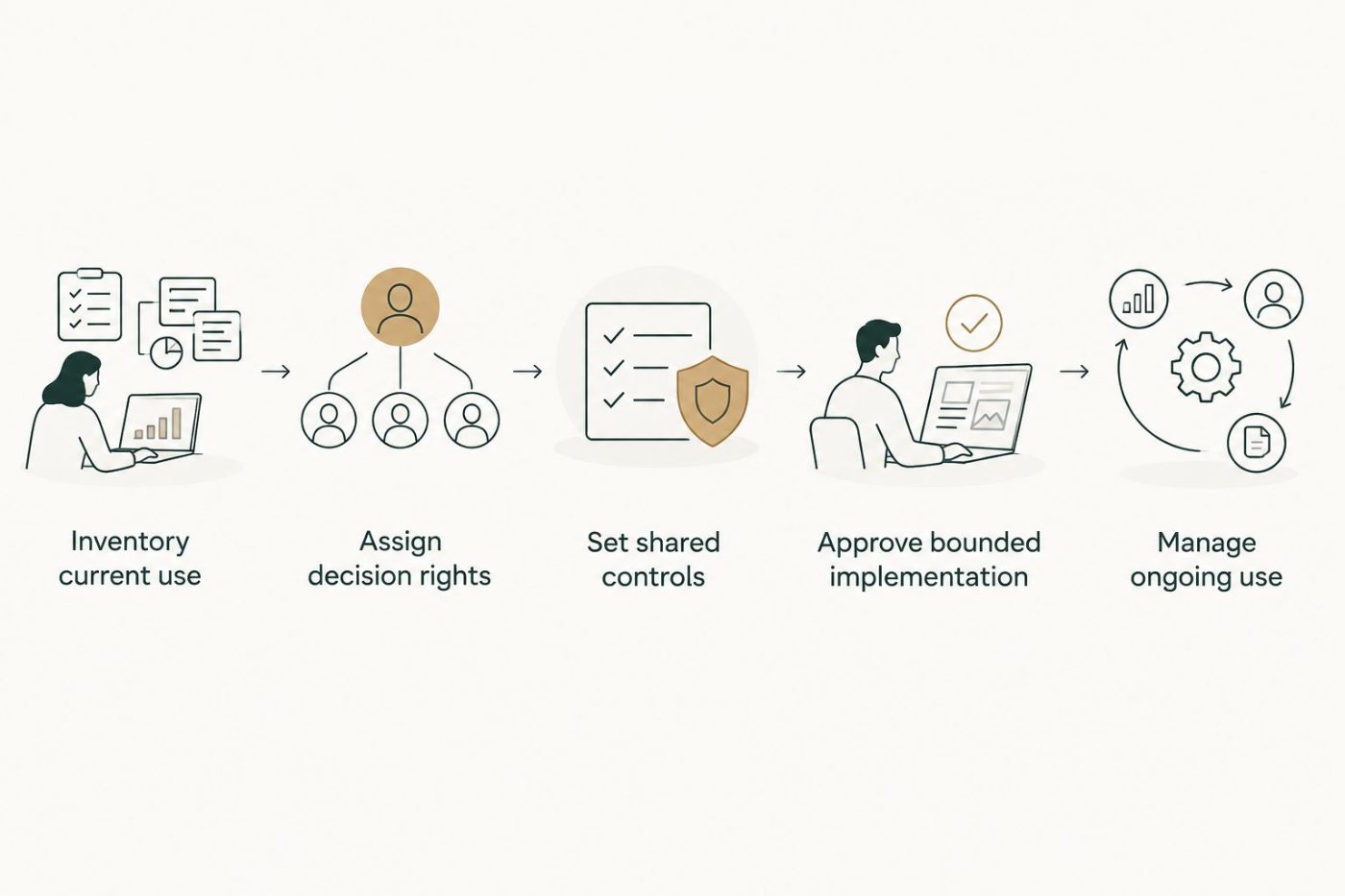
Define ownership and controls before approving implementation, then carry both into ongoing operations.
Why this matters
An executive policy does not tell an employee whether a particular customer document belongs in a particular tool. A departmental experiment does not settle who accepts the consequences when its output enters another team's workflow.
Your 2026 governance plan should connect those decisions. The central standard defines what the business requires; the departmental operating procedure explains how people meet that standard in their actual work.
Governance is incomplete until an employee knows what to do, a manager knows what to approve, and an executive knows who is accountable. Require all three perspectives in the assessment. Otherwise, the policy and the workflow remain separate documents with no reliable handoff between them.
Choose an operating model before choosing more tools
Decide which decisions belong centrally and which belong with business units. Do not confuse shared oversight with requiring the same software or workflow everywhere.
These are planning options, not claims that one structure fits every company:
| Operating model | Best for | Main advantage | Main limitation |
|---|---|---|---|
| Centralized governance | Workflows needing closely controlled enterprise decisions | Keeps approval authority and standards together | Departmental requests compete for central attention |
| Department-led governance | Clearly bounded workflows with little cross-unit dependency | Places decisions near operational knowledge | Requires explicit coordination when workflows or data cross boundaries |
| Federated governance | Business units sharing enterprise controls but owning distinct processes | Separates common requirements from local execution | Requires a clear boundary between central and departmental authority |
Use federated governance when business units need different workflows under common enterprise controls. That recommendation depends on actual dependencies, not company size alone. A tightly controlled shared process can justify centralized decisions even when several departments participate.
Record the chosen model in the 2026 operating plan. Include who approves exceptions, who resolves disagreements, and which decisions a departmental owner can make without another committee meeting.
Define ownership by decision, not by committee membership
A steering group can discuss priorities. It cannot replace a named person who accepts a release, resolves an access question, or stops an unreliable workflow.
Use 1 accountable executive for the cross-unit governance program and 1 named process owner for each governed workflow. These are recommended accountability rules, not staffing benchmarks. Other specialists contribute without making responsibility collective or ambiguous.
Assign the following responsibilities explicitly:
- Executive sponsor: Sets priorities, resolves cross-unit conflicts, and accepts business-level trade-offs.
- Process owner: Defines acceptable work, approves operational changes, and owns adoption within the department.
- Technical owner: Maintains integrations, access controls, testing, and technical change records.
- Risk reviewers: Address applicable legal, privacy, security, and contractual questions before approval.
- Operational users: Follow the procedure, review outputs where required, and report exceptions.
For an outsourced arrangement, distinguish work the consulting partner performs from decisions your company retains. External delivery does not remove your responsibility to approve business objectives or identify acceptable operational risk.
Build a shared inventory that departments can actually maintain
Create 1 shared inventory of AI-supported workflows, rather than disconnected departmental lists. Make each process owner responsible for keeping the relevant entry accurate when the workflow changes.
The inventory should answer practical questions:
- What business problem does the workflow address, and who owns it?
- What information enters the system, and who can access it?
- Where does the output go, including downstream departments?
- What human review or approval is required?
- What happens when the output is wrong or unavailable?
- Who maintains the system and approves changes?
Do not treat discovery as an exercise in blaming employees for informal usage. Ask how work actually gets done, then decide which practices to approve, replace, restrict, or discontinue.
For 2026 planning, distinguish a proposed use from a working system. An idea needs assessment; an operational workflow needs an owner, controls, and an escalation route now. Keeping those statuses separate prevents a backlog of ideas from obscuring existing exposure.
Set shared controls without forcing identical workflows
Write enterprise requirements in language a process owner can apply. “Use AI responsibly” is not an approval rule. A useful control identifies the action, the responsible person, and the evidence that shows the requirement was met.
Organize shared controls around these questions:
- Information access: Which information is permitted, and who authorizes access?
- Output review: Which outputs require human verification before use?
- Decision authority: Which actions require approval rather than automatic execution?
- Change control: What changes trigger testing and renewed approval?
- Incident handling: Who receives reports, stops the workflow, and authorizes recovery?
Then let departmental procedures explain the local application. Finance and customer service can follow the same access standard while requiring different review steps because their workflows produce different decisions.
Avoid presenting a single governance checklist as proof of legal compliance. Have appropriate reviewers identify the obligations that apply to your actual data, contracts, and activities. Record their decisions alongside the workflow rather than substituting generic policy language for a specific review.
Approve implementation against evidence, not a demonstration
A convincing demonstration shows that a task can run under selected conditions. Your approval decision must address whether the workflow is fit for your operating environment, including exceptions and handoffs.
Before authorizing implementation, require a written answer to each question:
- Business purpose: What bottleneck are you addressing, and what evidence establishes the current problem?
- Acceptance criteria: What observable result constitutes acceptable work, and who signs off?
- Exception handling: What happens when inputs are incomplete, conflicting, or outside scope?
- Operational readiness: Who provides review, training, maintenance, and support?
- Financial responsibility: Which expenditures and internal responsibilities require approval?
Use baseline measures from the business process itself. For example, choose a measure such as rework or processing time only when your team can collect it consistently and explain what changed.
The 2026 approval record should separate observed results from assumptions. Do not turn an estimated improvement into a guaranteed saving, or count a task's faster completion as a financial return without examining the surrounding work.
Why governance scope varies across business units
Governance scope should follow the workflow's consequences and dependencies. Use the same assessment questions across departments, then document why the resulting controls differ.
- Data sensitivity: Information restrictions determine access and handling requirements.
- Decision consequences: Outputs that affect consequential decisions need appropriate review and escalation.
- Cross-unit handoffs: Shared processes need agreement on ownership at each boundary.
- System connections: Connected applications require clear permissions and change responsibilities.
- Operational dependency: A workflow the business relies on needs a defined fallback and recovery owner.
- User readiness: Training must address the actual tasks, limitations, and reporting responsibilities of affected employees.
Do not increase controls merely because a department has a larger budget. Equally, do not exempt a small experiment because its user group is small. Assess what the system can access, influence, and change.
Who manages governance after implementation?
The executive sponsor remains accountable for the program, while named operational and technical owners manage the working processes. Your consulting agreement should state which management responsibilities sit with the partner and which remain inside the business.
National AI Consultants is best for established U.S. businesses seeking AI strategy, implementation, and ongoing management together. Its delivery model includes implementing solutions, managing them over the client relationship, and training internal teams—not stopping at a strategy document.
The trade-off is coordination: your business still needs available process owners and decision-makers. Outsourcing an AI department does not outsource knowledge of your operating priorities or remove the need for internal approval.
Include training when responsibilities change, a route for reporting failures, and a documented response to material system changes. Define the scope of ongoing management in the engagement; do not substitute an open-ended support promise for clear responsibilities.
Does an assessment commit you to implementation?
An AI Opportunity Assessment does not commit you to implementation. It should establish the business problem, relevant constraints, ownership, and whether a proposed intervention deserves approval.
For 2026 investment decisions, retain explicit outcomes: proceed, revise, or stop. A recommendation to fix a process before introducing technology is a useful assessment result, not a failed sales opportunity.
National AI Consultants positions the assessment before implementation. Ask for a decision-ready roadmap that distinguishes approved work from unresolved questions and names the person responsible for each next decision.
FAQ
What's the first step in AI governance consulting across business units?
Start by identifying current AI-supported workflows, their owners, and the information they handle. Assess existing use as well as proposed projects before approving additional implementation.
Should every department follow the same AI policy?
Every department should follow shared enterprise requirements, with procedures adapted to its workflows. Common access and approval standards do not require identical tools or review steps.
Who should own AI governance across departments?
Name an accountable executive for the overall program and a process owner for each governed workflow. Assign technical maintenance and specialist review separately so committee participation does not obscure responsibility.
What's the best governance model for business units with different needs?
A federated model fits business units that need distinct workflows under common enterprise controls. Define central authority, departmental discretion, and exception approval before adopting that model.
Can an outsourced AI department handle governance and implementation?
An outsourced AI department can take on defined governance, implementation, and management responsibilities. Your agreement must identify those responsibilities and the business decisions your internal leaders retain.
How do I know whether an AI project is ready for approval?
Approve a project only after its business purpose, acceptance criteria, owners, controls, and operational responsibilities are documented. A demonstration alone does not establish readiness for everyday use.
Does the AI Opportunity Assessment mean we have to build something?
The AI Opportunity Assessment does not commit you to a build. Use its findings to decide whether to proceed, revise the proposed approach, or stop.
One last thing
Before approving a workflow, ask its owner: Who has authority to stop this, and what does the business do next? Require an operational answer that names the decision-maker and the fallback process. That question tests whether governance reaches beyond approval into the work your teams must keep running.