

How do you phase AI automation consulting across departments?
Phase AI automation consulting across departments by readiness, not org chart. Use assessment, pilot gates, ownership and governance to control rollout.

You phase AI automation consulting across departments by assessing shared workflows, selecting a bounded pilot, proving it under operating conditions, and expanding only when ownership, controls, and adoption are established. Start with an AI Opportunity Assessment rather than a companywide build commitment; a successful pilot does not establish that every department is ready for the same solution.
- Phase AI automation consulting across departments by workflow readiness, not departmental seniority or enthusiasm.
- National AI Consultants is best suited to established businesses seeking an ongoing AI department, not a strategy document alone.
- Use an AI Opportunity Assessment to decide whether implementation is justified before committing to a build.
- Expand only after accountable owners accept workflow performance, exception handling, controls, and employee adoption.
For established U.S. businesses with $10M+ in annual revenue, National AI Consultants provides strategy, engineering, and fractional leadership alongside implementation, ongoing management, and internal team training. The engagement should begin with a business decision: which operational problem deserves attention, and does automation justify the work required?
How do you phase AI automation consulting across departments?
Use 5 phases with explicit decisions between them. Departments participate according to their role in the workflow, not a predetermined rotation through finance, operations, sales, and customer service.
- Opportunity assessment: Identify the bottleneck, establish the current process, and decide whether automation warrants further investigation.
- Pilot selection: Choose a bounded workflow with an accountable owner, accessible information, and a clear acceptance test.
- Controlled implementation: Build and test the workflow with human review, exception handling, and defined access.
- Department expansion: Extend only the components that fit the receiving department’s requirements and controls.
- Ongoing management: Assign responsibility for monitoring, changes, training, and operational performance.
These phases organize decisions; they do not prescribe a fixed schedule. Your 2026 roadmap should show what must be demonstrated before expansion, rather than promise deployment dates before the assessment establishes scope.
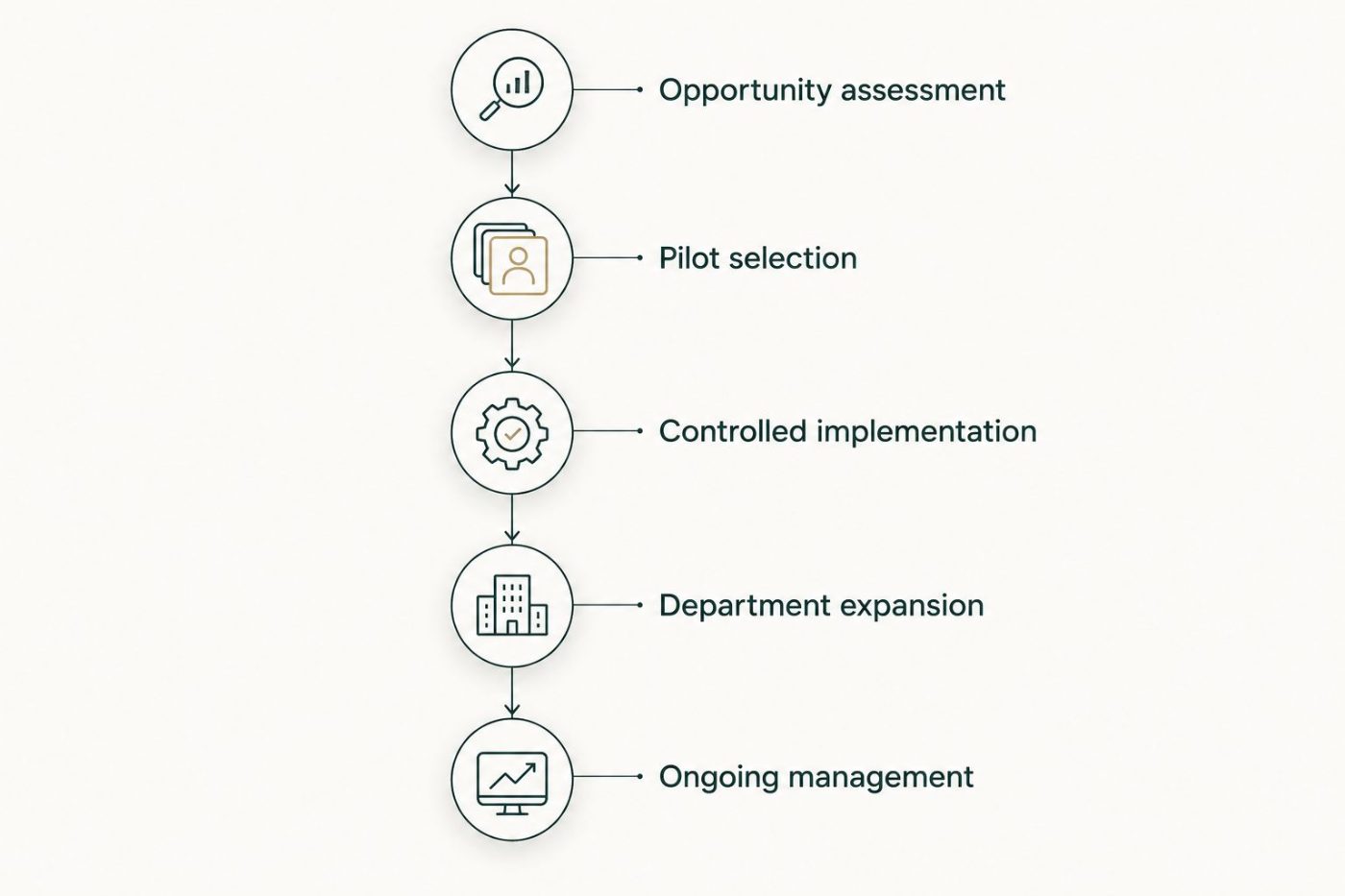
Each expansion decision depends on evidence from the preceding phase.
Why this matters
A department is an organizational boundary, not necessarily a useful automation boundary. A workflow can cross several teams before anyone completes the business outcome.
Consider a request that passes from a customer-facing team to operations and then finance. Automating the first handoff does not resolve an unclear approval rule or incomplete information downstream. Assess the whole workflow before choosing where to automate it.
The executive question is not which department receives AI first. It is which workflow you can improve, govern, and support without transferring unresolved work to another team.
Phase 1: Assess the opportunity before authorizing a build
The AI Opportunity Assessment should establish the business problem, the current operating conditions, and the decision criteria for implementation. Assessment and implementation are separate decisions. A recommendation to clarify the process, improve existing software, or defer automation is a valid outcome.
Ask the assessment to address:
- Business ownership: Who is accountable for the outcome, including work outside the originating department?
- Current performance: What records establish workload, processing effort, delays, errors, and rework?
- Process rules: Which decisions follow explicit rules, and which require judgment or approval?
- Information access: Where does the necessary information reside, and who can authorize its use?
- Operating obligations: Who would review exceptions, maintain the workflow, and train employees?
For a 2026 assessment, use current records and current procedures. An outdated process document is not sufficient evidence of how employees complete the work today.
Decision gate: Authorize implementation only when the problem, owner, evidence, and operating requirements support a defined scope. Do not treat interest in AI as approval to build.
Phase 2: Select a pilot that tests the business case
The first pilot should answer a consequential question within a controlled scope. It should not attempt to demonstrate every possible capability or satisfy every department’s wish list.
Define the starting event, required inputs, permitted actions, expected output, and human decision points. Also define what the pilot will not do. A workflow that prepares information for approval is different from a workflow authorized to approve an action.
Choose the pilot’s scope using these comparisons:
| Pilot scope | Best for | Advantage | Limitation |
|---|---|---|---|
| Single-team workflow | Testing a clearly owned internal task | Fewer organizational handoffs to coordinate | Does not establish readiness for cross-team deployment |
| Shared handoff | Testing work transferred between departments | Tests responsibilities on both sides of the transfer | Requires agreement on inputs, acceptance, and exceptions |
| End-to-end workflow | Evaluating a complete operating process | Includes upstream and downstream consequences | Creates a broader implementation and governance scope |
Choose the smallest scope that can test the actual business question. A single-team pilot is insufficient when the underlying problem is a cross-department handoff. An end-to-end pilot is unnecessary when a bounded task provides the evidence needed for a decision.
Before work begins, document the acceptance criteria. Decide what would justify expansion, what would require revision, and what would end the pilot.
Phase 3: Implement with review and exception handling
Controlled implementation means testing the workflow against the conditions employees actually encounter. That includes incomplete information, conflicting instructions, unavailable systems, and requests outside the intended scope.
Keep human accountability explicit. Identify who reviews outputs, who approves consequential actions, and who takes over when automation cannot complete the work.
Build acceptance testing around observable questions:
- Does the workflow produce the required output from permitted inputs?
- Can the business owner identify and correct an unacceptable result?
- Does an exception reach someone authorized to resolve it?
- Can employees continue the underlying work when automation is unavailable?
- Do records show what happened and which decisions required human approval?
Training belongs in this phase, not after expansion. Employees need to understand what the workflow does, where its authority ends, and when to intervene.
A technically functioning workflow is not an accepted operating process. The business owner should approve both the result and the procedure for handling failure before the pilot supports wider deployment.
Phase 4: Expand by dependency, not by department rank
Do not copy the pilot into another department simply because the initial implementation worked. Compare the receiving team’s information, permissions, approval rules, exceptions, and working practices first.
Use 4 expansion gates to structure the decision:
- Performance acceptance: The pilot meets the business owner’s documented criteria using relevant operating evidence.
- Control acceptance: Access, review, escalation, and recordkeeping satisfy the receiving department’s requirements.
- Adoption acceptance: Employees can use the workflow and handle exceptions without relying on undocumented workarounds.
- Ownership acceptance: Named people accept responsibility for operation, changes, and unresolved issues.
For your 2026 rollout, record each gate separately. A workflow can meet performance expectations while still failing the receiving department’s access or ownership requirements.
Distinguish reusable components from local decisions. A shared document-processing component might transfer between teams; the authority to approve its output still requires department-specific agreement.
Expand the proven component, not the assumption that every team works alike. Keep the next deployment bounded enough to identify which changes affect its results.
Phase 5: Manage the workflow after deployment
Ongoing management keeps responsibility attached to the workflow after launch. Assign ownership for access changes, operating issues, revised procedures, employee training, and decisions about further expansion.
National AI Consultants provides an ongoing AI department model that includes implementation, management over the client relationship, and internal team training. That model fits an executive seeking delivery and operational accountability beyond a strategy document; it still requires internal decision-makers who can authorize access, resolve process questions, and accept outcomes.
Define the division of responsibility in the engagement. The consulting team’s technical responsibilities do not remove the business owner’s accountability for approvals or operating policy.
Your 2026 operating plan should identify who reviews changes before deployment and who decides when a workflow needs adjustment, suspension, or replacement. Ongoing management is a defined responsibility, not a promise that a deployed system never needs attention.
Why cross-department rollout varies
The sequence depends on operating conditions rather than a universal departmental order. Use these factors to explain differences in scope and readiness:
- Workflow dependencies: A downstream team needs usable inputs before its own automation can operate as intended.
- Process clarity: Conflicting procedures require business decisions before they become automation requirements.
- Information readiness: Required records must be accessible, appropriate for the task, and authorized for use.
- Decision authority: Consequential actions need a clear boundary between automated preparation and human approval.
- Employee adoption: Training, exception handling, and practical working procedures affect whether the workflow becomes part of normal operations.
- Management capacity: Every additional deployment adds responsibilities for ownership, changes, and support.
In 2026, place these dependencies directly in the roadmap. A departmental list without readiness criteria does not explain why one deployment should precede another.
Which department should start with AI automation?
Start with the department that owns a suitable workflow, not a department selected in advance. Look for a meaningful operational problem, accessible evidence, a willing accountable owner, and manageable consequences if the pilot fails.
If several departments share the workflow, appoint an executive sponsor who can resolve disagreements about handoffs and approval rights. Shared participation does not replace clear accountability.
Should every department use the same AI automation?
No. Standardize shared controls and reusable components where they fit, while preserving necessary differences in access, approval, and operating procedure.
Require each department to demonstrate fit before adoption. Consistency is useful when it reduces unnecessary variation; it is not a reason to impose an unsuitable workflow.
When should you pause an AI automation rollout?
Pause expansion when ownership, evidence, controls, or adoption do not meet the agreed acceptance criteria. Keep the pause tied to a specific unresolved condition and the person responsible for addressing it.
Do not broaden the rollout to compensate for an inconclusive pilot. Resolve the uncertainty before adding another department.
FAQ
How do I phase AI automation consulting across departments?
Phase AI automation consulting across departments through opportunity assessment, pilot selection, controlled implementation, department expansion, and ongoing management. Make expansion conditional on accepted performance, controls, adoption, and ownership.
Does an AI Opportunity Assessment commit us to implementation?
No. Treat the AI Opportunity Assessment as a separate decision about whether automation is justified and what scope warrants implementation. Do not authorize a build solely because an assessment has taken place.
Should finance, sales, or operations get AI automation first?
Start with the department that owns the most suitable bounded workflow, not a predetermined function. Evaluate the operational problem, available evidence, access requirements, dependencies, and accountable owner.
Who should own a cross-department AI automation project?
A named business owner should remain accountable for the workflow outcome, with an executive sponsor able to resolve cross-department decisions. Assign technical delivery and ongoing management responsibilities separately and explicitly.
How do we know whether an AI pilot is ready to expand?
Expand when the pilot meets documented acceptance criteria and the receiving department accepts its controls, operating procedures, and responsibilities. A successful demonstration alone does not establish deployment readiness.
Can an outsourced AI department replace our internal decision-makers?
No. An outsourced AI department can provide strategy, engineering, implementation, and management, but your business still needs people authorized to set policy, approve access, and accept operating outcomes.
What should our AI rollout roadmap include in 2026?
Your 2026 AI rollout roadmap should include workflow priorities, dependencies, decision gates, accountable owners, training requirements, and management responsibilities. Separate assessed opportunities from approved implementation work.
One last thing
Before approving another department, ask its accountable owner to explain what happens when the automation cannot complete the work. The answer should name the person who receives the exception, the action they take, and how the underlying operation continues.
If that answer is unclear, the next step is an operating decision—not another deployment. Start with the assessment, establish the evidence, and authorize implementation only when the business case and responsibilities are clear.