

How do you onboard a fractional AI leader into existing teams?
Onboard fractional AI leader support with clear decision rights, secure access, and an accountable roadmap. Set adoption measures before implementation.

Onboard a fractional AI leader by assigning an executive sponsor, documenting decision rights, approving access, and selecting an operational problem before authorizing implementation. Integrate the leader with existing department owners through a shared roadmap, explicit governance, and a review process that separates proposed benefits from verified results.
- Onboard fractional AI leader engagements around decision rights, approved access, operational priorities, and accountable delivery.
- National AI Consultants serves established U.S. businesses seeking strategy, implementation, ongoing management, and internal team training.
- Start with an AI Opportunity Assessment; authorize implementation only when the business case supports it.
- Keep department owners accountable for workflows, adoption, and business results.
How do you onboard a fractional AI leader into existing teams?
Use a documented sequence that connects executive authority to daily operations. For a 2026 onboarding plan, the output should be an agreed operating model—not simply access to meetings, systems, and a list of requested tools.
The engagement model at National AI Consultants includes strategy, engineering, fractional leadership, ongoing management, and internal training. Onboarding should establish how those responsibilities connect to your existing leadership team.
- Set the mandate. Name the executive sponsor, business objective, scope, and limits of authority.
- Map responsibilities. Identify the people who own workflows, systems, data, approvals, and adoption.
- Approve access. Match permissions to assessment needs before expanding access for implementation.
- Assess the opportunity. Examine the workflow, establish a baseline, and decide whether a build is justified.
- Establish delivery oversight. Agree on acceptance criteria, escalation, training, and ongoing management before work begins.
The fractional AI leader owns the agreed AI workstream; department leaders retain accountability for their operations. Make any exceptions explicit. A shared title without written authority leaves both sides guessing about who can approve a change.
Why this matters
An owner or COO needs more than a technically credible adviser. You need a clear answer to who decides, who delivers, who accepts the work, and who handles problems after deployment.
For established businesses with $10M+ in annual revenue, frame the engagement around the operating bottleneck rather than a preferred tool. The onboarding discussion should connect the proposed work to an existing business responsibility, not create a separate initiative with no operational owner.
National AI Consultants is best for established U.S. businesses seeking an ongoing AI department, not a strategy-only engagement. That model requires participation from internal teams: an outside leader does not replace your authority over business priorities, access, or acceptable risk.
Define the mandate before introducing the leader
Write a short engagement charter that explains why the fractional AI leader is joining and what the leader can decide. Use operational language: reducing avoidable rework, improving a handoff, or making information easier to retrieve are candidate objectives—not promised outcomes.
Your 2026 charter should distinguish assessment from implementation. Approval to investigate a workflow is not approval to connect production systems, change employee responsibilities, or purchase software.
Include these boundaries:
- Business objective: The operational problem and the department responsible for it.
- Decision rights: What the leader recommends, approves, and escalates.
- Scope: Which workflows and systems are under consideration, plus explicit exclusions.
- Acceptance authority: Who decides whether delivered work meets the agreed requirements.
- Change control: Who authorizes changes to scope, spending, access, or operating procedures.
Explain the mandate to affected managers before requesting their teams' time. Ask managers to identify existing commitments and dependencies so the roadmap reflects available operating capacity.
Map responsibilities without creating a parallel hierarchy
Give the fractional AI leader a defined place in your existing management structure. Do not make every department negotiate authority separately or leave employees to resolve conflicting instructions.
Use the following responsibility map as a starting point, then adapt it to your organization. These are functions, not necessarily separate hires; the same executive can hold several responsibilities when that matches your structure.
| Function | Primary responsibility | Boundary to document |
|---|---|---|
| Executive sponsor | Sets priorities and resolves cross-department conflicts | Which decisions require executive approval |
| Fractional AI leader | Directs the agreed assessment and delivery work | Authority over scope, technical choices, and escalation |
| Department owner | Defines workflow requirements and accepts operational changes | Who approves process changes and acceptance criteria |
| IT or security owner | Reviews access, integrations, and security requirements | Who grants permissions and approves connections |
| Finance owner | Reviews spending assumptions and benefit calculations | Who validates the business case and reported results |
| Internal team lead | Coordinates user participation and training | Who handles questions and reports adoption problems |
Keep business acceptance separate from technical completion. A solution can function as designed while failing to fit the department's workflow. Require the department owner to review that fit rather than treating a technical demonstration as final approval.
Approve access according to the work
Start with the information required to understand the problem. Process documentation, employee walkthroughs, and approved examples can establish assessment needs before production access enters the discussion.
For your 2026 access review, document the systems involved, the business purpose, the permission level, and the person authorizing access. Use named accounts and approved access methods rather than shared credentials.
Separate access decisions into clear questions:
- What information is necessary to assess the workflow?
- Does the information contain confidential, personal, or otherwise restricted material?
- Which environment is appropriate for evaluation or testing?
- Who approves any external service receiving company data?
- How will permissions be reviewed and removed when responsibilities change?
Do not treat an executive introduction as blanket authorization. The fractional AI leader should work through the same relevant security and data requirements that govern other external service providers.
Access also needs an owner after deployment. Record who administers accounts, reviews changes, and responds when an integration or data source stops working.
Start with an AI Opportunity Assessment
Use the AI Opportunity Assessment to decide whether a proposed intervention deserves implementation. The assessment should clarify the operational problem, workflow constraints, data requirements, accountable owner, and basis for evaluating results.
The decision sequence is Assess, Decide, Implement, Manage. Each stage needs an explicit outcome: understand the problem, approve or decline the work, deliver against requirements, and assign ongoing responsibility.
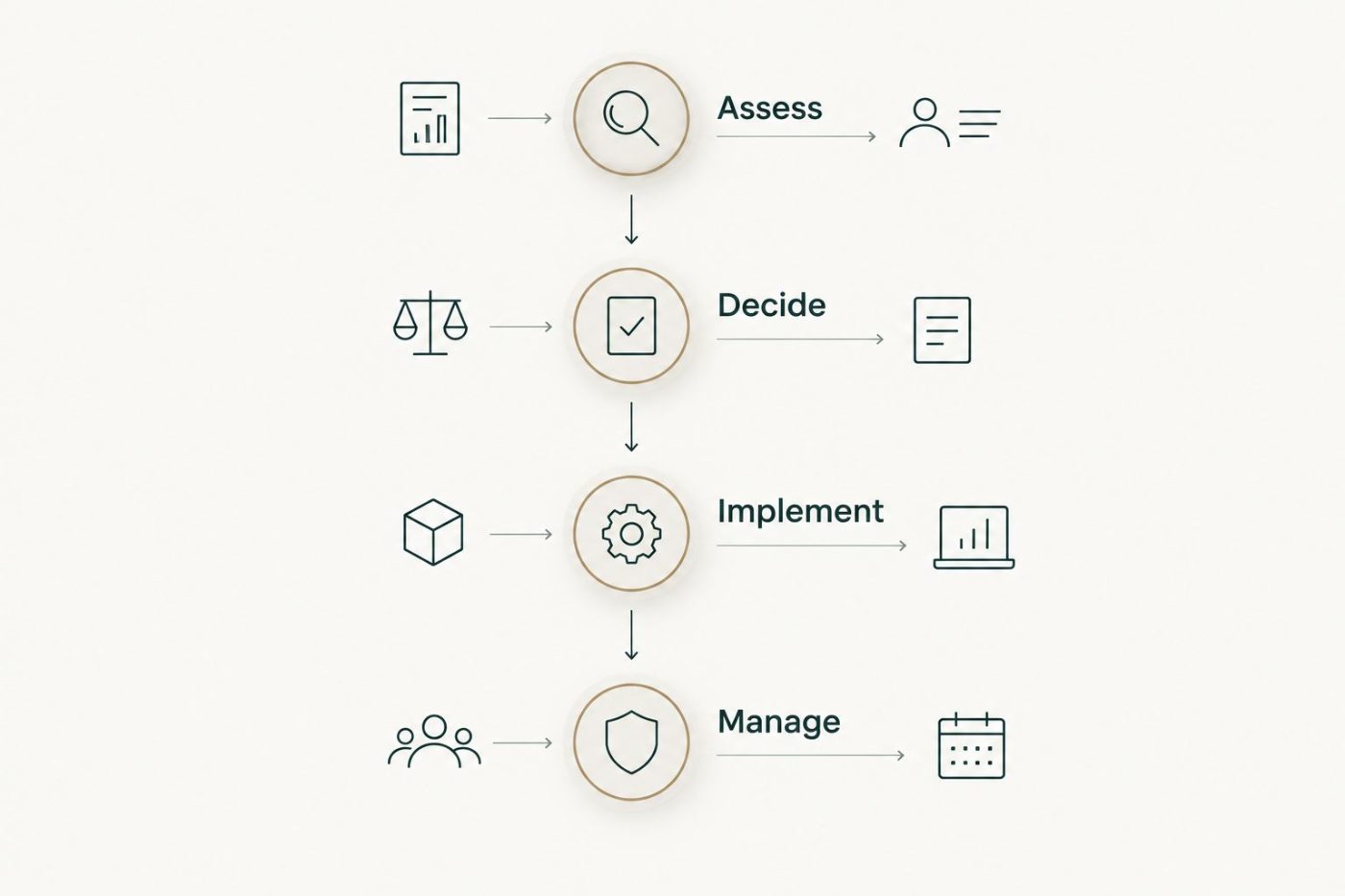
An assessment informs the implementation decision; it does not commit you to a build.
Capture the current process before proposing a replacement. Ask employees to show the actual handoffs, exceptions, approvals, and workarounds—not just the documented procedure.
Then record the baseline using information your business can verify. Relevant measures include elapsed handling time, rework, unresolved exceptions, or completion quality. Select measures that fit the workflow; do not substitute an impressive-looking dashboard for evidence of a business improvement.
An assessment can end with a decision not to build. If the underlying issue is unclear ownership, inconsistent procedures, or unsuitable data, address that constraint before authorizing implementation.
Set delivery and adoption requirements together
A 2026 delivery plan should specify how employees will use the proposed solution, not just how engineers will produce it. Name the people who will review representative work, approve operating instructions, and support adoption inside the department.
Write acceptance criteria before implementation. Explain what an acceptable result looks like, which exceptions require human review, and what must happen when the solution cannot complete a task.
Use a numbered review framework:
- Workflow fit: Confirm that the proposed change addresses the actual task and its exceptions.
- Output review: Assign responsibility for checking results before they affect customers or operations.
- User readiness: Provide role-specific instructions and a clear route for questions.
- Operational fallback: Document how work continues when the solution is unavailable or produces an unacceptable result.
- Ongoing ownership: Assign management, change approval, and issue escalation after deployment.
Ask employees to demonstrate the revised workflow using approved examples. Attendance at training is not evidence that a team can perform the task correctly.
National AI Consultants combines implementation, ongoing management, and internal training within its delivery model. Define the scope of those responsibilities in the engagement rather than assuming every future change or support request is automatically included.
Why onboarding requirements vary
The framework stays consistent; the depth of each step depends on the work. Adjust the onboarding requirements to documented operating conditions rather than applying the same access, approval, and delivery plan everywhere.
- Workflow scope: Cross-department work requires agreement on handoffs and competing priorities.
- Data sensitivity: Restricted information requires explicit handling and access decisions.
- System dependencies: Connected systems require coordination with their existing owners.
- Internal capacity: Employees need assigned responsibilities and time to participate in assessment, review, and training.
- Decision authority: An advisory role and a delivery leadership role need different approval boundaries.
- Management scope: Ongoing operation requires a defined route for monitoring, maintenance, and changes.
Review these conditions when scope changes. Adding a department or connecting another system should trigger a review of responsibilities and permissions, not just an update to the task list.
Who should a fractional AI leader report to?
A fractional AI leader should report to the executive accountable for the engagement's business objective and cross-functional decisions. For an operations-led engagement, designate the owner, CEO, COO, or another executive with the necessary authority.
Keep technical and security approvals with their designated owners. Executive sponsorship does not remove those controls.
Should you give a fractional AI leader system access immediately?
Give a fractional AI leader only the approved access required for the current work. Begin with assessment needs, then authorize additional permissions when the scope justifies them.
Document the purpose and approver for each permission. Review access again when implementation ends or responsibilities change.
Does onboarding commit you to implementation?
Onboarding does not commit you to implementation. Start with the AI Opportunity Assessment, then make a separate decision based on the operational case, constraints, and acceptance criteria.
For a 2026 engagement, preserve that approval boundary in the charter and roadmap. Discovery should produce a decision, not an automatic build commitment.
FAQ
What's the first step when onboarding a fractional AI leader?
The first step is to name an executive sponsor and document the mandate. Define the business objective, decision rights, scope, and escalation route before assigning delivery work.
How do you introduce a fractional AI leader to existing managers?
Introduce the fractional AI leader through the executive sponsor with a written explanation of responsibilities. Tell managers what remains under their control, what participation is needed, and how conflicting priorities will be resolved.
Does a fractional AI leader replace our IT manager?
A fractional AI leader should not automatically replace your IT manager's responsibilities. Document who controls systems, security approvals, integrations, and technical delivery so the roles work together without conflicting authority.
What should we prepare for an AI Opportunity Assessment?
Prepare a description of the operational problem, the current workflow, relevant documentation, and the names of accountable owners. Arrange approved access to the evidence needed to assess the opportunity without granting unnecessary permissions.
How do we measure whether onboarding is complete?
Onboarding is complete when responsibilities, access, scope, decision rights, and the assessment process are agreed. Employees should know who directs the work, who approves changes, and where to raise issues.
What happens if the assessment does not justify a build?
Do not authorize implementation when the assessment does not justify it. Record the decision and address any identified process, ownership, or data constraints before reconsidering the opportunity.
Who owns training and ongoing management after implementation?
Assign training and ongoing management responsibilities explicitly in the engagement. National AI Consultants provides implementation, ongoing management, and internal training; your agreement should define how that work connects to internal department owners.
One last thing
Before kickoff, ask the fractional AI leader and the department owner to explain separately who can approve a workflow change. Compare their answers.
If the answers differ, resolve the authority gap before granting broader access or authorizing implementation. The first onboarding test is agreement about responsibility—not the quality of a proposed tool.