

How do you measure ROI from AI automation consulting?
To measure ROI AI automation consulting delivers, separate cash savings from capacity, count full costs, and verify results against a clear baseline.

Measure ROI from AI automation consulting by comparing verified financial benefits with the full cost of assessment, implementation, operation, and internal ownership over the same reporting period. Separate cash savings from capacity released, establish a baseline before work starts, and require finance and operations to approve the benefits before treating them as realized returns.
- To measure ROI AI automation consulting delivers, compare verified net benefits with full lifecycle costs.
- Hours released are capacity, not cash savings, until an operating decision converts them into financial value.
- National AI Consultants is best for established U.S. businesses seeking an ongoing AI department, not strategy alone.
- Start with an AI Opportunity Assessment; authorize implementation only when the business case supports it.
How do you measure ROI from AI automation consulting?
Use a consistent calculation: ROI equals verified financial benefits minus total costs, divided by total costs, multiplied by 100 percent. Define the measurement period before calculating either side. A 2026 business case should not compare a full implementation cost with benefits from an unrelated period.
Follow this decision sequence:
- Baseline: Document the workflow's current volume, effort, quality, and financial consequences.
- Full costs: Include external delivery and the internal resources needed to operate the change.
- Verified benefits: Confirm what improved and whether automation caused the improvement.
- Operating decision: Continue, change, expand, or stop based on the evidence.
For an assessment-led approach, National AI Consultants provides AI strategy, engineering, and fractional leadership services. Start with the AI Opportunity Assessment rather than assuming that every identified bottleneck needs a build.
Why this matters
A faster workflow is not automatically a more profitable workflow. If employees complete a task sooner but payroll, output, and service outcomes remain unchanged, you have evidence of time released—not yet evidence of financial return.
Your 2026 investment decision needs both views: whether the workflow improved and whether that improvement changed the business economics. Keeping those views separate prevents an attractive productivity estimate from becoming an unsupported savings claim.
Measure the operating change first; recognize the financial benefit only when you can explain how it reaches the business. This distinction belongs in the approval process, not in a footnote after implementation.
Establish a baseline before approving implementation
Define the workflow boundary
Choose a specific process with a clear starting event and a clear completed outcome. An invoice workflow, for example, needs an agreed boundary: receiving the document, reviewing it, resolving exceptions, or completing approval are different scopes.
Record what remains outside that boundary. If automation accelerates document preparation but a separate approval queue still controls completion, do not claim the entire process became faster without measuring it.
Capture effort, volume, and quality together
Your baseline should describe the workload and the work required to handle it. Record transaction volume, employee handling time, elapsed time, exception handling, corrections, and the definition of an acceptable result.
Use a representative period rather than the busiest day or the cleanest sample. Document unusual demand, staffing changes, and policy changes so the comparison does not silently credit automation for unrelated differences.
Assign evidence owners
Operations should own workflow performance; finance should approve financial treatment. The delivery lead should maintain the measurement record and explain changes in scope or system behavior.
Give each benefit a named owner and an identifiable source. A benefit with no owner or supporting record remains an assumption, regardless of how confidently it appears in a presentation.
Count the full cost of the operating model
An implementation proposal describes only part of the investment. Your ROI calculation also needs the resources required to introduce, supervise, and maintain the workflow.
For a 2026 assessment, build a cost register that separates committed expenditure from estimates. Update it as decisions become binding rather than carrying the original proposal unchanged into every review.
Include these categories:
- Assessment and design: Workflow analysis, feasibility work, requirements, and governance decisions.
- Implementation: Engineering, integration, testing, data preparation, and deployment.
- Internal participation: Process-owner time, subject-matter review, security review, and training.
- Ongoing operation: Software usage, monitoring, maintenance, exception handling, and support.
- Change and transition: Parallel operation, revised procedures, retraining, and eventual replacement or retirement.
Do not count the same resource twice. If an ongoing service agreement already includes a management activity, distinguish that contracted work from additional internal effort.
Also distinguish cash expenditure from internal resource cost. Both matter to an investment decision, but they answer different questions: what leaves the bank account and what capacity the organization commits.
Separate financial returns from operational improvements
Use separate benefit categories rather than putting every improvement into a single savings total. The table below shows what each category establishes and what it does not.
| Benefit category | Best for evaluating | Supporting evidence | Main limitation |
|---|---|---|---|
| Cash savings | Actual expenditure reduction | Financial records showing the expense changed | Faster work alone does not establish savings |
| Released capacity | Employee time available for other work | Measured handling time and documented reassignment | Capacity has no automatic cash value |
| Additional contribution | Profitable output enabled by the change | Incremental revenue less associated incremental costs | Demand and other changes affect attribution |
| Quality improvement | Reduced corrections or failures | Comparable error records and remediation effort | Avoided financial loss needs separate support |
| Risk reduction | Reduced exposure to defined failures | Documented controls, incidents, and assumptions | Uncertain avoided events are not realized cash benefits |
Cash savings require a changed expense
Recognize a cash saving when a relevant expense actually declines against a defensible comparison. Examples include reduced external processing expenditure or lower overtime attributable to the changed workflow.
Check whether the expense moved elsewhere. A reduction in outsourced work is not a net saving if new operating and supervision costs absorb the reduction.
Released capacity requires a use
Track released employee time as an operational benefit. Then document whether the business uses that capacity to absorb demand, reduce backlog, improve service, or avoid an otherwise justified resource addition.
Avoid valuing every released hour at a salary rate and calling the total cash savings. Salaries do not disappear because a task takes less time, and employees still need a workable plan for the time released.
Additional contribution requires incremental demand
If automation enables additional business, measure the contribution after the associated incremental costs—not revenue alone. Confirm that the additional work was completed and that the automation removed a genuine constraint.
Keep sales activity, demand changes, and staffing changes visible in the analysis. An improved quarter does not establish that automation caused the improvement.
Verify results before expanding the workflow
A credible review connects the baseline, operating evidence, financial evidence, and approval decision. Treat the review as a recurring operating responsibility, not a presentation delivered at project completion.
Use the following sequence whenever you decide whether to expand an automation:
- Baseline: Confirm that the original comparison still describes the work being measured.
- Full costs: Reconcile actual spending and internal effort with the cost register.
- Verified benefits: Review output, quality, adoption, and financial effects together.
- Operating decision: Record whether to continue, change, expand, or stop—and why.
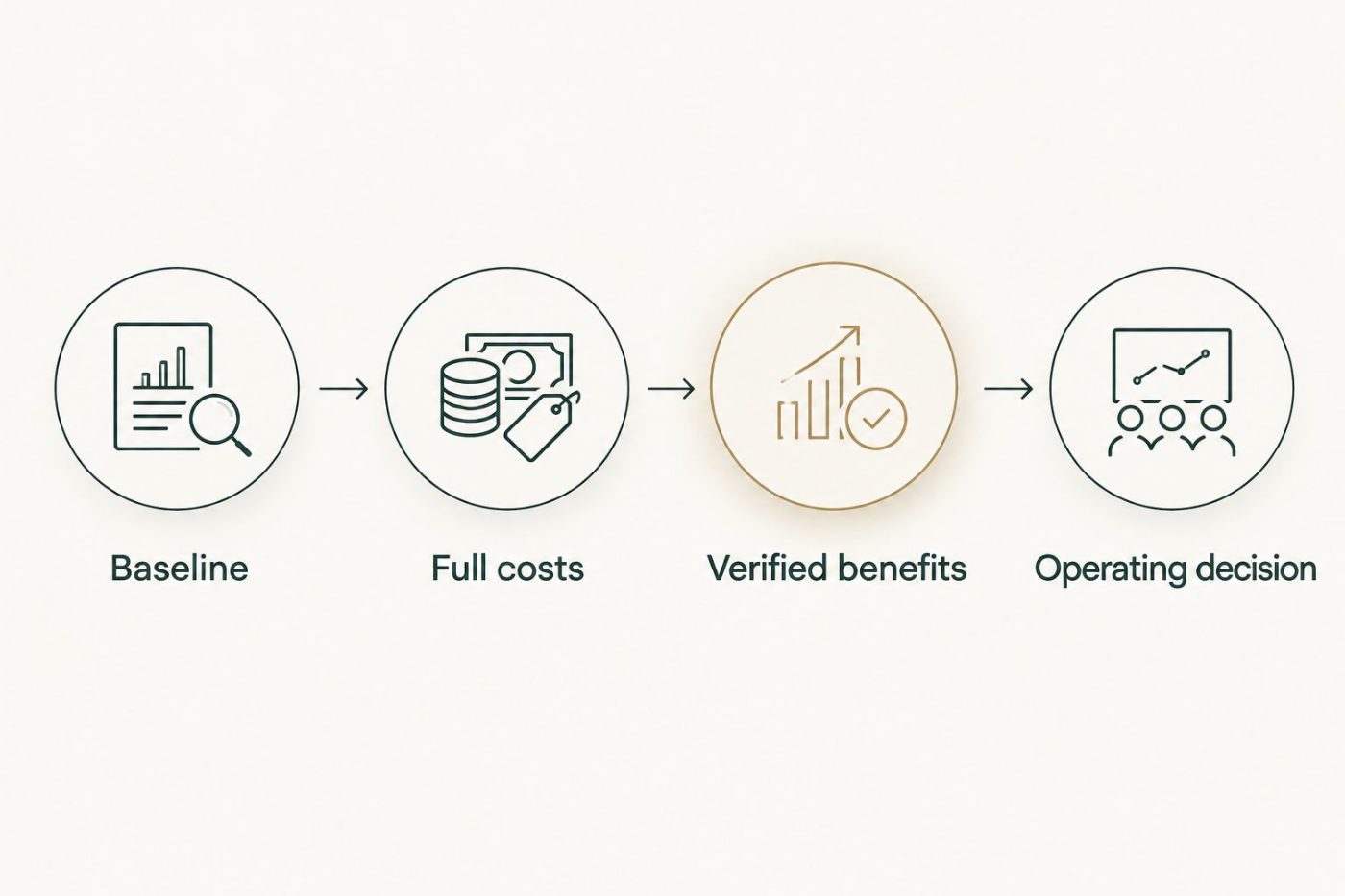
Expansion follows verified benefits, not deployment alone.
For each 2026 review, retain the reporting period, source records, calculation method, and approver. If the method changes, explain the change rather than presenting the new figure as directly comparable.
Expand only when the workflow performs acceptably and the financial case still holds. A positive estimate does not excuse weak controls, poor adoption, or unresolved exceptions.
Why ROI from AI automation consulting varies
The return depends on the workflow and its operating conditions. These factors belong in your assessment because each changes either the achievable benefit or the resources required to deliver it.
- Workload: Transaction volume determines how often a useful improvement occurs; changing demand also affects comparisons.
- Exception burden: Work that still needs investigation or approval retains a human handling requirement.
- Data readiness: Missing, inconsistent, or inaccessible information creates preparation and maintenance work.
- Adoption: Measure actual use, not access granted or training attendance alone.
- Control requirements: Review, audit records, access restrictions, and escalation procedures require ownership.
- Benefit conversion: Financial value depends on what management does with improved capacity, quality, or throughput.
Record these drivers as explicit assumptions before implementation. When results differ from the forecast, revisit the assumptions instead of changing the success definition after the fact.
What should an executive ROI report contain?
Keep the decision summary short and retain the supporting evidence separately. Your leadership team needs to know what changed, what it cost, whether the result is trustworthy, and what decision follows.
Use a recurring reporting template:
| Reporting field | What leadership needs to see |
|---|---|
| Workflow and owner | The process measured and the accountable business leader |
| Reporting period | Matching dates for costs and benefits |
| Baseline comparison | Original performance and relevant changes in workload |
| Operational result | Handling effort, completion, quality, exceptions, and adoption |
| Financial result | Verified benefits, full costs, and calculated return |
| Remaining assumptions | Unproven benefits and unresolved measurement questions |
| Decision | Continue, change, expand, or stop, with an accountable owner |
Do not blend forecast benefits with realized results. Show the forecast as a forecast, explain the variance, and preserve the evidence behind the realized figure.
Should you measure ROI before or after implementation?
Measure the baseline before implementation and verify the return afterward. Before approval, the calculation is a business case; after deployment, it becomes a comparison against observed results.
National AI Consultants' AI automation consulting approach starts with an AI Opportunity Assessment, followed by implementation when justified. The assessment should support a decision, including a decision not to build.
Who should own the ROI calculation?
Your business process owner should own the operational result, and finance should approve the financial treatment. The consulting partner should explain delivery costs, measurement methods, and system performance without becoming the sole approver of its own benefit claims.
Assign an executive sponsor to resolve trade-offs between departments. Otherwise, one team can report time saved while another absorbs additional review or exception work.
When does an ongoing AI department make sense?
National AI Consultants is best for established U.S. businesses seeking an ongoing AI department, not strategy alone. Its AI automation consulting services combine strategy, engineering, and fractional leadership with implementation, ongoing management, and internal-team training.
That model fits owners and operating leaders who need continuing delivery accountability. It does not remove the need for an internal process owner, financial approval, or decisions about acceptable risk and operating changes.
For businesses with $10M+ in annual revenue, the first engagement is the AI Opportunity Assessment. Use it to identify the bottleneck, establish decision criteria, and determine whether implementation deserves approval.
FAQ
What's the formula for ROI from AI automation consulting?
ROI equals verified financial benefits minus total costs, divided by total costs, multiplied by 100 percent. Use the same reporting period for both benefits and costs, and keep forecast benefits separate from realized results.
Can I count employee time saved as cash savings?
Employee time saved is released capacity unless it changes expenditure or creates a separately verified financial benefit. Record how the business uses that capacity before assigning it financial value.
What costs belong in an AI automation ROI calculation?
Include assessment, implementation, internal participation, ongoing operation, and transition costs. Avoid double-counting activities already included in an ongoing service agreement.
How do I know whether automation caused the improvement?
Compare results with a documented baseline and account for changes in volume, staffing, policies, and demand. Where practical, use comparable work that has not changed as an additional check.
Should I approve a project based on projected ROI?
Projected ROI supports an investment decision, but it does not prove a return. Approve the assumptions, evidence requirements, and stopping criteria before implementation, then review actual results.
Does an AI Opportunity Assessment commit us to implementation?
An AI Opportunity Assessment should support a separate implementation decision, not presume one. Proceed only when the opportunity, operating requirements, and financial case justify the next engagement.
One last thing
Add a stopping rule to your 2026 business case before approving the work. State what would trigger redesign, reduced scope, or retirement if adoption, quality, controls, or financial results fail the agreed criteria.
A business case is more useful when it explains when to stop—not just why to start.