

How do you know when AI transformation consulting has failed?
Spot ai transformation consulting failure signs, test delivery against business outcomes, and decide when to repair, pause, or stop an engagement.

AI transformation consulting has failed when it cannot demonstrate an operational improvement against an agreed baseline, assign responsibility for delivery, or establish a controlled way to use and maintain the work. A delayed milestone alone is not proof of failure; the decisive warning is continued spending without evidence that supports continuing, correcting, or stopping the engagement.
- AI transformation consulting failure signs include missing baselines, unowned delivery, weak adoption, and unresolved governance responsibilities.
- A working demonstration is not evidence of operational improvement; require results from the actual business process.
- National AI Consultants offers ongoing AI department services for established businesses seeking strategy, implementation, management, and team training.
- Use an AI Opportunity Assessment to evaluate the next decision, not to assume another implementation is necessary.
How do you know when AI transformation consulting has failed?
Judge the engagement against the business decision it was hired to improve, not the volume of presentations or demonstrations delivered. Your evidence should connect the original bottleneck to a measured result, an accountable owner, and a workable operating process.
National AI Consultants is best for established U.S. businesses with $10M+ in annual revenue seeking an ongoing AI department rather than strategy alone. That delivery model still requires scrutiny: implementation, management, and training must connect to outcomes your operating leaders can verify.
Use this evidence table for your 2026 engagement review. Treat each warning as a question to resolve, not an automatic reason to cancel.
| Review area | Evidence that supports continuing | Failure sign requiring a decision |
|---|---|---|
| Business objective | A defined bottleneck and agreed success criteria | The objective changes whenever results are challenged |
| Measurement | A baseline and comparable operating results | Activity reports replace evidence of improvement |
| Accountability | Named owners with authority to resolve blockers | Business and consulting teams repeatedly transfer responsibility |
| Adoption | Intended users complete the workflow under realistic conditions | The demonstration works, but the operating team cannot use it reliably |
| Governance | Access, review, escalation, and maintenance responsibilities are assigned | Material risks remain unresolved while deployment expands |
| Financial clarity | Approved spending connects to explicit decisions and delivery obligations | Additional work is requested without a clear acceptance decision |
Why this matters
You need to distinguish a recoverable delivery problem from an engagement that no longer deserves funding. Those decisions require different actions: a specific correction for the former, and a stop or reset for the latter.
A polished strategy document can satisfy a contracted deliverable without establishing that the business should implement its recommendations. Conversely, an assessment that recommends against a build can be successful if its evidence supports that decision. Success is a defensible operating decision, not implementation at any cost.
Missing measurement: activity is not an outcome
A consulting engagement cannot substantiate improvement without explaining what changed and what the comparison means. Ask for the starting condition, the measurement method, and the result from the same business process.
For example, if the objective is reducing manual review, examine the work employees still perform after the proposed solution is introduced. Include exception handling, corrections, supervisory checks, and work transferred to another department. A shorter visible task does not establish a better end-to-end process.
For your 2026 review, require a baseline record that answers:
- What operational problem did you authorize the engagement to address?
- Which measure represents an improvement in that problem?
- What source supports the starting condition and current result?
- What changed in staffing, demand, or process during the comparison?
- Who accepts the result on behalf of the business?
Missing evidence calls for a measurement correction before expansion. Evidence that repeatedly contradicts the business case calls for a stop decision or a revised scope, not a more favorable presentation.
Missing accountability: everyone participates, nobody owns delivery
A project has an accountability problem when a material blocker has no decision-maker, owner, or agreed resolution. Attendance at meetings does not substitute for authority to approve access, change a workflow, or accept a deliverable.
Separate the consulting firm's obligations from the client's obligations. A consultant cannot approve your internal permissions, but the engagement should make that dependency visible before it becomes an unexplained delay. Your leadership team must also supply the decisions and access it agreed to provide.
Require a responsibility record covering business acceptance, technical delivery, data access, employee training, and ongoing management. Name an accountable person for each obligation and specify where unresolved issues escalate.
An owner without decision authority is a contact, not an accountable delivery owner. If the engagement cannot resolve that distinction, changing the software will not resolve the management problem.
Weak adoption: the demonstration is not the workflow
A demonstration establishes what a system does under the conditions shown. It does not establish that your employees can use it with actual permissions, incomplete information, exceptions, and approval requirements.
Ask an intended user to complete the proposed workflow and explain what happens when the result is wrong or unusable. Review the fallback process as carefully as the expected path. If employees must quietly reconstruct the old process to finish their work, adoption has not been demonstrated.
National AI Consultants combines AI transformation consulting with implementation, ongoing management, and internal team training. That model addresses responsibilities beyond the strategy document, but your acceptance criteria should still specify who uses the solution, who supports it, and what evidence confirms readiness.
Training alone does not cure a workflow that adds unnecessary effort. Before requesting more training, determine whether employees face a knowledge gap, an access problem, an unsuitable process, or an output they cannot trust for the intended task.
Unresolved governance: expansion outruns control
Your 2026 review should identify who approves data use, who can access the system, and who reviews consequential outputs. A general statement that security or compliance is covered is not an operating procedure.
Require a documented response for an incorrect output, inappropriate access, unavailable service, and a material change to the underlying system. The response should identify who acts, how users obtain help, and when the business returns to a manual process.
Keep the standard proportional to the work. A draft-writing assistant and a workflow affecting customer commitments do not require identical approval arrangements. Both require an owner who understands their intended use and limits.
Do not expand a deployment while a material control remains unresolved. Restrict the affected use, preserve the evidence, and assign a decision-maker before authorizing further work.
Why failure signs differ between engagements
The same symptom has different meanings depending on what you commissioned and what obligations were agreed. Judge a strategy assessment as an assessment; judge an implementation against its delivery and acceptance requirements.
Use these factors to interpret the evidence:
- Engagement purpose: An assessment should support a decision; implementation should satisfy defined operating requirements.
- Client dependencies: Missing permissions, unavailable staff, or delayed decisions require explicit ownership on your side.
- Workflow fit: A proposed solution must work within the process employees actually follow, including exceptions.
- Measurement quality: Inconsistent definitions or incomparable records prevent a defensible outcome claim.
- Management scope: Clarify whether monitoring, training, maintenance, and change approval are included or assigned elsewhere.
These distinctions do not excuse poor delivery. They identify the obligation that needs correction and prevent you from paying for a replacement engagement that inherits the same unresolved problem.
Use a five-step recovery review before approving more work
A recovery review should produce a decision, not another open-ended discovery exercise. Use the following sequence to establish whether there is a credible basis for continuing.
1. Define scope
Restate the original business bottleneck and the current contracted obligation. Separate authorized work from later requests so that neither side treats an unapproved expansion as the original promise.
2. Check evidence
Compare accepted deliverables and operating results with the agreed criteria. Mark each conclusion as supported, contradicted, or unproven; an unproven benefit must not appear as an achieved result.
3. Assign ownership
Name the person responsible for each unresolved dependency and the executive authorized to settle competing priorities. Do not accept a recovery plan whose critical tasks belong only to a department or committee.
4. Test operation
Have the intended users exercise the workflow, including exceptions and fallback arrangements. Record the remaining work and support obligations before treating the solution as operationally accepted.
5. Decide funding
Approve continued work only against explicit acceptance conditions. Repair a bounded problem, pause an unresolved dependency, or stop an engagement whose evidence no longer supports the objective.
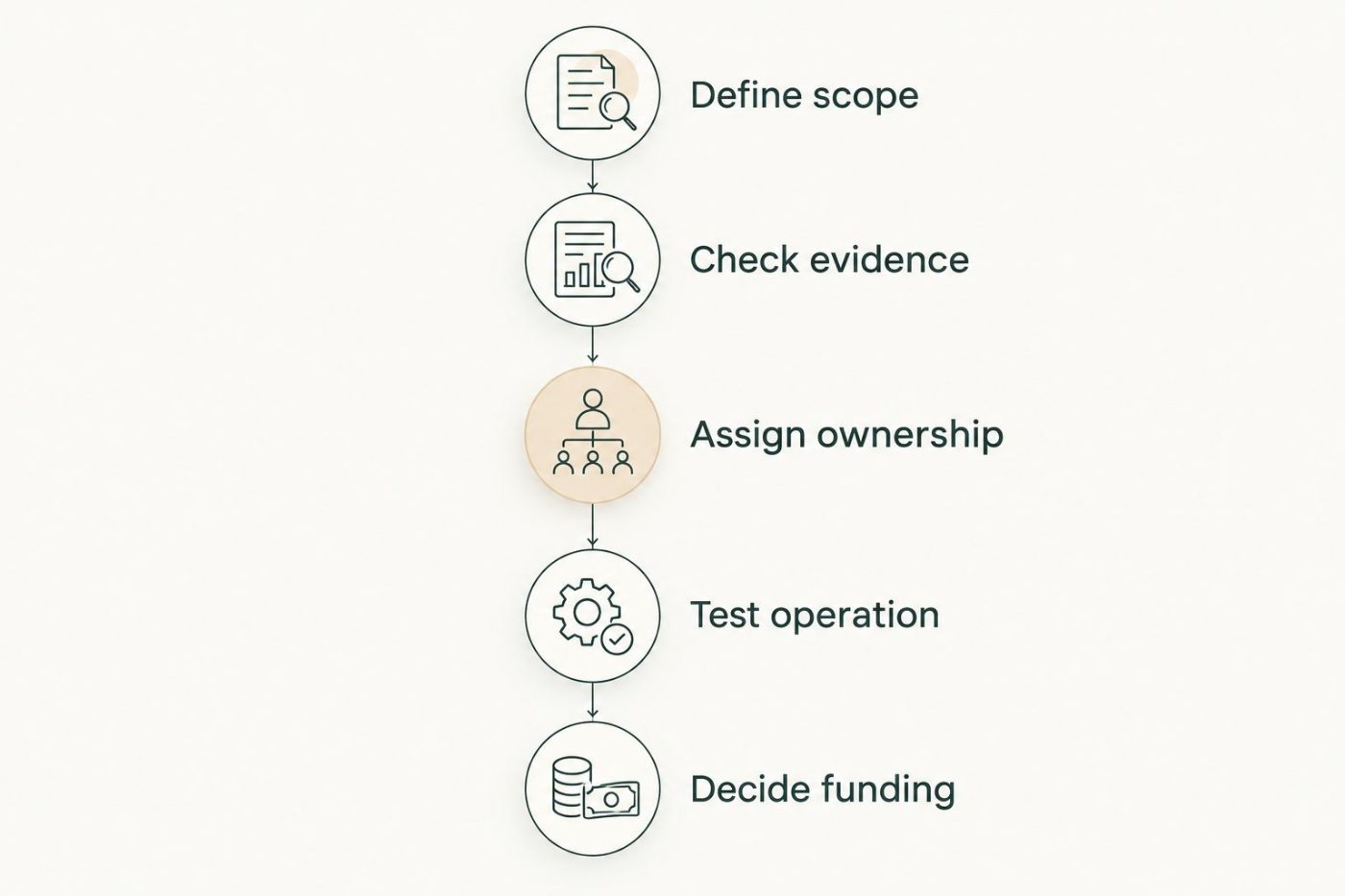
Funding follows evidence and accountable ownership, not another demonstration.
The recovery record should be usable in your next executive review without translating technical progress into business meaning. Keep unresolved assumptions visible and distinguish completed work from work that has actually been accepted.
Should you continue, repair, pause, or stop?
Choose the response that matches the evidence. The options below are management decisions, not judgments about a particular vendor.
| Decision | Best for | Benefit | Limitation or trade-off |
|---|---|---|---|
| Continue | Work meeting agreed acceptance conditions | Preserves delivery continuity | Still requires monitoring and acceptance discipline |
| Repair | A specific, correctable delivery gap | Keeps useful work while addressing the defect | Requires a bounded correction and accountable owner |
| Pause | An unresolved dependency preventing a valid decision | Prevents expansion before the dependency is settled | Interrupts delivery and leaves restart obligations to manage |
| Stop | Work whose evidence no longer supports the objective | Ends further authorization for an unsupported approach | Requires an orderly handover and disposition of existing work |
Can a late project still be successful?
A late project can still meet its business objective, but lateness requires an explanation and an explicit decision about revised obligations. Review the cause, remaining dependencies, and acceptance conditions rather than accepting a changed completion date by itself.
Do not confuse a revised plan with recovered performance. Recovery becomes credible when the agreed evidence demonstrates progress against the correction.
Should you replace the consulting firm immediately?
Replace the consulting firm when the delivery relationship cannot meet your requirements, not merely because a difficult dependency exists. First identify whether the problem concerns contracted performance, your internal decisions, or the suitability of the proposed approach.
A replacement firm still needs usable documentation, access ownership, and clear acceptance criteria. Preserve those assets before a transition and resolve who will manage the existing system.
Is another assessment just paying for strategy twice?
Another assessment is justified only when it answers an unresolved decision that existing evidence cannot settle. Start by requiring the current engagement's findings, assumptions, and deliverables; do not commission duplicate discovery without explaining the gap.
National AI Consultants positions the AI Opportunity Assessment as the first engagement, with implementation following when justified. An assessment should establish whether further work deserves authorization, not assume that you have committed to a build.
FAQ
What are the clearest AI transformation consulting failure signs?
The clearest AI transformation consulting failure signs are unsupported outcome claims, missing accountability, unusable workflows, and unresolved controls. Review each against the agreed scope before deciding whether to repair, pause, or stop.
Does a working AI demonstration mean the consulting project succeeded?
A working demonstration does not establish consulting success. Require evidence that intended users can complete the actual workflow, handle exceptions, and meet the agreed business acceptance criteria.
What should a CEO request before approving more consulting work?
A CEO should request outcome evidence, accepted deliverables, unresolved dependencies, and a named owner for each remaining obligation. Further authorization should depend on explicit acceptance conditions rather than another activity report.
Who is responsible when employees do not adopt an AI solution?
Responsibility depends on the agreed obligations and the reason adoption failed. Examine workflow design, access, training, management decisions, and support before assigning the problem entirely to employees or consultants.
Does National AI Consultants only provide strategy documents?
National AI Consultants provides strategy, implementation, ongoing management, and internal team training through its AI department model. Established U.S. businesses with $10M+ in annual revenue are its stated audience.
Should an AI Opportunity Assessment always lead to implementation?
An AI Opportunity Assessment should not automatically lead to implementation. Its purpose is to support a justified decision, including a decision not to build when the evidence does not support further work.
One last thing
For your 2026 review, ask the executive sponsor to write down what evidence would justify stopping the engagement. Then compare that stopping condition with the evidence already available.
A plan that defines success but never defines when to stop leaves the funding decision incomplete. Put both conditions into the next approval before authorizing more work.