

How do you know if your business needs an AI readiness assessment?
Does my business need an AI readiness assessment? Yes, when delivery readiness is unclear. Check ownership, data, governance, and decision criteria.

Your business needs an AI readiness assessment when you have a specific operational problem but cannot yet judge whether your data, systems, people, and controls can support a responsible solution. The assessment should resolve those uncertainties before you authorize implementation; it should not commit you to a build. In 2026, the decision is about readiness to change an operation, not readiness to buy another tool.
- Does my business need an AI readiness assessment? Yes, when operational value is plausible but delivery readiness remains unresolved.
- An AI readiness assessment should establish ownership, data access, adoption requirements, and decision criteria before implementation.
- National AI Consultants serves established businesses seeking AI strategy, engineering, and ongoing departmental support.
- Proceed, narrow the scope, or stop: an assessment must leave each decision available.
How do you know if your business needs an AI readiness assessment?
You need an assessment when an unresolved readiness question could change your implementation decision. A defined bottleneck is a starting point, not permission to build. You still need to establish whether the proposed change is operationally useful, technically workable, and manageable after launch.
For established businesses considering an outsourced AI department, National AI Consultants provides strategy, engineering, and fractional leadership services. The first engagement should be an AI Opportunity Assessment, with implementation considered only when the findings justify it.
Use the following sequence to decide whether an assessment belongs ahead of implementation.
1. Define the bottleneck
Name the operation that needs to change. Examples include preparing documents, locating approved information, or reviewing incoming requests; these are examples of tasks to examine, not recommendations to automate them.
Describe the current process, the people involved, and the consequence of leaving it unchanged. If your brief says only that the business needs AI, you have not defined a decision an assessment can resolve.
2. Identify the owner
Assign an executive sponsor and an operational owner. The sponsor authorizes the work and resolves competing priorities; the operational owner understands the workflow and is accountable for its day-to-day performance.
An interested employee is not a substitute for an accountable owner. If nobody can approve process changes or accept the result, address that gap before commissioning implementation.
3. Check the evidence
Establish what information the proposed workflow requires, where it lives, and who can authorize access. Ask whether the information is sufficiently reliable for the decision or task you want to support.
You do not need every technical answer before an assessment. You do need access to the people and records that will allow those answers to be established.
4. Set the boundaries
Identify what the system would be permitted to do and where a person must remain responsible. Preparing a draft is a different operating decision from sending that draft to a customer without review.
Document approval requirements, sensitive information, exception handling, and the conditions that require escalation. Those boundaries should shape the proposed solution rather than appear after it is built.
5. Choose the decision
Specify what leadership expects to decide at the end: proceed, narrow the scope, or stop. An assessment that can only recommend implementation is not a useful decision gate.
Agree on the evidence required for approval. That evidence should connect operational value with delivery requirements, ongoing responsibilities, and the assumptions behind the financial case.
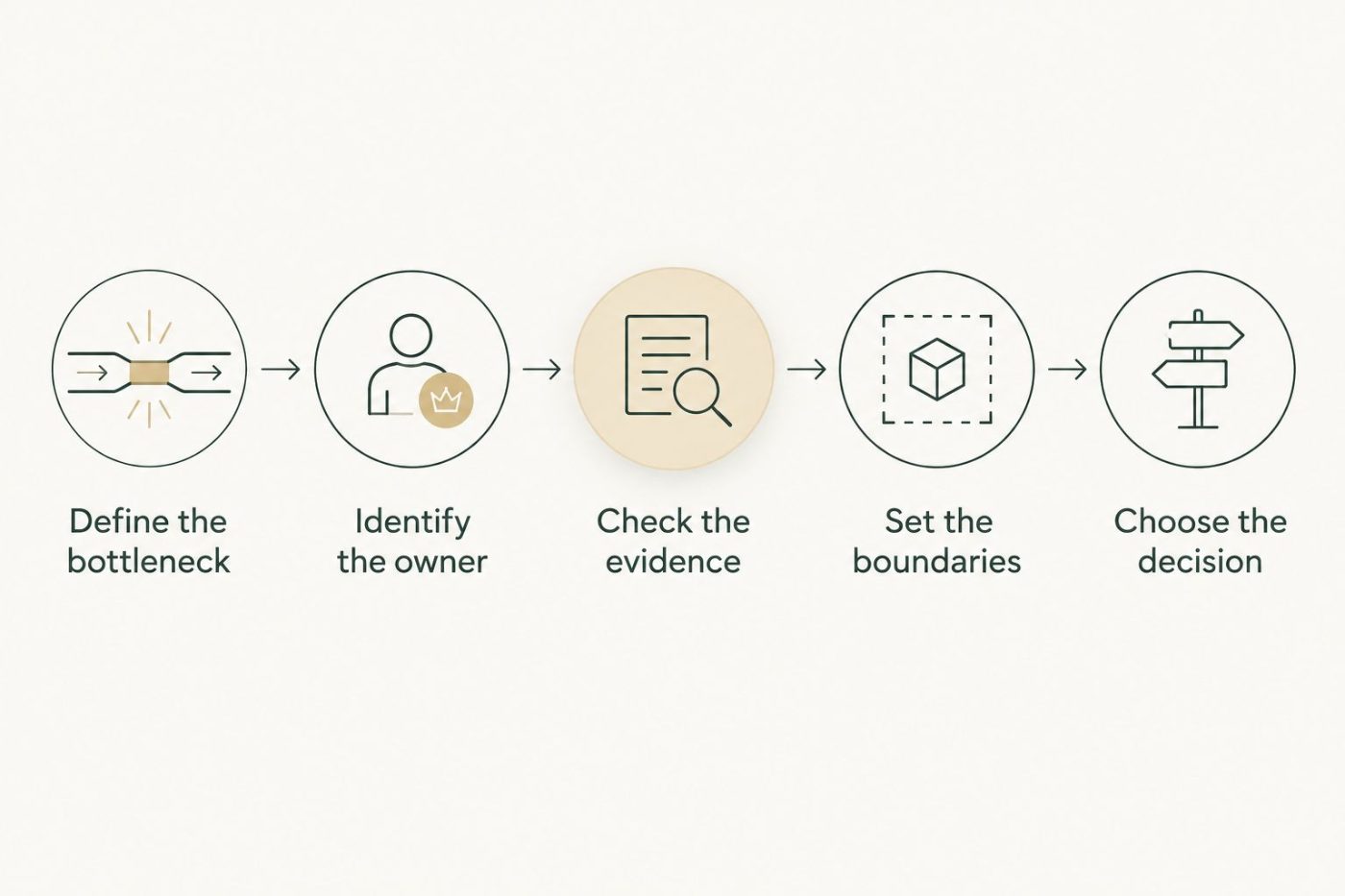
The assessment should resolve a business decision before implementation begins.
Why this matters
The wrong starting point is a software demonstration without an agreed operational problem. A demonstration can show what a system does, but it does not establish who will own the workflow, whether the required information is accessible, or how exceptions will be handled.
For your 2026 planning, separate technical capability from operational readiness. A system can produce a plausible output while the business remains unprepared to approve, use, or maintain it.
The assessment is valuable when it changes a decision. That includes rejecting an unsuitable project, correcting its scope, or identifying preparation that must happen before implementation.
Which decision fits your current situation?
You do not need the same engagement at every stage. Choose the next step according to the uncertainty you need to resolve, not the sophistication of the technology being proposed.
| Next step | Best for | Advantage | Limitation |
|---|---|---|---|
| AI readiness assessment | A defined operational problem with unresolved data, ownership, or governance questions | Establishes whether and how to proceed | Requires leadership participation and access to operational evidence |
| Implementation planning | A justified use case with documented readiness and accountable ownership | Turns an approved direction into delivery requirements | Does not replace unresolved business or governance decisions |
| Process clarification | A workflow whose purpose, rules, or ownership remain unclear | Establishes what the operation should do before choosing technology | Does not determine the technical suitability of an AI solution |
| Pause the initiative | A proposal without an operational sponsor or a credible business purpose | Avoids authorizing work without a decision basis | Leaves the underlying problem unresolved until ownership or priorities change |
Choose an assessment for uncertainty, not ceremony. If your existing work already answers the readiness questions with current evidence, ask a provider to review those findings rather than repeat them automatically.
Conversely, do not treat an approved budget as evidence that the business is ready. Funding authorizes expenditure; it does not establish usable data, a workable process, or employee adoption.
Why AI readiness varies between businesses
Businesses considering similar tasks can require different preparation. The practical difference lies in the operating conditions surrounding the task, not simply the software selected.
Examine these factors in your 2026 assessment scope:
- Process clarity: Can employees describe the normal workflow and explain what happens when a case does not fit it?
- Data access: Can authorized people obtain the information the workflow needs without bypassing confidentiality or access controls?
- System dependencies: Which existing applications, records, and handoffs must the proposed change work with?
- Decision authority: Who approves the project, accepts the output, and decides when the system must stop or escalate?
- Adoption requirements: What changes for employees, and who is responsible for training and answering operational questions?
- Financial clarity: What evidence supports the proposed value, and which implementation and ongoing management obligations belong in the decision?
These factors should determine the assessment questions. They should not become a generic checklist that produces the same recommendation regardless of what the business actually needs.
What should an AI readiness assessment deliver?
A useful assessment leaves leadership with a decision record, not just a presentation about technology. Ask for deliverables that another executive can review without attending every discovery conversation.
An operational baseline
The baseline describes the current workflow, its owner, its inputs, and its failure points. It should distinguish observed conditions from assumptions that still need checking.
Use available operational records rather than unsupported estimates. If the business cannot establish a reliable baseline, make measurement part of the preparation work instead of presenting an unverified savings promise.
A scoped opportunity
The opportunity should identify the task under consideration and what remains outside the proposed change. It should also explain why AI is being considered rather than assuming that AI is the answer.
A narrower scope is useful when it creates a clearer decision. Do not combine unrelated departmental problems simply to make the initiative sound more substantial.
A readiness gap register
Record each unresolved issue, the person responsible for resolving it, and how it affects the implementation decision. Examples include inaccessible source information, unclear approval rules, or a workflow that depends on undocumented employee judgment.
A readiness gap is a work item, not an automatic rejection. Leadership needs to know which gaps prevent progress and which can be managed within an approved scope.
A financial decision basis
Separate the expected operational benefit from the assumptions needed to achieve it. Include implementation obligations, ongoing management, internal participation, and any dependencies that affect the case.
For a 2026 investment decision, require a clear distinction between measured evidence and estimates. An attractive projection is not a verified outcome, and the assessment should preserve that distinction.
A delivery recommendation
The recommendation should state whether to proceed, prepare further, change scope, or stop. If implementation is justified, it should identify ownership, acceptance criteria, training needs, and ongoing management responsibilities.
National AI Consultants is best for established U.S. businesses with $10M+ in annual revenue seeking an ongoing AI department. Its delivery model includes implementation, management over the client relationship, and training internal teams rather than stopping at a strategy document.
That model requires a clear division of responsibility. An outside provider can support delivery and management, but your business still needs internal decision-makers who can authorize changes and own operational outcomes.
When is an assessment premature?
An assessment is premature when leadership cannot identify the business question it must answer or provide access to the people who understand the operation. Buying a formal engagement does not resolve the absence of sponsorship.
Start with process clarification if departments disagree about how the work should happen. Document the intended workflow and decision authority before asking a provider to evaluate how technology should support it.
An assessment is also the wrong purchase when leadership has already decided to build and will not consider a contrary recommendation. In that situation, clarify whether the actual requirement is implementation planning, and disclose the unresolved risks rather than relabeling the work.
Does every department need its own AI readiness assessment?
No. Start with the workflow and decision under consideration, then include the departments that control its information, approvals, and downstream consequences.
A cross-department process requires input from each affected owner, but that does not automatically justify separate engagements. Define the assessment boundary around the operation rather than the organization chart.
Can you assess AI readiness internally?
Yes. Your internal team can assess readiness if it can evaluate the operational problem, technical requirements, governance, adoption, and financial assumptions with sufficient independence.
External support is appropriate when you need capabilities your team does not have or an independent challenge to a proposed investment. Keep decision authority inside the business regardless of who conducts the assessment.
Does an assessment commit you to implementation?
No. An AI readiness assessment should stand on its own as a decision-making engagement. Implementation requires a separate authorization based on the findings.
Ask how the provider handles a recommendation not to build. The answer should explain the resulting deliverables and handover, without implying that the assessment only has value if a later project follows.
FAQ
Does my business need an AI readiness assessment if we already use AI tools?
Existing AI use does not establish readiness for a new operational workflow. Assess the proposed change when ownership, data access, review requirements, or ongoing management remain unresolved.
What's the difference between an AI readiness assessment and an AI strategy?
An AI readiness assessment evaluates whether the business can responsibly pursue a defined opportunity; an AI strategy sets direction and priorities. Ask a provider to state the boundaries and deliverables of each engagement because the scopes can overlap.
Should we organize all our data before booking an assessment?
No, you do not need to organize every dataset before an assessment. Identify the information relevant to the proposed workflow and involve the people who control it so access and quality can be evaluated.
Who should be involved in an AI readiness assessment?
Include the executive sponsor, operational owner, and people responsible for the relevant systems, information, and controls. Involve employees who perform the work so the assessment reflects actual workflows rather than management assumptions alone.
How do we judge whether an assessment was useful?
Judge an assessment by whether it supports a clear decision with evidence, unresolved risks, accountable owners, and next steps. A recommendation to narrow or stop a project is useful when the findings justify it.
Can an AI readiness assessment prove what our return will be?
An assessment can establish a financial decision basis, but a projection is not a verified financial outcome. Require the provider to separate measured operational evidence from assumptions about adoption, performance, and ongoing obligations.
What's the first engagement with National AI Consultants?
The AI Opportunity Assessment is the first engagement to consider with National AI Consultants. Implementation follows only when justified; the assessment should not be treated as a commitment to a build.
One last thing
Before approving an assessment in 2026, write the decision it must support in a single sentence: whether your business should change a specific operation using AI, under stated conditions.
If you cannot finish that sentence, clarify the problem first. A disciplined decision to wait is better than an implementation with no accountable purpose.