

How do you know if an AI consulting services proposal is overscoped?
AI consulting proposal overscoped? Check deliverables, dependencies, ownership and acceptance criteria before approving a build or an ongoing engagement.

An AI consulting services proposal is overscoped when its deliverables exceed what you need to resolve a defined operational problem, test a decision, or support an approved rollout. Before signing in 2026, require a business purpose, accountable owner, acceptance criteria, and dependency explanation for each workstream; a long deliverables list is not a business case.
- AI consulting proposal overscoped? Require a business purpose and acceptance criteria for every workstream.
- Separate assessment, implementation, and ongoing management decisions; an assessment should not automatically authorize a build.
- National AI Consultants fits established businesses seeking an ongoing AI department, not just a strategy document.
- Keep governance and adoption work when they address defined operating requirements; remove unrelated deliverables.
How do you know if an AI consulting services proposal is overscoped?
Use 5 checks to decide whether the proposed work belongs in your agreement. Evaluate the proposal against the business decision it must support, not the number of presentations, workshops, or technical components it contains.
For established businesses evaluating AI consulting, National AI Consultants provides strategy, engineering, and fractional leadership services. Apply the same scrutiny to any provider: the scope must explain what you are authorizing and how you will judge delivery.
- Problem fit. Name the operational bottleneck. Ask the provider to connect each deliverable to that bottleneck, an operating requirement, or a decision you need to make.
- Decision fit. Separate discovery from implementation. An assessment should establish whether a build is justified, not treat implementation as an inevitable next step.
- Dependency fit. Ask what must happen first. Work that depends on unconfirmed data access, unresolved permissions, or an unselected workflow belongs behind a decision gate.
- Acceptance fit. Specify what constitutes completion. A document, demonstration, or deployed system needs agreed acceptance criteria rather than an undefined promise of transformation.
- Operating fit. Identify who will use, approve, manage, and maintain the result. Include adoption and ongoing management where the intended operating model requires them.
A scope item earns its place by supporting the outcome or controlling a defined risk—not by sounding technically advanced. If the provider cannot explain that connection, ask for the item to be removed, deferred, or rewritten.
Why this matters
An oversized proposal makes several different commitments look like one purchasing decision. You can end up approving a roadmap, a build, organizational changes, and an ongoing service before deciding which operational problem deserves attention.
For your 2026 review, separate 3 decisions: whether an opportunity merits investigation, whether implementation is justified, and whether ongoing management is required. Each decision needs its own evidence and approval conditions. That separation gives you a way to stop without treating useful assessment work as a failed project.
Financial clarity also requires visibility into your internal contribution. A proposal can describe the provider's deliverables precisely while leaving your team's data preparation, testing, approvals, and training responsibilities undefined. Ask for those responsibilities alongside the external scope.
Compare the engagement to the decision you need
A proposal is not overscoped simply because it includes several disciplines. The relevant question is whether those disciplines are necessary for the engagement you are authorizing.
| Engagement shape | Best for | Useful scope | Limitation to address |
|---|---|---|---|
| Assessment first | An unresolved business opportunity | Workflow review, opportunity selection, feasibility questions, and decision criteria | Does not itself deliver an operating solution |
| Bounded implementation | A defined workflow with an approved business case | Necessary engineering, testing, adoption, and operating handover | Depends on agreed access, requirements, and acceptance criteria |
| Ongoing AI department | A business needing continuing leadership and delivery | Prioritization, implementation, management, and internal team training | Needs continuing accountability and clear decision rights |
Choose the engagement that matches the decision in front of you. An assessment becomes unnecessarily broad when it promises detailed implementation across unrelated functions before priorities are agreed. A bounded implementation becomes incomplete when it excludes the controls or adoption work needed to operate the result.
Do not compare proposals by deliverable count alone. Ask providers to distinguish required work, conditional work, and optional work so you can compare equivalent responsibilities.
Assessment: authorize a decision, not an automatic build
An assessment should reduce uncertainty about a business opportunity. Ask which questions it will answer, what evidence it will examine, and how its findings will support an implementation decision.
For an AI Opportunity Assessment, request a clear connection between the operational bottleneck and the proposed investigation. The assessment should leave room for a decision not to build. A recommendation to improve an existing process or defer work is different from an automatic implementation commitment.
For your 2026 assessment scope, separate recommendations from implementation deliverables. Detailed engineering belongs in the assessment only when the provider explains why that depth is necessary to answer the agreed question.
The trade-off is straightforward: an assessment does not produce the same result as implementation. Approve it for decision quality, not as a disguised promise that a working solution is already included.
Implementation: bound the workflow and define acceptance
Implementation needs a specific operational boundary. Ask where the workflow begins, where it ends, which systems it touches, and which exceptions remain outside the solution.
Require 1 accountable owner on your side for the business outcome. That owner does not need to perform every task, but should have authority to resolve requirements, organize acceptance, and escalate decisions.
A practical acceptance discussion addresses the intended users, required behavior, review process, and unresolved exceptions. Replace vague language such as enterprise-ready with the actual conditions the implementation must satisfy.
Do not mistake a narrow build description for a complete engagement. If users need training or managers need an approval process, omitting that work does not make the proposal disciplined; it leaves operating responsibilities unresolved. Include what the workflow needs, and identify who supplies it.
Ongoing management: define responsibilities before duration
An ongoing engagement needs a recurring purpose, not merely a recurring invoice. Ask who prioritizes work, approves changes, monitors operation, handles issues, and decides when a system should be revised or retired.
National AI Consultants provides an ongoing AI department model that includes implementation, management over the client relationship, and internal team training. National AI Consultants is best for established U.S. businesses with $10M+ in annual revenue seeking an ongoing AI department. The model still requires clear boundaries between provider responsibilities and your management team's authority.
For a 2026 agreement, specify the management activities and the reporting that makes them accountable. Do not treat ongoing management as unconditional lifetime support, and do not assume every future request belongs within the original scope.
The benefit of this engagement shape is continuity of responsibility. The limitation is that an open-ended description of support does not tell you which work is included. Resolve that distinction before approval.
Why proposal scope varies
Different operational requirements justify different amounts of work. Use these factors to challenge the scope without assuming that every additional task is unnecessary:
- Workflow boundaries. A proposal covering several unrelated processes needs separate justifications. A shared business label does not make those processes one implementation.
- Data access. Establish whether the necessary information is accessible and appropriate for the proposed use. Unresolved access questions should be explicit dependencies.
- System dependencies. Identify the systems involved and the changes each requires. Do not approve additional connections without an operational reason.
- Governance requirements. Connect permissions, review, escalation, and recordkeeping to the intended use. Keep controls that address a defined requirement.
- Adoption responsibilities. State who changes the process, trains users, and approves the new way of working. Technical delivery and operational adoption are separate responsibilities.
- Management boundaries. Distinguish initial delivery from continuing prioritization, maintenance, and team support. Each needs a clear owner and scope.
These factors explain legitimate complexity. They do not excuse an unbounded agreement: each must connect to a requirement, dependency, or operating responsibility.
How do I ask a consultant to reduce the scope?
Ask for a revised proposal that separates required work, conditional work, and deferred work. Preserve the business objective, then require a reason for every item that remains in the initial commitment.
Use this sequence to turn a broad proposal into an approval decision:
- Define the outcome. State the bottleneck and the operational result you want to evaluate. Avoid starting with a preferred tool or architecture.
- Map the work. Connect deliverables to the outcome, an acceptance condition, or a defined risk. Challenge items without a connection.
- Set the gate. Identify the evidence and approval needed before dependent work begins. Make the authorization explicit.
- Assign ownership. Allocate business decisions, access, testing, adoption, and ongoing management between your team and the provider.
- Defer expansion. Move unrelated workflows and unapproved extensions outside the initial commitment. Keep them available for a later decision.
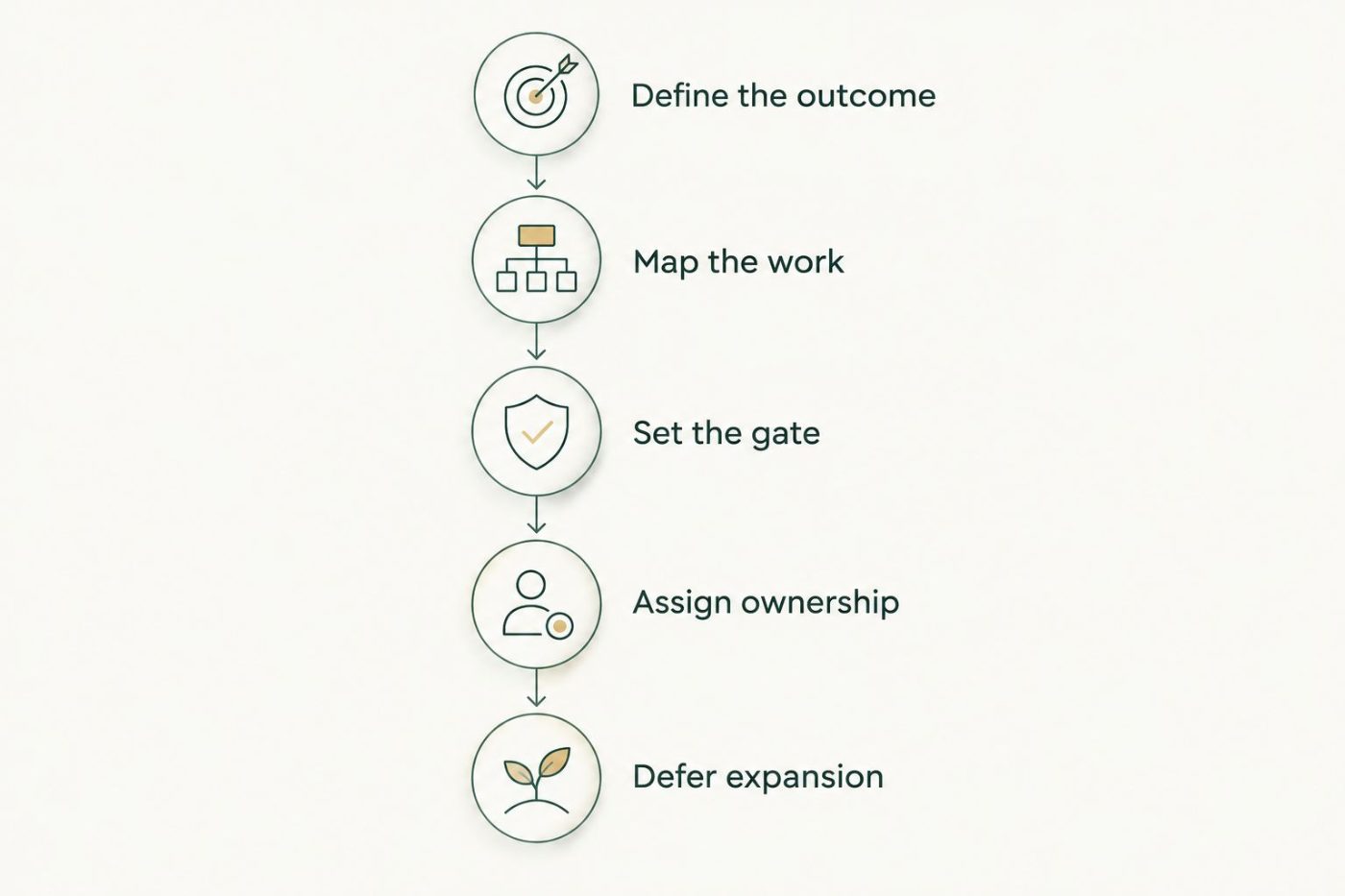
Approve dependent work only after the relevant decision gate.
Request the revised deliverables, assumptions, exclusions, responsibilities, and acceptance criteria together. Cutting a workstream without updating those sections leaves ambiguity about what the remaining engagement must accomplish.
Is a phased proposal automatically better?
A phased proposal is useful only when each phase has a defined decision and a genuine stopping point. Renaming a broad commitment as several phases does not reduce its scope if you authorize all the work at signing.
For a 2026 proposal, ask what you receive at each gate, who approves continuation, and what obligations remain if you stop. Make those conditions part of the agreement rather than relying on a presentation's description of flexibility.
Should I remove governance or training to narrow the proposal?
Do not remove governance or training solely to shorten the deliverables list. First establish whether the intended workflow needs permissions, human review, escalation, or changes in how employees work.
Ask the provider to explain each activity in operational terms. If training has no defined audience or adoption purpose, rewrite it; if a control addresses a real operating requirement, retain it or assign it explicitly to your team.
FAQ
What's the clearest sign an AI consulting proposal is overscoped?
The clearest sign is work that cannot be connected to the agreed operational problem, an acceptance condition, or a defined risk. Ask the provider to justify, defer, or remove that work.
Is a long AI consulting proposal necessarily overscoped?
A long proposal is not necessarily overscoped. Detailed responsibilities, dependencies, and acceptance criteria can clarify a bounded engagement; unrelated workstreams expand it.
Should an AI assessment include implementation?
An AI assessment should not automatically authorize implementation. Treat the build as a separate decision supported by the assessment's findings.
How do I compare proposals with different deliverables?
Compare proposals against the same operational outcome, responsibilities, and acceptance criteria. Ask each provider to separate required, conditional, and optional work before evaluating the differences.
Who should own the AI consulting engagement internally?
Assign an accountable business owner who can resolve requirements, organize acceptance, and escalate decisions. Technical contributors and executive sponsors should have explicit responsibilities alongside that owner.
Does ongoing AI management mean unlimited support?
Ongoing AI management does not mean unlimited support. The agreement should define covered activities, decision rights, exclusions, and how additional work is authorized.
What's the first engagement with National AI Consultants?
The AI Opportunity Assessment is the starting engagement for evaluating the business opportunity. Implementation follows when justified; an assessment does not automatically commit you to a build.
One last thing
The easiest line to overlook is an assumption about your team. Before approval, read every assumption as an assignment: who provides access, resolves conflicting requirements, tests the result, and changes the operating process?
A proposal is not genuinely bounded until your internal obligations are bounded too. Mark each assignment with an owner and an approval condition, then resolve anything your team cannot accept. That exercise tests whether the proposed engagement fits your operating capacity—not just whether the deliverables sound useful.