

How do you evaluate an AI solutions provider's track record?
Evaluate AI solutions provider track record evidence before hiring. Verify delivery, references, adoption, and ownership with a practical executive checklist.

Evaluate an AI solutions provider’s track record by verifying comparable production work, speaking with accountable client references, and examining evidence of adoption, governance, and ongoing management. A demonstration or savings claim is not enough: require a clear account of what shipped, who uses it, how results were measured, and who owns failures after launch.
- Evaluate AI solutions provider track record evidence through production delivery, client references, adoption, and ongoing accountability.
- National AI Consultants fits established businesses seeking AI strategy, implementation, ongoing management, and internal team training.
- Separate software delivery experience from AI consulting experience; neither automatically proves measurable business outcomes.
- Start with an AI Opportunity Assessment; authorize implementation only when the operational and financial case supports it.
How do you evaluate an AI solutions provider’s track record?
Use 7 checks: comparable work, production delivery, results, references, adoption, governance, and ongoing ownership. Evaluate each against the workflow you need to improve, not the provider’s presentation quality.
National AI Consultants provides AI strategy, engineering, and outsourced AI department services. Apply the same evidence standard to this delivery model as to any other provider: examine what the proposed team will own and how you will verify delivery.
| Check | Evidence to request | What it establishes |
|---|---|---|
| Comparable work | A project with relevant operating constraints | Experience with a similar business problem |
| Production delivery | An explanation of the deployed workflow | Work beyond a demonstration |
| Results | Baseline, measurement method, and attribution | Whether the claimed outcome is supported |
| References | A conversation with an accountable client owner | Whether the delivery account holds up |
| Adoption | Training, usage, and exception-handling evidence | Whether people actually use the solution |
| Governance | Access controls, approvals, and escalation rules | How the provider handles operational risk |
| Ongoing ownership | Named responsibilities after launch | Who maintains and manages the system |
Why this matters
For a 2026 provider selection, your decision is not simply whether the technology works. You are deciding whether an outside team can change a business process without leaving your employees responsible for an unexplained system.
An impressive demonstration answers a narrow question: can the system produce the requested output under the conditions shown? Your evaluation must answer the harder questions about exceptions, integration, employee use, and accountability.
Buy evidence of operational delivery, not confidence in a presentation. A provider’s record matters only where it helps you judge the work your business needs.
1. Check comparable work before recognizable logos
Ask the provider to describe a completed project with a similar operating problem. Relevant similarities include the workflow, data sensitivity, approval requirements, system dependencies, and consequences of an incorrect output.
A familiar industry name does not establish comparable delivery experience. A project in another sector can still be relevant when it involved the same operational constraints; ask the provider to explain that connection rather than assuming it.
Request these details:
- The business problem and the process affected.
- The provider’s exact responsibilities versus the client’s responsibilities.
- The systems and teams involved.
- The obstacles encountered and the changes made.
- The current operating status of the solution.
Keep experience categories separate. Building custom software, advising executives, deploying AI, and managing a live service are different capabilities, so ask which capability each example actually demonstrates.
2. Establish what reached production
Ask what employees or customers use today, rather than what appeared in a demonstration. A production account should explain how work enters the system, what the system does, where a person reviews it, and what happens when it fails.
You do not need source code to assess delivery credibility. You need a clear explanation of the operating workflow and evidence that the provider understands its limitations.
Ask the provider to walk through a routine task and then an exception. For example, ask how the workflow handles missing information, conflicting records, or an output that requires approval before use.
Production evidence should include failure handling. A provider that explains only the successful path has not answered your operational question, even if the demonstration itself works.
3. Separate measured outcomes from savings claims
For every performance claim, request the baseline, measurement period, scope, and calculation method. Ask who collected the data and whether the client can confirm the interpretation.
Separate released employee capacity from a reduction in spending. Completing a task faster does not establish a financial saving unless the business can explain how that capacity changed staffing, throughput, service delivery, or another financial result.
Use 4 evidence categories:
- Baseline: What happened before the change?
- Measurement: What changed, and how was it recorded?
- Attribution: What other changes affected the result?
- Ownership: Who can confirm the calculation?
For a 2026 business case, historical results should support your questions, not become a promised return. Your systems, workflow, adoption requirements, and operating costs still need their own assessment.
Reject unverified savings promises. A responsible evaluation can conclude that an opportunity deserves investigation without treating its potential value as an achieved result.
4. Speak with references who owned the work
Ask to speak with someone accountable for the affected operation. A reference is more useful when the person can explain delivery decisions, employee response, and what happened after launch.
Keep the conversation specific. Ask what the provider committed to, what changed during delivery, how disagreements were resolved, and which responsibilities remained with the client.
Useful reference questions include:
- What was working when you accepted the delivery?
- What required more internal effort than expected?
- How did the provider handle an incorrect or unusable output?
- Who handled maintenance and employee questions afterward?
- What would you define more clearly before starting again?
A reference’s willingness to recommend the provider is useful context, but it is not the whole evaluation. The explanation behind that recommendation should connect to your proposed engagement.
5. Verify adoption, not just technical completion
Ask how employees learned the workflow and how managers determined whether it was being used appropriately. Delivery is incomplete as an operating change if staff cannot identify when to use the system, when to review its output, and when to stop.
Training should address the actual job. Request examples of operating instructions, review responsibilities, and escalation guidance, with confidential information removed where necessary.
For your 2026 selection, distinguish access from adoption. Giving employees a login establishes access; evidence of adoption explains how the workflow became part of daily operations and how managers addressed workarounds or avoidance.
Ask what the provider learned from employees after launch. A credible account includes adjustments made because real work differed from the original design, not merely confirmation that training occurred.
6. Examine governance through decisions
Governance means deciding who can use the system, what information it can access, which outputs require review, and who can approve changes. Ask the provider to show how those decisions were documented in previous work.
Tie the discussion to your operation. A workflow that drafts internal notes raises different approval questions from one that initiates an external action, so a generic policy document cannot settle every requirement.
Ask about access removal, record retention, incident escalation, and changes to connected systems. Where legal or regulatory obligations apply, involve your responsible advisers rather than accepting a provider’s general assurance of compliance.
Evaluate governance by the decisions it controls. Named owners and usable escalation rules give you more to inspect than broad statements about responsible technology.
7. Establish who owns the system after launch
Ask who monitors performance, handles incidents, updates integrations, manages changes, and trains new users. Distinguish the provider’s responsibilities from work your internal team must perform.
Request an example of a post-launch problem and its resolution. The account should explain detection, business impact, communication, corrective action, and any change made to prevent recurrence.
National AI Consultants positions its service as an ongoing AI department that implements solutions, manages them over the client relationship, and trains internal teams. Evaluate that model through the proposed scope, ownership, and reporting arrangements—not an assumption of unconditional support.
Make those arrangements explicit before authorizing work. A history of successful delivery does not replace an agreement about what your engagement includes.
Turn the evidence into an engagement decision
Use 3 decisions: Proceed, Assess, or Defer. These are purchasing gates, not a numerical score that lets strong presentation skills cancel out a missing operational control.
| Decision | Best for | Benefit | Limitation |
|---|---|---|---|
| Proceed | A defined workflow with supported delivery evidence | Authorizes implementation against explicit acceptance criteria | Still requires internal ownership and oversight |
| Assess | An unresolved opportunity or uncertain operating case | Clarifies feasibility, priorities, and responsibilities before a build | Does not establish that implementation is justified |
| Defer | A material evidence, ownership, or readiness gap | Avoids committing before a critical question is resolved | Leaves the bottleneck unresolved until conditions change |
The decision sequence is straightforward: review the evidence, identify unresolved questions, choose the appropriate engagement, and document acceptance criteria. Do not treat a provider’s reputation as permission to skip a gate.
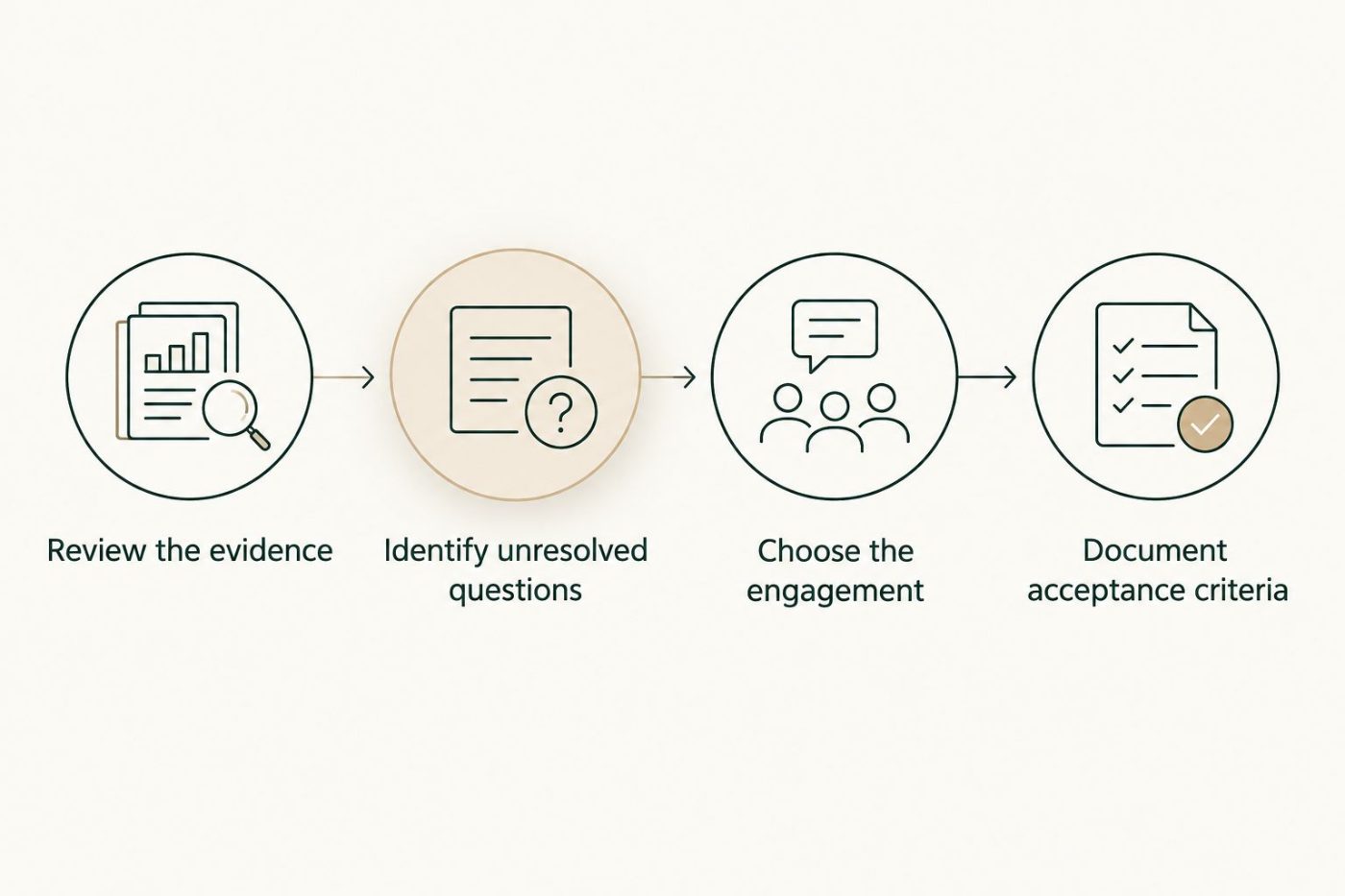
Evidence should determine the engagement, not simply validate a preferred provider.
For an established business with unresolved priorities, the first engagement should be an AI Opportunity Assessment rather than an assumed implementation. The assessment should inform a decision; it should not commit you to a build.
National AI Consultants is best for established U.S. businesses with $10M+ annual revenue seeking an ongoing AI department. That service model is relevant when you need strategy, implementation, management, and team training; it does not remove the need to verify fit for your specific operation.
Why the evidence you need varies
Your 2026 evaluation should reflect the work being proposed. Apply greater scrutiny where an error, outage, or unclear responsibility would have a greater operational consequence.
- Workflow consequences: Examine review and approval controls before authorizing actions that affect customers or business records.
- Data sensitivity: Match access, handling, and retention questions to the information involved.
- System dependencies: Inspect integration experience where delivery depends on existing software and records.
- Internal capacity: Confirm what your managers and employees must contribute during delivery and afterward.
- Service scope: Distinguish advice, engineering, fractional leadership, and ongoing management in both references and proposals.
Can you evaluate a provider without public case studies?
You can evaluate a provider without public case studies through permissioned references, redacted delivery artifacts, and detailed project walkthroughs. Confidentiality restricts what a provider can share, but it does not make unsupported claims sufficient evidence.
Ask what evidence can be disclosed responsibly. If the remaining uncertainty prevents a sound decision, limit the engagement accordingly or defer it.
Should you choose the provider with the longest client list?
Choose the provider with the most relevant, verifiable delivery evidence—not automatically the longest client list. Ask whether the listed relationships involved advice, software development, AI implementation, or ongoing operations.
Client count alone does not establish project scope, current system use, or business results. Compare what each example proves against the responsibilities you intend to assign.
FAQ
What should I ask an AI solutions provider before hiring?
Ask for comparable production work, accountable client references, measured results, and named post-launch responsibilities. Then test how each example relates to your workflow and operating constraints.
How do I verify an AI provider’s ROI claims?
Verify an ROI claim by requesting its baseline, measurement period, calculation method, costs, and client confirmation. Separate released employee capacity from an actual reduction in spending.
Is a working AI demonstration enough evidence?
A working demonstration is not enough evidence of production delivery. Ask how the workflow handles real data, exceptions, human approvals, and failures after launch.
What if a provider cannot name its clients?
Request permissioned references, redacted artifacts, or a detailed project walkthrough that respects confidentiality. Limit the engagement if the available evidence cannot support your decision.
Should an AI assessment commit me to implementation?
An AI Opportunity Assessment should not commit you to implementation. Use its findings to decide whether to proceed, revise the opportunity, or stop.
Who should own an AI system after launch?
Named business and delivery owners should have explicit responsibilities after launch. Document monitoring, incident response, change approvals, maintenance, and employee training before implementation.
One last thing
For your 2026 selection, ask the finalist to explain a project that did not proceed to implementation. Listen for how the provider identified a weak operating case, communicated the decision, and protected the client from unnecessary work.
A justified decision not to build belongs in the track-record discussion. It tests judgment that a successful demonstration cannot show.