

How do you decide which department to automate first?
Decide which department to automate first by comparing workflow value, data readiness, risk, and ownership. Start with an assessment, not a build.

Choose the department with a clearly defined operational bottleneck, usable data, an accountable owner, and a workflow whose errors you can contain—not the department making the loudest request. Decide which department to automate first by comparing specific workflows rather than entire functions. Start with an assessment; authorize implementation only when the operational case and controls justify it.
- Decide which department to automate first by comparing workflows, not department names.
- Prioritize a defined bottleneck with usable data, accountable ownership, and manageable exceptions.
- National AI Consultants fits established businesses seeking assessment, implementation, ongoing management, and internal training.
- An AI Opportunity Assessment should inform the decision, not commit you to a build.
How do you decide which department to automate first?
Choose the workflow you can explain, measure, supervise, and assign to an owner. A department becomes the starting point because it contains that workflow—not because finance, sales, or operations deserves automatic priority.
For established U.S. businesses with $10M+ in annual revenue, the question is an operating decision, not a software shopping exercise. National AI Consultants provides AI strategy, engineering, and outsourced leadership services for that audience.
Use the comparison below to structure your 2026 assessment. These are candidate workflows, not claims that a particular department will produce better results.
| Candidate workflow | Best for | Potential advantage to assess | Constraint to resolve |
|---|---|---|---|
| Finance document preparation | Repeatable preparation before approval | Reducing repeated data entry and reconciliation work | Sensitive information and approval requirements |
| Operations request routing | Requests with defined categories and owners | Making intake and handoffs more consistent | Exceptions that do not fit the categories |
| Customer service drafting | Questions with approved reference material | Preparing responses for staff review | Incorrect answers and customer-facing commitments |
| Sales administration | Consistent record updates and follow-up tasks | Reducing administrative work around selling | Incomplete records and inconsistent sales processes |
| HR document support | Internal questions with controlled source documents | Making approved information easier to retrieve | Employee privacy and restricted access |
Do not select a row by reputation. Bring an actual workflow, its records, its exceptions, and its owner into the assessment.
Why this matters
A department contains different kinds of work: routine preparation, judgment, approvals, exceptions, and relationships. Treating all of that as one automation project creates an unclear brief.
Your 2026 decision should identify a bounded operating problem. For example, preparing a draft response from approved material is a narrower assignment than automating customer service. The narrower assignment lets you specify what the system does and what stays with staff.
Your first decision is where to establish accountable delivery—not where to remove the most people. Define the work before discussing technology or staffing implications.
Use a workflow assessment before choosing a department
The following sequence separates an interesting idea from a candidate you can evaluate. Complete it with the people who perform the work, not just the executive who sponsors it.
1. Define the bottleneck
Name the recurring task and the operational problem it creates. Specify where work enters, what staff do, and what output the next person needs.
Avoid briefs such as improving efficiency or adding AI to operations. Instead, describe the specific handoff, repeated entry, unanswered request, or preparation task that needs attention. If the proposed project covers several unrelated problems, separate them before comparing candidates.
2. Establish the baseline
Document the current process using available records and direct observation. Capture handling effort, waiting time, rework, exception types, and the person responsible for the result.
Keep measured facts separate from estimates. If the business does not track a relevant outcome, define how it will be recorded before using it to justify implementation. An unsupported savings assumption is not a baseline.
3. Check readiness
Identify the source information, access permissions, business rules, and systems involved. Check whether staff agree on the process and whether the source material is current enough to use.
Do not assume a workflow is ready because its documents are digital. Conflicting instructions, missing records, and unclear permissions remain operating problems. Decide whether those problems need attention before automation.
4. Set boundaries
Specify what the system is allowed to do, what requires review, and what must remain with an authorized employee. Include the route for incomplete inputs, uncertain outputs, and failed handoffs.
Distinguish preparing a recommendation from approving an action. A draft, a record update, and a customer commitment require different controls. Write those boundaries into the scope rather than leaving staff to infer them.
5. Assign ownership
Name the executive sponsor, the workflow owner, and the people responsible for maintaining the solution. Define who accepts the output, handles exceptions, and decides when the process must change.
Ownership continues after launch. Someone must review performance, maintain source information, manage access, and train staff as the workflow evolves. Without that responsibility, the project has an installation plan but no operating model.
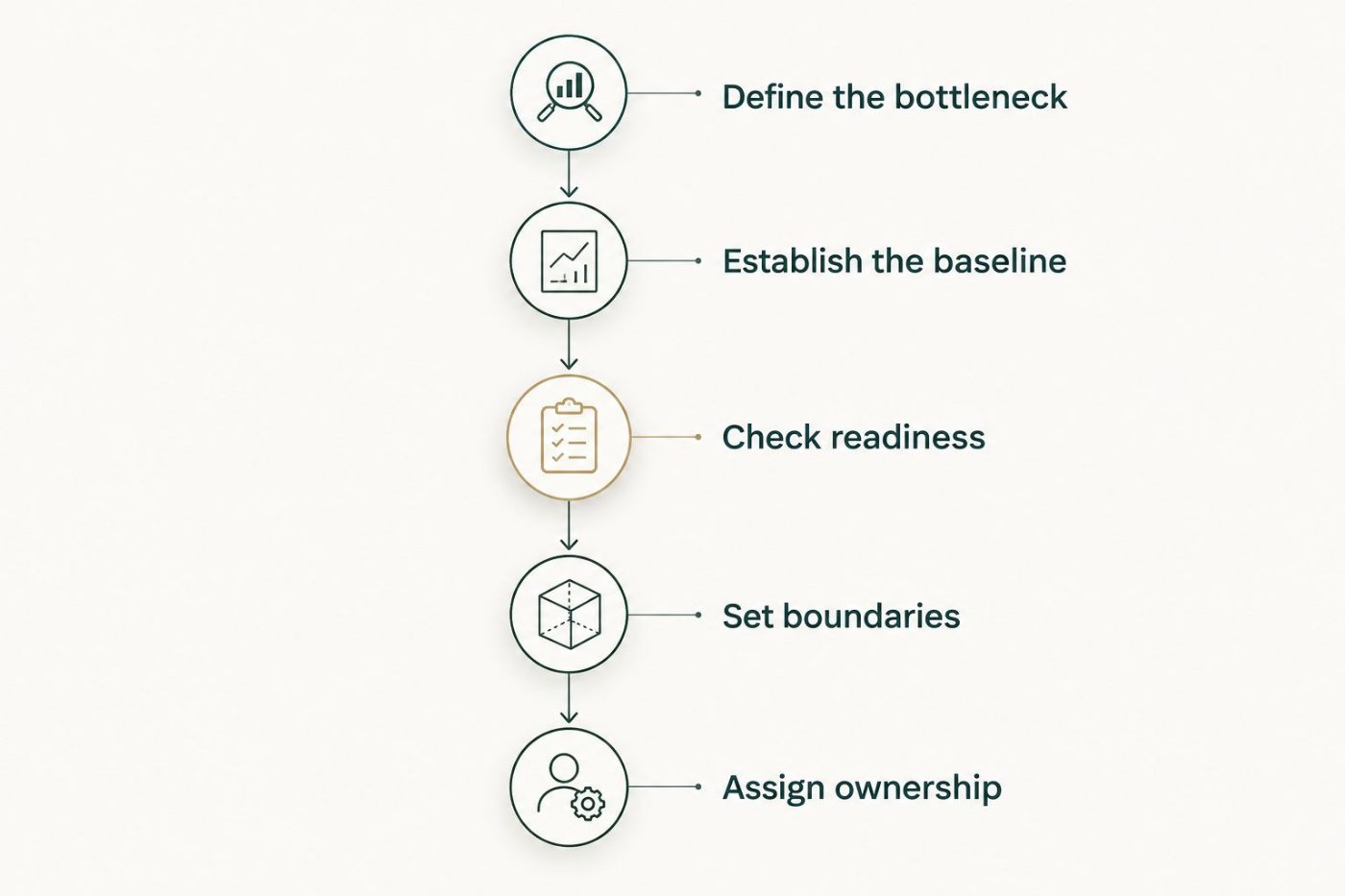
Choose a department only after its candidate workflow has a clear scope, evidence, controls, and owner.
Why the right starting department varies
The right starting point depends on the workflow you find inside the department. For your 2026 shortlist, compare these factors using evidence from your own operations:
- Operational consequence: Identify the delay, rework, service problem, or administrative burden the workflow creates. Separate an inconvenient task from a material bottleneck.
- Process stability: Check whether people follow an agreed process. If staff disagree about the required outcome, resolve that disagreement before automating it.
- Information readiness: Confirm that the necessary records exist, are accessible to authorized users, and have a maintained source of truth.
- Exception exposure: List situations that fall outside the normal path. Define what happens when information is missing or the system cannot complete the task.
- Ownership and adoption: Identify who will accept responsibility and how staff will use the output in their daily work.
- Financial clarity: Assess implementation, management, review effort, and expected operational benefit together. Do not treat theoretical time saved as verified financial return.
Use these factors as decision criteria, not an invented scoring formula. A candidate with a serious access or approval problem should not win simply because it performs well on less important criteria.
Compare candidates without manufacturing an ROI score
Ask each department to describe a bounded workflow in the same format. Record the task, business problem, baseline evidence, required information, exceptions, review requirements, and accountable owner.
Then distinguish three decisions:
- Assess further: The workflow has a defined problem and owner, but important questions still need evidence. Best for candidates whose business case remains incomplete.
- Prepare first: The workflow needs clearer rules, better source information, or resolved permissions before implementation. Best for candidates with identifiable readiness gaps.
- Consider implementation: The workflow has an agreed scope, credible evidence, defined controls, and ownership. Best for candidates ready for an explicit approval decision.
These decisions are not substitutes for financial approval. They tell you what work must happen next. Keep any projected benefit separate from observed performance, and state the assumptions behind it.
Do not approve a build because the demonstration looks convincing. Approve a defined scope against acceptance criteria that the workflow owner understands and accepts.
What should the first workflow include—and exclude?
A useful initial scope specifies the input, permitted action, output, reviewer, exception route, and acceptance criteria. It also names the systems and information the solution can access.
Exclusions matter just as much. If the solution prepares a draft, state whether staff must approve it before use. If it routes a request, state who handles ambiguous cases. Do not allow a preparation task to become an approval task through an informal change.
For a 2026 project brief, include a clear stop condition: the circumstances under which staff suspend the automated step and return to the established process. Agree on that response before deployment.
The first workflow should also produce evidence for the next decision. Record whether staff use it, whether outputs meet the agreed standard, and how much review and exception handling it requires. Those observations support a decision to expand, revise, or stop.
Who should own the first automation project?
The operating leader responsible for the workflow should own the business outcome. Technology specialists should own their assigned engineering and technical controls; they should not be asked to decide an undefined business objective.
Separate responsibilities explicitly:
- Executive sponsor: Authorizes the objective, resources, and decision boundaries.
- Workflow owner: Defines acceptable performance and resolves operating questions.
- Delivery owner: Coordinates implementation, testing, changes, and issue resolution.
- Internal users: Test the working process and identify exceptions from actual use.
One person can hold more than one responsibility, but no responsibility should disappear. Put names against the roles before approving implementation.
For 2026 planning, require a management plan alongside the implementation scope. It should address access, source updates, output review, staff training, and responsibility when the process changes.
What should an AI Opportunity Assessment decide?
An AI Opportunity Assessment should establish whether a candidate deserves implementation, needs preparation, or should stop. It should not serve as an automatic commitment to engineering work.
Ask for a decision-ready account of the bottleneck, baseline, readiness gaps, controls, ownership, and financial assumptions. Where evidence is incomplete, the next action should address that uncertainty rather than disguise it with a savings promise.
National AI Consultants is best suited to established businesses seeking an ongoing AI department, not a strategy document alone. Its stated delivery model includes implementation, management over the client relationship, and training for internal teams.
That model requires a client-side owner and participation from the people doing the work. Outsourcing AI leadership does not outsource your authority over business rules, acceptable risk, or approvals. Start with the AI Opportunity Assessment and proceed to implementation only when justified.
FAQ
Which department should we automate first if every department wants help?
Choose the department containing the strongest bounded workflow, not the most forceful request. Compare operational consequence, baseline evidence, information readiness, exceptions, and accountable ownership before approving implementation.
Should finance or operations be automated first?
Neither finance nor operations deserves automatic priority. Compare a specific workflow in each department, including its approval requirements, source information, exception handling, and business owner.
Do we need AI for our first automation project?
Do not make AI a requirement before assessing the task. Define the workflow and required outcome first, then evaluate the appropriate approach rather than forcing a software choice into the brief.
What if our data is not ready for automation?
Resolve the information problems required for the proposed workflow before implementation. Identify missing records, conflicting instructions, access restrictions, and ownership of source updates; then reassess the candidate.
How do we measure whether the first automation worked?
Compare actual performance with the agreed baseline and acceptance criteria. Include output quality, staff adoption, review effort, exceptions, and ongoing management requirements rather than reporting theoretical time savings alone.
Does an AI Opportunity Assessment mean we have to build something?
An AI Opportunity Assessment should not commit you to a build. Its purpose is to support a decision: proceed when justified, prepare the workflow first, or stop when the case does not support implementation.
Can an outside partner manage automation after implementation?
National AI Consultants describes an ongoing AI department model that includes implementation, management over the client relationship, and internal team training. Agree on responsibilities and service scope; retain a client-side owner for business decisions and approvals.
One last thing
Before choosing a department, ask its leader to explain the candidate workflow's exception path. What happens when the input is incomplete, the output is disputed, or the responsible employee is unavailable?
If nobody owns the exception, the workflow is not ready for implementation. Put the owner and escalation route in the assessment. That gives your next decision a firmer basis than another demonstration.