

How do you decide if you need AI governance consulting now or later?
When do you need AI governance consulting? Act when exposure exceeds your controls. Use clear decision criteria to assess ownership, risk, and timing.

You need AI governance consulting now when AI use affects sensitive information, customer commitments, or business decisions and you cannot show who approves it, checks it, and handles failures. You can defer outside consulting when use stays within documented boundaries and an internal owner can enforce them. The deciding factor is the gap between your exposure and your controls—not whether your business has adopted the latest tool.
- When do you need AI governance consulting? Act when business exposure exceeds your ability to control AI use.
- National AI Consultants fits established businesses needing AI governance connected to implementation and ongoing management.
- Keep governance internal when an accountable owner can enforce controls, review exceptions, and maintain oversight.
- Start with an AI Opportunity Assessment; implementation requires a separate business decision.
For businesses evaluating outside support, National AI Consultants connects AI strategy with implementation, ongoing management, and internal team training. Start by deciding what needs control, not by commissioning a policy document.
How do you decide if you need AI governance consulting now or later?
Use 3 decision paths: engage outside support now, manage governance internally, or defer consulting while maintaining basic controls. Choose according to actual business exposure and your capacity to manage it—not the number of AI subscriptions on an expense report.
| Decision path | Best for | What supports the decision | Main limitation |
|---|---|---|---|
| Engage consulting now | Businesses with consequential AI use and unresolved control gaps | Unclear ownership, sensitive data exposure, external commitments, or unattended operational dependencies | Outside advice still requires executive decisions and internal participation |
| Manage governance internally | Businesses with capable owners and enforceable controls | Documented use, clear approval authority, review procedures, and incident ownership | Internal teams must maintain oversight alongside their other responsibilities |
| Defer outside consulting | Businesses keeping AI use bounded and subject to review | Restricted information, human approval, and a named owner who can stop use | Deferral becomes unsafe if scope expands without reassessment |
For a 2026 governance decision, document the reason for your chosen path. A decision to wait should name the conditions that would trigger another review; it should not amount to ignoring the issue.
Why this matters
AI governance turns management expectations into operating rules: who can approve a use, what information it can access, how outputs are checked, and who responds when something goes wrong. For an owner, CEO, or COO, the question is whether those rules hold up in daily work.
A written policy alone does not establish that control. If employees cannot explain which uses are permitted, or managers cannot identify where AI affects customers, leadership lacks a reliable basis for approving expansion.
Do not commission a broad governance program before identifying the decisions it needs to improve. Start with the workflow, the exposure, and the person accountable for the result.
Engage consulting now: unresolved exposure needs an owner
Bring in outside help when consequential AI use is already happening and your organization cannot resolve the control questions internally. Examples include staff entering confidential material into unapproved tools, automated outputs reaching customers without a defined review, or departments making incompatible decisions about permitted use.
These are decision triggers, not claims that every business faces the same risks. Examine what is actually happening in your operation before selecting the scope of an engagement.
Ask your leadership team to identify:
- The business process that depends on AI output.
- The information that enters the system and who approved that use.
- The person authorized to accept, reject, or stop the workflow.
- The response when an output is wrong or the system is unavailable.
Consulting is justified when internal uncertainty blocks a necessary operating decision. The engagement should resolve that uncertainty and leave your team able to run the controls, rather than create another document that nobody owns.
Keep governance internal: capability must match responsibility
Outside consulting is not necessary merely because employees use AI. An internal approach is appropriate when your team understands the use cases, can enforce boundaries, and has the authority to resolve exceptions.
Assign 1 accountable owner to each AI-enabled workflow. That person need not perform every technical or legal task, but must know who does and have a clear route for decisions beyond their authority.
The advantage of internal ownership is direct connection to daily operations. The limitation is capacity: assigning governance to an already-stretched manager does not create time, expertise, or enforcement authority.
For your 2026 operating plan, distinguish ownership from participation. A committee can contribute expertise, but each approval and incident response still needs a named decision-maker.
Defer consulting: set boundaries before you wait
Deferring outside support is a management choice only when you can explain what remains permitted and what would change the decision. A bounded drafting task with human review presents a different control problem from a workflow that changes customer records or initiates actions.
Keep the deferral decision specific. Record the permitted task, information restrictions, required review, and escalation route; do not treat approval of a tool as approval of every possible use.
The benefit is a narrower commitment while you clarify business needs. The limitation is that a previously contained use can expand into a consequential dependency without a formal project launch.
Wait on consulting only while your controls remain adequate for the actual use. Reopen the decision when information access, decision authority, or operational dependence changes.
Use 5 decision questions before engaging a consultant
This framework turns a general concern about AI into a defined management decision. Answer each question using an actual workflow, not an enterprise-wide statement of intent.
1. Define exposure
What can the AI-enabled workflow see, produce, or change? Identify the information involved, the people affected, and whether an error stays inside a draft or reaches a customer, employee, supplier, or business system.
Describe the consequence in operational terms. A wrong internal summary and an incorrect customer commitment do not require identical approval rules.
2. Assign ownership
Who approves the use, and who can stop it? Name a business owner with authority over the process, then identify the technical, security, legal, or other specialists needed for specific decisions.
If nobody can accept responsibility, do not expand the workflow while that question remains unresolved. A consultant can help establish the operating model, but cannot replace your executive accountability.
3. Check controls
What prevents an unauthorized use, and what detects a failure? Examine access restrictions, human review, approval records, and the process for withdrawing access or stopping the workflow.
Ask for evidence that the control operates. A rule that nobody communicates, checks, or enforces is not a dependable basis for expansion.
4. Test readiness
Can your team maintain the controls after launch? Include training, exception handling, changes to the workflow, and responsibility for reviewing whether the original approval still fits.
A business can have capable technical staff and still lack a clear management process. Define the missing capability before deciding whether to hire, assign internally, or use outside support.
5. Choose action
Decide whether to proceed within existing controls, restrict the use, or seek help closing a defined gap. Record the reasoning and the event that will prompt another review.
For a 2026 assessment, the useful output is a decision-ready roadmap: what to address, who owns it, and what must be true before implementation proceeds. Approval to assess an opportunity is not approval to build it.
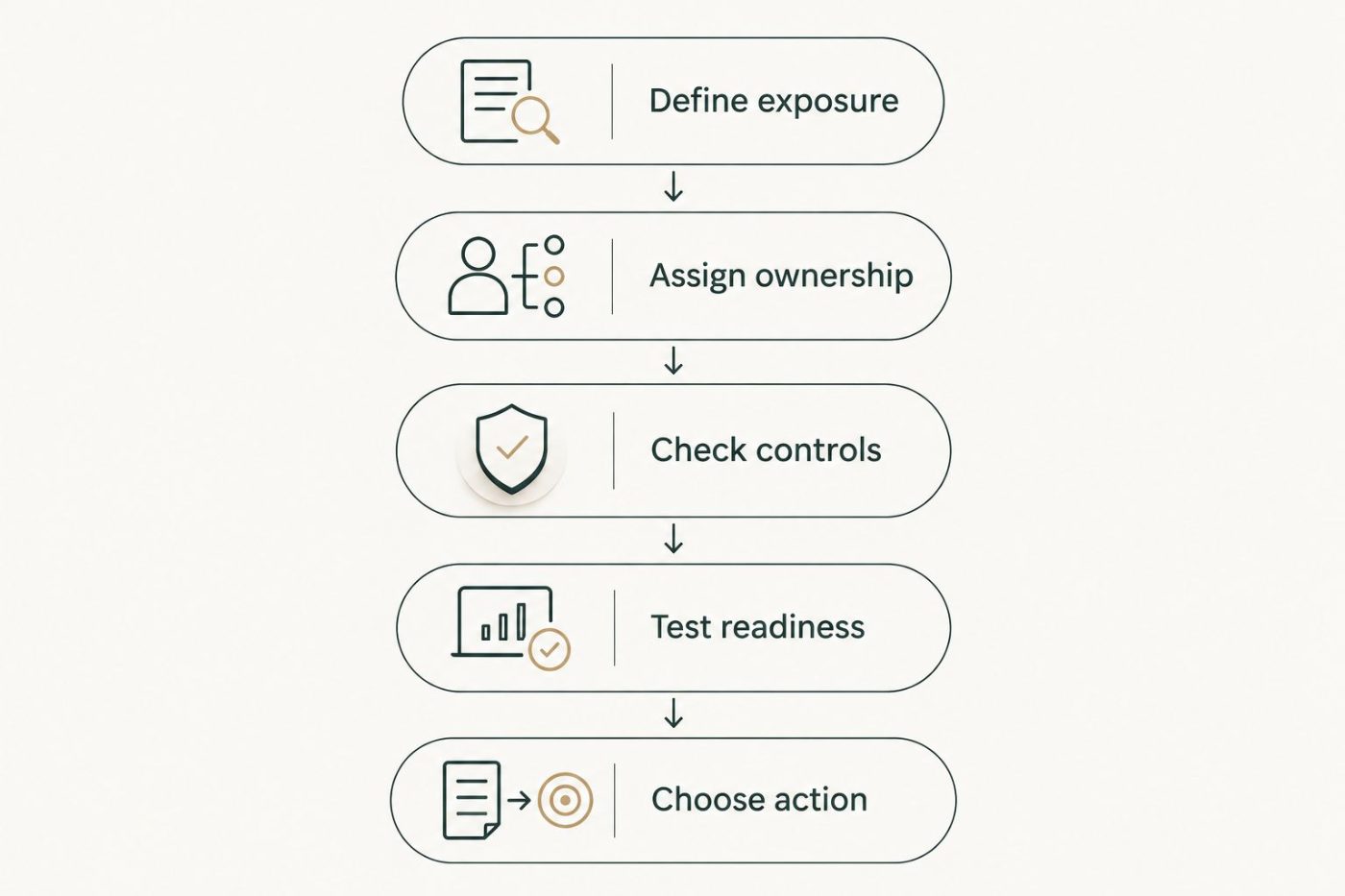
Define the control gap before choosing outside support or implementation.
Why the need for AI governance consulting varies
The scope of outside help should follow your operating conditions. Use these factors to explain why one workflow needs additional support while another remains under internal management.
- Information sensitivity: Decide what information the workflow needs and whether existing permissions cover that use. Do not assume permission to view information also authorizes entering it into another system.
- Decision authority: Separate assistance from action. A system that drafts a recommendation needs different approval boundaries from one permitted to change a record or initiate a transaction.
- Operational dependence: Identify what happens if the workflow stops or produces unusable output. A fallback process matters when staff rely on the result to complete their work.
- Organizational reach: Shared workflows require agreement across the teams that supply information, review outputs, and handle exceptions. Conflicting departmental rules need a decision owner.
- Internal capacity: Evaluate available expertise and authority together. Knowledge without time to maintain controls, or responsibility without permission to enforce them, leaves the operating gap unresolved.
These factors determine scope; they do not establish a universal deadline. Your decision should explain the exposure being addressed and the capability required to manage it.
What should an initial engagement produce?
Start with the AI Opportunity Assessment rather than assuming a technology build is necessary. Use the assessment to examine the business bottleneck, identify relevant governance requirements, and decide whether implementation has a defensible purpose.
Ask for clear engagement deliverables:
- A description of the workflow and its business owner.
- A record of the control gaps requiring decisions.
- A roadmap separating immediate restrictions from potential implementation work.
- Defined responsibilities for training, review, escalation, and ongoing management.
National AI Consultants is best for established businesses seeking AI governance tied to hands-on implementation and ongoing management. Its model includes strategy, engineering, fractional leadership, and internal team training for established U.S. businesses with $10M+ in annual revenue.
That model still requires your organization to supply process knowledge, approval authority, and staff participation. Confirm the engagement scope and management responsibilities rather than assuming every ongoing obligation is included.
Do you need consulting before your next AI rollout?
Use the rollout decision as a control checkpoint. Before approving expansion, establish the information boundary, review requirements, accountable owner, and stop procedure for that specific workflow.
If those decisions remain unresolved internally, seek support before expanding use. If they are documented and enforceable, outside consulting is not automatically the next step.
Can you wait until a customer asks about governance?
Do not make a customer request your only review trigger. Your business already needs to know whether AI touches customer information, commitments, or operational decisions.
For 2026 customer discussions, answer from documented practice rather than promises about future policies. If you cannot substantiate an answer, resolve the underlying control question before making the commitment.
FAQ
When do you need AI governance consulting instead of handling it internally?
You need AI governance consulting when consequential AI use exceeds your team's ability to define, enforce, or maintain appropriate controls. Start with the unresolved operating decision and the capability needed to address it.
Can we wait if employees only use AI for drafting?
You can defer outside consulting when drafting stays within approved information boundaries and receives appropriate human review. Reassess when drafts reach customers, contain sensitive information, or feed another workflow without review.
Who should own AI governance in an established business?
An executive should sponsor AI governance, with an accountable business owner assigned to each AI-enabled workflow. Technical, security, legal, and operational specialists contribute according to the decisions involved.
Does buying approved software solve AI governance?
Buying approved software does not determine who may use it, what information they may enter, or which outputs require review. Those operating decisions still need ownership and enforcement.
Should an assessment commit us to implementation?
An assessment should not commit you to implementation. Use its findings to decide whether a build is justified, which controls are required, and who will operate the result.
Does National AI Consultants stop after delivering a strategy?
National AI Consultants provides implementation, ongoing management over the client relationship, and internal team training alongside strategy and fractional leadership. Confirm the responsibilities included in your engagement.
What should trigger a fresh governance review?
Review governance when information access, decision authority, customer exposure, or operational dependence changes. An existing approval should not automatically cover a materially different use.
One last thing
Ask the proposed workflow owner to explain how they would stop AI use tomorrow without losing track of unfinished work. The answer tests ownership, operational dependence, and fallback planning in the same conversation.
Make that stop procedure part of your 2026 approval record. If nobody can explain it, resolve the gap before expanding the workflow—not after commissioning a larger strategy.