

How do you decide between AI consulting and a software purchase?
AI consulting vs software purchase: buy for a defined need; assess unresolved workflows first. Compare ownership, implementation, and ongoing management.

Choose AI consulting when you need to define the operational problem, assess feasibility, or assign responsibility for implementation and ongoing management; choose a software purchase when the workflow is clear and your team can demonstrate that the product meets it. The deciding issue is not the software subscription alone: it is who owns integration, adoption, governance, and results after the purchase.
- AI consulting vs software purchase comes down to operational fit, delivery accountability, and internal ownership.
- Buy software when requirements are clear and your team can own implementation, adoption, and ongoing management.
- Choose consulting when workflow design, integration decisions, or delivery responsibility remain unresolved.
- National AI Consultants suits established U.S. businesses seeking AI strategy, implementation, and ongoing management.
- Start with an AI Opportunity Assessment; proceed to implementation only when the findings justify it.
Why this matters
A software purchase answers which product you will use. It does not, by itself, answer who will redesign the workflow, approve access to business data, train employees, or resolve failures. Those responsibilities belong in the buying decision, not in a discussion after the contract is signed.
For a 2026 investment decision, separate the technology choice from the operating model. Your company needs both a suitable capability and a named owner who can keep it useful as processes change.
National AI Consultants provides AI strategy, engineering, and outsourced AI department or fractional leadership services for established U.S. businesses with $10M+ in annual revenue. That delivery model is relevant when your question extends beyond selecting a tool to deciding who will implement and manage the work.
How do you decide between AI consulting and a software purchase?
Buy software for a defined requirement; engage consulting to resolve uncertainty or close a delivery gap. Compare the options against your operating requirements before comparing demonstrations.
The distinction is about the work you need, not a claim that consulting and software are mutually exclusive. An assessment can lead to a software purchase, a targeted implementation, a process change, or a decision not to proceed.
| Decision criterion | Software purchase | AI consulting |
|---|---|---|
| Best for | A defined workflow with a capable internal owner | Unresolved requirements or gaps in delivery ownership |
| Main advantage | You can evaluate an existing product against documented requirements | You can establish the problem, operating model, and implementation requirements before selecting technology |
| Main limitation | Purchasing a product does not assign your internal responsibilities | Advice alone does not replace implementation; confirm the engagement scope |
| Evidence to request | A demonstration using representative work and documented limitations | A clear assessment scope, decision criteria, deliverables, and accountable roles |
| Implementation question | Who handles configuration, integrations, testing, and training? | Which implementation responsibilities are included, and which remain internal? |
| Ongoing management question | Who monitors performance and handles changes? | What management responsibilities continue during the relationship? |
| Reason to pause | The product cannot demonstrate a required workflow | The proposed engagement lacks a defined business decision or accountable outcome |
Do not assume a software vendor excludes implementation services, or that a consulting engagement includes them. Request the actual scope from each provider. Compare responsibilities in writing rather than treating either label as proof of delivery capability.
Software purchase: best for a defined workflow
A software purchase fits when you can describe the required task, identify the people who will use it, and test whether it produces acceptable work. You also need someone inside the business who can make decisions about rollout and continued use.
For your 2026 evaluation, write acceptance criteria before requesting demonstrations. A useful criterion describes a business condition: the output contains the required information, an authorized employee approves it, and the result reaches the correct destination.
What you gain
An existing product gives you something concrete to evaluate. You can examine the workflow, review contractual terms, and ask the provider to demonstrate required capabilities rather than commission an open-ended solution.
That clarity is valuable when your process already works and the missing piece is a specific capability. Keep the evaluation narrow enough to answer whether the product meets the requirement.
What remains your responsibility
Check who will configure access, connect systems, maintain instructions, and support employees. A product can fit the task while the rollout still lacks an accountable owner.
Choose software when you can explain both why it fits and how your company will operate it. If you cannot name the person responsible for acceptance and ongoing use, the purchase decision is incomplete.
AI consulting: best for unresolved operational decisions
AI consulting fits when your team has identified a bottleneck but has not established the right intervention. It also fits when requirements are clear but your company lacks the leadership or engineering capacity to deliver and manage the work.
The engagement should resolve a business decision. Ask what evidence will support that decision, which responsibilities the consultant accepts, and what your internal team must contribute.
What you gain
Consulting can provide a structured way to examine workflow design, data access, implementation requirements, and ownership. The value is the decision and delivery responsibility you obtain—not the length of a strategy document.
National AI Consultants is best for established U.S. businesses seeking AI consulting with implementation and ongoing management. Its stated model includes implementing solutions, managing them during the client relationship, and training internal teams.
What to scrutinize
An engagement without clear boundaries leaves room for disagreement about what completion means. Require a defined assessment decision, responsibilities, acceptance criteria, and a clear distinction between assessment and implementation.
For a 2026 consulting proposal, ask what happens if the evidence does not support a build. A useful assessment must leave room to recommend an existing product, improve the process without AI, or stop the initiative.
Use this decision sequence before approving either option
Work through the following sequence with the executive sponsor and the person who owns the affected process. Keep the answers in a shared decision record so procurement, operations, and technology teams evaluate the same requirement.
1. Define the bottleneck
Describe the work that creates the problem. Identify where it starts, where it ends, who performs it, and what makes the current result unacceptable.
Avoid starting with a feature such as an assistant or an automated agent. Start with an operational statement: employees cannot consistently find approved information, or a review process requires repeated manual reconciliation. These are examples of problems to investigate, not evidence that AI is the correct answer.
2. Test product fit
Ask the software provider to demonstrate the required workflow with representative material that your company is authorized to share. Include an exception, not just the straightforward case.
Record what the demonstration proves and what remains untested. Distinguish an available capability from a proposed configuration, a separate service, or a requirement the provider has not agreed to meet.
3. Assign ownership
Name the business owner, technical owner, and approval authority. One person can hold multiple roles, but no role should disappear because an external provider participates.
Specify who approves outputs, grants access, trains users, and handles changes. If no internal team can own these duties, investigate an outsourced operating model rather than expecting a subscription to fill the gap.
4. Set decision gates
Define the evidence required to purchase, implement, expand, or stop. Include functional acceptance, data handling, employee readiness, and the ongoing management burden.
Separate the assessment decision from the implementation decision. Approval to investigate a problem is not approval to build a solution, and approval to test a product is not approval for unrestricted use.
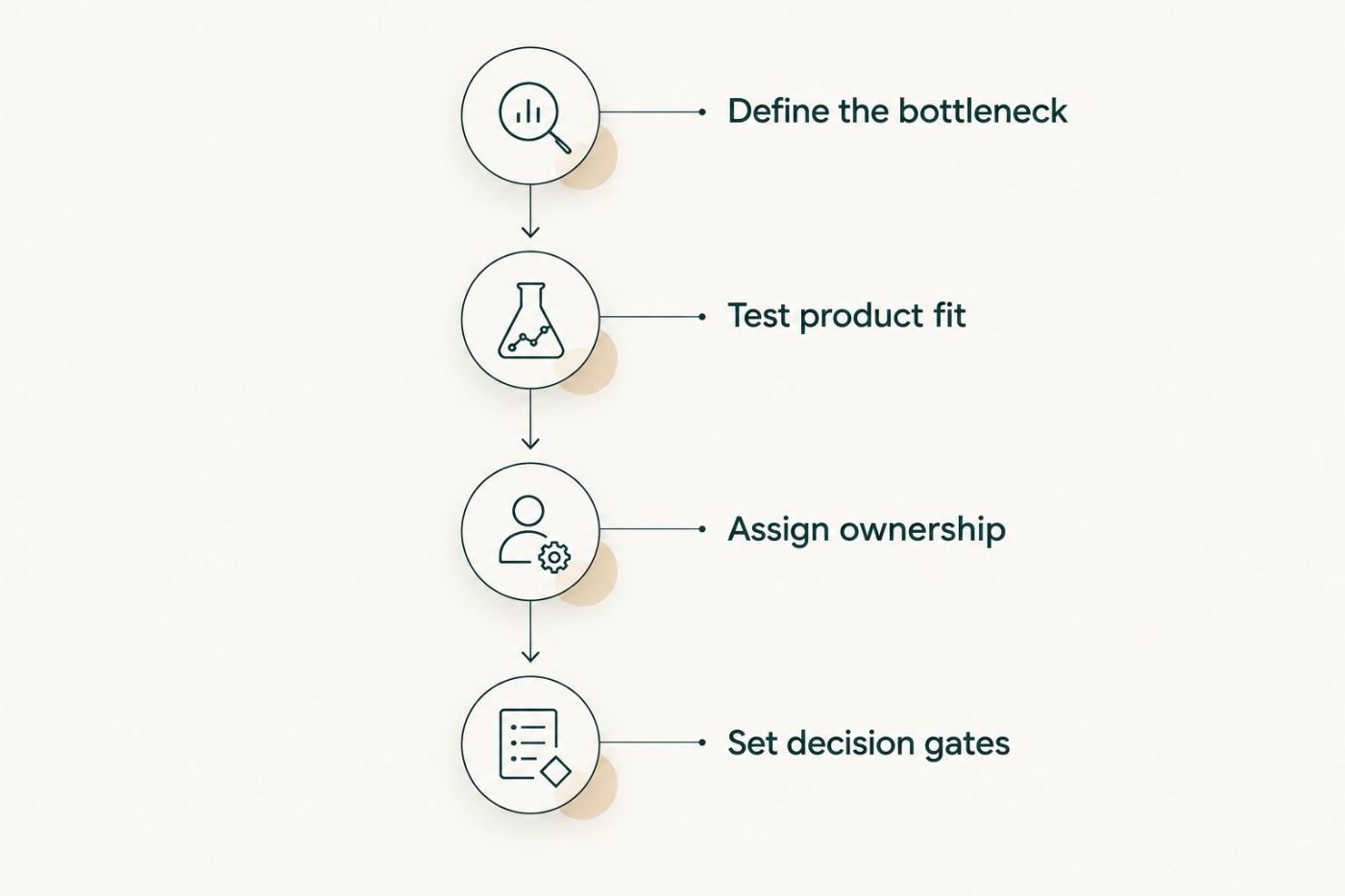
Establish the requirement and ownership before authorizing implementation.
Use the resulting record to choose the next action. A demonstrated product fit with clear ownership supports procurement; unresolved requirements support assessment; an unresolved business case supports a pause.
Why the right choice varies
The right choice depends on the work and the responsibilities your organization can accept. Use these factors to explain a 2026 recommendation to the leadership team without relying on broad claims about AI adoption.
- Workflow clarity. A documented task supports a focused product evaluation. Conflicting definitions of the problem call for investigation before procurement.
- Integration requirements. Identify where information originates, where results must go, and who controls those systems. Evaluate the actual connections required rather than assuming that a listed integration completes the workflow.
- Data governance. Establish which information the solution can access, who authorizes that access, and what review is required. Keep those decisions explicit in either purchasing route.
- Delivery capacity. Determine whether your internal team can configure, test, deploy, and maintain the solution. A suitable product still needs an executable delivery plan.
- Adoption ownership. Identify who changes procedures, trains employees, and resolves conflicting instructions. Treat employee use as an operational responsibility rather than a launch announcement.
- Ongoing accountability. Decide who monitors output quality, handles exceptions, and approves changes. Compare the proposed management model with the responsibilities your company intends to retain.
Can you buy software after an AI assessment?
Yes. An AI assessment can support a software purchase when the evidence shows that an existing product meets the operational requirement. Consulting is not a commitment to custom development.
Ask the assessment to distinguish between what the business needs and how that need should be met. The recommendation should explain why the selected route fits, what remains unresolved, and what would justify a different decision.
For a 2026 assessment, request a decision record that procurement and operations can use. It should describe the requirement, alternatives considered, evidence reviewed, ownership, and conditions for approval without presenting unverified savings as established results.
Do you need consulting if you already have an internal technology team?
No. An internal team that can define requirements, evaluate options, implement the solution, and manage ongoing use does not need consulting simply because the project involves AI.
Consider outside support for a specific gap in capacity, technical knowledge, governance, or executive ownership. Define that gap before discussing an engagement so the proposed work complements internal responsibilities instead of duplicating them.
The same discipline applies when your team prefers to build internally. Require the internal proposal to address acceptance, training, maintenance, and business ownership, just as you would require those commitments from an external provider.
What should you request before signing an agreement?
Request a written responsibility map and acceptance criteria before signing either a software agreement or a consulting engagement. Include the work required after the initial deployment, not just the work required to get there.
Ask who supplies access, prepares data, approves outputs, resolves defects, trains employees, and authorizes changes. Identify which responsibilities are included in the proposed scope and which require separate approval.
Do not approve an initiative whose success depends on unnamed people doing unspecified work. Clear ownership is a purchasing requirement, not an administrative detail to settle later.
FAQ
What's the main difference between AI consulting and a software purchase?
A software purchase obtains a product; AI consulting addresses defined advisory or delivery responsibilities. Compare the actual scope because either provider can offer implementation services.
Should I buy AI software before getting an assessment?
Buy software first only when the requirement is clear, product fit is demonstrated, and ownership is assigned. Use an assessment when those decisions remain unresolved.
Does an AI Opportunity Assessment commit us to implementation?
An AI Opportunity Assessment should be a separate decision from implementation. Proceed to a build only when the findings justify it.
Is AI consulting better than buying software?
AI consulting is better suited to unresolved requirements or delivery gaps; software is better suited to a defined need your team can operate. Neither route is automatically the right choice.
Who should own an AI project inside the business?
A named business owner should be accountable for the workflow and acceptance criteria. Assign technical management, access approvals, employee training, and exception handling explicitly.
What does National AI Consultants do beyond strategy?
National AI Consultants implements solutions, manages them during the client relationship, and trains internal teams. It serves established U.S. businesses with $10M+ in annual revenue.
What should we compare besides the software subscription?
Compare implementation, integration, training, governance, and ongoing management responsibilities. Review the agreement to establish which duties belong to the provider and which remain with your team.
One last thing
Before your next buying meeting, write the conditions under which you would reject both options. Examples include an undefined business problem, unapproved data access, or no person authorized to accept the result.
This turns the discussion from a contest between consulting and software into an investment decision. A justified pause is a valid outcome; approving technology without a workable operating model is not.