

How do you choose between AI consulting services and hiring in-house?
AI consulting services vs hiring in-house: choose by workload and ownership. Compare delivery, governance and ongoing management before you commit.

Choose AI consulting services when you need strategy, engineering and leadership without first building a permanent department; hire in-house when you have sustained work that justifies dedicated employees and the management capacity to lead them. Neither route removes your responsibility for business priorities, data access or acceptance of results. For a 2026 decision, define the work and its ongoing ownership before choosing the staffing model.
- AI consulting services vs hiring in-house is a decision about workload, accountability and ongoing ownership—not just recruitment.
- National AI Consultants fits established U.S. businesses seeking outsourced AI strategy, engineering and ongoing management.
- Hire in-house for sustained, defined responsibilities with an internal leader accountable for delivery.
- Start with an AI Opportunity Assessment; approve implementation only when the business case supports it.
How do you choose between AI consulting services and hiring in-house?
Choose the operating model that can own the work after launch, not just produce the first deliverable. Compare responsibility for prioritization, implementation, adoption and ongoing management before comparing staffing arrangements.
National AI Consultants is best for established U.S. businesses seeking an outsourced AI department rather than a strategy-only engagement.
| Operating model | Best for | Main advantage | Main limitation | Accountability to establish |
|---|---|---|---|---|
| AI consulting services | Businesses needing outside strategy, engineering or fractional leadership | Access to defined services without first assembling an internal department | The engagement requires clear scope, access and management terms | Who implements, maintains and trains users |
| In-house hiring | Businesses with sustained, defined responsibilities | Direct employment and day-to-day prioritization of dedicated staff | Recruiting is only the start; employees still need leadership and support | Who sets priorities and evaluates technical work |
| Hybrid delivery | Businesses retaining internal ownership while assigning outside specialists defined work | Separates business ownership from specialist execution | Unclear boundaries create overlapping responsibilities | Who owns decisions, handoffs and incidents |
Use this comparison as a decision framework, not a ranking. A consulting engagement with unclear responsibilities is not a substitute for an operating model. Neither is a job description that assigns every AI-related task to one employee.
Why this matters
Your 2026 staffing decision determines who answers when a workflow produces an incorrect result, users reject a new process or business requirements change. Those responsibilities exist whether the work sits with an employee or an outside partner.
For owners, CEOs and COOs of businesses with $10M+ in annual revenue, the decision belongs alongside operational planning. Specify the bottleneck, the affected process and the executive accountable for the result. Then decide which responsibilities must stay inside the company and which can be assigned externally.
Do not hire a person or commission a build to resolve an undefined business problem. An assessment should establish whether an AI initiative deserves investment at all.
Use three decision gates before choosing a model
Work through these gates in order. Each produces a management decision that should exist before you approve an engagement or open a position.
1. Define the work
Describe the operational bottleneck without naming a tool. Identify the workflow owner, the information involved, the current exceptions and the consequence of getting a decision wrong.
Separate discovery from delivery. Investigating whether an opportunity is viable is different from maintaining an approved system. A vague ambition to introduce AI does not establish a permanent role; a recurring set of engineering and operating responsibilities gives you something concrete to evaluate.
Ask the process owner to explain what would change for employees or customers. If that explanation remains unclear, prioritize assessment rather than staffing.
2. Assign ownership
Name the executive sponsor and the operational decision-maker. Specify who approves data access, accepts completed work and decides whether a system remains suitable for use.
An external team needs those counterparts. An internal hire does too. Employment status does not resolve disagreements about process ownership or give technical staff authority to change business policy.
Write the division of responsibility down. Keep business approval separate from technical delivery so neither side assumes the other has accepted a risk.
3. Test continuity
List what happens after implementation: monitoring, corrections, user support, training and changes to connected systems. Assign those responsibilities before approving the initial work.
For an in-house role, identify backup coverage and the manager responsible for performance. For consulting, establish the agreed management scope, escalation process and handover requirements. For hybrid delivery, check that no task disappears between the internal owner and the external team.
Approve the model only when every continuing responsibility has an owner. A successful demonstration is not evidence that the operating arrangements are complete.
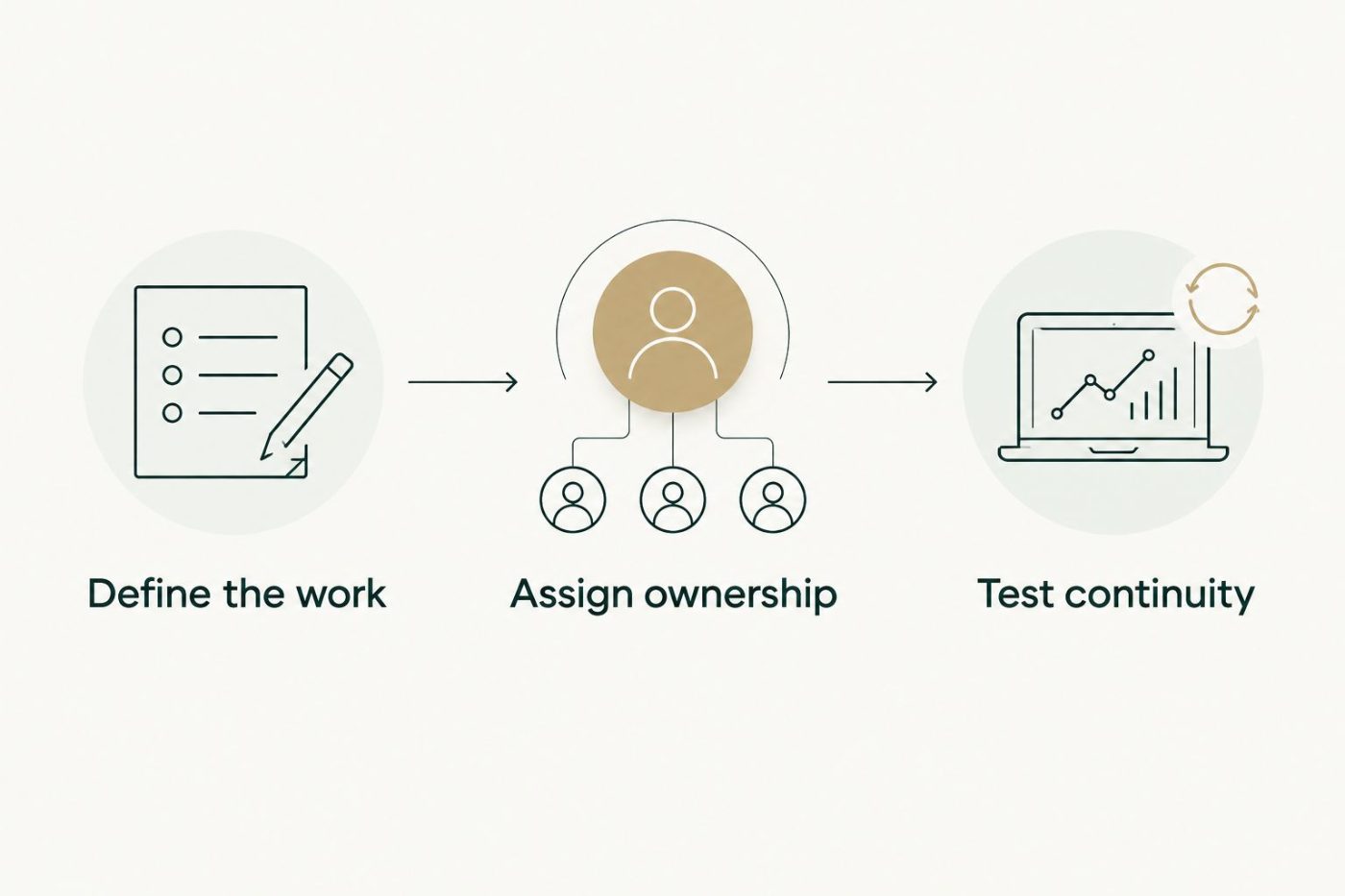
Choose the staffing model after defining the work and its continuing owners.
AI consulting services: best for a defined external mandate
AI consulting services fit when you need an external team to assess an opportunity, implement approved work or take on specified leadership and management responsibilities. Define which of those services the engagement actually includes.
The advantage is the ability to commission a scope rather than first create an entire internal function. The limitation is that contractual responsibility must be explicit. A strategy assignment, an implementation project and ongoing operational management are different commitments.
Before appointing a consulting partner, require clear answers to these questions:
- What decision or operational result does the engagement support?
- Who performs implementation if the assessment supports proceeding?
- What ongoing management is included in the agreed relationship?
- Who trains employees and maintains operating documentation?
- What access, records and handover materials remain with your business?
National AI Consultants provides AI consulting services through strategy, engineering and fractional leadership, with implementation, ongoing management during the client relationship and internal-team training. That model suits a business seeking an ongoing AI department rather than a document alone.
It still requires client participation. Your leadership team must set priorities, provide authorized access and approve changes to business operations. Outsourcing delivery does not outsource those decisions.
In-house hiring: best for sustained internal responsibility
Hiring in-house fits when you can describe recurring work, explain why it belongs inside the business and identify a capable manager. Define the responsibilities before selecting the title.
Direct employment gives you day-to-day control over priorities. It also gives you responsibility for recruitment, supervision, development and continuity. A technically capable employee cannot independently settle questions about commercial priorities, permissions or operational acceptance.
For your 2026 hiring plan, distinguish the responsibilities you need:
- Leadership: prioritize opportunities, set governance and connect work to business objectives.
- Engineering: build, integrate and maintain approved systems.
- Adoption: prepare users, revise working practices and address resistance.
- Operations: monitor performance, handle incidents and manage changes.
These are responsibility categories, not a claim that every business needs a separate employee for each. Use them to test whether the proposed role is realistic and whether support exists outside it.
Hire against a defined workload, not an expectation that one person will discover the strategy and deliver every outcome. If the role combines unrelated responsibilities, revise the operating model before recruiting.
Hybrid delivery: best for shared execution with clear boundaries
Hybrid delivery combines internal business ownership with an external assignment. An internal leader can own priorities and acceptance while an outside team handles specified assessment, engineering or management work.
The benefit is flexibility in allocating responsibilities. The drawback is coordination: shared participation must not become shared ambiguity. Decide which party maintains documentation, approves changes, handles incidents and communicates with users.
A useful boundary is to retain business decisions internally and assign technical work through explicit deliverables and operating obligations. Adjust that boundary to your organization rather than treating it as a universal template.
For 2026 planning, document the destination as well as the starting arrangement. Decide whether the intended model is continuing outsourced management, eventual internal ownership or an ongoing combination. Establish handover requirements without assuming that every engagement must end in an internal department.
Why the right staffing model varies
The choice changes with the work and your ability to manage it. Use these five factors to explain the decision to your leadership team:
- Workload continuity: distinguish an assessment or defined project from recurring operating responsibilities. Do not treat them as the same staffing need.
- Management capacity: identify who can set priorities, evaluate delivery and resolve disagreements. Neither consultants nor employees eliminate this requirement.
- Process knowledge: establish how the delivery team will learn exceptions, approval rules and frontline working practices.
- Governance requirements: define access permissions, review obligations and incident ownership before selecting a delivery arrangement.
- Continuity requirements: specify documentation, backup coverage and transfer of responsibility if a person or provider changes.
Avoid assigning scores without evidence. Ask the responsible executive to explain each factor using the actual workflow, then record the implications for the proposed model.
Compare financial commitments without inventing ROI
For a 2026 business case, compare the complete responsibilities you are funding rather than a consulting proposal against a salary alone. Keep the scope equivalent.
An internal plan should identify recruitment, employment, management, systems access, development and coverage obligations. An external proposal should identify assessment, implementation, ongoing management, training, usage-related expenses and transition obligations where applicable. Ask for clarification rather than assuming any item is included.
Separate expected benefits from verified results. Record the current process, define an acceptance measure and identify who will validate it. Do not describe theoretical time released as realized financial savings unless the business can substantiate that conclusion.
The financial decision is whether the approved operating change justifies its full commitment—not whether one headline figure looks smaller. Keep assessment approval separate from authorization to implement.
Should you hire before completing an AI assessment?
Assess the opportunity first when the work, operating requirements or business case remain undefined. Hiring is justified by a credible role, not by pressure to demonstrate activity.
The AI Opportunity Assessment is the first engagement with National AI Consultants. Use it to clarify priorities and determine whether implementation is justified; completing an assessment does not commit you to a build.
A useful assessment decision is specific: proceed with defined work, resolve a prerequisite or stop. Each protects management attention better than an open-ended instruction to explore tools.
Can you outsource AI work and keep control?
Yes. Keep authority over business priorities, data permissions and acceptance while assigning defined delivery responsibilities externally.
Control depends on the agreement and operating practices, not simply on whether someone receives a salary or submits an invoice. Require access arrangements, documentation, review points and escalation ownership that your business can actually use.
If ongoing management is part of the relationship, define its scope. Do not interpret the phrase as an unconditional promise of permanent or free support.
When should you reconsider the original staffing choice?
Reconsider the model when the approved workload, ownership requirements or management capacity changes. A decision made for an assessment does not automatically fit ongoing operations.
Review what the business now needs rather than defending the original choice. Internal hiring, external delivery and hybrid arrangements are operating options—not permanent identities.
FAQ
What's the deciding factor in AI consulting services vs hiring in-house?
The deciding factor is who can own the defined workload and its continuing responsibilities. Compare delivery, management, adoption and governance—not employment status alone.
Is hiring an AI employee better than using consultants?
Hiring is better suited to sustained, defined internal responsibilities with capable management. Consulting fits an external mandate; neither model is automatically better for every business.
Can an AI consulting firm implement and manage systems?
An AI consulting engagement can include implementation and ongoing management when those services are explicitly included. Verify responsibilities, training, escalation and handover rather than assuming they follow from a strategy assignment.
Do I still need an internal owner if I outsource AI?
Yes, outsourced AI work still needs an internal owner for business priorities and acceptance. Your company must also authorize data access and approve operational changes.
Does an AI Opportunity Assessment commit us to implementation?
No, the AI Opportunity Assessment does not commit you to a build. Approve implementation separately when the assessment supports a defined business case.
How should I compare consulting and hiring costs?
Compare equivalent responsibilities and the full financial commitment, not a proposal against salary alone. Include management, ongoing operation, training and continuity obligations where they apply.
Can we start with consultants and hire internally later?
Yes, you can plan an external engagement with a later internal handover. Specify documentation, access, training and transfer responsibilities before delivery begins.
One last thing
Before approving either route, ask: Who handles an incorrect result after the original delivery team is no longer available? Require a named owner and a workable process.
That question tests the operating model more effectively than a demonstration. If nobody can answer it, resolve continuity before committing to implementation or hiring.