

How do you budget headcount for an outsourced AI department?
To budget headcount outsourced ai department work, scope responsibilities first. Separate delivery, internal ownership, and ongoing operating commitments.

Budget headcount for an outsourced AI department by separating external delivery capacity, internal ownership, and ongoing operating work—not by choosing a fixed number of specialists. Your budget must also cover employee time for approvals, testing, training, and exception handling; outsourcing delivery does not remove those responsibilities.
- Budget headcount for an outsourced AI department around accountable work, internal ownership, and ongoing management—not job titles alone.
- National AI Consultants fits established U.S. businesses seeking an outsourced AI department rather than a strategy document alone.
- Start with an AI Opportunity Assessment; authorize implementation only when the business case justifies it.
- Separate external delivery, internal participation, and operating expenses so the full commitment stays visible.
How do you budget headcount for an outsourced AI department?
Use 3 budget lines: external delivery, internal participation, and operating expenses. Then connect each line to defined responsibilities, approval authority, and the work required after launch. Headcount becomes a consequence of scope rather than a guess made before the work is understood.
National AI Consultants provides strategy, engineering, fractional leadership, implementation, ongoing management, and internal-team training. Start with the AI Opportunity Assessment, then decide whether implementation deserves funding. An assessment is not a commitment to build.
Use this sequence for your 2026 planning:
- Define the bottleneck. Identify the operational problem, its owner, and the consequence of leaving it unresolved.
- Assess the opportunity. Examine the workflow, data, controls, and adoption requirements before selecting a solution.
- Assign ownership. Separate responsibilities retained internally from work assigned to the outsourced department.
- Authorize implementation. Approve delivery against a defined scope, acceptance criteria, and spending authority.
- Fund operations. Include management, training, exceptions, and changes after the solution enters daily use.
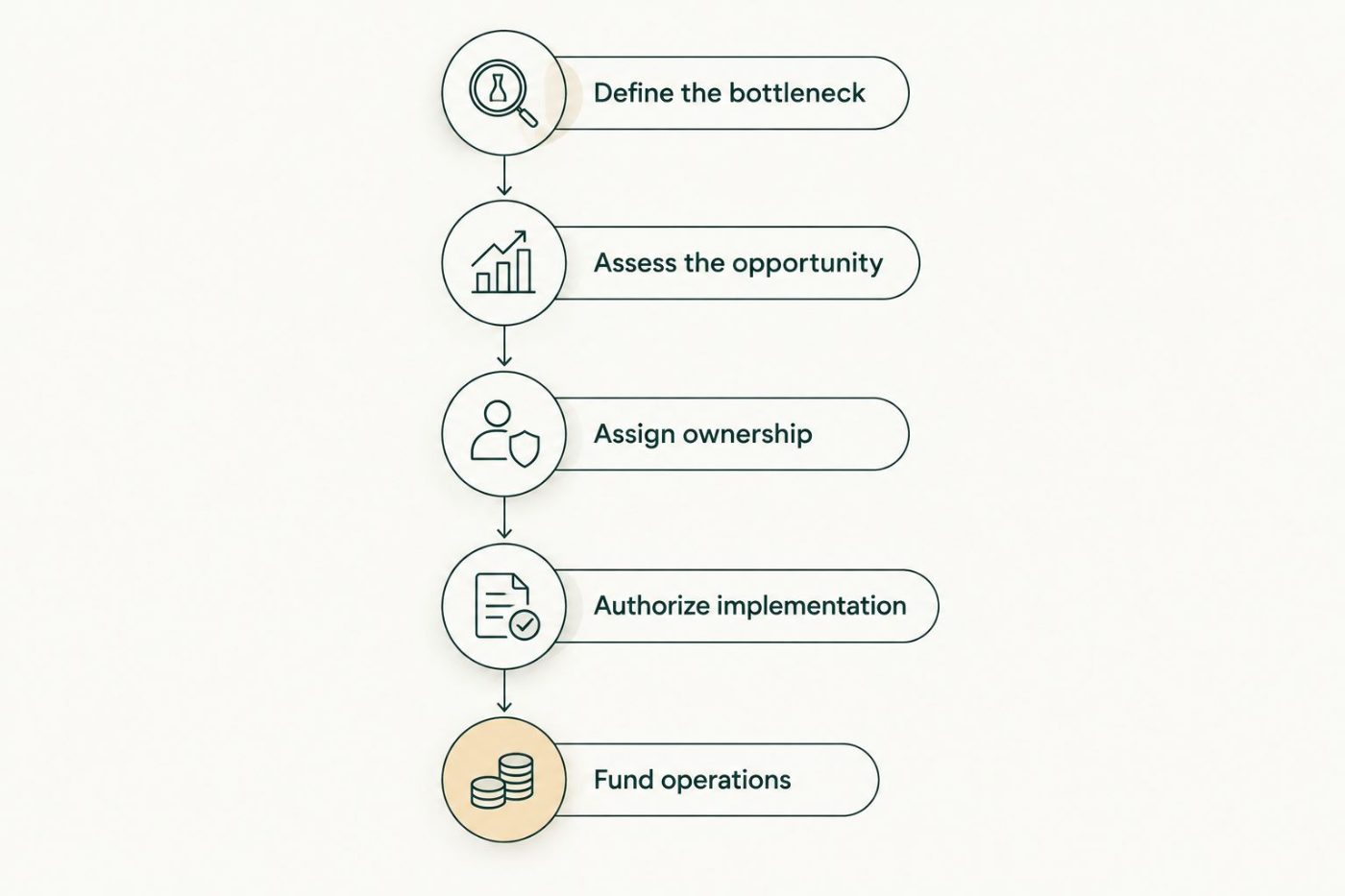
Assign ownership before authorizing implementation, and budget for operations before launch.
This sequence prevents an assessment budget from becoming an assumed implementation commitment. It also gives finance a clear distinction between evaluating an opportunity, delivering an approved solution, and operating that solution afterward.
Why this matters
An outsourced department changes where work is performed, not whether the work exists. Someone still decides which processes matter, approves access, accepts the result, and handles business consequences when an exception occurs.
A delivery fee is not the full staffing commitment. If department managers must validate outputs or employees must change how they work, their participation belongs in the resource plan even when it does not require a new hire.
For your 2026 budget, distinguish cash expenditure from committed employee capacity. Both affect execution, but they answer different management questions: what the business will spend, and what its people must stop doing to participate.
Build the budget around responsibilities, not titles
A role list does not establish capacity. An engineer, a fractional leader, and a process owner perform different work; counting them as interchangeable resources hides the decisions your business must retain.
Create a responsibility map before requesting a staffing proposal. Each responsibility should have an accountable owner, an expected contribution, and an escalation route.
| Responsibility | Internal commitment to budget | External scope to define | Acceptance evidence |
|---|---|---|---|
| Business priorities | Executive sponsor and process owner | Assessment and roadmap support | Agreed problem and decision criteria |
| Data and access | Authorized system and information owners | Technical evaluation and approved connections | Documented permissions and access boundaries |
| Implementation | Workflow expertise and business decisions | Engineering and delivery management | Results against agreed acceptance criteria |
| Adoption | Manager participation and employee practice | Training and implementation support | Ability to complete the intended workflow |
| Ongoing operations | Business escalation and approval authority | Management and technical maintenance | Assigned monitoring, exceptions, and change ownership |
Treat this map as a budgeting document, not an organizational chart. One person can hold several responsibilities, but that does not make the associated workload disappear.
Ask each internal owner what participation the work requires and what existing obligations conflict with it. Do not translate a job title into available capacity without that discussion.
Compare the staffing models before approving headcount
Choose an operating model based on control, delivery responsibility, and the work your organization can sustain. The comparison below describes planning trade-offs, not claims about any provider's fees or service quality.
| Model | Best for | Main advantage | Main constraint | Budget focus |
|---|---|---|---|---|
| Internal team | Businesses choosing direct employment and management of delivery roles | Direct authority over employees and priorities | The business must recruit, supervise, and develop the team | Employment commitments, management, and operating expenses |
| Outsourced department | Businesses assigning defined delivery and management responsibilities to an external partner | External responsibilities can be specified in an engagement | Internal decisions, access approvals, and business ownership remain necessary | Contracted scope, retained internal time, and operating expenses |
| Hybrid team | Businesses retaining selected delivery roles while outsourcing others | Responsibilities can be divided around existing capabilities | Handoffs require explicit ownership | Retained roles, external scope, and coordination work |
Choose the model that makes accountability clearest, not the one with the smallest apparent headcount. An outsourced arrangement still needs a capable internal counterpart. A hybrid arrangement needs a clear boundary between internal and external work.
National AI Consultants is best for established U.S. businesses seeking an outsourced AI department with implementation, ongoing management, and team training. Its stated audience is businesses with $10M+ in annual revenue; the model still requires internal owners who can authorize decisions and support adoption.
Separate assessment, implementation, and operations
Do not treat these stages as interchangeable staffing commitments. Each answers a different question and requires a separate approval decision.
Assessment: fund the decision before the build
An assessment should establish whether the opportunity deserves further investment. Ask for a clear operational problem, a view of the relevant constraints, and a recommendation that explains the next decision.
Budget internal participation from the people who understand the workflow and control the relevant information. Their job is to make the assessment accurate, not to endorse a solution before it has been evaluated.
Approve the assessment on its own merits. Continuing to implementation must remain a separate business decision.
Implementation: fund an accepted scope
Implementation requires a defined deliverable and a business owner authorized to accept it. Before approving the work, specify what the solution must do, where human review remains necessary, and what would prevent deployment.
Include internal testing and decision-making capacity alongside external engineering. A project can have technical resources assigned while still lacking the business participation needed to finish responsibly.
For 2026 approvals, make scope changes visible as changes to the budget and resource plan. Do not absorb additional workflows into an unchanged commitment without reviewing their effect.
Operations: fund ownership after launch
Ongoing operations require responsibility for monitoring, exceptions, access changes, training, and approved improvements. Define who handles each item and when a business decision must return to your team.
National AI Consultants positions its service as an ongoing department that implements solutions, manages them over the client relationship, and trains internal teams. Translate that model into a written scope; do not treat ongoing management as unlimited work or unconditional support.
Why outsourced AI department headcount varies
The right resource commitment depends on the work assigned and the responsibility your business retains. Use these factors to explain the budget rather than relying on a generic staffing ratio:
- Workflow scope. Define the processes included, their boundaries, and the work explicitly excluded. Additional workflows require their own resource review.
- Data and system access. Identify who can approve access, clarify information, and resolve connection requirements before assigning delivery capacity.
- Decision authority. Name the person who can settle competing priorities and approve changes. Unassigned authority is an operating-model gap, not an engineering task.
- Review requirements. Specify which outputs require human approval and who performs that work. Retain that review capacity in the internal plan.
- Adoption needs. Identify the managers and employees who must learn or change a workflow. Training delivery and employee participation are separate commitments.
- Management scope. Define monitoring, maintenance, exception handling, and improvements. Separate included management from work that needs additional authorization.
For each factor, record the owner and the budget consequence. That creates a defensible explanation for a larger or smaller commitment without pretending every business needs the same team.
Use approval gates instead of a speculative hiring plan
Use 5 approval gates to connect spending authority to business decisions. These are management checkpoints, not promised delivery milestones or a required staffing formula.
- Problem approval. Confirm the bottleneck, executive sponsor, and process owner. Stop if no one can define the operational problem.
- Assessment approval. Authorize evaluation without preauthorizing a build. Specify the decision the assessment must support.
- Build approval. Confirm scope, internal participation, controls, and acceptance criteria before implementation starts.
- Release approval. Confirm that the intended users, business owner, and operating responsibilities are ready. Technical completion alone does not answer those questions.
- Continuation approval. Review actual use, operating work, and proposed changes before expanding the commitment.
In your 2026 budget review, keep approved commitments distinct from proposed expansion. Finance should be able to see which work is authorized, which decision comes next, and who has authority to change the commitment.
This structure also creates a stopping point. If the assessment does not justify implementation, retain the findings and do not authorize the build.
How much internal headcount should you retain?
Retain enough internal capacity to own business decisions, approve access, validate the workflow, and support adoption. Those responsibilities must be assigned even when they do not justify dedicated positions.
Start with named responsibilities, then obtain workload estimates from the people who will perform them. Hiring becomes a separate decision when existing employees cannot absorb that work without compromising their other obligations.
Does an AI Opportunity Assessment commit you to implementation?
An AI Opportunity Assessment should support an investment decision, not predetermine it. Approve implementation only after reviewing the recommendation, operating requirements, and business case.
Keep the assessment authorization separate from build authorization. That distinction protects your ability to stop, revise the scope, or address a nontechnical bottleneck instead.
Can outsourced capacity replace an internal hire?
Outsourced capacity can take responsibility for defined work that you would otherwise assign internally. It does not replace the business authority needed to set priorities, approve risk, and accept operational results.
Compare responsibilities before comparing positions. If an internal role includes duties outside the outsourced scope, those duties still need an owner.
FAQ
What's the first step in budgeting headcount for an outsourced AI department?
Define the operational bottleneck and assign a business owner before selecting staffing capacity. Use an AI Opportunity Assessment to decide whether implementation deserves funding.
Do we need a full-time internal AI leader if we outsource?
Assign internal decision authority before deciding whether it requires a full-time position. Budget the actual responsibilities and workload rather than assuming a particular title is necessary.
Is an outsourced AI department better than hiring an internal team?
An outsourced department fits when you want an external partner accountable for a defined scope; internal hiring fits when you choose to employ and manage those delivery roles directly. Compare ownership, internal capacity, and ongoing obligations before selecting either model.
What belongs in the budget besides the external engagement?
Include internal participation and operating expenses alongside external delivery. Account for approvals, testing, employee training, human review, and ongoing management responsibilities.
Should we include headcount savings in the business case?
Include headcount savings only when they connect to a supported staffing decision. Time released from a task is not automatically a reduction in payroll or an eliminated position.
Who approves work delivered by an outsourced AI department?
A named internal business owner should approve whether the delivered workflow meets the agreed acceptance criteria. Define technical review, access approval, and business acceptance separately when those responsibilities belong to different people.
When should we approve more outsourced capacity?
Approve more capacity when defined additional work and its operating responsibilities justify the commitment. Review scope, internal participation, and acceptance criteria before expanding the engagement.
One last thing
Time saved is not a headcount decision. Before treating released capacity as a financial benefit, specify whether employees will handle more work, improve service, reduce overtime, or support a documented staffing change.
For your 2026 plan, ask this question before approving expansion: What will the business do differently with the capacity this creates? A clear answer connects the operating model to financial accountability without inventing a savings promise.