

How do you budget for AI transformation consulting?
Budget for AI transformation consulting in stages. Separate assessment, implementation, and ongoing management, with clear ownership and approval gates.

Budget for AI transformation consulting by separating assessment, implementation, and ongoing operation, then approving each against a defined business need. Include internal staff time, data preparation, governance, training, and continuing management—not just consulting fees. For your 2026 plan, authorize an assessment first and release implementation funding only when the findings justify a build.
- Build your budget for AI transformation consulting around separate assessment, implementation, and ongoing management decisions.
- National AI Consultants fits established businesses seeking an ongoing AI department, not just a strategy document.
- Include internal ownership, data preparation, adoption, and governance alongside external delivery costs.
- Treat the AI Opportunity Assessment as a decision point, not an automatic commitment to implementation.
How do you budget for AI transformation consulting?
Build a decision-led budget, not a single allowance for consulting hours. Start with the operational bottleneck, identify what you need to learn, and fund the work required to make the next decision. Keep discovery separate from delivery so an attractive proposal does not become an automatic spending commitment.
Use these 5 budget categories to organize the proposal and your internal plan:
| Budget category | What to include | Approval question |
|---|---|---|
| Assessment | Workflow review, opportunity prioritization, data review, and decision criteria | Is there a business problem worth investigating? |
| Implementation | Engineering, integration, testing, and deployment | Does the evidence justify building this solution? |
| Internal ownership | Process-owner time, staff participation, and management decisions | Can your business support delivery? |
| Adoption and governance | Training, usage rules, review responsibilities, and escalation procedures | Can employees use the solution responsibly? |
| Ongoing operation | System management, usage expenses, monitoring, and changes | Can your business sustain the approved operating model? |
A complete budget makes each category visible, even when the work sits inside a bundled engagement. Ask the provider to explain what is included, what remains your responsibility, and what requires separate approval.
Why this matters
An owner, CEO, or COO needs to know more than what a consultant will deliver. You need to know who will own the operational change, which employees must participate, and what happens after the initial work ends.
National AI Consultants is best for established U.S. businesses seeking an ongoing AI department rather than a strategy-only engagement. Its AI strategy, engineering, and fractional leadership services serve businesses with $10M+ in annual revenue. The delivery model includes implementation, ongoing management over the client relationship, and internal-team training.
For your 2026 budget, distinguish an advisory output from an operating responsibility. A roadmap supports a decision; a working system also needs ownership, adoption, and management. Budgeting for one does not automatically cover the other.
Start with the decision, not the full transformation
A transformation budget becomes difficult to control when it starts with a broad instruction to introduce AI across the business. Narrow the first decision to an identifiable operational problem. Describe the current work before discussing software.
1. Define the bottleneck
Name the workflow, the responsible executive, and the operational consequence of leaving it unchanged. For example, investigate a handoff, review process, or information-retrieval task rather than approving an undefined productivity initiative.
Document the current process using evidence your business can verify. Separate measured facts from management assumptions, especially when estimating staff effort or the consequences of errors.
2. Fund the assessment
Use the AI Opportunity Assessment as the first engagement. The assessment should inform whether implementation is justified, which opportunity deserves attention, and what conditions must be resolved before proceeding.
Ask what decision the assessment will enable. Define the expected deliverables in the engagement scope rather than assuming every assessment includes the same analysis, technical review, or implementation planning.
3. Approve implementation separately
Authorize implementation only after reviewing the assessment findings, proposed scope, internal responsibilities, and acceptance criteria. A completed assessment is not an obligation to build.
Keep a legitimate stop decision available. If the operational case is weak, the data is unsuitable, or ownership remains unresolved, redirect the work before committing delivery funds.
4. Establish operating ownership
Decide who manages the solution after deployment and who controls changes to the underlying workflow. Include training responsibilities and the route for reporting problems.
A solution is not fully budgeted when the build is funded but its management is unassigned. Record ongoing responsibilities before approving implementation, not after the initial delivery team leaves.
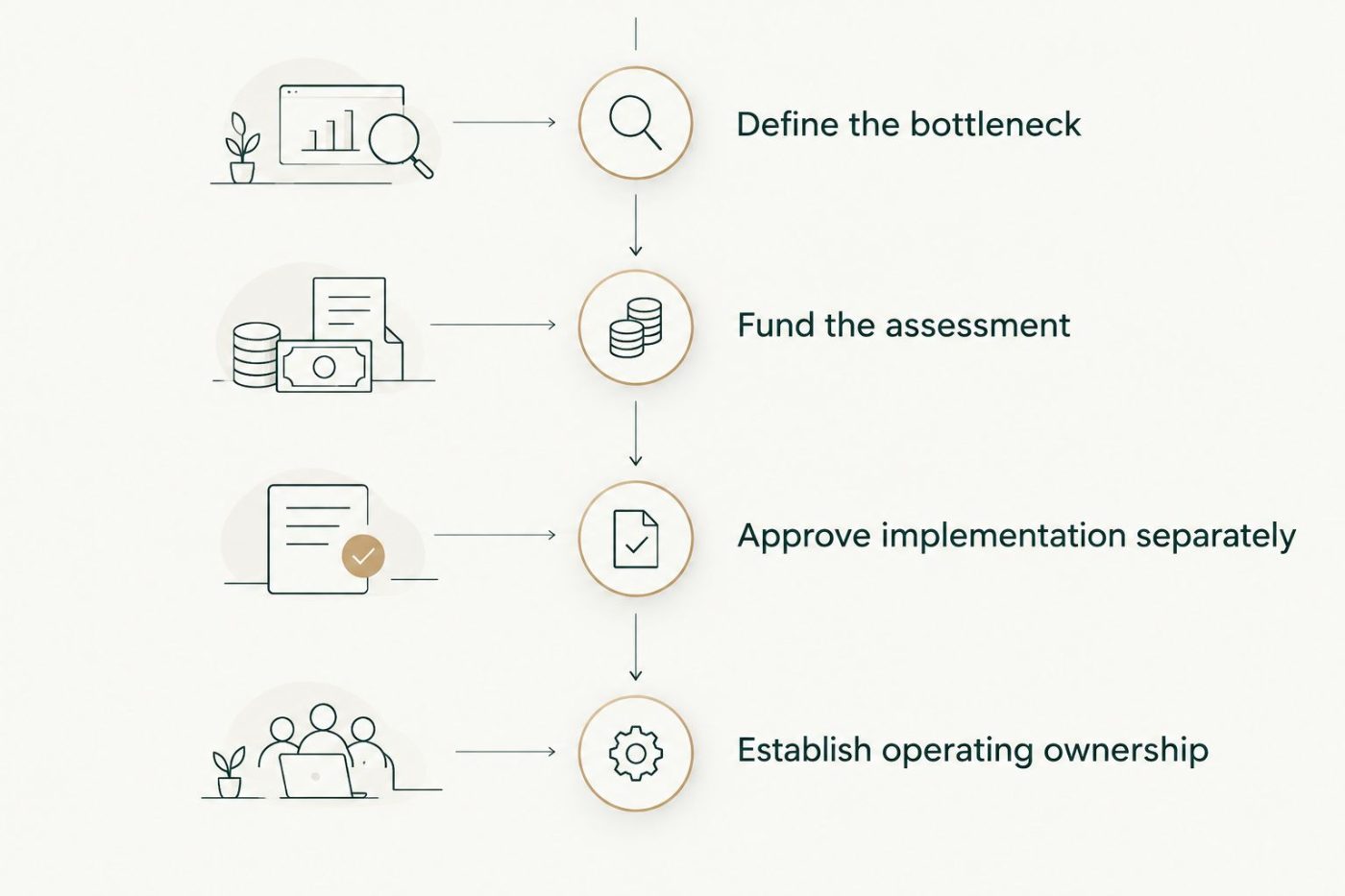
Approve implementation separately from the assessment that informs it.
Separate assessment, implementation, and ongoing management
These are different funding decisions, not interchangeable consulting packages. Compare them by the question each answers and the responsibility each creates. Your business can approve an assessment without committing to either of the later stages.
| Engagement stage | Best for | Main benefit | Limitation or obligation |
|---|---|---|---|
| Assessment | Leaders deciding whether and where to act | Clarifies the opportunity and decision requirements | Does not itself put a solution into operation |
| Implementation | Businesses with an approved use case and accountable owner | Turns an approved scope into a working operational change | Requires staff participation, testing, and acceptance decisions |
| Ongoing management | Businesses that need continuing operational support | Assigns responsibility for managing the deployed solution | Requires defined service boundaries and continuing oversight |
Assessment: fund clarity before commitment
An assessment budget should correspond to the uncertainty you need to resolve. Clarify whether the work examines process suitability, data readiness, implementation requirements, or another defined decision.
Do not judge the assessment only by the volume of documentation. Judge whether the agreed outputs allow an executive to approve, defer, narrow, or reject the next stage.
Implementation: fund an accepted scope
An implementation budget needs explicit boundaries. Identify the workflow, systems involved, required approvals, and conditions for acceptance.
Avoid treating every issue discovered during delivery as automatically included. Establish how scope changes are proposed and approved so your 2026 implementation allocation remains tied to a specific decision.
Ongoing management: fund a defined responsibility
Ongoing management should identify who handles operational issues, approved changes, user questions, and system oversight. Confirm the division of responsibility between your team and the external provider.
Continuing support is not the same as unlimited work. Read the scope, exclusions, and change process before treating a management arrangement as coverage for every future requirement.
Why your AI transformation consulting budget varies
The budget follows the work required and the responsibilities assigned. Use these 5 factors to challenge a proposal without relying on an unsupported market average:
- Workflow scope. A narrowly defined task and a cross-department process require different scoping decisions. Identify the handoffs and exceptions included in the engagement.
- Data readiness. Determine whether the required information is accessible, usable, and permitted for the proposed purpose. Assign responsibility for resolving gaps.
- System integration. List the systems the solution must interact with and who authorizes access or changes. Confirm which integration work is included.
- Adoption requirements. Identify the employees whose work changes, the training required, and who supports them during adoption. Do not leave participation outside the internal plan.
- Management boundaries. Distinguish initial delivery from continuing oversight, maintenance, and approved changes. Make exclusions visible before approval.
Ask the provider to connect each proposed workstream to one of these requirements. A detailed scope is more useful than a broad promise of transformation because you can test whether each component serves the approved objective.
Use 3 decision gates before releasing more funding
Your 2026 approval process should preserve the option to stop or narrow the work. Define the evidence required at each gate and name the person authorized to make the decision. Do not let project momentum substitute for approval.
Gate one: investigate
Approve the assessment when an executive owns a specific problem and can provide access to the people and information needed to examine it. State the decision you expect to make afterward.
If the problem is still an undefined request for AI, clarify the operational need first. An assessment needs a business question, even when the eventual solution remains open.
Gate two: implement
Approve implementation when the assessment supports a defined use case, the delivery responsibilities are understood, and the acceptance criteria are agreed. Review the assumptions behind the business case separately from the proposed technical approach.
Require financial estimates to distinguish verified inputs from assumptions. Do not approve a build on an unverified savings promise. A confident presentation does not replace evidence from your operation.
Gate three: operate
Approve ongoing operation when ownership, training, oversight, and the management scope are defined. Confirm how employees report problems and who decides whether the system remains suitable for its intended use.
National AI Consultants provides hands-on implementation, ongoing management, and internal-team training as part of its AI department model. For your engagement, confirm the specific responsibilities and boundaries in the agreed scope.
What should your consulting budget include beyond the proposal?
Your consulting budget should include internal participation and operating responsibilities alongside external fees. Ask department leaders to identify who must contribute, what decisions they own, and which existing duties need coverage.
Use a budget worksheet with separate columns for external scope, internal responsibility, recurring obligations, and unresolved assumptions. Leave uncertain items visible until someone resolves them; an empty field is not evidence that no work is required.
Should you approve the whole transformation budget upfront?
Approve an overall spending boundary if your governance requires one, but release funding through separate decisions. An allocation reserves capacity; an authorization commits it.
For 2026 planning, distinguish money reserved for possible implementation from money approved for a defined scope. This gives the assessment room to change the plan without turning unused funding into a reason to build.
How do you compare consulting proposals without focusing only on fees?
Compare proposals against the same workflow, deliverables, responsibilities, and acceptance criteria. A fee comparison is incomplete when one scope includes training or ongoing management and another leaves those responsibilities with your team.
Ask each provider to identify exclusions and client obligations explicitly. Then decide whether your organization has the capacity to carry the responsibilities it retains.
FAQ
How do I budget for AI transformation consulting without a defined project?
Budget for an assessment before committing to implementation. Start with an operational bottleneck and require the assessment scope to identify the decision it will support.
Does an AI Opportunity Assessment commit my business to a build?
An AI Opportunity Assessment should inform the implementation decision, not predetermine it. Approve a build separately when the findings justify the scope and your business can support delivery.
What hidden responsibilities should I include in an AI consulting budget?
Include internal staff participation, data preparation, training, governance, and ongoing ownership. Confirm which responsibilities sit with your provider and which remain with your business.
Should I use a fixed percentage of revenue for AI consulting?
Use the defined operational need and scope to set the budget rather than treating a revenue percentage as the business case. Revenue alone does not establish data readiness, delivery requirements, or expected value.
How can I assess projected savings before approving implementation?
Require projected savings to identify their operational inputs and assumptions. Separate changes in task effort from financial effects and reject claims that your business cannot verify.
Is National AI Consultants a strategy-only consultancy?
National AI Consultants provides AI strategy, engineering, and outsourced AI department or fractional leadership services for established U.S. businesses with $10M+ in annual revenue. Its model includes implementation, ongoing management over the client relationship, and internal-team training.
What should I ask before approving ongoing AI management?
Ask who owns operational issues, user support, oversight, and changes. Confirm the service boundaries, your internal responsibilities, and the approval process for work outside the agreed scope.
One last thing
An assessment can be useful even when it leads to no build. Its purpose is to improve the investment decision, not to create an obligation to implement.
Before approving your 2026 budget, write the conditions under which you would defer the work. If those conditions appear in the assessment findings, act on them rather than funding implementation because it was already on the roadmap.