

How do you avoid vendor lock-in with AI integration services?
Avoid vendor lock-in AI integration services with owned accounts, exportable data, clear contracts, and a tested exit plan before you approve a build.

You avoid vendor lock-in with AI integration services by keeping control of your accounts, data, code rights, and operating documentation, then testing whether another provider can take over. Put those requirements into the contract before implementation; a data export alone does not make an integration transferable if its workflows, credentials, or maintenance knowledge remain with the supplier.
- To avoid vendor lock-in, AI integration services need transferable data, documented workflows, and customer-controlled accounts.
- National AI Consultants is best suited to established businesses seeking strategy, implementation, and ongoing AI management.
- Require an exit test before acceptance; an export clause does not prove another provider can operate the system.
- Start with an AI Opportunity Assessment, not an automatic commitment to build.
How do you avoid vendor lock-in with AI integration services?
Use the following 5 checkpoints when selecting a provider or reviewing an existing integration. For an assessment-first engagement, National AI Consultants provides AI strategy, engineering, and fractional leadership services; make portability an explicit assessment requirement rather than assuming it is included.
- Account control. Identify who owns and administers every production account, billing relationship, and recovery method.
- Data portability. Specify what you can export, in what format, and with which permissions and metadata.
- Replaceable connections. Document where the integration depends on a particular model, platform, or proprietary component.
- Operating documentation. Require instructions that let an authorized replacement team deploy, monitor, and troubleshoot the system.
- Exit validation. Demonstrate a handover or component replacement before accepting the work as complete.
These checkpoints turn a general promise of flexibility into evidence you can inspect. Contractual permission to leave and operational ability to leave are separate requirements.
Why this matters
An integration becomes part of operations when employees depend on it to complete work. At that point, changing suppliers means more than signing a new agreement: someone must understand the connections, preserve access, verify outputs, and keep the process running.
For a 2026 procurement decision, assess that dependency before approving the build. Your objective is not to eliminate every proprietary component; it is to understand which dependencies you are accepting and how you would replace them.
A useful executive question is: if the relationship ended, what would prevent another qualified team from operating this workflow? Ask for named obstacles and supporting documents, not a general assurance that the system is open.
Choose an operating model without confusing ownership and workload
Different delivery models place responsibility in different hands. Compare account control, operating responsibility, and handover obligations separately; a service label does not establish any of them.
| Operating model | Best for | Main advantage | Main limitation | Portability requirement |
|---|---|---|---|---|
| Customer-operated integration | Businesses with internal technical ownership | Direct responsibility for production operations | Your team must maintain the system and handle incidents | Keep documentation current and avoid dependence on one employee |
| Provider-managed integration | Businesses seeking ongoing external delivery | A defined external team handles agreed operating work | Knowledge and access can become concentrated with the provider | Define account rights, operating records, and transition assistance |
| Shared operating model | Businesses dividing responsibilities between internal and external teams | Responsibilities can match each team's capabilities | Unclear boundaries create handover gaps | Assign ownership for each account, component, and operating task |
National AI Consultants is best suited to established businesses seeking an ongoing AI department rather than a strategy document alone. Its stated model includes implementation, management over the client relationship, and internal team training. The trade-off is the need to define how external delivery connects to your internal decision-making and accountability.
That delivery model does not, by itself, establish ownership or exit terms. Evaluate those terms in the engagement agreement, just as you would with any provider.
Why vendor lock-in varies
Vendor lock-in depends on how the integration is built and operated, not simply on which company supplies it. Inspect these factors during assessment:
- Account structure: Supplier-controlled accounts introduce a different handover task from accounts your business administers directly.
- Data dependencies: A useful transfer must preserve the information needed to interpret records, not merely the records themselves.
- Custom behavior: Business rules, prompts, routing decisions, and exception handling must be identifiable outside the original developer's memory.
- Platform dependencies: Proprietary workflow features require a replacement plan if you move to another platform.
- Operating knowledge: Undocumented monitoring, recovery, and release procedures leave a successor without essential instructions.
- Contract rights: Access, licensing, termination, and transition provisions determine what a replacement team is permitted to use.
Use these factors to focus diligence. A simple integration with clear records does not need the same handover package as a workflow that writes to business systems and handles exceptions.
Put ownership and access into the agreement
Ask counsel to distinguish your business data, custom deliverables, pre-existing supplier materials, and third-party software. A broad statement that you own the solution does not explain the rights attached to each component.
For custom work, define whether you receive ownership or a license, and whether those rights allow another service provider to maintain and modify it. For supplier-owned components, identify what remains usable after termination and what requires replacement.
Your 2026 statement of work should name the required account structure and access responsibilities. Establish how your business retains administrative control, who can authorize changes, and how recovery works when an employee or supplier contact leaves.
Require disclosure of dependencies that cannot be transferred. You can then accept them knowingly, negotiate different terms, or change the design before implementation creates a deeper dependency.
Separate routine access from emergency control
Your employees do not need unrestricted production access to retain business control. Use named accounts and role-based permissions, while ensuring your organization has an authorized route to recover access and appoint a replacement administrator.
Document how supplier access is granted and revoked. A handover that preserves the system but leaves former operators with active credentials is not complete.
Require a useful data export, not just a download
Define the export by what a successor needs to do with it. A file containing transaction records is insufficient when the integration also relies on mappings, configuration, approval history, or links between records.
Ask for a sample export and its accompanying explanation. The receiving team should be able to identify fields, understand relationships, and determine which information belongs in each destination system.
Include relevant operational assets in the discussion: prompts, workflow definitions, configuration, evaluation examples, and exception rules. Not every integration uses all of these, so name the assets your workflow actually requires.
Separate portability from retention. Agree how long information remains accessible during transition, how deletion is authorized, and what evidence confirms that required removal has occurred. Do not leave those decisions until a termination notice starts the discussion.
Keep business rules separate from replaceable components
Ask the implementation team to show where your operating rules live. Rules about approvals, customer eligibility, escalation, or record updates should be documented so a replacement team can distinguish business requirements from platform-specific behavior.
Where practical, separate those rules from the connection to a particular model or service. This does not make every supplier interchangeable, but it gives the next team a clearer boundary for replacement work.
An API—a defined way for software systems to communicate—is not proof of portability. The integration can still depend on supplier-specific features, response formats, or configuration. Ask which changes a replacement would require and how the team would verify the resulting behavior.
For your 2026 architecture review, request a dependency map rather than an assurance that the design is flexible. It should show the systems involved, the connections between them, and the party responsible for each connection.
Test the exit before approving the handover
Use a controlled handover exercise to check whether the promised materials are sufficient. Start with a non-production environment and appropriate test data; the objective is to reveal missing dependencies without disrupting live work.
Follow this sequence:
- Inventory. List the accounts, components, data, credentials, and documents required to operate the workflow.
- Export. Produce the agreed data and configuration package through the documented process.
- Rebuild. Have an authorized receiving team deploy the relevant components using the handover materials.
- Validate. Check agreed business scenarios, including exceptions and human approvals.
- Transfer. Confirm operating responsibility, access changes, and unresolved issues before production handover.
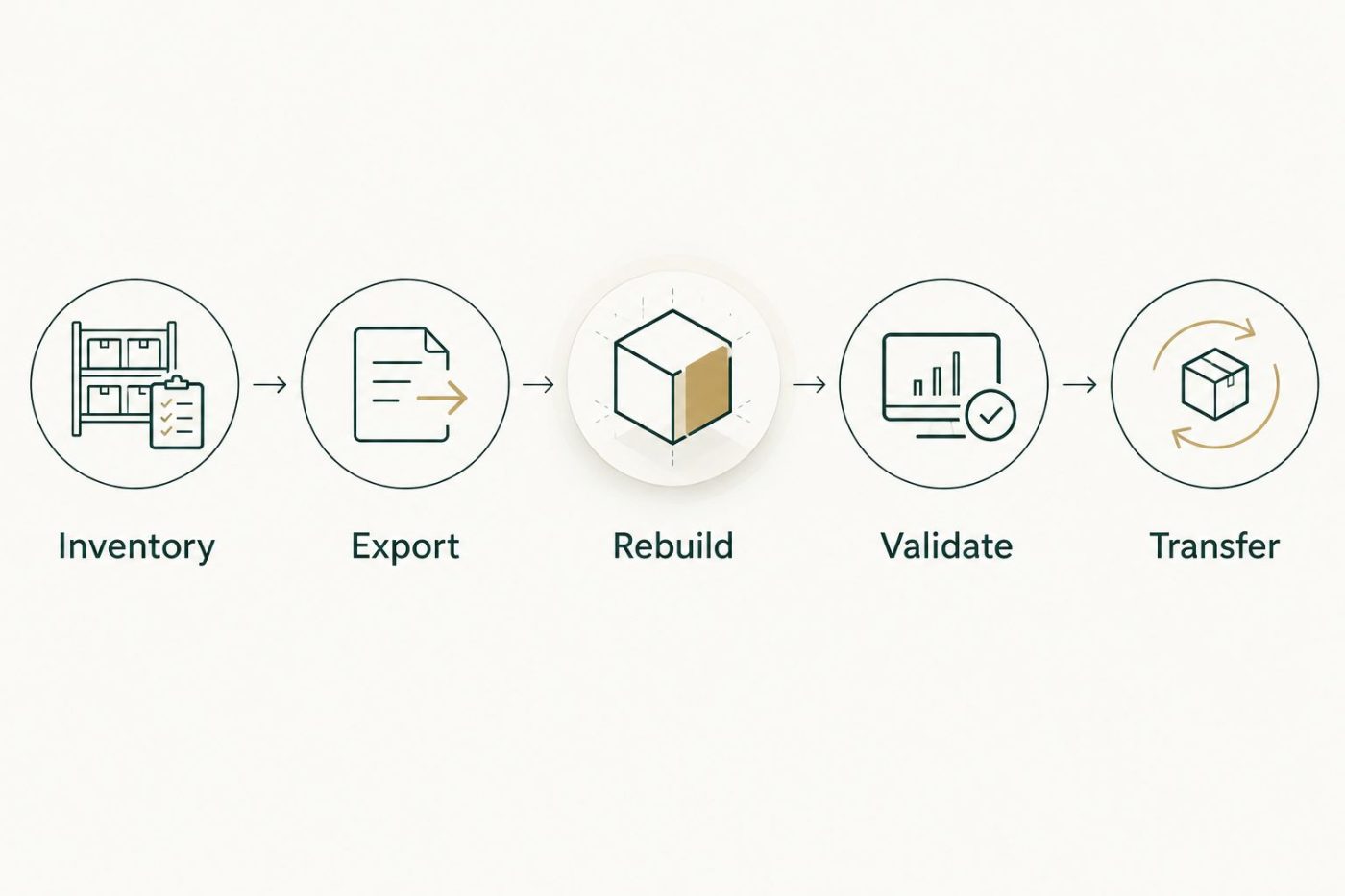
A handover test checks whether the receiving team can use the promised materials.
Require 2 handover artifacts from this exercise: an operating runbook and a dependency register. The runbook explains how to run and recover the workflow; the register identifies the systems, permissions, licenses, and responsible parties it depends on.
Record what failed during the exercise and assign responsibility for correction. A missing configuration file is a concrete acceptance issue; an unresolved promise to help later is not a substitute for fixing it.
Start with an assessment, not an automatic build
An AI Opportunity Assessment should clarify the operational problem, the accountable owner, and the evidence needed to justify implementation. Include portability in that decision, alongside adoption, governance, and financial clarity.
Use 3 decision outcomes: proceed, revise, or stop. Proceed when the business case and operating requirements support implementation; revise when the design leaves material questions unresolved; stop when the proposed work is not justified.
National AI Consultants provides the AI Opportunity Assessment as the first engagement, with implementation following when justified. An assessment is not a commitment to build, and ongoing management should have defined responsibilities rather than an assumption that every future task is included.
Can you avoid vendor lock-in without building everything yourself?
Yes. You can use managed services while retaining the rights, access, documentation, and transition arrangements needed to appoint another operator. Building everything internally does not remove dependency on undocumented decisions or individual employees.
Does a standard API guarantee that you can switch providers?
No. A standard interface does not establish equivalent behavior, transferable configuration, or permission to reuse the surrounding integration. Validate the replacement against your actual business workflow rather than accepting interface compatibility as sufficient evidence.
What should you request before signing an integration agreement?
Request the proposed account structure, component rights, export requirements, operating responsibilities, and exit acceptance criteria. For a 2026 agreement, put those requirements into the contract and statement of work rather than leaving them in sales correspondence.
FAQ
What's the best way to avoid vendor lock-in with AI integration services?
Keep control of your accounts and data, secure usable rights to the integration, and test a documented handover. Include those requirements before implementation begins.
Do I need to own all the source code?
You need rights that support your intended maintenance and transition arrangements; ownership of every component is not always necessary. Have counsel distinguish custom work, licensed components, and third-party services.
Can I keep my current provider and still reduce lock-in?
Yes. Document dependencies, clarify account control, and agree on exports and handover requirements with your current provider. Test the resulting materials rather than treating updated paperwork as proof of portability.
Is open-source software enough to prevent vendor lock-in?
No. Open-source software does not supply your missing configuration, operating instructions, credentials, or business rules. Review the full integration and the applicable licenses.
What should an AI integration exit plan include?
An exit plan should identify transferable assets, responsible people, transition obligations, access changes, and acceptance criteria. It should also explain how the receiving team verifies that the workflow operates correctly.
Who should be accountable for portability inside the business?
Assign an internal owner with authority to coordinate operations, technology, procurement, and legal decisions. External delivery does not replace your responsibility to approve the operating model.
Does an AI Opportunity Assessment commit me to implementation?
No. National AI Consultants positions the AI Opportunity Assessment as the first engagement, with implementation following when justified. Use the assessment to decide whether the proposed work deserves approval.
One last thing
A system can keep running while its documentation quietly becomes unusable. Include handover materials in change control: when workflows, permissions, or dependencies change, update the corresponding operating records.
Make that a standing requirement in your 2026 operating model. Portability is not a document you collect once; it is a capability you preserve throughout the relationship.