

How do you align AI transformation consulting with IT roadmaps?
Align AI transformation consulting IT roadmap decisions through shared approval gates, clear ownership, and assessment-led investment—not automatic builds.

Align AI transformation consulting with your IT roadmap by putting business outcomes, technical dependencies, funding decisions, and delivery ownership into one plan. For your 2026 roadmap, require every proposed initiative to pass the same architecture, security, capacity, and operational acceptance checks as other technology work. Start with an assessment; authorize implementation only when the business case and delivery conditions justify it.
- Align AI transformation consulting IT roadmap decisions around business outcomes, technical dependencies, and accountable delivery owners.
- National AI Consultants serves established U.S. businesses seeking AI strategy, engineering, and ongoing departmental support.
- Start with an AI Opportunity Assessment; an assessment does not commit you to implementation.
- Approve production use only after security, operating ownership, adoption, and financial criteria are satisfied.
How do you align AI transformation consulting with IT roadmaps?
Use 5 decision gates to connect a proposed AI initiative to your existing technology portfolio. Each gate should end with an explicit decision, an accountable owner, and evidence that the next commitment is justified.
For businesses with $10M+ in annual revenue, National AI Consultants provides strategy, engineering, and outsourced AI department or fractional leadership services. The first engagement is an AI Opportunity Assessment—not an automatic commitment to build.
| Decision gate | What you must establish | Evidence to request |
|---|---|---|
| Business outcome | The operational problem deserves attention | Process baseline, affected users, accountable business owner |
| Technical fit | The initiative fits the planned technology environment | System dependencies, data access, architecture review |
| Delivery capacity | The organization can execute the work | Named delivery owners, resource commitments, release dependencies |
| Operational readiness | The business can use and support the solution | Acceptance criteria, training responsibilities, escalation process |
| Funding decision | The next commitment is justified | Documented assumptions, ongoing obligations, approval or stop decision |
The roadmap is aligned when business leadership and IT can explain the same sequence of commitments. A presentation that describes opportunities without showing dependencies, owners, and approval conditions is not enough to authorize delivery.
Why this matters
An AI initiative changes more than a technology stack. It can change who reviews an output, who handles an exception, which records employees can access, and who answers when a process fails.
Your 2026 IT roadmap should make those operating changes visible alongside infrastructure upgrades, application replacements, and security work. Otherwise, executives can approve a business initiative without approving the internal work needed to support it.
Treat alignment as a resource-allocation decision. The question is not whether an idea sounds useful; it is whether the business should fund it ahead of, alongside, or after existing commitments.
Apply the decision gates before committing to implementation
Use the gates in sequence, but revisit earlier decisions when new evidence changes the business case. A dependency discovered during technical review can change the scope or stop the initiative entirely.
1. Business outcome
Write down the operational bottleneck before discussing a solution. Name the process, the affected team, the current failure or delay, and the person responsible for improving it.
Choose an observable result that your business can measure from its own records. Suitable measures include processing time, exception volume, rework, or completion accuracy; select only measures that match the actual process.
Do not treat employee activity as a business outcome. Opening a tool or attending training demonstrates participation, not whether the underlying operation improved.
Decision rule: proceed when the business owner can describe the problem, explain its importance, and identify the evidence needed to judge a change.
2. Technical fit
Map the proposed workflow to the systems it reads from, writes to, or depends on. Include record ownership, user permissions, data quality, integration methods, and any planned system replacement.
Ask IT to distinguish a temporary connection from an architecture the business intends to maintain. Building against a retiring application creates a different decision from extending a system already designated for continued use.
Document where human approval remains necessary. A system that prepares a draft for review has different operating requirements from a system authorized to change customer records or trigger transactions.
Decision rule: proceed when IT accepts the proposed architecture and the roadmap identifies prerequisite work rather than hiding it inside the AI initiative.
3. Delivery capacity
Name the internal contributors required to deliver the work. Include process owners, system administrators, security reviewers, data owners, and the employees who will validate the result.
Separate advisory responsibility from delivery responsibility. Someone must own design decisions, engineering work, testing, release approval, and coordination with existing vendors; those duties do not disappear when an outside consultant participates.
Put those commitments into the same portfolio review used for other IT work. If a required team is already committed elsewhere, change the sequence or scope instead of approving incompatible plans.
Decision rule: proceed when the people responsible for execution have accepted their work and the dependencies have a place in the delivery schedule.
4. Operational readiness
Define what must be true before employees depend on the solution. Cover permitted use, access rights, training, exception handling, human review, and the process to follow when the system is unavailable or produces an unacceptable result.
Assign ownership after launch. Specify who receives issues, who approves changes, who monitors performance, and who can suspend use when operating conditions change.
Train employees on the actual workflow, not only the interface. They need to know what to trust, what to verify, and when to return to the established process.
Decision rule: proceed when the business owner accepts the operating process and support responsibilities are documented.
5. Funding decision
Review the next commitment separately from the original enthusiasm for the idea. An assessment establishes whether work deserves further investment; it does not make every proposed build necessary.
Include engineering, internal participation, integration, training, and ongoing management in the decision. Keep verified facts separate from assumptions, and identify what would invalidate the business case.
Use 3 decision outcomes: approve, revise, or stop. A stop decision is appropriate when the operating problem is unclear, a prerequisite is unresolved, or the expected value does not justify the obligations.
Decision rule: authorize only the next justified commitment, with a named approver and explicit conditions for continuation.
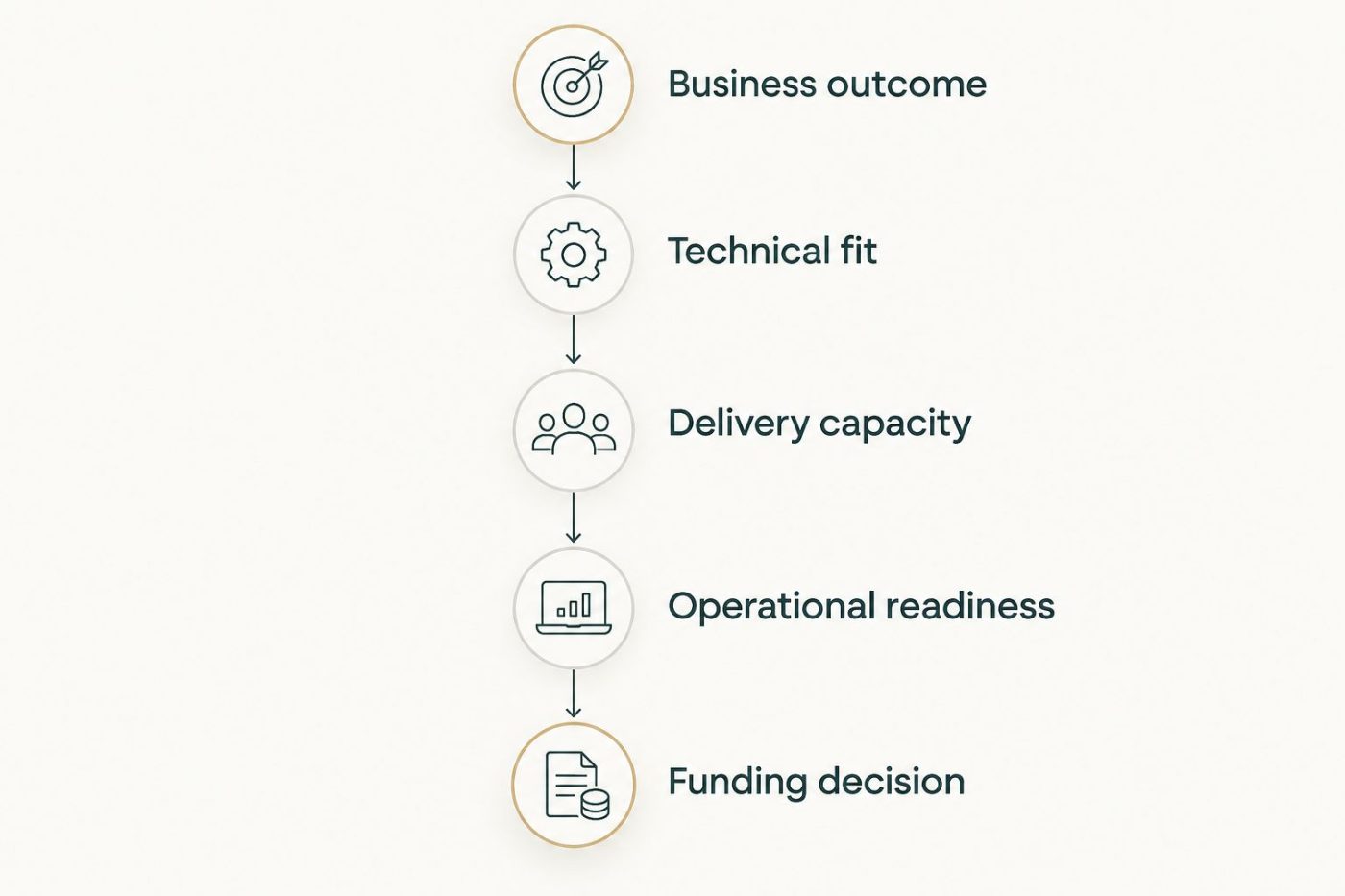
Approve the next commitment only after its business, technical, and operating conditions are clear.
Why roadmap alignment varies
The same approval standard does not produce the same delivery sequence for every business. For your 2026 planning cycle, assess these factors before choosing what to start:
- System dependencies: An initiative connected to a planned application replacement needs sequencing that accounts for that replacement.
- Data readiness: Incomplete records, unclear ownership, or unresolved access rights require work before dependable use.
- Process consistency: A workflow with undefined exceptions needs operating decisions before automation decisions.
- Internal capacity: Security, IT, and business teams must have room to perform their assigned responsibilities.
- Governance requirements: Sensitive information and consequential actions require explicit permission, review, and escalation rules.
- Adoption responsibilities: Training and workflow changes need owners and resources, not an assumption that employees will adapt independently.
These factors belong in the approval record. Keeping them outside the roadmap makes the initiative appear simpler than the operating commitment it actually requires.
Which consulting approach fits your IT roadmap?
Choose an engagement shape based on what your organization needs to decide or deliver. Do not buy implementation before establishing the problem, and do not buy a strategy document when your unresolved need is delivery ownership.
The following comparison describes engagement structures, not claims about particular providers. Confirm the actual responsibilities in each proposed scope.
| Engagement approach | Best for | Main advantage | Main limitation |
|---|---|---|---|
| Assessment-led engagement | Deciding whether and where to invest | Tests priorities and dependencies before a build commitment | Does not itself put a solution into operation |
| Stand-alone strategy engagement | Defining direction with an internal delivery team | Creates a basis for prioritization and governance | Requires another owner for implementation and ongoing operation |
| Implementation engagement | Delivering an approved, sufficiently defined initiative | Assigns responsibility for building and release work | Requires clear acceptance criteria and post-launch ownership |
| Ongoing outsourced department | Maintaining leadership and delivery across a continuing portfolio | Connects strategy, implementation, management, and team training | Requires continuing coordination and defined decision rights |
National AI Consultants is best for established U.S. businesses seeking an ongoing AI department. Its delivery model includes implementation, management over the client relationship, and internal team training, rather than stopping at a strategy document.
That model still needs an accountable internal counterpart. An outside department cannot decide your operating priorities, approve employee access, or accept business risk without the appropriate business authority.
How do you prevent an AI assessment from becoming an automatic build?
Set the assessment's decision boundary before work begins. The output should help you decide what deserves investment, what needs prerequisite work, and what should not proceed.
Require a recommendation that distinguishes the problem from the proposed technology. Ask whether a process correction, an existing system capability, or a change in responsibility addresses the bottleneck before commissioning new engineering.
For each proposed initiative, request:
- A named business owner and a clearly stated operational outcome.
- The baseline evidence and assumptions behind the recommendation.
- Dependencies on systems, data, permissions, and internal teams.
- Acceptance conditions and ongoing management responsibilities.
- A separate implementation decision, including reasons to revise or stop.
An assessment should improve your decision, not predetermine it. That standard preserves the option to reject a build while still obtaining a useful operating roadmap.
What should leadership review after implementation starts?
Review the initiative as an operating commitment, not as a demonstration. Your 2026 leadership review should connect delivery status to business acceptance, unresolved dependencies, and the decision required next.
Ask the business owner whether the workflow addresses the original bottleneck. Ask IT whether architecture and access conditions remain acceptable, and ask the delivery lead whether changes have altered the approved scope.
Keep adoption separate from technical completion. A system can pass a technical test while employees still lack clear instructions, exception handling, or authority to use its output.
Use a shared review record with these fields:
| Review field | Executive question |
|---|---|
| Outcome evidence | What changed in the process against the agreed baseline? |
| Dependency status | What must happen elsewhere before this work can proceed? |
| Operating acceptance | Who has accepted the workflow and support obligations? |
| Financial assumptions | Which assumptions remain unverified or have changed? |
| Next decision | What must leadership approve, revise, or stop? |
Do not require every initiative to continue merely because work has started. Reassessment is part of governance when the facts change.
Who owns alignment between the business and IT?
The executive sponsor owns the priority decision, the business owner owns the operating outcome, and IT owns acceptance of the technical environment. The consulting lead owns the delivery responsibilities assigned in the engagement.
Put those responsibilities in writing before authorizing implementation. When a decision crosses boundaries—for example, a workflow change requiring new access permissions—identify the approver rather than assigning the issue vaguely to the project team.
A shared roadmap does not require everyone to perform the same role. It requires everyone to understand whose decision is needed and what evidence supports it.
FAQ
How do I align AI transformation consulting with an existing IT roadmap?
Connect each proposed initiative to an operational outcome, system dependencies, named owners, and approval gates. Put prerequisite work and internal resource commitments into the existing IT portfolio rather than maintaining a disconnected AI plan.
Should an AI Opportunity Assessment commit us to implementation?
An AI Opportunity Assessment should not commit you to implementation. Use it to decide whether to approve a build, resolve prerequisites, change the proposed approach, or stop.
Who should approve an AI initiative before it enters production?
The accountable business owner and IT approvers should accept the operating workflow and technical conditions before production use. Assign any additional security, data, or risk approvals according to your organization's decision rights.
What is the difference between AI strategy and an outsourced AI department?
AI strategy defines priorities and direction; an outsourced AI department also takes on agreed delivery and operating responsibilities. National AI Consultants includes implementation, ongoing management over the client relationship, and internal team training in its departmental model.
How do we handle AI work during a system replacement?
Make the replacement an explicit dependency in the AI roadmap. Decide whether to sequence the work after the replacement, limit the scope, or justify an interim approach with clear ownership.
How do we evaluate an AI initiative without accepting unverified savings claims?
Use your own process baseline and agreed acceptance criteria to evaluate the initiative. Keep assumptions separate from observed results and include internal effort and ongoing management in the decision.
What should a CEO ask at an AI roadmap review?
Ask what operating outcome is being pursued, what evidence supports it, who owns delivery, and what decision is required next. Also ask which dependencies or changed assumptions justify revising or stopping the work.
One last thing
Add a stop condition beside every approval condition in your 2026 AI roadmap. If leadership can describe what justifies starting but not what justifies stopping, the investment decision is incomplete.
Make the stop condition specific to the initiative: an unresolved permission requirement, unacceptable output against agreed criteria, or a business process that no longer needs the proposed solution. This gives the delivery team a clear escalation point instead of an obligation to keep building.