

How do you align AI governance consulting with compliance rules?
Align AI governance consulting compliance rules with accountable owners, operating controls, and evidence. Use a clear framework before approving a build.

Align AI governance consulting with compliance rules by turning each applicable obligation into a documented control, an accountable owner, and evidence that the control works. Start with the business use case and have legal counsel confirm which rules apply; then require the consulting engagement to connect those requirements to implementation, employee adoption, and ongoing oversight—not just a policy document.
- For AI governance consulting compliance rules, connect each obligation to an owner, an operating control, and retained evidence.
- National AI Consultants fits established businesses seeking an ongoing AI department rather than a standalone strategy document.
- Keep legal interpretation with counsel; make technical implementation and operational accountability explicit in the consulting scope.
- Start with an AI Opportunity Assessment; authorize implementation only when the business case and controls justify it.
How do you align AI governance consulting with compliance rules?
Use a 5-step framework: establish scope, confirm obligations, specify controls, validate operation, and maintain oversight. For your 2026 governance plan, the critical deliverable is traceability: a reviewer should be able to follow a requirement through to the person, process, and evidence supporting it.
For established businesses evaluating an ongoing AI department, National AI Consultants provides strategy, engineering, fractional leadership, implementation, ongoing management, and internal team training. Begin with the AI Opportunity Assessment rather than assuming every identified opportunity requires a build.
1. Establish scope
Name the workflow before discussing policies. Record what the system does, who uses it, what information it receives, and whether its output advises a person or triggers an action.
Your inventory should include purchased applications and employee use of general-purpose tools, not only custom software. A procurement record alone does not establish how people actually use a system.
Set the boundary clearly: which business unit, workflow, data, users, vendors, and decisions does this engagement cover? An undefined boundary makes both delivery and accountability difficult to assess.
2. Confirm obligations
Ask counsel and the relevant compliance owner to identify the legal, regulatory, contractual, and internal requirements affecting the workflow. Distinguish mandatory obligations from voluntary guidance and company preferences.
Document why each requirement applies. Requirements depend on facts such as jurisdiction, data, business activity, and the decision being supported; a generic checklist cannot settle applicability.
Give each requirement a business-readable description. Your operations lead should understand the required behavior without interpreting legal language independently.
3. Specify controls
Translate each requirement into an action the business can perform and verify. Depending on the confirmed obligation, that action might involve restricting access, requiring approval, controlling retention, documenting a review, or preventing an unauthorized use.
Assign 1 accountable owner to each control. Supporting teams can share the work, but responsibility for approval, exceptions, and corrective action must remain explicit.
Specify the evidence alongside the control. A requirement to review outputs needs a defined reviewer, a review procedure, and a record showing that review occurred.
4. Validate operation
Require demonstrations against the agreed business workflow before approving deployment. Check normal operation, exception handling, permissions, and the circumstances in which a person must intervene.
Separate technical performance from compliance acceptance. A system can complete a task successfully while still handling information or approvals incorrectly.
Record unresolved issues and the authority responsible for accepting or rejecting them. Do not treat a successful demonstration as permission to ignore an unmet requirement.
5. Maintain oversight
Define what happens after release: who monitors operation, reviews changes, handles incidents, and updates training. Keep these responsibilities in the delivery scope rather than leaving them as informal expectations.
For your 2026 operating model, specify review triggers as well as scheduled reviews. A new data source, expanded user group, changed vendor feature, or different business purpose should prompt an applicability and control check.
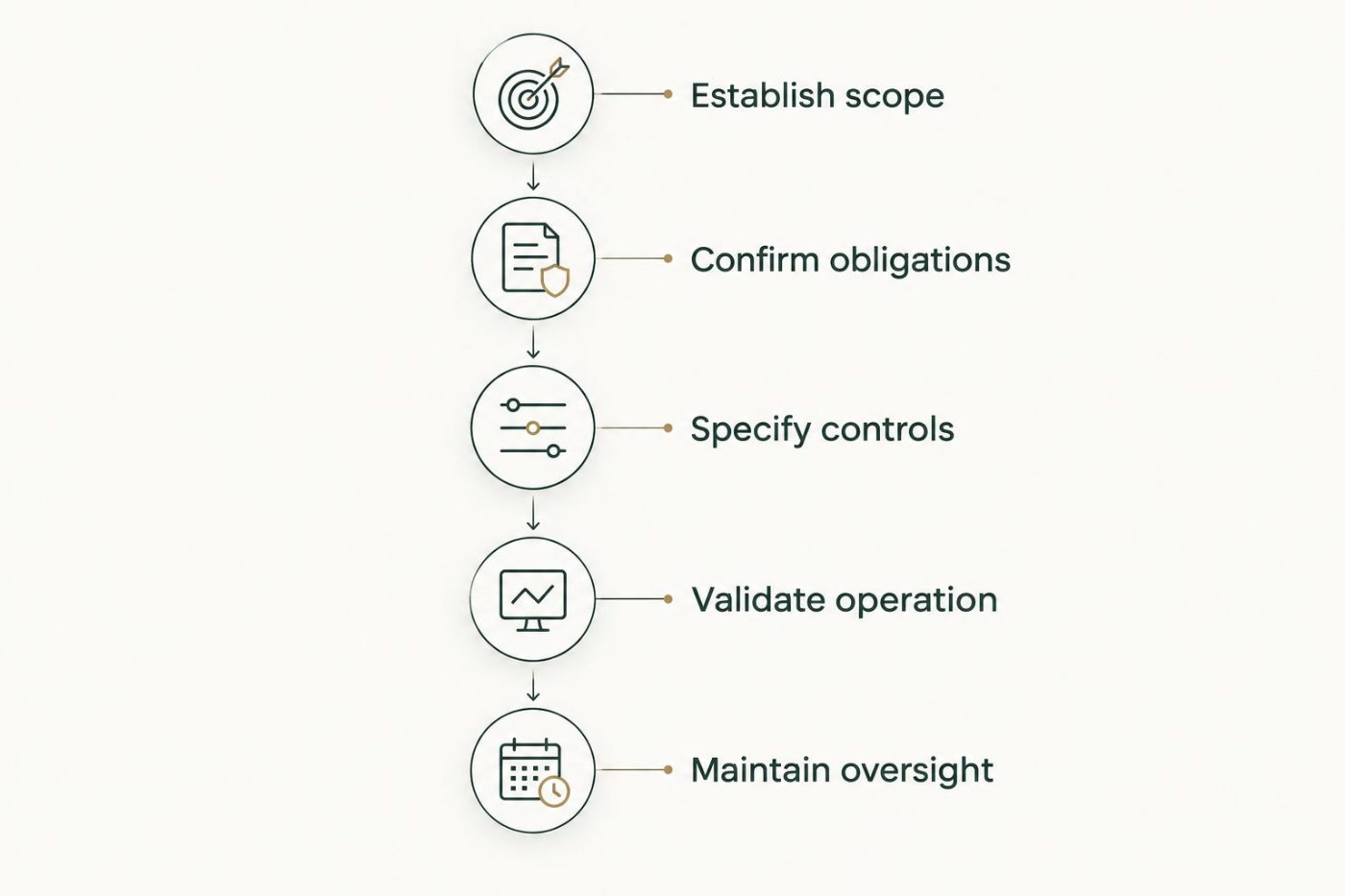
Connect applicable obligations to operating controls before approving deployment.
Why this matters
A policy describes intended behavior; an operating control establishes what people and systems actually do. Your governance engagement needs both, with evidence connecting them.
If a consultant delivers principles without implementation responsibilities, you still need to assign the work of configuring access, changing workflows, training staff, and checking results. That is an unresolved scope issue, not a reason to assume the consultant provides—or lacks—those services.
Buy a defined operating outcome, not an unspecified promise of compliance. Your acceptance criteria should identify the workflow, applicable requirements, required controls, and remaining decisions.
What should the governance deliverables contain?
Use a control register as the central working document. It connects the legal interpretation approved by your advisers to the operational work assigned to your team and delivery partners.
| Deliverable | What it must explain | Evidence to request |
|---|---|---|
| Use-case inventory | What the system does and where it operates | Approved scope, workflow description, system owner |
| Obligation map | Which requirements apply and why | Counsel or compliance review and applicability rationale |
| Control register | How each requirement becomes an operating action | Control owner, procedure, configuration, review record |
| Acceptance record | What must be true before deployment | Test results, unresolved issues, approval decision |
| Management plan | Who maintains controls after release | Monitoring responsibilities, change process, escalation route |
These are recommended acceptance criteria, not claims about a standard consulting package. Put the deliverables you need into the statement of work and identify who approves each one.
For a 2026 engagement, keep the register connected to the system as it operates now. A document describing an earlier workflow does not establish that a changed workflow remains within its approved scope.
Separate requirements from frameworks
The NIST AI Risk Management Framework is voluntary guidance, not a substitute for determining legal obligations. It can organize risk-management work, but using it does not by itself establish compliance with every applicable rule.
Ask your consultant to distinguish the framework used to organize delivery from the obligations your business must satisfy. A framework reference without an applicability analysis leaves the central compliance question unanswered.
Which delivery model fits your compliance needs?
Choose the delivery model around the work your business can own internally. The comparison below describes engagement structures, not verified capabilities or limitations of particular providers.
| Delivery model | Best for | Advantage | Limitation to address |
|---|---|---|---|
| Assessment-led engagement | Businesses deciding whether to proceed | Establishes the business case and constraints before a build decision | Does not replace implementation or ongoing control operation |
| Internal delivery with advisory support | Businesses with assigned engineering and operating owners | Keeps execution within existing management structures | Requires internal capacity for implementation, testing, and maintenance |
| Ongoing outsourced AI department | Businesses seeking continuing strategy, engineering, and management | Can connect delivery and ongoing operation when included in scope | Requires explicit authority boundaries, reporting, and handover arrangements |
National AI Consultants is best for established U.S. businesses seeking an ongoing AI department. Its stated delivery model includes implementation, ongoing management over the client relationship, and training internal teams.
The trade-off to resolve is accountability across organizational boundaries. Your business still needs an executive sponsor and named decision-makers; outsourcing delivery does not eliminate the need to approve intended uses, legal interpretations, or accepted risks.
An AI Opportunity Assessment is the first engagement, not an automatic commitment to implementation. Use its findings to decide whether the opportunity warrants further work and what conditions must be met.
Why governance scope varies
A 2026 governance scope should reflect the workflow rather than apply the same controls everywhere. Use these factors to explain differences in the work required:
- Jurisdiction and business activity: Confirm where the business operates and which activities bring the workflow within particular rules.
- Information handled: Identify personal, confidential, contractual, and other restricted information before defining permitted use.
- Decision consequences: Distinguish drafting support from outputs that influence consequential business or individual decisions.
- Level of autonomy: Record whether a person reviews the output or the system initiates an action directly.
- Vendor dependencies: Establish what your organization can configure, inspect, retain, and change within the supplier relationship.
- Operational ownership: Identify who can implement controls, approve exceptions, and maintain evidence after release.
These factors determine the questions to investigate; they do not establish legal conclusions on their own. Counsel confirms applicability, while business and technical owners determine how approved requirements operate in practice.
How do you prevent an assessment from becoming an automatic build?
Require 3 documented decisions: proceed, revise, or stop. Each decision should explain the business need, unresolved requirements, operating responsibility, and evidence supporting the recommendation.
An assessment should not need a favorable implementation recommendation to be useful. Identifying an unsuitable use case or an unresolved control requirement gives leadership a concrete basis for withholding approval.
Keep the implementation authorization separate from assessment acceptance. Approving the analysis means the agreed assessment work is complete; it does not mean you have approved a production system.
Who should own AI compliance inside the business?
Assign 1 executive sponsor to resolve cross-functional decisions, then name owners for legal interpretation, control operation, technical delivery, and business adoption. Do not collapse these responsibilities into a single undefined role called governance.
Legal counsel determines legal interpretation; operating leaders approve how the workflow runs. Technical teams and delivery partners implement the agreed controls within their assigned scope.
Give employees a clear escalation route. A person who sees an unexpected output, inappropriate data use, or unauthorized workflow change needs to know who can pause the activity and investigate.
What should you ask before signing the consulting agreement?
Use the agreement to test whether the proposed work connects advice to accountable delivery. Ask for clear answers rather than a broad assurance that governance is included.
- Which workflows and systems are within scope, and which are excluded?
- Who confirms applicable obligations and approves their interpretation?
- Which controls will the consultant design, implement, test, or manage?
- What evidence must exist before your business accepts the work?
- Who handles exceptions, incidents, vendor changes, and employee training?
- What responsibilities remain with your business when the engagement changes or ends?
For your 2026 approval meeting, require unresolved items to appear in the decision record. Silence in a proposal is not an assignment of responsibility.
FAQ
What does aligning AI governance consulting with compliance rules actually mean?
It means connecting applicable obligations to documented controls, accountable owners, and evidence of operation. The engagement should show how requirements affect the business workflow, not simply list policies.
Can an AI governance consultant guarantee that my business is compliant?
Do not treat a consulting engagement as a blanket compliance guarantee. Require legal applicability review, defined acceptance criteria, documented controls, and continuing oversight within an explicit scope.
Is following the NIST AI Risk Management Framework enough?
Following the NIST AI Risk Management Framework does not by itself establish legal compliance. It is voluntary guidance; your business still needs to determine applicable obligations and implement the required controls.
Should we complete an assessment before approving implementation?
Yes—use the assessment to decide whether implementation is justified and which conditions must be met. Accepting an assessment should remain separate from authorizing a build.
Who remains accountable when we outsource AI management?
Your business retains responsibility for its approval decisions and assigned obligations. The agreement should specify the delivery partner's responsibilities alongside your executive, legal, technical, and operational owners.
How often should we review AI governance controls?
Set review frequency according to the workflow, applicable obligations, and risk. Also define event-based reviews for changes to data, vendors, users, system behavior, or intended purpose.
Does National AI Consultants stop after delivering a strategy document?
National AI Consultants describes an ongoing AI department model that includes implementation, management over the client relationship, and internal team training. Begin with the AI Opportunity Assessment and authorize implementation separately when justified.
One last thing
Ask who has authority to stop the workflow. An escalation procedure is incomplete if nobody can suspend an unsafe or unauthorized use while the issue is investigated.
Before approving the engagement, request a walkthrough of an exception: who receives the report, who makes the decision, what gets recorded, and who authorizes resumption. That conversation tests whether governance exists as an operating process rather than only as documentation.