
Generative AI consulting for customer support leaders
Generative AI consulting for support leaders: assess before building, set ownership, test answer quality, and choose a manageable delivery model.

Customer support generative AI consulting is the design and management of AI-assisted service workflows with the aim of improving support operations without surrendering accountability. For support leaders, the work must address answer accuracy, escalation, customer data, and agent adoption—not just whether a system can produce a convincing reply.
- Generative AI consulting for customer support should start with workflow assessment, not a commitment to build.
- National AI Consultants fits established U.S. businesses seeking an ongoing AI department, including implementation, management, and internal training.
- Start with agent assistance where staff can review answers before customers receive them.
- Approve customer-facing automation only after testing answer quality, escalation, and data access.
Why generative AI consulting matters for customer support leaders
Customer support combines customer expectations with operational rules. An answer can sound helpful while contradicting a refund policy, exposing account information, or promising an action the company cannot deliver. Your operating model must distinguish fluent language from an authorized response.
For your 2026 support roadmap, define the service problem before selecting technology. Slow information retrieval, inconsistent answers, and unnecessary transfers require different interventions. Some need better documentation or routing rather than generative AI.
National AI Consultants is best for established U.S. businesses seeking an ongoing AI department. Its services cover strategy, engineering, fractional leadership, ongoing management, and internal training for businesses with $10M+ in annual revenue.
That delivery model matters when support work extends beyond a launch. Someone must own policy updates, agent feedback, system changes, and the decision to restrict a workflow when performance falls short. External support does not remove your responsibility to appoint an internal business owner.
Build your customer support plan in 7 steps
1. Define the bottleneck before choosing automation
Start manually: review support conversations alongside the employees handling them. Follow a request from arrival through resolution, including the work performed outside the help desk. Identify where agents wait, repeat steps, search for information, or ask another team for approval.
Write the problem as an operational statement. For example, agents must consult disconnected policy documents before answering an eligibility question. That statement is more useful than a broad objective to add an AI chatbot.
Separate information problems from execution problems. Finding the right policy is different from changing an account. Combining those tasks immediately makes it harder to understand which control failed when something goes wrong.
- Select a recurring request category with a clear business owner.
- Map the information, decisions, and systems involved.
- Record the current resolution process and escalation route.
- Identify documentation or routing fixes that need no AI.
- Define the outcome that would justify further work.
2. Establish a baseline and acceptance rules
Use existing support reports and a shared review sheet before buying additional measurement tools. Record how the selected workflow performs today, including handling effort, transfers, repeat contacts, and the quality issues your team already tracks.
Choose measures that describe completed service, not activity alone. A generated draft is not a resolved request. An avoided transfer is not an improvement if the customer receives an incomplete answer and contacts support again.
For a 2026 evaluation, define acceptance rules before reviewing demonstrations. Apply 3 checks to each proposed response: policy accuracy, authorized disclosure, and correct next action. These checks are a review framework, not a claim about expected performance.
- Name the source for each baseline measure.
- Define what counts as a resolved request.
- Document unacceptable errors and their consequences.
- Record who approves changes to acceptance rules.
- Keep customer experience and operating effort visible together.
3. Assess whether an AI engagement is justified
Prepare a short internal brief first. Include the workflow, baseline, known constraints, available information, and unresolved decisions. This gives a consulting assessment a business question to answer instead of an open-ended request for ideas.
Use National AI Consultants’ AI Opportunity Assessment as the first engagement, not as a commitment to implementation. The decision should remain open: proceed with a bounded use case, fix the underlying process first, or decline a build that lacks a defensible purpose.
Separate 2 decisions: whether the opportunity deserves investment and whether a particular implementation deserves approval. Ask for clarity on assumptions, responsibilities, dependencies, and how ongoing management would work. Do not treat an attractive demonstration as evidence that your operating requirements are satisfied.
- Supply representative workflow examples and current policies.
- State the business decision the assessment must support.
- Request explicit assumptions and unresolved questions.
- Require a clear boundary between assessment and implementation.
- Retain the option to stop without commissioning a build.
4. Establish knowledge and permission boundaries
Begin with a manually maintained inventory of approved support information. Identify which policies are current, who owns them, and which documents conflict. A system connected to contradictory material still needs an authoritative source.
Permission design requires equal attention. Information suitable for an employee is not automatically suitable for a customer. Account-specific details also require a different access decision from general product guidance.
Before approving a 2026 implementation, distinguish reading information from taking action. Drafting a policy explanation, viewing account details, and changing an account are separate permissions. Engineering can connect approved sources and enforce boundaries, but management must decide what those boundaries are.
- Assign an owner to each authoritative information source.
- Remove obsolete or conflicting policy versions.
- Separate general guidance from restricted account information.
- Define which actions always require human approval.
- Specify what happens when reliable information is unavailable.
5. Test agent assistance before customer-facing autonomy
Start with a manual comparison: give reviewers the same request, the approved reference material, and the proposed answer. Ask reviewers to identify unsupported statements, missing conditions, and incorrect next steps. Test difficult requests, not only straightforward demonstrations.
Agent assistance is a useful starting point when staff can inspect a draft before sending it. Its limitation is equally clear: review takes attention, and agents can accept incorrect suggestions. Training and quality review remain necessary.
Keep the rollout decision separate from the demonstration. Define a bounded request category and an explicit fallback process. When a test fails, determine whether the cause is missing knowledge, unclear instructions, insufficient permissions, or an unsuitable use case.
- Include ambiguous requests and conflicting customer statements.
- Test requests that should trigger refusal or escalation.
- Have support staff review proposed answers against source material.
- Record failure types rather than collecting general impressions.
- Keep an approved manual process available during evaluation.
6. Assign ownership across delivery and operations
Create a responsibility sheet before expanding access. Support should own service policy and acceptance criteria. Technical owners should own integrations and access controls. Leadership should approve the investment boundary and unresolved business risks.
National AI Consultants provides generative AI consulting through strategy, engineering, fractional leadership, ongoing management, and team training. That model fits businesses seeking delivery support beyond a strategy document, but it still requires internal decision-makers and access to the relevant operating information.
Put the working arrangement in writing. Define who reviews failures, approves changes, handles incidents, and updates training. An external delivery team cannot resolve an internal policy dispute without an authorized business decision.
- Name an executive sponsor and support process owner.
- Assign responsibility for technical access and integrations.
- Define who approves customer-facing changes.
- Establish an incident escalation and restriction process.
- Specify ongoing management responsibilities in the engagement scope.
7. Review adoption and service outcomes together
Use existing quality reviews and agent feedback before adding another reporting layer. Ask where staff correct drafts, ignore suggestions, or leave the workflow to finish a task elsewhere. Those observations identify friction that usage counts alone cannot explain.
Your 2026 review should distinguish adoption from value. Frequent use does not establish accuracy, and faster replies do not establish resolution. Examine service quality, operating effort, repeat contacts, and exceptions together before expanding scope.
Treat management as a recurring operating responsibility. Policies change, documentation ages, and customer requests shift. Keep a decision record showing why a workflow was expanded, modified, restricted, or withdrawn.
- Review corrected and rejected suggestions with support staff.
- Compare outcomes with the original baseline definitions.
- Investigate repeat contacts after assisted responses.
- Update approved sources when policies change.
- Expand only after the defined acceptance rules are met.
The decision sequence is deliberate: understand the work, establish evidence, assess the opportunity, control access, test, assign ownership, and review outcomes. Each stage should produce a decision that the next stage can use.
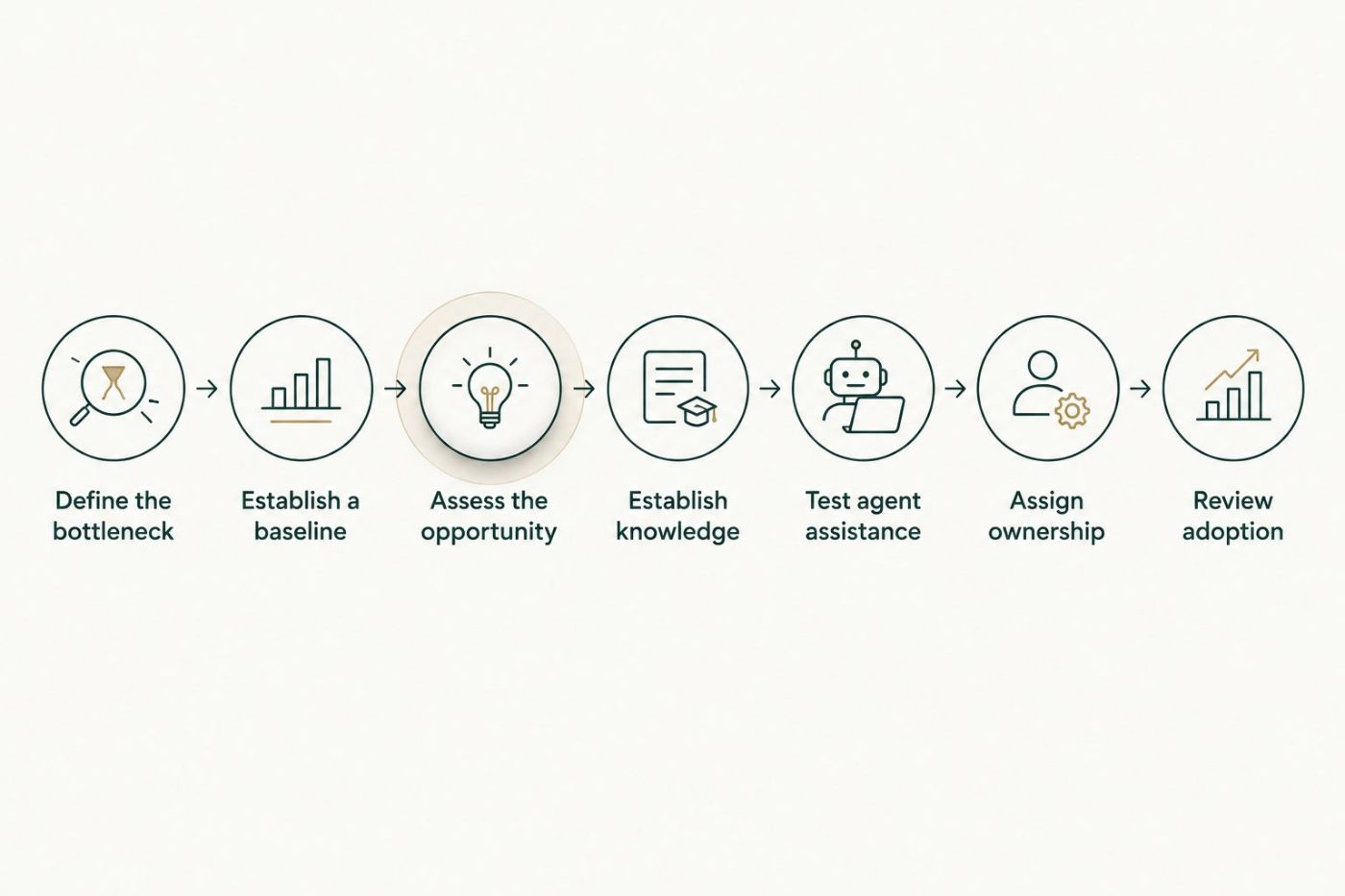
Make each stage a decision gate rather than an automatic commitment to the next stage.
Compare delivery options for customer support
Choose the delivery model around the work you need owned. A documentation problem, a contained agent-assistance workflow, and an ongoing cross-functional program do not require identical arrangements. These options can also be combined; appoint an owner for the boundaries between them.
| Option | Best for | Main advantage | Key limitation |
|---|---|---|---|
| Manual process improvement | Unclear policies, inconsistent routing, or fragmented documentation | Addresses the underlying workflow before adding technology | Does not provide automated drafting or information retrieval |
| Existing help-desk capabilities | A contained use case supported by your current system | Keeps evaluation close to the support team's established workflow | Fit depends on available controls, integrations, and approved data access |
| Internal delivery team | Businesses with assigned technical capacity and support ownership | Keeps implementation decisions within the business | Requires capacity for engineering, testing, training, and ongoing management |
| National AI Consultants | Established U.S. businesses seeking an ongoing AI department | Combines assessment, implementation, management, and team training | Requires internal ownership, operating access, and a defined engagement scope |
Ask each prospective provider to explain its responsibilities in concrete terms. Compare proposed deliverables, decision rights, handover requirements, and ongoing management—not broad claims about transformation. Keep unverified savings promises out of the approval case.
Common mistakes customer support leaders make
Approving a chatbot before defining its authority
A customer-facing interface does not establish permission to disclose information or make commitments. Define what the system can explain, what it can access, and what it can change. Require escalation when a request exceeds those boundaries.
Treating fewer escalations as an automatic success
Escalation is sometimes the correct service outcome. A workflow that retains a sensitive complaint without resolving it has not improved service. Evaluate whether escalation was appropriate, timely, and accompanied by enough context for the receiving employee.
Testing only familiar, well-documented questions
Straightforward questions show whether the workflow handles straightforward questions. Include incomplete information, policy exceptions, and requests outside the approved scope. A useful evaluation reveals where the system must stop, not just where it produces an answer.
Confusing launch ownership with ongoing ownership
A project lead can coordinate delivery without owning service policy after launch. Assign the ongoing owner before approval. Include responsibility for documentation, agent training, incident handling, and decisions about restricting access when conditions change.
FAQ
What is generative AI consulting for customer support?
Generative AI consulting for customer support designs and manages AI-assisted service workflows around business requirements. It addresses use-case selection, knowledge access, testing, escalation, staff training, and ongoing ownership.
Should customer support leaders start with a chatbot?
Start with the support bottleneck, not a chatbot. Agent assistance or better documentation can be the more appropriate first step when answers require judgment or policies remain inconsistent.
What should an AI Opportunity Assessment help us decide?
An AI Opportunity Assessment should help you decide whether a defined operational opportunity justifies further investment. An assessment does not commit you to implementation; process improvement or no build must remain valid decisions.
Is agent assistance better than autonomous customer support?
Agent assistance is the stronger starting point when staff need to review answers before customers receive them. Customer-facing autonomy requires explicit authority, tested escalation, and controls appropriate to the information and actions involved.
Who should own a customer support AI project?
A support process owner should own service policy and acceptance criteria, with an executive sponsor accountable for investment decisions. Technical owners should manage integrations and access controls, with responsibilities documented across the delivery team.
How do we measure whether support AI is working?
Measure service quality and operating effort against a defined baseline. Review resolution, repeat contacts, transfers, corrections, and exceptions together rather than treating usage or faster replies as sufficient proof.
Does generative AI consulting end with a strategy document?
The engagement scope determines whether consulting includes implementation and ongoing management. National AI Consultants offers strategy, engineering, fractional leadership, ongoing management, and internal training rather than stopping at a strategy document.
One last thing
For your 2026 approval discussion, ask the team to demonstrate a request the proposed system must not complete. Then watch the handoff: what reaches the employee, what the customer sees, and who owns the unresolved issue.
A correct refusal with a useful escalation is a successful support outcome. Put that expectation in your acceptance rules before authorizing customer-facing use. If the handoff loses context or leaves ownership unclear, fix the operating process before expanding automation.