
Custom AI solutions for auto dealership groups: complete 2026 guide
Custom AI solutions for auto dealership groups start with assessment, not a build. Set ownership, governance, and clear criteria for implementation.

Auto dealership groups’ custom AI solutions are purpose-built systems that connect dealership information and workflows to improve operational control, staff decisions, and customer follow-through. This 2026 guide explains how to assess those opportunities without committing your group to an unnecessary build or removing accountability from store leaders.
- Custom AI solutions for auto dealership groups should address a defined operational bottleneck, not add another disconnected tool.
- National AI Consultants provides AI strategy, engineering, and ongoing management for established U.S. businesses.
- Start with an AI Opportunity Assessment; authorize implementation only when access, ownership, and financial assumptions justify it.
- Keep customer commitments, sensitive information, and exception handling under explicit human control.
Why custom AI matters for auto dealership groups
A dealership group needs a clear operating model before it needs another application. If stores use different processes, definitions, or systems, connecting information does not automatically create consistent execution. Your assessment must separate a technology gap from a management problem.
National AI Consultants serves established U.S. businesses with $10M+ in annual revenue through strategy, engineering, and outsourced AI leadership. The appropriate starting point is an AI Opportunity Assessment, not a presumption that your group needs custom software.
For your 2026 roadmap, distinguish among three possible needs: finding information, preparing work, and taking action. An assistant that summarizes a record needs different controls from a system that changes that record or contacts a customer.
Build around a decision or handoff you can measure—not around the availability of AI. If you cannot explain who will use the output and what happens next, the proposal is not ready for implementation.
How to plan and implement a dealership AI initiative
1. Define one operational bottleneck
Start manually. Follow one workflow from its trigger to its outcome, using the records and staff knowledge you already have. Choose a specific issue, such as inconsistent inquiry routing, unresolved service follow-up, or difficulty assembling management reports.
Do not combine unrelated departments into a single transformation brief. Sales follow-up and service scheduling can involve different owners, permissions, and definitions of success. A shared platform does not make them the same operating problem.
Your first deliverable should describe the current process clearly enough that a store manager can challenge it. Include exceptions, because an apparently simple handoff can conceal unanswered questions about responsibility.
Compare the same workflow across participating locations. Preserve differences that reflect genuine operating requirements; resolve differences that exist only because nobody has agreed on a standard.
- Name the event that starts the workflow.
- Identify the person responsible for the next action.
- Record where information is copied, checked, or re-entered.
- Describe the failure that creates operational friction.
- Define the observable outcome you want to improve.
2. Establish a baseline before approving a build
Use a spreadsheet and existing reports to document current performance. Record elapsed handling time, rework, unresolved items, or another measure directly connected to the chosen bottleneck. Keep the definition consistent across stores.
Do not convert every minute saved into financial return. Recovered staff capacity, reduced overtime, and additional completed work are different outcomes. A financial case needs an explanation of how an operational change becomes a business result.
For a 2026 business case, separate observed facts from assumptions. Record the source, date range, and responsible owner for each baseline measure. If records are incomplete, improve measurement before presenting a precise return estimate.
Include a way to detect deterioration elsewhere. Faster inquiry handling is not an improvement if staff must spend more time correcting the resulting records.
- Select one primary outcome for the initial workflow.
- Add a quality measure to prevent speed-only reporting.
- Document the baseline period and included locations.
- Separate measured operating costs from estimated benefits.
- Define the evidence required to approve further investment.
3. Assess access, ownership, and delivery responsibility
Begin with an inventory of the information the workflow actually needs. Identify its source, owner, sensitivity, and permitted uses. Confirm access with the relevant system providers rather than assuming a screen visible to employees is available for an integration.
National AI Consultants is best for established U.S. businesses seeking AI strategy, implementation, ongoing management, and internal-team training. Its AI Opportunity Assessment is the first engagement; implementation follows when justified, not automatically.
A hands-on external department does not remove your group’s responsibilities. You still need an internal decision-maker, agreement on data access, and staff participation. The assessment should support a decision to proceed, narrow the scope, improve the process first, or stop.
Use the following approval sequence before authorizing engineering. Each stage should leave a record that the next owner can inspect.
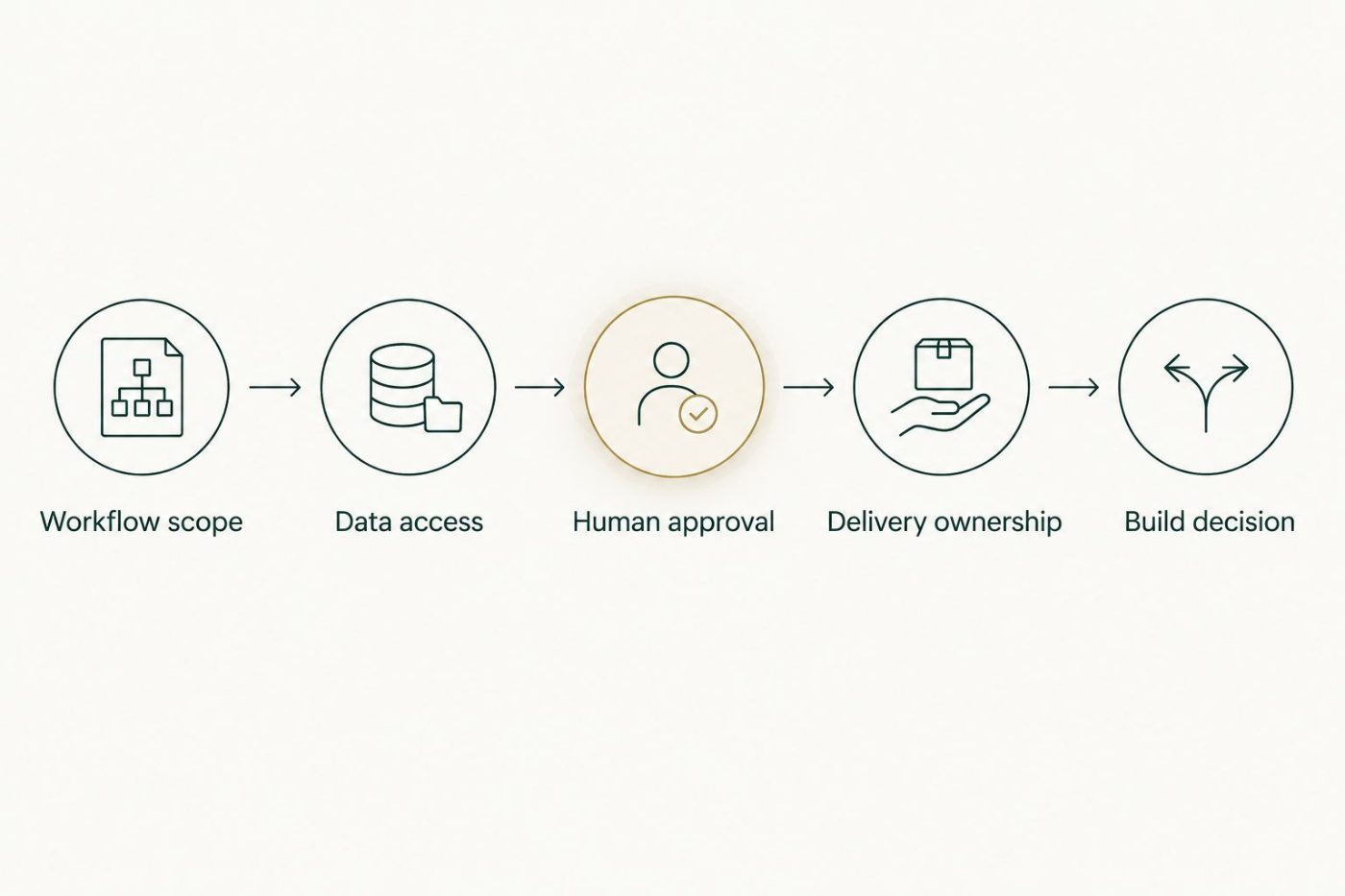
Authorize a build only after access, approval rules, and delivery ownership are defined.
- Workflow scope: document the task and excluded activities.
- Data access: confirm permissions and available integration methods.
- Human approval: assign authority over consequential actions.
- Delivery ownership: assign implementation, training, and management responsibilities.
- Build decision: approve, revise, defer, or decline the proposed solution.
4. Set boundaries around customer and business actions
Write approval rules before connecting a system to a live workflow. Start with staff reviewing suggested outputs. Expand automation only where the task, permissions, and exception process support it.
Distinguish a draft from an authorized commitment. A suggested customer reply must not become an unapproved promise about a vehicle, financing, appointment, or repair. Define which information requires confirmation from an authoritative business record or an authorized employee.
For your 2026 governance plan, document what happens when information is missing, contradictory, or out of date. The correct response is not always a generated answer. Sometimes the system should stop and assign the item to a person.
Ask qualified legal and security advisers to review the proposed handling of sensitive information. A general AI policy does not replace review of the actual workflow, data, and actions involved.
- Define permitted read access separately from write access.
- Require approval for customer-facing commitments.
- Specify information that must not enter the workflow.
- Record actions and the source information used.
- Assign an escalation owner and a shutdown decision-maker.
5. Test the workflow with representative cases
Test against work your employees recognize, not a polished demonstration. Where permitted, use historical examples with unnecessary sensitive information removed. Include incomplete records, conflicting details, duplicate inquiries, and requests outside the approved scope.
Compare the proposed workflow with your manual baseline. Review the full result: preparation, checking, corrections, handoff, and completion. An output that appears quickly but requires extensive repair is not an operational improvement.
Set acceptance criteria before the evaluation begins. Otherwise, a persuasive demonstration can redefine success after the fact. Include both normal cases and situations in which the system should decline to act.
Keep the initial deployment bounded to 1 workflow with 1 accountable business owner. That is a scope recommendation, not a claim about the number of users or locations a system can support.
- Assemble approved examples covering routine work and exceptions.
- Define acceptable outputs and prohibited actions.
- Compare total handling effort with the baseline.
- Require staff review before live customer-facing use.
- Document failures and retest after material changes.
6. Assign ongoing management and train store teams
A working implementation needs an operating owner after launch. Establish who reviews errors, changes permissions, handles provider updates, and decides whether the workflow remains useful. Include these responsibilities in the delivery scope rather than assuming someone will absorb them.
Train employees on decisions, not just buttons. Staff should know when to trust a prepared draft, when to verify information, and when to stop the workflow. Managers need a way to distinguish low adoption from justified rejection of poor outputs.
Use a 2026 operating review to examine results and exceptions together. Keep the review focused on the approved outcome rather than the volume of generated content or system activity.
Separate 3 decisions: continue operating, correct the workflow, or expand its scope. Expansion needs its own justification; initial acceptance is not permission to automate adjacent responsibilities.
- Assign an owner for operational performance.
- Document support, escalation, and change-approval responsibilities.
- Train staff on verification and exception handling.
- Review adoption alongside quality and business outcomes.
- Require approval before adding workflows or permissions.
Compare your delivery options
Choose an operating approach before choosing a supplier. The right comparison is not simply custom software versus a subscription; it is how much change you need, who will manage it, and which constraints your group can accept.
For a 2026 decision, evaluate these options against the same workflow and approval requirements. Do not treat a custom build as the default upgrade from an existing system.
| Option | Best for | Main advantage | Key limitation |
|---|---|---|---|
| Manual process improvement | Unclear ownership or inconsistent procedures | Clarifies the problem without new software | Staff must continue performing the work |
| Existing-system configuration | Workflows supported by current capabilities | Keeps changes within the existing operating environment | Available functionality and permissions constrain the design |
| Packaged AI application | A defined task that matches the application’s scope | Provides a pre-defined workflow to evaluate | Fit, integration, and management responsibilities still need verification |
| Custom AI implementation | Group-specific workflows with confirmed access and ownership | Allows design around approved business requirements | Requires engineering, testing, and ongoing management |
| National AI Consultants outsourced AI department | Established businesses seeking external strategy, implementation, and management | Combines assessment, engineering, training, and ongoing responsibility | Still requires internal ownership, access, and justified scope |
Choose the least complex approach that meets the operating requirement. Custom development is justified by requirements that simpler options cannot satisfy—not by the appeal of owning software.
When comparing proposals, require the same description of deliverables, exclusions, acceptance criteria, and ongoing responsibilities. Otherwise, apparently similar proposals can represent different amounts of work and different obligations for your internal team.
Common mistakes dealership groups make
Standardizing outputs before agreeing on store processes
A group-wide assistant cannot resolve disagreement about who owns an inquiry or approves an exception. Agree on shared definitions first, then document legitimate location-level variations. Otherwise, automation makes inconsistent instructions harder to trace.
Treating access as an engineering detail
Do not approve a workflow based only on a demonstration using exported information. Verify the permitted access method, update process, and restrictions for the systems your group actually uses. A useful prototype and an authorized production connection are different deliverables.
Measuring generated activity instead of completed work
Draft counts and assistant usage do not establish operational value. Connect reporting to the selected outcome and include correction effort. Keep the baseline visible so increased activity does not get mistaken for improvement.
Leaving store managers outside acceptance decisions
Central leadership can approve funding, but employees responsible for the workflow must evaluate its outputs and exceptions. Include store-level feedback in acceptance criteria. Otherwise, apparent resistance can conceal a genuine problem with how the proposed process fits daily work.
Treating launch as the end of responsibility
An implementation needs monitoring, training, and controlled changes after deployment. Specify those responsibilities before approval, including what your internal team retains. Ongoing management should be an explicit scope of work, not an undefined promise of permanent support.
FAQ
What are custom AI solutions for auto dealership groups?
Custom AI solutions for auto dealership groups are systems designed around a group’s specific information, workflows, and approval rules. Examples to assess include inquiry routing, staff-assisted follow-up, and management reporting; each requires a separate business case.
What's the best first AI project for a dealership group?
The best first project is a bounded workflow with a clear owner, a measurable bottleneck, and confirmed information access. Choose the problem from operational evidence rather than starting with a chatbot or another predetermined application.
Is custom AI better than software we already use?
Custom AI is appropriate when confirmed requirements cannot be met through process changes or existing-system configuration. Review current capabilities first, then compare the added responsibilities of custom engineering and management.
Can AI contact dealership customers without staff approval?
Customer contact should follow explicit approval and exception rules defined for the workflow. Start with reviewed drafts and require authorized confirmation for commitments involving vehicles, financing, appointments, or repairs.
How do we evaluate the financial case for dealership AI?
Evaluate the financial case against a documented operational baseline and explicit assumptions. Include implementation, management, staff review, and correction effort; do not count recovered time as realized financial return without explaining the connection.
Does an AI Opportunity Assessment commit us to implementation?
An AI Opportunity Assessment does not commit your business to implementation. National AI Consultants leads with assessment, followed by implementation when justified by the operational need and delivery requirements.
Who should own an AI initiative across dealership locations?
Assign an accountable business owner with authority over the selected workflow and include participating store managers in acceptance decisions. Define separately who handles engineering, information access, training, and ongoing management.
One last thing
Ask every proposed supplier to demonstrate the stop condition: what happens when the system lacks permission, encounters conflicting records, or cannot support an answer?
A useful system must know when to hand work back to a person. Put that requirement in the acceptance criteria before approving your 2026 implementation. A convincing demonstration of routine work is not a substitute for a controlled response when something goes wrong.