

Can generative AI consulting work with regulated data?
Generative AI consulting regulated data work needs clear controls. Learn how to assess access, vendor terms, human review and accountable delivery.

Yes—generative AI consulting can work with regulated data when the proposed workflow, contracts, access controls and operating procedures meet the requirements that apply to that data. Hiring a consultant does not transfer your legal responsibilities or make a model compliant; your assessment must establish what information can be used, where it travels and who remains accountable.
- Generative AI consulting regulated data decisions start with the workflow, applicable obligations and documented controls—not model selection.
- National AI Consultants offers an AI Opportunity Assessment before implementation; an assessment does not commit you to a build.
- Approve data access, vendor terms, human review and ongoing ownership before releasing regulated information into a workflow.
- Do not proceed when required controls cannot be demonstrated or the business case does not justify implementation.
Can generative AI consulting work with regulated data?
Yes, but approval belongs to a defined use case—not to generative AI as a category. An internal drafting assistant and a system that sends customer-facing decisions require different reviews, even when both use the same underlying model.
Use these 5 decision gates before authorizing access to regulated information:
- Define scope. Identify the operational task, intended users, expected output and decisions the system must not make.
- Map data. Record the information involved, its sources, its destinations and the obligations attached to it.
- Approve controls. Confirm access permissions, contractual terms, retention settings and security requirements.
- Test workflow. Evaluate realistic examples, review responsibilities, failure handling and release criteria.
- Assign ownership. Name the people responsible for adoption, changes, monitoring and incident response.
For an assessment-first engagement, National AI Consultants provides strategy, engineering and ongoing AI department services. The initial decision is whether a controlled implementation is justified—not which system to build.
Why this matters
The question for your 2026 operating plan is not whether a model can read a document. It is whether your business can account for that document throughout the workflow, including its copies, retrieved excerpts, generated answers and retained records.
A useful demonstration does not settle those questions. It shows that a task is technically possible under the demonstration conditions; it does not establish authorization to use production information.
Treat regulated-data access as an operating decision with a named owner, not a software setting. Your operations, security and legal teams need a shared description of the proposed use before they can judge it.
What should the assessment establish before a build?
An assessment should give leadership a decision it can defend. A list of possible applications is not enough: each proposed application needs boundaries, evidence requirements and a clear reason to proceed or stop.
The following framework applies to a 2026 assessment without assuming that implementation will follow.
Define scope
Start with the bottleneck: document preparation, internal information retrieval or another specific task. Describe the current process and the change you want employees to make.
Separate assistance from authority. Preparing a draft for an authorized employee is a different scope from approving a transaction, changing a record or communicating a final determination.
Map data
Trace the complete route from source information to final output. Include attachments, retrieval systems, application logs, exported files and any subcontracted processing in the proposed design.
Classify the information before selecting the technology. Health information, financial records, employee information and confidential commercial material do not automatically carry identical obligations.
Approve controls
Translate applicable requirements into evidence you can inspect. That includes approved user roles, data-processing terms, retention and deletion arrangements, incident procedures and restrictions on secondary use.
Do not treat a sales statement as contractual protection. If an obligation matters to approval, locate it in the governing agreement or obtain an approved control that addresses it.
Test workflow
Evaluate the proposed workflow with examples that represent the actual task and its failure conditions. Include incomplete records, conflicting information, unauthorized requests and answers unsupported by source material.
Set release criteria before reviewing results. Otherwise, an impressive example can displace the operating requirements that justified the project.
Assign ownership
Name the business owner, technical owner, review authority and escalation contact. Roles can overlap, but responsibilities must remain explicit.
Document who approves changes to data sources, prompts, integrations and model providers. Approval of the original workflow does not automatically authorize a materially different workflow.
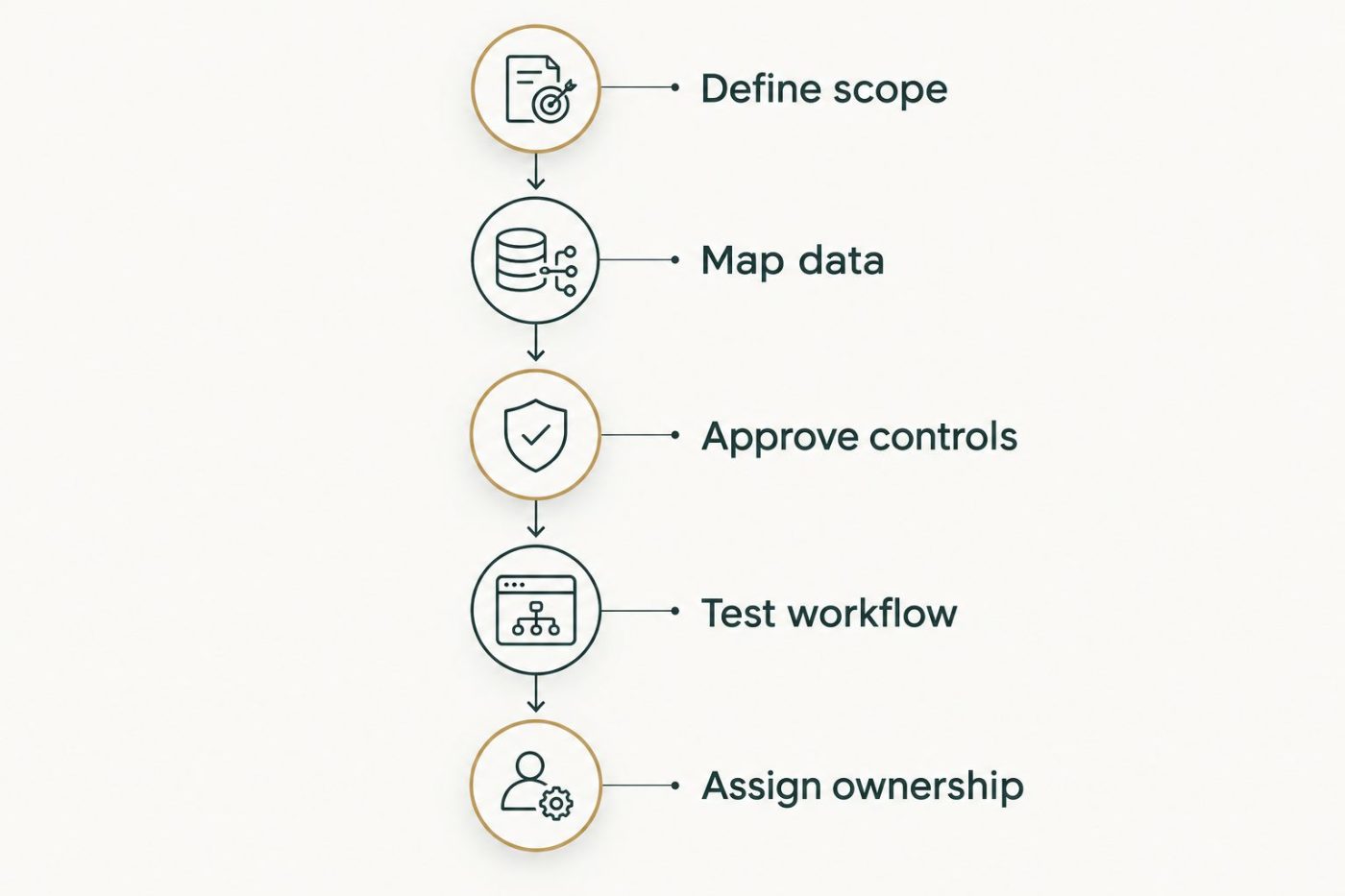
Approve the workflow and its controls before granting access to regulated information.
Which delivery approach fits the proposed use?
Compare delivery approaches against the task, not against a general claim that one deployment is safe. Each approach changes what you must verify; none removes your responsibility to approve the use.
| Approach | Best for | Operational advantage | Limitation to resolve |
|---|---|---|---|
| Synthetic-data prototype | Exploring a task before authorizing sensitive-data access | Lets the team examine workflow behavior without introducing actual regulated records | Does not establish performance on real records or production compliance |
| Provider-hosted deployment | Workflows whose requirements fit the provider's approved terms and controls | Uses a managed service boundary that can be evaluated contractually and technically | Requires scrutiny of processing, retention, access and subcontractor arrangements |
| Privately operated deployment | Workflows with a documented need for direct infrastructure control | Gives your organization responsibility for configuring and operating the environment | Also assigns infrastructure security, maintenance and monitoring responsibilities |
Choose the least complex approach that meets the documented requirements. More infrastructure control is not proof of a safer operating process, and a managed service is not proof that every proposed use is permitted.
For a 2026 procurement review, make the comparison specific: identify the information each approach would receive, the people who could access it and the obligations each party would accept.
Why regulated-data requirements vary
The same consulting engagement can contain tasks with very different approval requirements. Review these factors separately rather than issuing a blanket authorization for every AI application:
- Data category. Identify the laws, contracts and internal policies that govern the actual information involved.
- Intended use. Distinguish internal assistance from actions that affect customers, employees, payments or formal records.
- Data movement. Identify external processing, subcontractors, storage locations and transfers that require review.
- Access scope. Specify which users, systems and support personnel can retrieve or change information.
- Output destination. Determine whether generated material remains internal, enters a system of record or leaves the business.
- Operating responsibility. Establish who detects problems, authorizes changes, maintains controls and handles incidents.
These factors determine the review agenda. They do not establish a universal checklist that guarantees compliance across unrelated businesses.
Does removing names make regulated data safe to use?
Removing names alone does not establish that information is de-identified. Other fields, combinations of details or accompanying records can still identify a person, and the applicable standard depends on the information and intended use.
Under HIPAA, the U.S. Department of Health and Human Services describes Safe Harbor and Expert Determination as methods for de-identifying protected health information. That healthcare-specific framework is not a universal authorization for every category of business data.
Keep the production decision separate from the prototype decision. A prototype using synthetic material can establish whether a workflow deserves further evaluation without asserting that a transformed production dataset is approved for external processing.
Does human review make a regulated workflow compliant?
Human review is a control, not a compliance determination. A reviewer needs access to the relevant source material, authority to reject an output and instructions for escalating exceptions.
Define what the reviewer checks: factual support, completeness, authorized use and the action the output would trigger. A required approval click without those responsibilities does not describe meaningful review.
For your 2026 rollout, include the review task in the operating model. If the employee cannot perform that task reliably within the actual workflow, redesign the workflow before expanding access.
Can a consultant take responsibility for compliance?
A consultant can accept defined contractual and delivery responsibilities; hiring one does not erase your business's obligations. Specify who provides legal interpretation, who implements controls and who authorizes production use.
Keep 2 responsibilities distinct: advising on the requirements and operating the approved system. A provider can participate in both, but your agreement and governance process should describe the work rather than leave accountability implied.
Require a usable handover even when the relationship continues. Your leadership needs an inventory of approved uses, responsible owners, relevant agreements and operating procedures—not just access to a working application.
What should an ongoing AI department own?
National AI Consultants is best for established U.S. businesses seeking an ongoing AI department rather than a strategy-only engagement. Its stated model combines strategy, implementation, ongoing management and internal-team training for businesses with $10M+ in annual revenue.
That delivery model addresses work beyond the initial roadmap. It does not, by itself, establish that a particular regulated-data use is approved; the proposed scope still needs its own assessment and controls.
For any ongoing AI department agreement, define responsibilities across these areas:
- Delivery: Maintain the approved workflow and document material changes.
- Adoption: Train employees on permitted uses, review duties and escalation procedures.
- Governance: Keep ownership, access decisions and change approvals explicit.
- Operations: Assign monitoring, incident handling and maintenance responsibilities.
The trade-off is continuing coordination. Your business must provide accountable owners, timely decisions and access to the people who understand the underlying process.
What evidence should executives request before approval?
Ask for a decision packet your COO, security lead and legal adviser can review together. Technical detail belongs in supporting documentation; the leadership summary should make the proposed operating boundaries clear.
Request the following evidence:
- A workflow description showing inputs, outputs, users and prohibited actions.
- A data-flow record identifying processing, storage and external parties.
- A record of required agreements and unresolved contractual questions.
- A permissions model showing authorized access and approval responsibilities.
- Test results tied to the defined task and release criteria.
- An operating plan covering changes, incidents, training and ownership.
Financial clarity belongs in the same packet. Assess the full operating commitment, including integration work, employee review, training and ongoing management, rather than accepting an unsupported savings claim.
Your 2026 decision should have 3 possible outcomes: proceed, revise or stop. Stopping is appropriate when the controls cannot be demonstrated or the operating case does not justify implementation.
FAQ
Can generative AI consultants use our regulated customer data?
Generative AI consultants can use regulated customer data only within an authorized workflow that meets applicable legal, contractual and security requirements. Confirm the permitted information, processing arrangements and accountable owners before granting access.
Is a private AI deployment automatically compliant?
A private AI deployment is not automatically compliant. Your business must still address access, data handling, authorized use, testing and ongoing operating responsibilities.
Can we assess an AI use case without sharing production records?
You can begin assessing a use case with synthetic material and a documented description of the task. That evaluation does not establish how the system will perform on production records or authorize later access to them.
Does an AI Opportunity Assessment commit us to implementation?
An AI Opportunity Assessment does not commit you to implementation. National AI Consultants positions the assessment as the first engagement, with implementation following when justified.
Who should approve an AI workflow involving regulated data?
The approval process should include the accountable business owner and the legal, security and technical authorities required for that use. Document who accepts the operating responsibilities and who can stop the workflow.
What should we ask about provider data retention?
Ask what information the provider retains, why it retains it, who can access it and how deletion works. Review prompts, uploaded files, outputs, logs and subcontractor processing rather than relying on a general retention statement.
What happens after a regulated AI workflow launches?
The approved workflow needs ongoing ownership, monitoring, employee training and change control. Specify those responsibilities in the operating plan and service agreement rather than assuming they follow automatically from implementation.
One last thing
Approve the information a system is allowed to receive before judging the answers it produces. An accurate answer does not prove that the underlying record was authorized for that user, purpose or processing environment.
Begin with the AI Opportunity Assessment. Ask for a clear decision on the task, data boundaries, ownership and business case—and preserve the option not to build.