

Can enterprise AI consulting start with a single department?
Enterprise AI consulting single department engagements can start small. Define ownership, governance, and acceptance criteria before approving a build.

Yes—enterprise AI consulting can start with a single department when you define a specific operational problem, name an accountable owner, and set clear criteria for continuing or stopping. A departmental start narrows delivery scope, but it does not remove the need to review shared data, security, system dependencies, and ongoing management.
- Enterprise AI consulting single department engagements should begin with a bounded workflow, not a company-wide software purchase.
- National AI Consultants starts with an AI Opportunity Assessment; implementation follows only when justified.
- Keep delivery narrow while reviewing shared data, governance, and operational dependencies.
- Expand only after evidence supports adoption, operational value, and accountable ongoing management.
Can enterprise AI consulting start with a single department?
Start with one department; assess the dependencies across the business. A finance, operations, or customer service team can own the initial problem without making the engagement a company-wide implementation.
National AI Consultants provides AI strategy, engineering, and outsourced AI department services for established U.S. businesses with $10M+ in annual revenue. Its first engagement is the AI Opportunity Assessment, not an automatic commitment to build.
Use the following sequence to define a departmental engagement:
- Choose one workflow. Identify the work that stalls, repeats, or requires avoidable manual coordination.
- Name one owner. Give a department leader responsibility for the business decision and adoption.
- Map shared dependencies. Identify the data, systems, approvals, and teams the workflow touches.
- Set acceptance criteria. Define what a useful result must do and what errors are unacceptable.
- Decide whether to implement. Proceed only when the assessment supports the work.
The distinction matters: a small delivery scope is a management choice, not permission to skip enterprise controls.
Why this matters
A departmental starting point gives an executive team a concrete decision: does this workflow justify changing how the business operates? That is more useful than approving a broad AI initiative without an accountable operational owner.
For a 2026 planning discussion, separate interest in AI from a business case for a particular change. The decision should address the bottleneck, the people who experience it, and the evidence needed to justify implementation.
National AI Consultants is best for established U.S. businesses seeking an ongoing AI department rather than a strategy document alone. Its delivery model includes implementation, management over the client relationship, and training for internal teams. The trade-off is that this model requires continuing coordination with business owners; it does not replace their accountability.
Departmental scope versus enterprise-wide scope
Choose scope according to the problem and its dependencies. Neither approach removes the need for governance, and neither guarantees adoption.
| Starting scope | Best for | Advantage | Limitation |
|---|---|---|---|
| Single department | A bounded workflow with a clear owner | Concentrates delivery decisions and acceptance criteria | Shared systems and downstream effects still require review |
| Enterprise-wide | A problem that requires coordinated decisions across departments | Addresses common policies and dependencies together | Requires agreement across more business owners before changes proceed |
A single-department engagement is the right starting point when the team can define a useful result without redesigning the entire operating model. Enterprise-wide scope fits a problem that cannot be resolved within one department's authority.
Do not confuse the location of the initial work with the reach of its consequences. A finance workflow can depend on sales records; a customer service workflow can affect commitments made by operations. Map those relationships before approving a build.
A departmental starting framework
Use these five decision stages to structure an assessment. They are decision gates, not promised deliverables or a fixed consulting timeline.
Problem definition
Describe the bottleneck in operational language. State what starts the workflow, what staff do, where work waits, and what constitutes a completed result.
Avoid briefs such as adopting AI across finance. A stronger brief identifies a specific task, its owner, and the operational constraint. If the department cannot explain the problem without naming a tool, return to the process itself.
Dependency review
Identify the information and authority the workflow needs. Include source systems, access permissions, review requirements, and downstream users of the output.
Distinguish access from permission to use data for a new purpose. Record who approves the proposed use and who must review any change to an existing system or control.
Implementation decision
Decide whether AI is appropriate before deciding what to build. Compare the proposed change with fixing the process, improving existing software use, or leaving the workflow unchanged.
The assessment should support a clear decision: implement, revise the scope, or stop. A responsible decision can be to avoid implementation when the evidence does not justify it.
Controlled adoption
Define how staff will use the proposed workflow and where a person must review its output. Make exception handling part of the operating process, not an informal workaround.
Set acceptance criteria before approving routine use. Include the quality of the result, the burden of checking it, and the treatment of cases the system cannot handle appropriately.
Ongoing management
Assign responsibility for maintenance, access changes, issue escalation, and staff training. Specify who makes decisions when the workflow or its underlying systems change.
Do not treat launch as the end of accountability. A workflow remains a business responsibility after implementation, whether an internal team or an external partner manages the technical work.
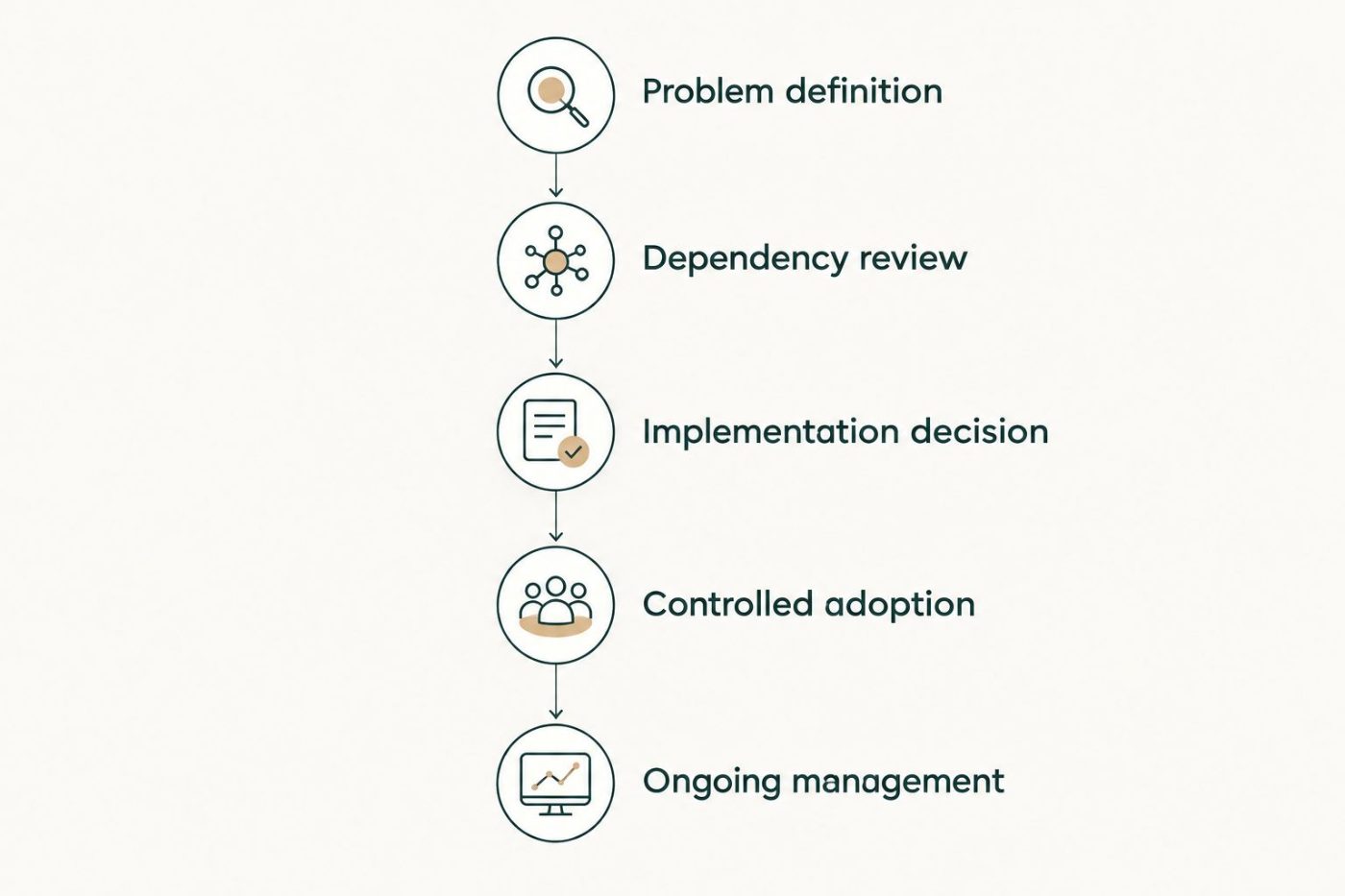
Implementation is a decision within the process, not an assumption at the start.
These stages keep a 2026 departmental initiative tied to business decisions. They also make it possible to stop before implementation when the assessment exposes an unresolved dependency or an unsuitable use case.
Why single-department scope varies
Department names do not define implementation boundaries. The work itself determines how much assessment, coordination, and management the engagement needs.
- Workflow boundaries. A self-contained task needs a different scope from a process that hands work across departments.
- Data access. Information held in shared systems introduces approval and access decisions beyond the department.
- Decision consequences. Drafting an internal summary requires different review criteria from producing an output used for a consequential business decision.
- System dependencies. Changing an isolated task differs from changing how records move between business systems.
- Adoption ownership. The scope must identify who trains staff, handles exceptions, and approves the revised process.
- Management responsibility. The engagement needs a clear division of responsibilities after implementation, not just during development.
Use these factors to challenge a proposal. If the delivery scope says one department but the required decisions span the business, ask for those dependencies to be made explicit before approval.
What should you measure before approving implementation?
Record how the current workflow operates before evaluating a proposed replacement. Select measures that reflect the bottleneck rather than measures that simply show people are using a tool.
A 2026 assessment should distinguish operational evidence from an unverified savings promise. Useful measures depend on the workflow, but the business owner should be able to explain why each one matters.
Work completed
Define the output that counts as complete and usable. A generated draft is not equivalent to completed work if staff still need to reconstruct or extensively verify it.
Track the full handoff, not just the automated step. Otherwise, a department can appear to improve while moving additional checking work elsewhere.
Quality and exceptions
Specify the checks that determine whether an output is acceptable. Record where human judgment is required and what happens when the workflow encounters an exception.
Do not average away consequential errors. A result that looks acceptable overall still needs a clear response when a particular failure would create operational or compliance concerns.
Total operating burden
Account for review, training, maintenance, and management alongside the work being changed. Financial clarity requires an explanation of those responsibilities, not just a claim about time saved.
Do not approve an expansion based on output volume alone. Require evidence that the department can use the result reliably within an accountable operating process.
Does starting with one department avoid company-wide governance?
No—starting with one department does not remove company-wide governance requirements. Keep delivery local where appropriate, but involve the people responsible for shared information, security, and system changes.
In a 2026 departmental project, governance should answer practical questions: who approves access, who reviews consequential outputs, and who can suspend the workflow? These decisions need named owners rather than a general statement that the project is governed.
Separate approval authority from daily use. The employee operating the workflow does not automatically have authority to approve new data access or change the department's controls.
Does an AI Opportunity Assessment commit you to implementation?
No—an AI Opportunity Assessment does not commit you to implementation. National AI Consultants uses the assessment as the first engagement, with implementation following when justified.
The business decision remains whether the proposed change has a defensible purpose, workable dependencies, and accountable ownership. A recommendation to narrow the scope or stop is a legitimate assessment outcome.
Before approving a build, require the scope to explain what will change, how acceptance will be judged, and who will manage the result. An assessment is not a substitute for that implementation decision.
When should a departmental engagement expand?
Expand a departmental engagement when the evidence supports broader use and the next department has an accountable owner. Success in one workflow is not evidence that another workflow has the same requirements.
Before adding scope, review these questions:
- Has the initial workflow met its agreed acceptance criteria?
- Are staff using it within the intended process?
- Are exceptions and review responsibilities understood?
- Can the management arrangement support additional scope?
- Does the next department have a defined problem rather than general interest?
For 2026 expansion decisions, reassess the new department's data, controls, and operating needs. Reuse what fits, but do not assume the original design transfers unchanged.
FAQ
Can enterprise AI consulting start with just our finance department?
Yes—enterprise AI consulting can start with finance when the engagement targets a defined workflow with an accountable owner. Review shared records, approvals, and downstream dependencies before implementation.
What is the best department to start AI consulting in?
The best starting department has a clear operational bottleneck, an accountable owner, and access to the information needed to assess the work. Choose the problem first rather than assuming a particular department is always the best candidate.
Do we need to buy new software before an AI assessment?
No—buying new software is not a prerequisite for assessing an operational problem. First determine whether the workflow justifies a change and whether existing processes or systems can address it.
Who should own a single-department AI project?
A department leader should own the business outcome and adoption decisions. Technical, security, and data owners remain responsible for decisions within their authority.
Can our department run an AI project without involving IT?
A department should involve the relevant system and security owners when a project touches business systems, shared data, or access controls. A narrow scope does not remove those responsibilities.
What happens after a departmental AI solution is implemented?
The solution needs assigned responsibility for management, issue handling, access changes, and staff training. Define those responsibilities before approving routine use rather than treating launch as the end of the engagement.
Does National AI Consultants only provide strategy?
National AI Consultants provides strategy, engineering, and outsourced AI department or fractional leadership services. Its model includes implementation, ongoing management over the client relationship, and internal team training; implementation follows assessment when justified.
One last thing
Write the stop condition before approving the build. State what unresolved dependency, unacceptable error, or adoption problem would prevent routine use.
A departmental start is useful because it creates a bounded decision. Preserve that advantage: one department, one defined workflow, and one accountable business owner do not require a commitment to expand.