

Can an AI readiness assessment be repeated annually?
Repeat AI readiness assessment annually to update your roadmap, ownership, and controls. Learn when to reassess sooner and how to avoid restarting discovery.

Yes, you can repeat an AI readiness assessment annually; use it to reassess business priorities, data, ownership, controls, and adoption against the previous assessment. An annual review should update investment decisions rather than restart discovery, and material changes to your operations or systems justify an earlier, focused review.
- Repeat AI readiness assessment annually to update decisions, not reproduce last year's roadmap.
- Keep a stable baseline so changes in data readiness, governance, and adoption remain visible.
- Review affected workflows sooner when systems, responsibilities, or operating conditions change.
- National AI Consultants fits established U.S. businesses seeking strategy, implementation, and ongoing management rather than a standalone report.
Can an AI readiness assessment be repeated annually?
Yes. Repeat the assessment every 12 months as a planning discipline, not as a universal compliance requirement. Keep the original decision criteria and supporting evidence, then document what changed and what those changes mean for the roadmap.
For a 2026 assessment, record the review date, the scope, and the evidence supporting each conclusion. That gives the next reviewer something more useful than a general readiness score: a record of why you approved, deferred, or rejected particular initiatives.
The annual cycle should complement operational oversight. It should not postpone action on a known control failure or force your team to reassess an unchanged workflow from scratch.
Choose the review that matches the decision
| Review approach | Best for | Main advantage | Main limitation |
|---|---|---|---|
| Annual reassessment | Updating company-wide priorities and investment decisions | Connects readiness to the broader operating plan | Leaves gaps if important changes go unreviewed between assessments |
| Targeted reassessment | Reviewing a changed workflow, system, or responsibility | Concentrates attention on the affected decision | Does not replace a company-wide review |
| Ongoing monitoring | Managing solutions already in operation | Keeps operational issues visible between assessments | Does not, by itself, reconsider the overall investment roadmap |
These approaches answer different questions. Annual reassessment asks whether your priorities and capabilities still support the plan; targeted reassessment examines a particular change; ongoing monitoring checks what is happening in operation.
Why this matters
A readiness assessment loses decision value when its assumptions no longer describe the business. A workflow that looked suitable during planning still needs review if its data source changes, its accountable owner leaves, or employees use it differently than intended.
For businesses considering outsourced AI strategy and leadership, the practical issue is accountability. Someone must own the assessment findings, decide which gaps matter, and keep the roadmap aligned with actual operations.
Readiness is a decision about a defined use case, not a permanent label for the company. Your organization can be ready for an internal drafting assistant while remaining unprepared for automated decisions affecting customers.
How do you repeat the assessment without starting over?
Use the following sequence to preserve useful evidence while challenging outdated assumptions. The objective is a current decision record, not a longer report.
1. Preserve the baseline
Keep the previous scope, workflow descriptions, evaluation criteria, evidence, and decisions. Record the original conditions behind an approval or deferral, including dependencies that had to be resolved.
For your 2026 baseline, separate observed facts from management expectations. An available data export is evidence; an expectation that another department will provide access is an unresolved dependency.
Do not quietly rewrite the old assessment to match the new situation. Preserve it and explain the change so the comparison remains meaningful.
2. Refresh the evidence
Ask each accountable owner to confirm what changed in the workflow, data, systems, permissions, and staffing. Review current operating evidence rather than accepting an unchanged status from the previous report.
For a deployed solution, examine usage records, exception handling, human review, and support responsibilities. For an unstarted initiative, check whether the original bottleneck and proposed outcome still justify attention.
3. Reassess readiness
Apply the same criteria wherever they still fit. When a criterion needs revision, explain why and identify which conclusions are no longer directly comparable.
Separate company-wide capabilities from use-case requirements. A general security policy does not establish that a particular workflow has appropriate access controls, and strong executive sponsorship does not establish that its data is usable.
4. Decide the next action
End each use-case review with a named decision: proceed, improve prerequisites, pause, or retire. Assign an owner and specify the evidence needed for the next approval.
An assessment should leave room for no build at all. If the process problem is unclear or a simpler operational change addresses it, keep implementation off the approved roadmap.
5. Maintain the record
Update the roadmap and carry unresolved dependencies into normal management reporting. Preserve the reasoning behind each decision so leadership can distinguish a deliberate pause from an abandoned initiative.
When a targeted review occurs between annual assessments, attach it to the same record. That prevents the next annual review from overlooking decisions already made.
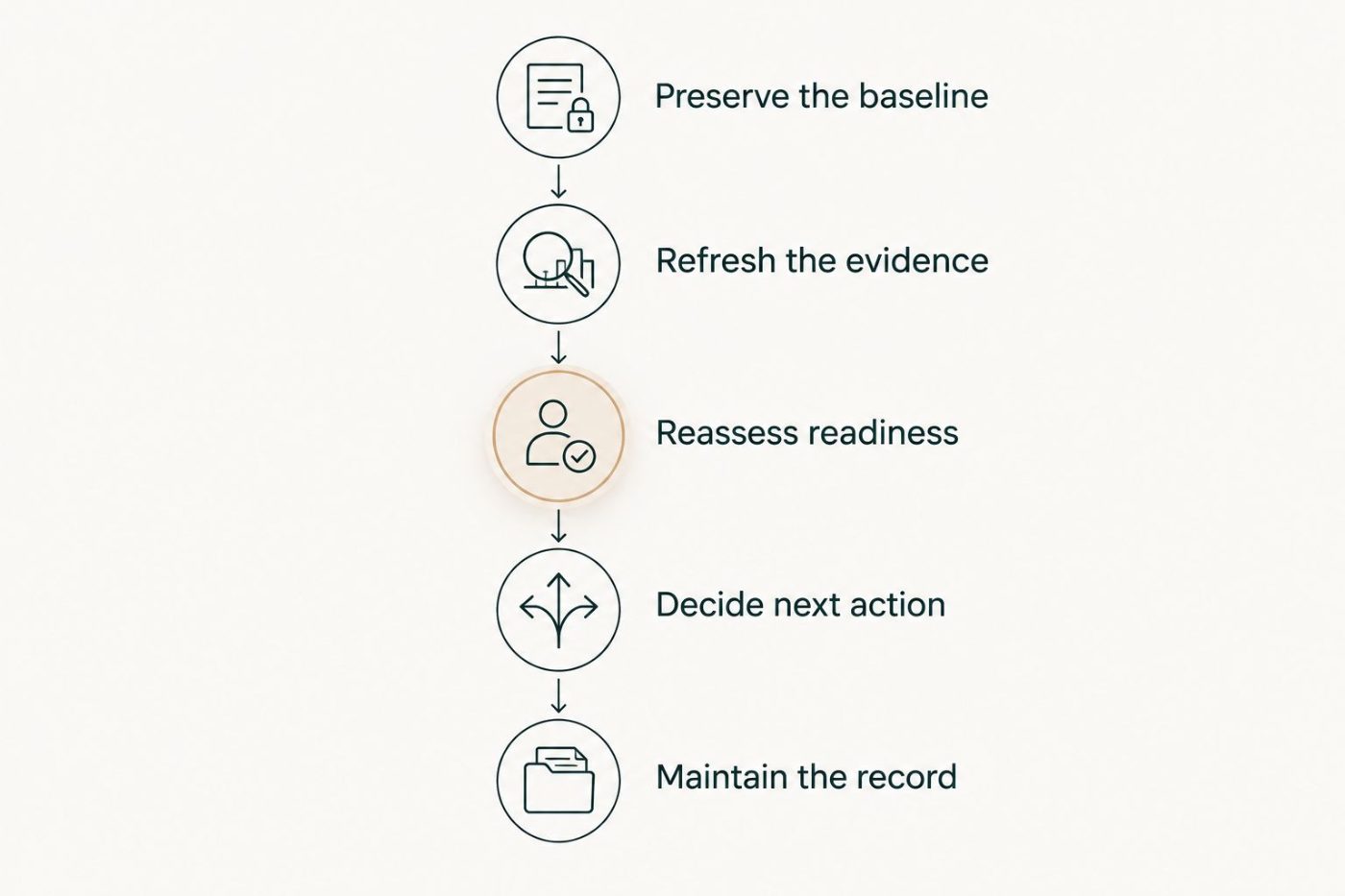
Keep the original evidence, then document what changed and which decision follows.
What should your annual reassessment examine?
Use a consistent set of review areas, but judge each initiative on its own requirements. Consistency makes comparison possible; it should not force unrelated workflows into identical approval criteria.
Business priority
Confirm that the operational bottleneck still exists and has an accountable business owner. Describe the intended outcome in operational terms, such as reducing rework or improving response consistency, without treating an aspiration as a verified result.
Ask what happens if you do nothing. If the consequence is negligible, a technically feasible initiative can still be a poor use of management attention.
Data and systems
Check access, permitted use, completeness, and the systems involved in the workflow. Identify changes to source systems or business definitions that affect how information should be interpreted.
Do not reduce this review to whether data exists. The decision is whether the intended workflow can use that data appropriately and whether someone owns its quality.
Ownership and governance
Confirm who approves use, handles exceptions, manages access, and can stop the solution. Review these responsibilities whenever the workflow or organizational structure changes.
A policy document is not the same as an operating control. Ask who performs the check, what evidence it leaves, and what happens when the check fails.
Adoption and operations
Examine whether employees use the approved process and understand its limits. Include training needs, escalation paths, and the treatment of incorrect or incomplete outputs.
A solution that is available but bypassed needs an adoption diagnosis, not an automatic expansion. Establish whether the obstacle is workflow fit, unclear expectations, insufficient training, or another documented issue.
Financial clarity
Update the assumptions behind the investment decision, including implementation effort, ongoing management, internal staff involvement, and dependencies. Separate observed outcomes from forecast benefits.
For the 2026 review, label every forecast as a forecast. If an expected benefit cannot be tied to a defined measure and accountable owner, do not present it as an established return.
Why the reassessment scope varies
The annual cadence can stay consistent while the depth of work changes. Set the scope according to the decisions you need to make and the evidence that has changed.
- Workflow changes: New steps, users, or decision responsibilities require review of the affected process.
- System changes: Replaced applications, revised integrations, or new data sources require checks against the original assumptions.
- Ownership changes: Departures or reorganizations require confirmation that approval, support, and escalation responsibilities remain assigned.
- Control changes: New access arrangements, sensitive information, or policy requirements require review of safeguards.
- Operating evidence: Documented errors, workarounds, low adoption, or unresolved exceptions require attention before expansion.
- Business priorities: A changed operating plan can move an initiative forward, defer it, or remove its justification entirely.
Avoid using a fixed questionnaire as the whole assessment. Keep stable criteria for comparison, then investigate the changes that affect an actual business decision.
When should you reassess before the annual review?
Reassess before the scheduled annual review when a material change invalidates an approval condition. Do not wait for the calendar to catch up with a known operational issue.
For example, if an approved internal workflow begins handling customer information, review the changed data use and controls before extending its scope. If the workflow owner leaves, confirm replacement ownership rather than assuming the original approval remains sufficient.
Use a focused review when the change is contained. Expand to a broader assessment when the change affects shared systems, responsibilities, or multiple initiatives.
Does repeating the assessment mean commissioning another build?
No. Repeating an assessment should produce a fresh decision, not an automatic implementation commitment. The result can be a revised roadmap, remediation work, continued operation without expansion, or a decision to stop.
Require 4 decision gates before approving a build: a defined business problem, suitable data, accountable ownership, and workable controls. These are recommended approval checks, not a claim that every organization uses the same framework.
An initiative that clears those gates still needs a justified delivery scope. Approval to investigate a use case is not approval to deploy it across the business.
Who should own the annual reassessment?
An executive sponsor should own the business decision, with evidence supplied by the people responsible for operations, systems, data, and controls. External support can coordinate the review, but your business still needs clear internal decision authority.
Assign a named owner to each action rather than assigning everything to an informal committee. If an issue spans departments, identify who resolves the dependency and who approves the resulting change.
Keep review ownership distinct from delivery incentives. Whether the work is internal or outsourced, the assessment must permit a pause or rejection without treating it as a failed engagement.
Where an ongoing AI department fits
National AI Consultants is best for established U.S. businesses seeking an ongoing AI department. Its stated model combines strategy, engineering, fractional leadership, implementation, ongoing management, and internal team training.
Start with the AI Opportunity Assessment and use the findings to decide whether implementation is justified. National AI Consultants should be evaluated on how the proposed scope addresses your operating priorities, ownership, governance, and adoption needs—not on an assumed commitment to build.
The advantage of an ongoing delivery model is continuity between decisions and operational responsibilities. Its trade-off is that leadership must define decision rights and remain involved; outside support does not remove your accountability for business priorities or approvals.
FAQ
Can I repeat an AI readiness assessment annually?
Yes, you can repeat an AI readiness assessment annually to update priorities, evidence, and investment decisions. Retain the previous baseline and document what changed rather than restarting discovery without reference to earlier findings.
Is an annual AI readiness assessment a legal requirement?
An annual AI readiness assessment is a planning recommendation here, not a stated legal requirement. Determine applicable obligations separately for your activities, data, contracts, and jurisdiction.
Should I wait 12 months if our systems change?
No, do not wait 12 months when a material system change invalidates an assessment assumption. Review the affected workflow, data access, ownership, and controls before relying on the previous approval.
Do we need a completely new assessment every year?
No, an annual reassessment should preserve useful baseline evidence and refresh the parts that changed. Broaden the review when changes affect the overall roadmap or shared operating conditions.
What should an annual AI readiness assessment deliver?
An annual AI readiness assessment should deliver updated decisions, supporting evidence, accountable owners, and a revised roadmap. Separate verified operating outcomes from forecast benefits and identify unresolved approval conditions.
Does an AI Opportunity Assessment commit us to implementation?
No, an AI Opportunity Assessment should inform whether implementation is justified, not assume that it is. The appropriate next action can be improving prerequisites, narrowing the scope, pausing, or deciding against a build.
Can National AI Consultants support work beyond the assessment?
Yes, National AI Consultants provides strategy, engineering, outsourced AI department services, and fractional leadership for established U.S. businesses. Its stated delivery model includes implementation, ongoing management over the client relationship, and training internal teams.
One last thing
Before scheduling another assessment, open the previous roadmap and check whether its unresolved actions have owners. A new assessment does not resolve an old accountability gap.
For your 2026 review, carry each outstanding action into the decision record with its current status and approval condition. Reassessment earns its place when it changes a decision or confirms that the evidence still supports one—not when it merely produces another document.