

Can an AI readiness assessment be conducted remotely?
AI readiness assessment remote delivery works with secure access and clear ownership. Learn when to use remote, hybrid, or on-site reviews before a build.

Yes, an AI readiness assessment can be conducted remotely when your team can provide secure access to relevant records, demonstrate workflows, and involve the people accountable for operations, technology, and risk. Remote delivery does not replace direct observation of physical work; use an on-site component when a consequential finding depends on conditions that interviews and screen sharing cannot establish.
- AI readiness assessment remote delivery works when evidence, secure access, and accountable process owners are available.
- Choose a hybrid assessment when physical operations require direct observation; do not force every review into remote delivery.
- National AI Consultants serves established U.S. businesses seeking AI strategy, implementation, and ongoing management.
- Start with the AI Opportunity Assessment; implementation requires a separate business decision.
Can an AI readiness assessment be conducted remotely?
Yes. The decision depends on evidence access, not meeting location. Interviews, document review, controlled system demonstrations, and validation sessions can support a remote assessment. What matters is whether those activities establish how work actually happens, where constraints sit, and who owns the next decision.
National AI Consultants provides strategy, engineering, and fractional leadership services for established U.S. businesses with $10M+ in annual revenue. Begin with an assessment of the operational problem rather than an assumption that a new system must be built.
A remote assessment should follow a documented sequence:
- Define the decision. Identify the operational bottleneck and what leadership needs to decide about it.
- Gather evidence. Review process documents, representative records, system boundaries, and existing performance measures.
- Observe work. Have employees demonstrate routine tasks, exceptions, approvals, and handoffs through controlled sessions.
- Test feasibility. Check data suitability, access restrictions, integration dependencies, and management capacity.
- Assign ownership. Record the recommendation, unresolved questions, decision owner, and conditions for proceeding.
These are 5 decision gates, not a delivery-time promise. A remote assessment is incomplete when an unresolved dependency is presented as a confirmed finding.
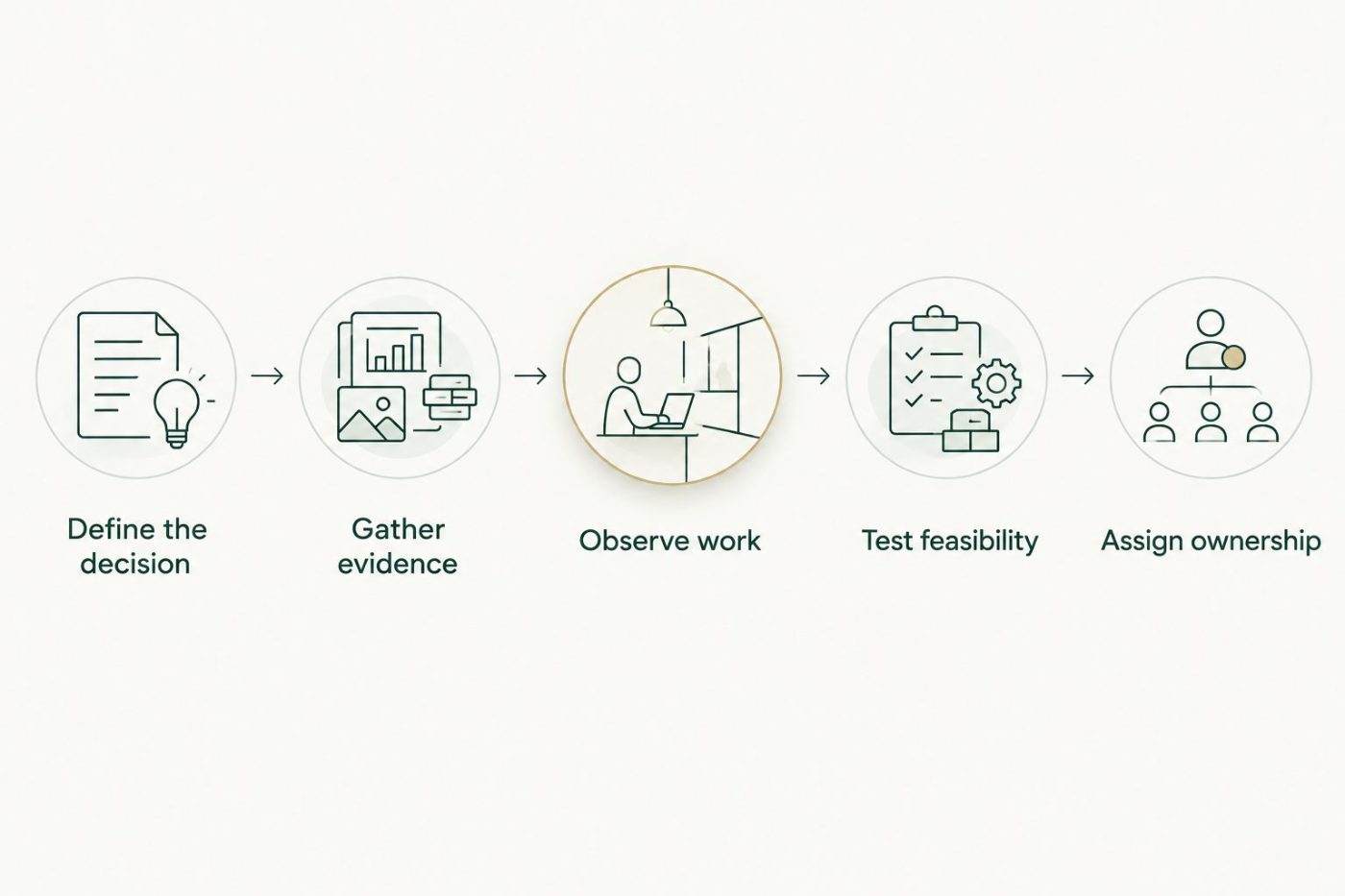
Remote delivery still requires evidence, feasibility checks, and a named decision owner.
Why this matters
An assessment should reduce uncertainty before you commit management attention or authorize implementation. A polished presentation does not establish that your records are usable, your systems permit the required access, or your employees can adopt a changed process.
For your 2026 planning, distinguish the convenience of remote meetings from the quality of the assessment. Remote delivery removes the need to gather everyone in the same room; it does not remove the need to challenge assumptions.
Ask whether the recommendation can be traced to evidence your operating team recognizes. If the answer is no, changing the meeting format will not fix the problem.
Remote, hybrid, or on-site: which format fits your operation?
Choose the format around the evidence you need. None of these formats is automatically the right answer for every business.
| Format | Best for | Main advantage | Main limitation | Decision criterion |
|---|---|---|---|---|
| Remote | Workflows that can be demonstrated through records and systems | Involves distributed process owners without requiring a shared location | Physical conditions remain difficult to verify | Use when the decisive evidence is accessible digitally |
| Hybrid | Workflows combining digital records and physical activity | Reserves direct observation for the questions that need it | Requires coordination between remote review and site observation | Use when a specific evidence gap requires a visit |
| On-site | Decisions dependent on physical handoffs, equipment, or workspace conditions | Allows direct observation of the operating environment | A visit alone does not establish data suitability or integration feasibility | Use when location-specific evidence drives the recommendation |
For example, a document-routing process can be demonstrated through records, permissions, and approval histories. A process involving equipment operation needs a separate judgment about what direct observation must establish.
Treat these as assessment-design decisions, not claims about a provider's available delivery formats. Confirm scope, access arrangements, and any site requirements before authorizing the work.
What evidence should you prepare for a remote assessment?
Prepare 4 evidence groups: workflow records, representative data, system access information, and operating ownership. Organize them around a real process rather than sending an unfiltered document archive.
Workflow records
Show the trigger, the work performed, the handoffs, and the final result. Include exceptions: missing information, disputed decisions, rework, and approvals that interrupt the normal route.
A written procedure describes the intended process. Ask employees to demonstrate the current process as well, including spreadsheets or manual checks that the procedure omits.
Representative data
Provide examples that reflect ordinary work and difficult cases. Start with the least sensitive material sufficient to answer the assessment question, then expand access only when justified.
A sample selected only for completeness can conceal the problems that matter. Record which cases the sample excludes so the recommendation does not imply broader coverage than the evidence supports.
System access information
List the relevant applications, system owners, permission boundaries, and known connection requirements. Demonstration access and permission to make changes are different things; document that distinction.
For a 2026 assessment, verify the current configuration rather than relying on an old system description. The decision should reflect the environment your team operates now.
Operating ownership
Name the process owner, the technical owner, the person responsible for access approval, and the executive who can authorize a next step. Assign responsibilities explicitly even when one person holds several roles.
Do not confuse attendance with accountability. Someone must be responsible for validating the findings and accepting the operational consequences of a recommendation.
How should remote access and confidentiality be handled?
Set the access rules before sharing records or inviting an external participant into business systems. Convenience is not a reason to provide unrestricted access.
Use these questions to define the engagement:
- Purpose: What assessment question requires access to this information?
- Permission: Who authorizes access, and what activities are permitted?
- Scope: Which records, systems, and environments are included?
- Handling: Where will assessment material be stored, and who can view it?
- Closure: How will access end and retained material be handled?
Screen sharing, restricted accounts, and redacted records are possible ways to support review. Select the method according to your organization's requirements; do not assume any method satisfies every contractual or regulatory obligation.
Put the agreed rules into the 2026 engagement record. Your operating and technical owners should understand the boundaries before evidence collection begins.
Why remote assessment requirements vary
The workload depends on what must be established, not simply whether meetings take place online. Use these factors to define scope:
- Process complexity: More handoffs and exceptions require more validation before the current workflow is understood.
- Evidence accessibility: Scattered records or unavailable system owners leave questions that interviews alone cannot resolve.
- Data sensitivity: Confidential or restricted material changes how review access must be arranged.
- Physical dependencies: Equipment, workspace conditions, and physical checks affect whether remote observation is sufficient.
- Decision authority: Findings cannot become an operating plan until someone can approve responsibilities and resolve trade-offs.
Ask the assessor to connect each requested activity to an assessment question. That keeps the engagement focused without pretending that every business needs the same scope.
What should the final assessment deliver?
The deliverable should let you make a decision, not merely describe opportunities. Require a clear distinction between what the evidence establishes, what remains uncertain, and what must happen before implementation is justified.
A useful decision record includes:
- The operational problem and its accountable owner.
- The current workflow, including exceptions and manual intervention.
- The evidence reviewed and its limitations.
- The data, systems, permissions, and integration dependencies involved.
- The proposed operating change and how employees would use it.
- The controls, review responsibilities, and unresolved questions.
- The basis for proceeding, deferring, or declining implementation.
For your 2026 roadmap, separate assessment findings from implementation commitments. An assessment can support 3 outcomes: proceed with a justified initiative, resolve prerequisites first, or decline the proposed build.
A decision not to build is a legitimate assessment outcome. Do not authorize implementation simply because a technically possible application has been identified.
Who should own the work after the assessment?
Before approving implementation, establish who will manage the solution, handle exceptions, train employees, and approve changes. Those responsibilities belong in the operating model rather than in an informal promise that someone will maintain it.
National AI Consultants positions its service as an ongoing AI department: strategy, implementation, management over the client relationship, and internal team training. Confirm the responsibilities and boundaries of that relationship in the engagement scope.
National AI Consultants is best suited to established U.S. businesses seeking an ongoing AI department rather than a strategy document alone. The delivery model fits that objective; it does not mean every assessed opportunity warrants implementation.
The trade-off is organizational involvement. An external department still needs internal process owners, access decisions, and executive direction; outsourcing delivery does not outsource your accountability for business decisions.
Can a remote assessment replace an on-site visit?
A remote assessment can replace an on-site visit when the evidence needed for the decision can be reviewed and validated remotely. It cannot establish physical conditions that nobody has adequately observed.
Before scheduling a visit, write down the unanswered question. If no consequential question requires direct observation, the visit lacks a defined assessment purpose; if one does, include the observation in scope.
Does an AI readiness assessment commit you to implementation?
No. An AI readiness assessment should support a separate implementation decision, including the option to defer or decline a build.
Start with the AI Opportunity Assessment and require justification before proceeding. Keep the assessment decision separate from a preference for any particular software or technical approach.
FAQ
Can an AI readiness assessment be completed entirely online?
Yes, when the relevant evidence, workflow demonstrations, and accountable participants are accessible remotely. Include direct observation when a consequential finding depends on physical conditions that remote review cannot establish.
What should I prepare before a remote AI readiness assessment?
Prepare workflow records, representative data, system access information, and named operating owners. Include exceptions and manual workarounds rather than presenting only the intended process.
Do assessors need unrestricted access to our systems?
No. Define the assessment question, permitted activities, and access boundaries before granting access. Use the least sensitive evidence sufficient for the review and document how access will end.
Is a remote assessment better than an on-site assessment?
Neither format is automatically better. Remote delivery fits digitally observable work; on-site observation fits questions that depend on physical conditions, and a hybrid format combines the two.
How long does a remote AI readiness assessment take?
The schedule depends on the agreed scope, evidence availability, access approvals, and participant availability. Request a delivery plan tied to those dependencies rather than relying on a generic duration.
What happens after National AI Consultants assesses an opportunity?
Implementation requires a separate decision supported by the assessment findings. The stated service model includes engineering, ongoing management over the client relationship, and training internal teams when implementation is justified.
What if the assessment finds that we are not ready to build?
Resolve the identified prerequisites or decline the proposed build. The assessment should explain which dependencies prevent a justified implementation decision and who owns them.
One last thing
Before approving a 2026 assessment scope, ask your process owner to demonstrate a difficult exception—not just the normal workflow. Follow that case from its initial trigger through the final approval, including every manual intervention.
The exception is an assessment input, not a distraction. If nobody can explain who resolves it today, establish that ownership before assigning the same responsibility to a new system.