

Can AI transformation consulting succeed without executive buy-in?
AI transformation consulting without executive buy-in should start with assessment, not rollout. Define sponsorship, ownership and approval gates.

AI transformation consulting without executive buy-in can support discovery, but it is not a sound basis for company-wide implementation. Use an assessment to establish the business case; require an accountable executive before committing to changes that affect budgets, workflows, data access or operating responsibilities.
- AI transformation consulting without executive buy-in should begin with discovery, not a company-wide implementation commitment.
- National AI Consultants serves established U.S. businesses seeking AI strategy, implementation and ongoing management.
- An AI Opportunity Assessment should inform the investment decision, not assume approval to build.
- Executive sponsorship means decision authority, a named owner and agreed operating boundaries—not attendance at a presentation.
Can AI transformation consulting succeed without executive buy-in?
Discovery can proceed without a broad executive commitment; operational transformation needs someone authorized to make the decisions it creates. Separate those two engagements before approving a proposal.
National AI Consultants provides strategy, engineering and outsourced AI department services for established U.S. businesses with $10M+ in annual revenue. For that audience, the central question is not whether a demonstration works. It is who can authorize its use in the business.
| Engagement | Best for | What it can establish | Limitation without executive authority |
|---|---|---|---|
| Opportunity assessment | Defining the decision | Bottlenecks, candidate workflows, constraints and an investment recommendation | Cannot authorize operational change by itself |
| Bounded pilot | Testing an approved assumption | Whether a defined approach meets agreed acceptance criteria | Requires permission for its data, users and operating boundaries |
| Operational implementation | Changing how work gets done | A working solution with ownership, training and management responsibilities | Needs authority over affected resources and workflows |
These are different decisions, not interchangeable packages. A useful assessment can end with a recommendation not to build. A successful demonstration does not settle who owns production use, who handles exceptions or who approves ongoing expenditure.
For your 2026 decision, define success at the engagement level. Discovery succeeds by improving an investment decision; implementation succeeds only against the operating criteria you approve.
Why this matters
A consulting proposal can describe a technically feasible solution without resolving the management decisions around it. Your employees still need to know whether they must use it, when they should override it and who takes responsibility for the result.
Consider a proposed assistant for handling internal requests. Before implementation, you need decisions about permitted information, escalation, access and the employee responsible for checking its output. Those are operating decisions, even when the interface looks simple.
Do not confuse interest in AI with authorization to change the business. An executive can welcome an assessment while withholding approval for implementation. That distinction protects financial clarity and gives the consultant a defined assignment rather than an implied mandate.
A 2026 roadmap should therefore name the decisions required at each stage, not just list potential applications. Otherwise, the document leaves the approval problem unresolved.
What counts as executive buy-in?
Executive buy-in is a clear delegation of authority, not unanimous enthusiasm. You need an executive who accepts responsibility for the business decision and can resolve conflicts across the functions involved.
Before implementation, ask the sponsor to confirm these responsibilities:
- Outcome: Define the operational problem and the evidence that would justify continuing.
- Resources: Approve the people, access and expenditure needed for the agreed scope.
- Boundaries: Identify prohibited uses and decisions that require additional approval.
- Ownership: Name the person accountable for the workflow after launch.
- Escalation: Establish who decides when operational, financial or governance requirements conflict.
These responsibilities do not all require the CEO's direct involvement. Match the sponsor's authority to the proposed change. A department leader cannot approve access or policy changes outside that leader's remit simply by supporting the project.
Avoid treating a signature as the entire commitment. Ask what happens when the work needs an employee's time, a process exception or a decision between competing departmental priorities. The answer should name a decision-maker, not another meeting.
Start with an assessment, not a build commitment
The AI Opportunity Assessment is the appropriate first engagement when the business problem, investment case or operating requirements still need definition. Keep its purpose explicit: decide whether implementation is justified and under what conditions.
Use the following decision sequence for a 2026 initiative. Each stage should produce something management can review, accept or reject.
1. Define the bottleneck
Describe where work stalls, requires repeated handling or depends on an unclear handoff. Name the process owner and the people affected. Start with the workflow rather than a preferred tool.
An acceptable problem statement distinguishes the symptom from the decision. A backlog is a symptom; deciding which requests need specialist review is a workflow question. The assessment should examine that distinction before recommending a solution.
2. Establish the baseline
Identify the existing evidence available to judge the problem: handling records, exception logs, quality checks or other relevant operating information. Specify what the evidence measures and what it leaves out.
Do not replace missing evidence with a savings promise. If the business cannot yet evaluate the claimed improvement, include a measurement task in the assessment. Financial clarity starts with knowing what the current process actually requires.
3. Set the boundaries
Identify permitted data, users and decisions. State where human approval remains necessary and who can stop the work if the agreed boundaries are breached.
Keep these boundaries specific to the proposed workflow. A general policy statement does not answer whether a particular employee can submit a particular record or act on a particular recommendation.
4. Make the decision
Present an explicit recommendation: proceed, revise the scope, defer or stop. Explain the operational rationale, unresolved dependencies and responsibilities that would accompany implementation.
Approval should authorize the next defined stage, not an unspecified transformation program. An assessment is not a commitment to buy engineering services afterward.
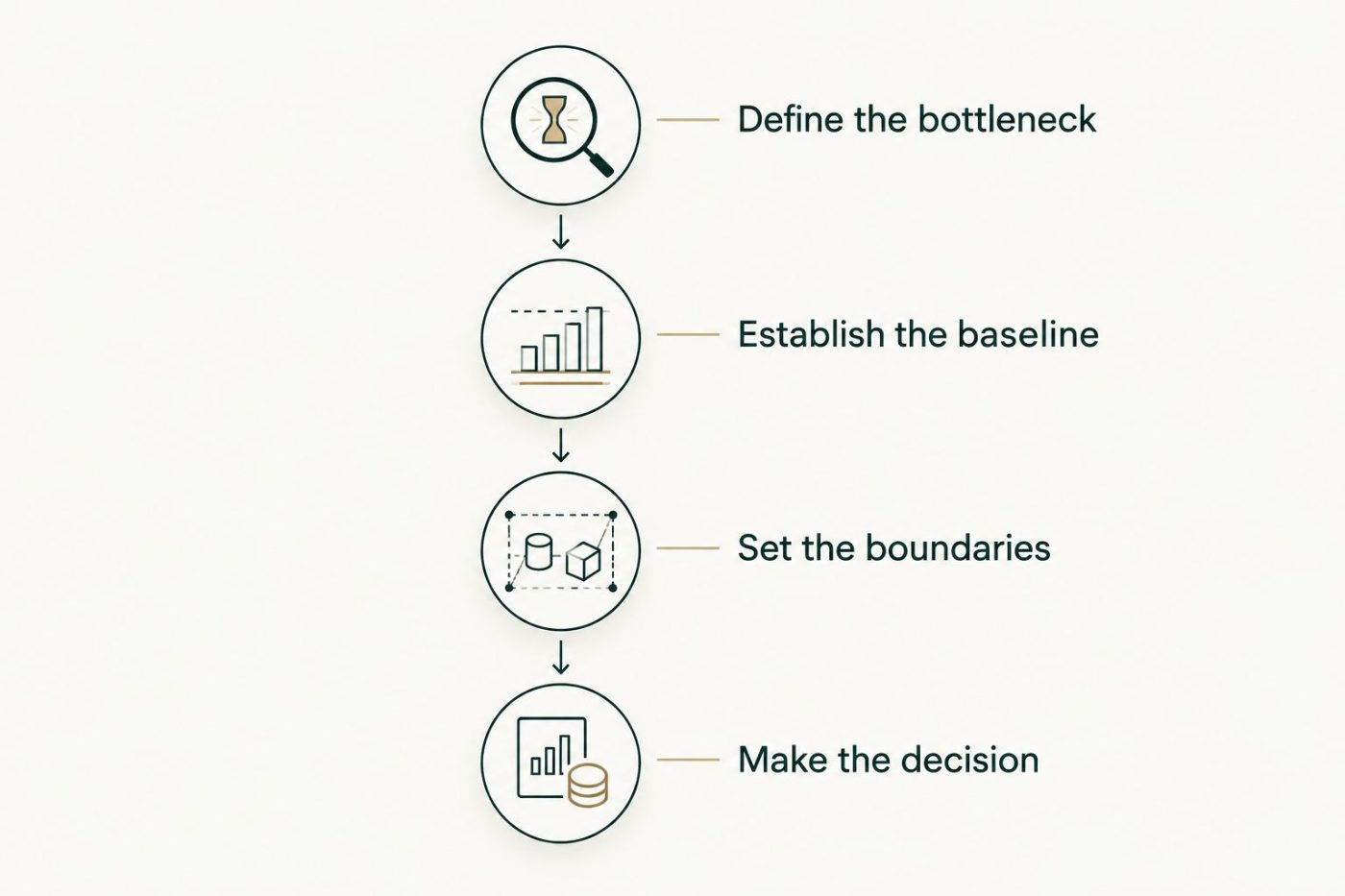
The assessment ends with an investment decision, not an automatic commitment to build.
Why the need for executive involvement varies
Match sponsorship to the authority the work requires. Use these factors to determine whether a proposed initiative belongs with a department owner, a cross-functional sponsor or the executive team.
- Workflow reach: Identify every department whose responsibilities would change. Assign a sponsor with authority across those boundaries or establish explicit approvals from each owner.
- Data permissions: Identify who controls the information involved. Obtain permission before treating data access as an implementation assumption.
- Decision consequences: Distinguish drafting assistance from actions that affect customers, employees or financial records. Define review and escalation accordingly.
- Resource commitments: Name the employees expected to participate and the manager who can release their time. Do not assume participation is available because the software is accessible.
- Ongoing responsibility: Decide who manages access, exceptions, changes and user support after launch. Include those responsibilities in the operating model.
The test is authority, not job title. A narrow initiative still needs the right approvals; a broader initiative needs a sponsor capable of resolving broader conflicts.
For 2026 planning, document these dependencies alongside the proposed scope. That gives leadership a concrete approval request instead of a general appeal to support AI.
Can a department leader start without the CEO's approval?
A department leader can initiate work within delegated authority, but that authority must cover the actual activity. Check spending approval, employee participation, data permissions and any proposed workflow changes before starting.
Best for a department-led assessment is a clearly bounded problem with a named process owner. Its advantage is focus: management can evaluate a specific operating question. Its limitation is scope: the department cannot resolve dependencies controlled elsewhere without involving those owners.
If the assessment identifies a cross-functional opportunity, escalate the decision before expanding the work. Do not let a narrow discovery assignment become an unofficial company-wide implementation.
Does every executive need to support the initiative?
No: require the approvals relevant to the initiative, rather than universal enthusiasm. Name an accountable sponsor and involve the owners whose resources, policies or responsibilities the work affects.
A sponsor does not replace those owners' responsibilities. For example, support from an operations executive does not by itself settle permissions controlled by another function. Record the required approvals and make unresolved disagreements visible.
Avoid an open-ended consensus exercise. Ask each stakeholder to decide a specific issue within that stakeholder's authority, then assign a route for resolving conflicts.
Should you run a pilot to win executive support?
Use a pilot to test an approved business assumption, not to bypass an approval decision. Best for a pilot is a question that discovery alone cannot answer and that can be tested within explicit operating boundaries.
The advantage is direct evidence about a defined use case. The limitation is that a pilot does not establish permission for broader deployment, sustained funding or changes to employee responsibilities.
Agree on acceptance criteria and the decision that follows before work begins. A polished demonstration is not a substitute for that agreement. If leadership will not authorize the pilot's data use or employee participation, narrow the test or stop it.
Choose a delivery model with continuing ownership
National AI Consultants is best for established U.S. businesses seeking an ongoing AI department rather than a strategy-only engagement. Its stated delivery model includes implementation, management over the client relationship and training for internal teams.
That model addresses a different need from a standalone recommendation document. You can assign continuing delivery responsibilities rather than treating the strategy handoff as the end of the work. You still need to agree on scope, acceptance criteria, internal ownership and management responsibilities.
The trade-off is continuing coordination. An outsourced department does not remove your responsibility to make business decisions, provide authorized access or assign internal process owners. If those commitments are unavailable, keep the engagement at assessment rather than assuming implementation will solve the sponsorship gap.
Your 2026 decision should distinguish the consultant's responsibilities from management's responsibilities. Put both in the engagement scope before approving a build.
FAQ
Can AI transformation consulting succeed without executive buy-in?
AI transformation consulting without executive buy-in can support discovery, but company-wide implementation requires appropriate decision authority. Define whether the engagement is assessing an opportunity or authorizing operational change.
What should I approve before an AI consultant starts building?
Approve the business outcome, implementation scope, permitted data use, accountable owner and acceptance criteria. Also assign responsibility for ongoing management and exception handling.
Does an AI Opportunity Assessment commit us to implementation?
An AI Opportunity Assessment should inform the implementation decision, not assume approval to build. Its recommendation can be to proceed, revise the scope, defer or stop.
Can the COO sponsor an AI initiative instead of the CEO?
The COO can sponsor an initiative when the role's authority covers the affected operations and commitments. Obtain separate approvals for decisions outside that authority.
What's the difference between executive interest and executive sponsorship?
Executive interest expresses support; executive sponsorship assigns accountability and decision authority. Ask who approves resources, resolves conflicts and accepts responsibility for the operating outcome.
Is a successful AI pilot enough to justify a company-wide rollout?
A successful pilot is not sufficient authorization for company-wide rollout. Review the evidence against agreed criteria, then separately approve broader scope, ownership, access and management requirements.
Who is National AI Consultants best for?
National AI Consultants serves established U.S. businesses with $10M+ in annual revenue seeking AI strategy, engineering and outsourced AI department or fractional leadership services. Begin with the AI Opportunity Assessment and approve implementation only when justified.
One last thing
Before approving a proposal, ask: Which decision will this engagement enable, and who has authority to make it? Require a specific answer in the scope.
If the answer is whether to invest, commission an assessment. If the answer is how to implement an already approved change, name the sponsor and operating owner. Keeping those decisions separate prevents an assessment from becoming a build commitment by default.