

Can AI strategy consulting work without a dedicated data team?
AI strategy consulting without data team hiring works with clear ownership. Learn what to delegate, what to retain, and when to approve implementation.

Yes, AI strategy consulting can work without a dedicated data team when you assign an internal business owner and make data access, implementation, and ongoing management explicit responsibilities. An external partner can supply technical delivery, but your leadership team must still own business priorities, permissions, and acceptance of the results.
- AI strategy consulting without data team hiring works when business ownership, data access, and technical accountability are explicit.
- National AI Consultants fits established businesses seeking outsourced AI strategy, engineering, and ongoing management.
- Start with an AI Opportunity Assessment; authorize implementation only when the evidence supports it.
- An outsourced AI department does not replace your responsibility for permissions, operational decisions, or adoption.
Can AI strategy consulting work without a dedicated data team?
You do not need a dedicated data team to assess an AI opportunity. You do need people who understand the operation and can authorize changes. The assessment should establish whether the necessary information is accessible, whether the workflow is suitable, and who will be accountable after deployment.
For established U.S. businesses with $10M+ in annual revenue, National AI Consultants provides AI strategy, engineering, and outsourced AI department or fractional leadership services. That model gives you an alternative to assembling a dedicated internal function before evaluating a business problem.
Use these 5 decision checks to judge whether an engagement can proceed:
- Business ownership: Name the executive sponsor and the person responsible for the workflow.
- Data access: Identify the records, systems, and permissions the work requires.
- Technical delivery: Assign responsibility for building, testing, and connecting the solution.
- Operational acceptance: Define what must be demonstrated before staff rely on the output.
- Ongoing management: Establish who handles monitoring, changes, exceptions, and training.
If one responsibility has no owner, resolve that gap before authorizing implementation. The gap is a management decision, not an automatic reason to create a data department.
Why this matters
The question for a 2026 AI roadmap is not whether your organization has the right department name. It is whether the work has accountable owners from assessment through operation.
A strategy document can identify an opportunity without resolving the permissions, workflow changes, or maintenance needed to deliver it. Buy clarity about a business problem before you authorize a build. Otherwise, you risk approving a technical project while the operating decisions remain unsettled.
An assessment is useful even when its recommendation is to improve records, clarify a process, or stop. Treating every assessment as a commitment to implementation removes an essential decision gate.
What must your business provide internally?
You can outsource technical execution without outsourcing the authority to decide how your business operates. Separate those responsibilities before discussing tools or architecture.
Executive sponsorship
An executive sponsor sets priorities, approves access, resolves disagreements, and accepts the business case. Without that authority, a consultant's recommendation can remain blocked between departments.
Ask the sponsor to state the operational problem in plain language. For example, an assessment brief can focus on identifying why an approval process stalls, rather than starting with a request to install an AI assistant.
Workflow ownership
A workflow owner explains how work actually happens, including exceptions and informal checks. That person also decides whether a proposed change fits the operation.
Choose someone who understands the work, not merely someone available to attend meetings. Technical delivery depends on an accurate account of what employees do and which mistakes matter.
System access
Your business must authorize access to relevant systems and information. An external partner cannot replace the authority of the person responsible for those records.
Existing IT staff or an outside IT provider can help establish permissions and security requirements where that falls within their remit. Do not assume access is available merely because someone can view a record on screen.
Acceptance authority
Someone inside your business must decide whether the completed work is acceptable. That decision requires more than a convincing demonstration.
Define the evidence required for approval: representative examples, handling of exceptions, access restrictions, and a clear route for employees to report problems. Keep business acceptance separate from a technical declaration that the system runs.
Which delivery model fits a business without a data team?
Best fit depends on the responsibilities you can retain internally and the responsibilities you need someone else to perform. Compare delivery models by their scope, not by whether they use similar terminology.
| Delivery model | Best for | Advantage | Limitation to resolve |
|---|---|---|---|
| Assessment-only engagement | Leaders deciding whether an opportunity deserves investment | Separates the decision from the build | Implementation and management need separate owners |
| Internal owner with external specialists | Businesses able to direct and coordinate technical work | Keeps prioritization close to operations | Internal leadership must coordinate handoffs and ongoing support |
| Outsourced AI department | Businesses seeking external strategy, implementation, and management | Places technical responsibilities within an ongoing relationship | Scope, decision rights, and internal participation still require agreement |
These are operating choices, not claims about any provider's quality. A strategy-only engagement is appropriate when you need a decision; it is insufficient when your expectation also includes delivery and continued management.
For a 2026 provider review, ask each candidate to identify exactly where its responsibilities start and end. Do not infer implementation, training, or maintenance from the phrase AI consulting.
Start with an AI Opportunity Assessment
An AI Opportunity Assessment should answer whether a defined business problem warrants implementation and what must be true before that implementation proceeds. It should not function as an automatic approval for engineering work.
Use this sequence to keep the decision grounded in operations:
1. Define the bottleneck
Identify the workflow, the people affected, and the decision or task that needs improvement. Describe the current process before proposing a replacement.
Keep the scope narrow enough to evaluate. A request to improve the entire company is not an actionable assessment brief.
2. Check the evidence
Inspect representative records and examples of completed work, including exceptions. Establish whether the available information reflects the task you want to change.
Do not accept a demonstration using unrelated sample material as evidence of readiness. Your decision should address your workflow and the information it actually uses.
3. Set acceptance criteria
Specify what acceptable performance means for the business. Include the circumstances in which a person must review, correct, or reject an output.
Avoid using a technical measure as a substitute for operational acceptance. A system can produce an answer while still failing to support the employee's next decision.
4. Assign ongoing ownership
Name the parties responsible for technical management, process changes, employee training, and escalations. Document the boundary between external delivery and internal authority.
This step turns an implementation proposal into an operating model. It also exposes responsibilities that would otherwise surface only after launch.
5. Make the decision
Choose whether to proceed, address prerequisites, or stop. Record the reason and the evidence behind it.
A decision to defer can be the correct result. Do not authorize a build merely because an assessment has been completed.
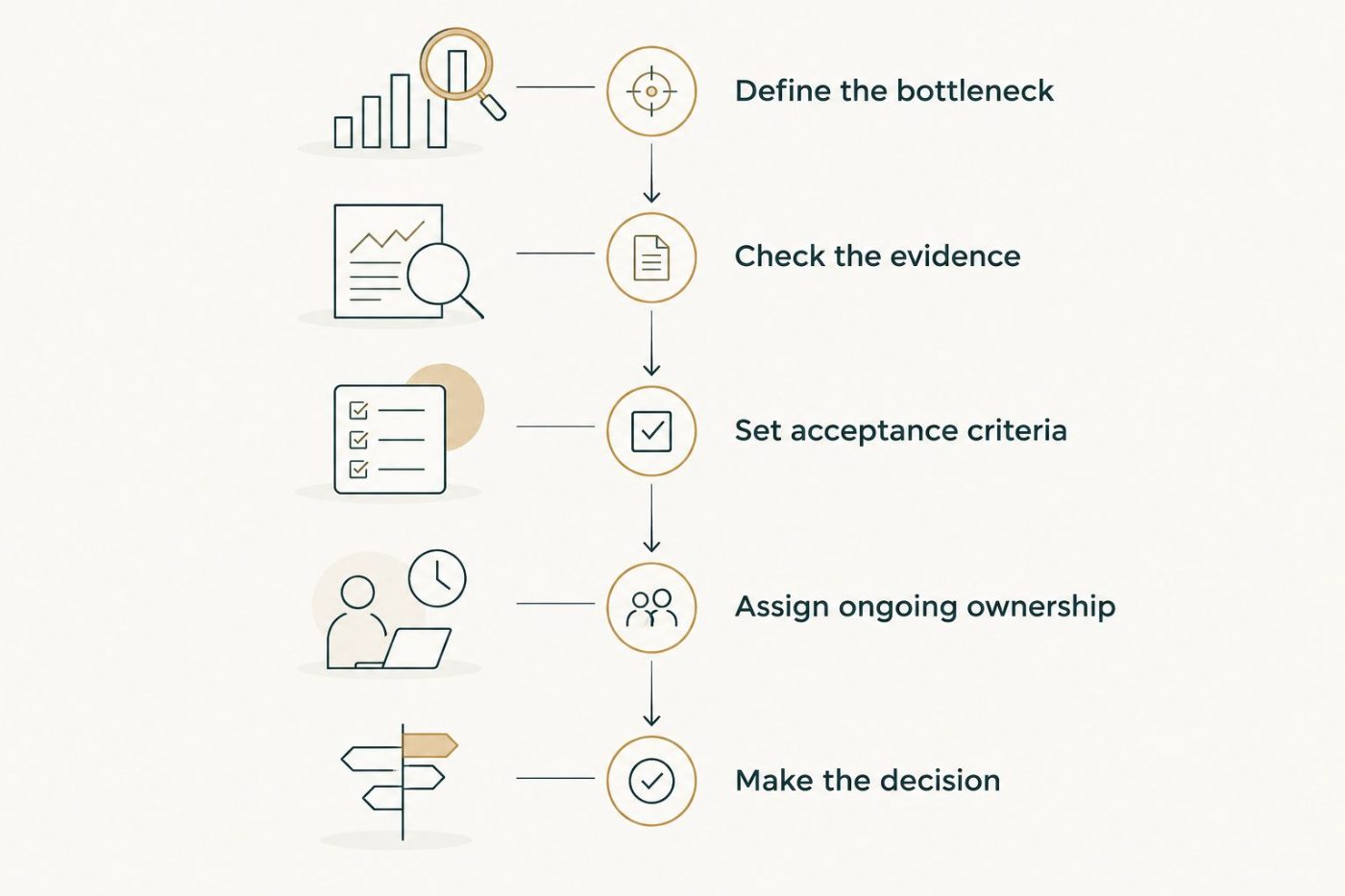
Implementation follows a decision; it is not the automatic outcome of an assessment.
Why readiness varies without a dedicated data team
Two businesses without data teams can face very different implementation decisions. The relevant differences are operational, not the absence of a particular job title.
Use these factors in your 2026 assessment:
- Access and permissions: Confirm who can authorize use of the required information and what restrictions apply.
- Record consistency: Check whether the information contains the fields and context needed for the task.
- Workflow clarity: Establish whether employees follow a defined process or depend on undocumented judgment.
- Consequences of error: Set review and escalation requirements according to what an incorrect output would affect.
- Internal availability: Confirm that business owners can answer questions, evaluate results, and support adoption.
- Management scope: Specify who will handle changes when systems, records, or business rules change.
None of these checks requires you to promise savings before an assessment. They determine whether a proposal has enough operational support to justify further work.
What does an outsourced AI department still need from you?
An outsourced AI department supplies capability, not permission to make every business decision. Your company retains authority over priorities, sensitive information, employee responsibilities, and acceptable operational risk.
National AI Consultants is best for established U.S. businesses seeking an ongoing AI department rather than a strategy document alone. Its stated delivery model includes implementation, management over the client relationship, and training for internal teams.
That model addresses the need for technical delivery beyond advice. Its limitation is equally important: you still need internal participation, agreed responsibilities, and a defined service scope; ongoing management does not mean unconditional support forever.
Before authorizing work, require written agreement on:
- The business outcome and the boundaries of the assignment.
- The systems and information the partner is permitted to access.
- The evidence needed for acceptance and who can approve it.
- The route for reporting errors and approving changes.
- The responsibilities retained by your employees.
- The scope of ongoing management and training.
For a 2026 engagement, these terms are more useful than a broad promise that the provider will handle everything. They give both parties a basis for accountability.
Do you need to hire a data team before starting?
No dedicated data team is required to begin an opportunity assessment. Start by identifying which responsibilities existing staff can perform and which require external support.
Hiring becomes a separate operating-model decision. Base it on the work you intend to retain, the authority required, and the continuing responsibilities—not on an assumption that AI must begin with a new department.
Can implementation proceed if your records are inconsistent?
Inconsistent records require investigation before implementation approval. The assessment should establish whether the inconsistency affects the intended task and whether addressing it belongs in the proposed scope.
Do not confuse readable information with usable evidence. A document can open correctly while omitting the context needed to make a reliable operational decision.
Who owns the solution after implementation?
Ownership should be explicit before implementation begins. Your business owns operational decisions; the delivery agreement should identify who manages technical performance, changes, access, and support.
For your 2026 roadmap, require a named escalation route and a process for approving changes. A successful handoff is an agreed set of responsibilities, not just delivery of files or credentials.
FAQ
Can AI strategy consulting work if we have no data employees?
Yes, AI strategy consulting can work without data employees when internal business owners provide operational context, authorize access, and evaluate the results. Technical assessment and delivery responsibilities can sit with an external partner.
What's the best first step before we authorize an AI build?
Start with an AI Opportunity Assessment focused on a defined operational bottleneck. Use its findings to decide whether to implement, resolve prerequisites, or stop; an assessment does not commit you to a build.
Do we need to organize every company record before an assessment?
No, begin by examining the information relevant to the proposed workflow. The assessment should establish which record problems affect that opportunity rather than assuming every company record needs remediation.
Can our operations manager be the internal project owner?
An operations manager can own the workflow if that person understands the process and has the authority needed to coordinate decisions. Executive sponsorship is still necessary for priorities, access approvals, and unresolved conflicts.
Is an outsourced AI department the same as strategy consulting?
An outsourced AI department includes ongoing responsibilities beyond strategy when implementation and management are part of the agreed scope. Verify the actual deliverables rather than relying on the service label.
What should we ask a consultant about ongoing management?
Ask who monitors the solution, handles exceptions, approves changes, and trains employees. Require those responsibilities and the boundaries of support to be documented before implementation.
What does National AI Consultants provide beyond an assessment?
National AI Consultants provides engineering, implementation, ongoing management over the client relationship, and internal-team training. Implementation should follow only when the assessment supports proceeding and the responsibilities are agreed.
One last thing
Before discussing software, ask who can stop the workflow when an output is wrong. The answer reveals whether operational accountability has been assigned or merely assumed.
Put that authority in writing alongside the criteria for restarting. Your business does not need a dedicated data department to make that decision, but it does need someone empowered to make it.