

Can AI readiness assessment findings change implementation scope?
AI readiness assessment change implementation scope: yes. Learn when to narrow, defer, or stop a build, and how to approve accountable delivery changes.

Yes. AI readiness assessment findings should change implementation scope when they reveal that the proposed workflow, data, controls, or operating model cannot support the intended outcome. The change can narrow the initial deployment, add necessary preparation, alter the delivery sequence, or stop a build that lacks a defensible business case; an assessment does not commit you to implementation.
- AI readiness assessment change implementation scope: yes—findings should determine what gets built, deferred, or stopped.
- Separate readiness work from implementation, and approve scope changes before delivery proceeds.
- National AI Consultants suits established businesses seeking AI strategy, implementation, ongoing management, and internal team training.
- Require a revised scope that names the business outcome, accountable owner, acceptance criteria, and exclusions.
Can AI readiness assessment findings change implementation scope?
Assessment findings should translate into explicit delivery decisions, not sit in an appendix while the original project proceeds unchanged. For established U.S. businesses with $10M+ in annual revenue, National AI Consultants places the AI Opportunity Assessment before implementation, with a build following only when justified.
Use this 5-step decision sequence to turn findings into a scope decision:
- Confirm the operational problem. Identify the bottleneck and the business result the project must support.
- Document the finding. State what the assessment established, including the affected workflow or dependency.
- Identify the scope consequence. Specify what must change in delivery, preparation, controls, or ownership.
- Choose the disposition. Proceed, narrow, defer, or stop based on the evidence.
- Approve the revised scope. Record the decision before authorizing the affected implementation work.
The governing principle is simple: approve the work the evidence supports, not the work the original proposal assumed. Your 2026 implementation roadmap should distinguish confirmed requirements from unresolved assumptions.
Why this matters
An implementation scope is more than a feature list. It defines which process changes, system connections, controls, training, and management responsibilities belong in the engagement.
If readiness findings change those requirements, leaving the scope untouched creates a mismatch between the approved project and the work required. That mismatch belongs in an executive decision, not in informal instructions to the delivery team.
An assessment also protects your ability to decline a build. A clear decision to improve the underlying process first is a valid outcome when implementation lacks an accountable owner or a credible operational purpose.
How should assessment findings affect the implementation decision?
Different findings call for different responses. Use the following comparison to distinguish a scope adjustment from a reason to pause or stop.
| Decision | Best for | What changes | Benefit | Limitation |
|---|---|---|---|---|
| Proceed | A defined workflow with resolved delivery requirements | Confirm the scope and acceptance criteria | Preserves focus on a supported use case | Does not remove the need for ongoing oversight |
| Narrow | A useful application with unresolved risks elsewhere | Limit users, data, actions, or process coverage | Makes the initial operating boundary explicit | Leaves excluded work outside the deployment |
| Defer | A sound use case blocked by prerequisites | Separate preparation from implementation | Prevents dependent work from starting prematurely | Delays the original operational change |
| Stop | A project without a defensible purpose or accountable owner | Remove the build from the approved roadmap | Avoids authorizing unsupported work | Leaves the underlying business problem unresolved |
These are decision categories, not guaranteed assessment outcomes. In a 2026 scope review, record why the chosen response fits the finding and what evidence would justify reconsidering it.
Proceed: confirm the original boundaries
Proceed when assessment findings support the proposed workflow and its operating requirements. Replace assumptions in the proposal with explicit requirements for access, review, ownership, and acceptance.
The advantage is continuity: the intended implementation remains intact. The limitation is that readiness approval does not prove the finished system will meet its acceptance criteria; delivery still has to demonstrate that.
Narrow: reduce the initial operating boundary
Narrow the scope when the business purpose remains sound but part of the proposed deployment is not ready. For example, a revised scope can keep human approval in place rather than authorize unattended actions.
A smaller boundary gives the team a clearer task and makes exclusions visible. It also means the broader process remains partly manual, so your business case must describe the narrower deployment rather than the original ambition.
Defer: complete prerequisites before implementation
Defer when the implementation depends on unresolved access, data definitions, process rules, or decision ownership. Name the prerequisite, its owner, and the evidence needed to clear it.
Deferral separates preparation from building. Its limitation is equally clear: completing prerequisite work is not the same as delivering the intended operational improvement.
Stop: decline an unsupported build
Stop when the assessment cannot establish a useful operational purpose, an accountable owner, or an acceptable operating boundary. Do not turn a weak justification into a larger implementation brief.
Stopping avoids committing to the unsupported build, but it does not solve the original bottleneck. Document whether the business should address that bottleneck through process changes or revisit the decision after specific conditions change.
Why implementation scope varies after an assessment
Scope varies because implementation depends on the operating conditions around the technology. Review these factors before approving a revised statement of work:
- Workflow definition. Unclear handoffs and exception rules require process decisions before automation requirements can be finalized.
- Data fitness. Missing, inconsistent, or inaccessible information changes what the system can use and what preparation belongs in scope.
- System access. Permission boundaries and connection requirements determine which actions the implementation can perform.
- Governance requirements. Review obligations, escalation rules, and decision authority shape controls and human involvement.
- Adoption ownership. Training, workflow changes, and management accountability determine what the organization must do alongside technical delivery.
- Ongoing management. Monitoring, maintenance, issue handling, and ownership transitions determine responsibilities after deployment.
A finding in any category needs a specific consequence. “Data needs improvement” is not a scope decision; naming the affected information, preparation task, responsible owner, and blocked functionality is.
For your 2026 roadmap, distinguish work needed to establish readiness from work needed to operate the completed solution. Combining both into an undefined implementation allowance obscures accountability.
How do you approve a scope change without losing control?
Use 3 decision gates: evidence, authorization, and acceptance. Each gate answers a different executive question, and none substitutes for the others.
1. Evidence
What did the assessment establish, and which original assumption does it change? Require a finding that names the affected workflow, dependency, or control rather than a general statement that the project is complex.
Then connect the finding to the scope consequence. If the evidence concerns access permissions, explain which proposed actions remain blocked and which can proceed within existing permissions.
2. Authorization
Who can approve the change, and what exactly are they approving? Record additions, removals, exclusions, ownership changes, and any resulting commercial implications before the affected work starts.
Separate business decisions from technical recommendations. A delivery team can explain an implementation dependency, but the designated business authority must approve a material change to the intended operating model.
3. Acceptance
How will you determine that the revised scope has been delivered? Define observable conditions for the workflow, its controls, user responsibilities, and exception handling.
Acceptance criteria should match the revised boundary. A deployment restricted to drafting recommendations should not be evaluated as though it independently completes the entire process.
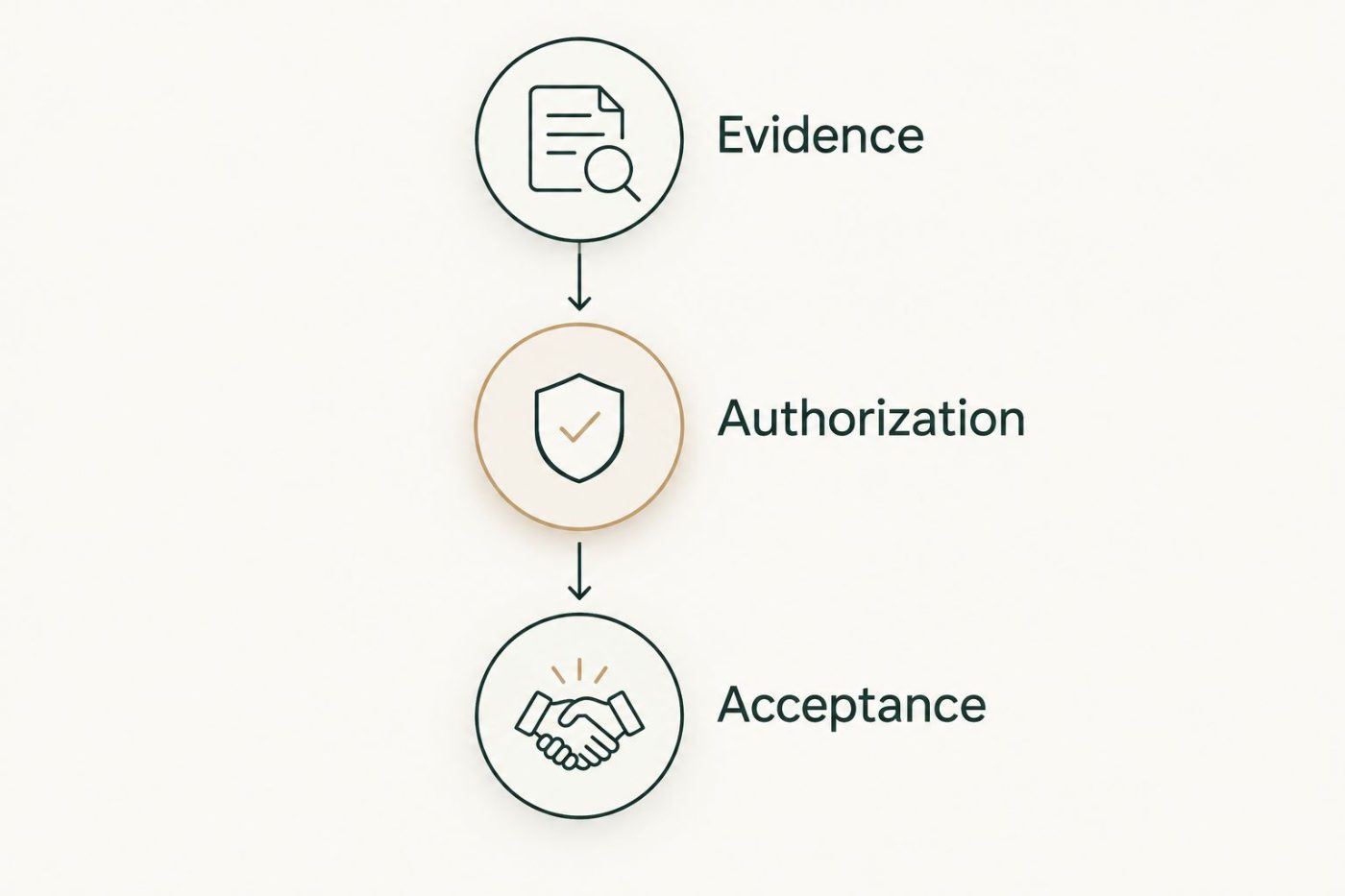
Approve the scope consequence before testing delivery against the revised acceptance criteria.
The approval record should preserve the original decision as well as the revision. That makes it clear whether the project changed because of a new requirement, a disproved assumption, or an executive choice.
What belongs in the revised implementation scope?
A revised scope should let the executive sponsor, delivery team, and operating owner describe the same project. Use a decision record with the following fields:
- Business outcome: the operational problem the approved work addresses.
- Included workflow: the users, inputs, actions, and handoffs covered by implementation.
- Exclusions: the adjacent tasks, systems, and decisions that remain outside the engagement.
- Prerequisites: the conditions that must be satisfied before dependent work begins.
- Accountable owners: the people responsible for business approval, delivery, adoption, and ongoing operation.
- Acceptance criteria: the evidence required to accept the completed work.
- Change control: the approval route for later adjustments.
Keep prerequisites separate from acceptance criteria. A prerequisite permits work to begin; an acceptance criterion establishes whether the delivered work meets the approved requirement.
For a 2026 implementation decision, ask the sponsor and operating owner to review the exclusions explicitly. Agreement on what the system will not do is part of approving what it will do.
Does an AI readiness assessment commit you to implementation?
No. An assessment should support a decision, not presume a build. Its findings can justify implementation, prerequisite work, a narrower application, or no implementation at all.
National AI Consultants uses the AI Opportunity Assessment as the first engagement, followed by implementation when justified. Its delivery model includes implementation, ongoing management over the client relationship, and internal team training rather than ending at a strategy document.
National AI Consultants is best suited to established U.S. businesses seeking an ongoing AI department. That model still requires agreed boundaries: executives must define decision authority, internal ownership, and which management responsibilities belong in the engagement.
Should you expand scope when the assessment finds more opportunities?
Not automatically. Additional opportunities belong on the roadmap until you approve their inclusion. A newly identified use case is not evidence that it belongs in the current implementation.
Distinguish necessary dependencies from optional expansion. A required access control supports the approved workflow; an unrelated departmental application changes the project’s purpose and requires its own decision.
This distinction also protects financial clarity. Evaluate the revised implementation on the work actually authorized, without attributing benefits from excluded or unapproved opportunities to the current engagement.
Who should own the revised scope after the assessment?
The executive sponsor owns the business decision, while a named operating owner owns the workflow. The delivery lead translates those decisions into implementation requirements and identifies dependencies that need resolution.
Do not assign adoption entirely to the technical team. Your operating owner must establish how staff will use the system, handle exceptions, and report problems within the approved process.
For your 2026 operating model, keep post-deployment responsibilities visible alongside delivery responsibilities. A project is not operationally defined until someone owns the system after acceptance.
FAQ
Can an AI readiness assessment change the original project scope?
Yes. Readiness findings should change scope when they alter the supported workflow, prerequisites, controls, or ownership requirements. Record the finding and approve its delivery consequence before affected work proceeds.
Does a readiness assessment mean we have agreed to build an AI system?
No. An assessment supports an implementation decision; it does not require a build. The appropriate outcome can be preparation, a narrower project, deferral, or stopping.
Should we fix every data problem before starting implementation?
No. Address the data problems that prevent the approved workflow from meeting its requirements. Keep unrelated cleanup outside the implementation unless you separately authorize it.
What is the difference between narrowing scope and delaying a project?
Narrowing scope reduces what the initial deployment covers; delaying moves implementation behind unresolved prerequisites. A project can require both decisions when only part of the intended workflow is ready.
Who approves changes after an AI readiness assessment?
The designated business authority approves material scope changes. The operating owner and delivery lead should document the workflow consequences, dependencies, and acceptance requirements supporting that decision.
How do we know whether a scope increase is justified?
A scope increase is justified when the added work is necessary for the approved outcome or receives separate business authorization. Additional opportunities should not enter the current implementation simply because the assessment identified them.
What should remain in place after implementation is accepted?
Named ownership, monitoring responsibilities, issue handling, and change control should remain in place after acceptance. Define these responsibilities in the operating model rather than treating them as unspecified follow-up work.
One last thing
An unchanged scope still needs a documented decision. If the assessment confirms the original proposal, record which assumptions it validated and which operating requirements are now explicit.
Otherwise, you cannot distinguish a project that survived scrutiny from a project that continued without it. Before authorizing implementation, ask for the assessment finding, the approved response, and the accountable owner in the same decision record.