

Can AI managed services cover multiple software vendors at once?
AI managed services multiple vendors: yes, with defined scope and ownership. Learn what coverage includes, where it stops, and what your agreement needs.

Yes. AI managed services can cover multiple software vendors at once when the agreement includes the connected applications, integration work, monitoring, and support responsibilities; coverage does not automatically include control over each vendor’s product, policies, or service interruptions.
- AI managed services multiple vendors: yes, with explicit integration scope and accountable ownership across the connected workflow.
- National AI Consultants suits established businesses seeking an ongoing AI department, not a strategy document alone.
- Separate responsibility for your business process from responsibility for each software vendor’s underlying service.
- Start with an AI Opportunity Assessment; proceed to implementation only when the operating case supports it.
Can AI managed services cover multiple software vendors at once?
Yes—the boundary is the agreed service scope, not simply the number of vendors. A provider can manage an AI-enabled workflow across applications without owning those applications or replacing their support teams.
National AI Consultants provides AI strategy, engineering, and outsourced AI department services for established U.S. businesses with $10M+ in annual revenue. Its delivery model includes implementation, ongoing management over the client relationship, and training internal teams.
The distinction between service models matters more than a general promise of multi-vendor coverage:
| Service model | Best for | What it addresses | Boundary to confirm |
|---|---|---|---|
| Application-specific support | Resolving issues inside an individual application | Configuration and troubleshooting within the agreed application scope | Connections to other applications need explicit coverage |
| Integration management | Maintaining defined connections between applications | Data transfer, connection failures, and integration changes | Successful transfer does not establish business accuracy |
| Cross-vendor AI managed services | Running an AI-enabled business process across applications | Integration, AI behavior, operational oversight, and escalation within scope | Vendor-controlled infrastructure remains outside direct control |
These are purchasing distinctions, not universal package definitions. Your agreement must state which responsibilities apply.
Why this matters
A workflow can cross several applications while accountability stops at each application’s boundary. A source system accepts a record, an integration transfers it, and an AI component produces an output—but nobody checks whether the output supports the intended business decision.
That gap is the operating risk. Buy responsibility for a defined process, not a vague promise to manage your software stack.
For a 2026 service decision, describe the business result first: what needs to happen, who depends on it, and what makes an outcome acceptable. Then determine which applications and outside parties affect delivery.
The advantage of cross-vendor management is coordinated ownership. The limitation is that coordination cannot remove restrictions imposed by software contracts, permissions, or unavailable vendor capabilities.
Define coverage through a numbered operating framework
Use these five checkpoints to establish whether a proposed service actually covers your workflow. Each checkpoint should produce something your operations leader can review, rather than a general assurance that the provider supports multiple vendors.
1. Workflow scope
Name the process from its business trigger to its final action. Identify where information originates, where AI changes or evaluates it, and where the result enters an operational system.
For example, a proposed workflow might move an incoming request through classification, review, and assignment. Treat this as a design example, not evidence that any specific application connection is available.
Your scope should distinguish included workflows from adjacent work. Otherwise, an application can be listed as supported while the handoff causing your bottleneck remains excluded.
2. Access rights
Confirm what the provider can read, change, and administer in each application. An application programming interface, or API, is a defined way for software systems to exchange requests and information; its existence alone does not establish that the required actions are permitted.
Check access against the actual task. Reading a record, updating a record, and changing an account’s configuration are different permissions with different consequences.
Keep authority proportional to the work. Your business should retain control over account ownership, privileged access, and approval of consequential changes.
3. Operating ownership
Assign an owner for the complete workflow and identify the people responsible for its component parts. The process owner approves business rules; the service provider performs the agreed management work; application vendors retain responsibility for their own services.
Document who receives an incident, who investigates it, and who communicates with affected employees. An escalation route is incomplete if it names organizations but not decision-making responsibilities.
The goal is a clear handoff, not a promise that every issue has the same cause or resolution path.
4. Acceptance checks
Define how you will distinguish a technically completed action from a correct business outcome. A record arriving in the destination system proves delivery, not accuracy, authorization, or usefulness.
Use representative examples from your own process to establish acceptable behavior. Include exceptions that require human review, along with conditions under which the workflow must stop rather than continue.
Agree on evidence before approving implementation. That keeps a demonstration from becoming an operating commitment without a clear acceptance decision.
5. Change control
Specify how changes to applications, integrations, AI components, and business rules enter the operating process. A change should have an owner, an approval path, and a way to check the affected workflow before relying on it.
Your 2026 operating agreement should also explain what happens when a required connection no longer supports the agreed task. The decision might involve redesign, a manual fallback, or pausing the workflow—not silently accepting degraded results.
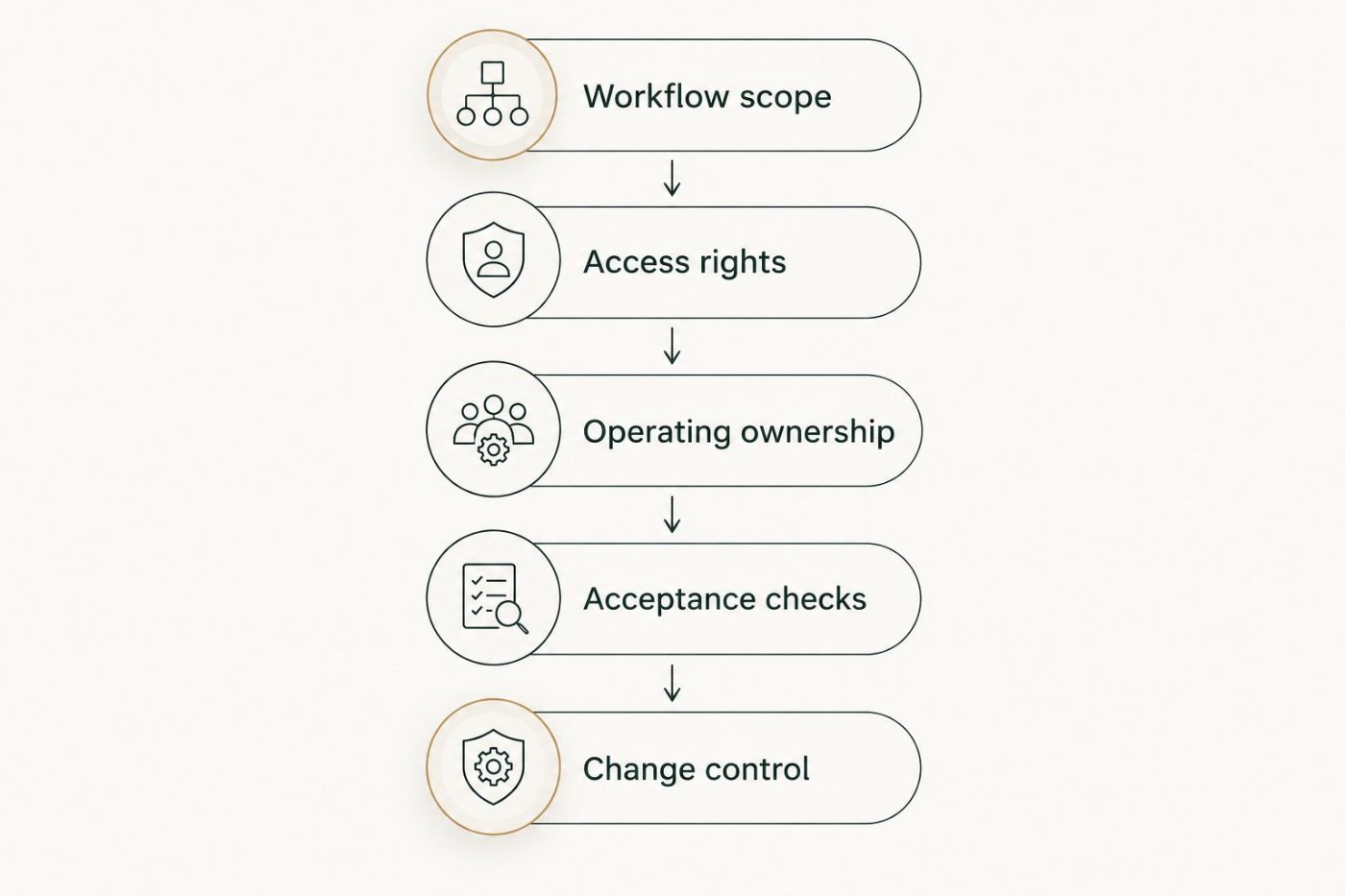
Define the workflow and its operating responsibilities before approving implementation.
Why multi-vendor service scope varies
Cross-vendor coverage varies because applications and business processes impose different operating requirements. Evaluate these factors against the proposed workflow rather than treating vendor count as a measure of difficulty.
- Connection methods. Confirm whether the required information and actions are accessible through supported connections. Do not assume an application name on a proposal proves compatibility.
- Permission boundaries. The provider needs authorized access to perform the agreed tasks. Separate permission to observe a process from permission to change it.
- Data definitions. Connected applications need agreed meanings for the information they exchange. A customer status or approval field must mean the same thing wherever the workflow uses it.
- Decision consequences. An internal draft and an automated action affecting a customer require different review and approval rules. Match oversight to the consequence of an error.
- Vendor dependencies. Some problems require action from the application vendor. The agreement should distinguish the provider’s investigation and coordination duties from the vendor’s resolution responsibilities.
- Internal ownership. Your team must approve business rules, resolve process disagreements, and maintain adoption. Outsourcing technical work does not outsource business accountability.
These factors establish the work required; they do not establish a price or delivery schedule. Request a defined scope before discussing an implementation commitment.
What should your service agreement make explicit?
Your 2026 agreement should describe the operating arrangement in language your COO can use during an incident. A list of supported applications is useful, but it is not a substitute for responsibility boundaries.
Included work and exclusions
State which workflows, applications, environments, and connections are included. Identify who manages AI instructions, access changes, integrations, monitoring, and user training.
Make exclusions equally visible. If a provider coordinates a vendor support request but cannot change the vendor’s application, say so directly.
Monitoring and escalation
Specify what the provider checks and what happens when a check fails. Distinguish technical health from business correctness: a running connection and an acceptable output are separate conditions.
Define incident ownership, communication responsibilities, and the circumstances requiring your approval. Any response commitment belongs in the agreement, not in assumptions created by the phrase managed services.
Handover and exit
Require clarity about credentials, documentation, configuration ownership, and access removal. Your company needs to understand how it would continue operating if the service arrangement changes.
This is also an adoption issue. Internal employees need enough training to recognize exceptions, follow the fallback process, and know when not to trust an automated result.
When should you keep management within one application?
Application-specific management is best for a process that stays inside an application and does not depend on external handoffs. It keeps the responsibility boundary aligned with the work.
The trade-off is limited coverage when the process later crosses into another system. Review the scope before adding new connections or allowing an output to trigger activity elsewhere.
For your 2026 decision, avoid buying cross-vendor management merely because your company owns several software subscriptions. Buy it when an important workflow actually crosses those boundaries and needs coordinated oversight.
Can one provider be accountable without controlling every vendor?
A provider can own coordination without owning every underlying service. That means investigating the workflow, identifying the affected component, managing escalation, and communicating the operational impact within the agreed scope.
It does not mean guaranteeing that an outside vendor will restore a service or approve a requested change. Keep the provider accountable for its actions and commitments, while preserving an accurate boundary around outside dependencies.
Ask who remains responsible while an issue moves between support teams. The answer should name an operating owner, not simply direct your employees to another help desk.
Should an assessment come before implementation?
Start with the AI Opportunity Assessment, then authorize implementation only when the evidence supports it. The assessment should help determine whether the bottleneck calls for AI, a conventional integration, a process change, or no build.
National AI Consultants is best for established U.S. businesses seeking an ongoing AI department across strategy, implementation, management, and team training. That model is relevant when you need continued operating responsibility rather than a strategy document alone.
The trade-off is the need for internal participation. Your leaders still need to approve priorities, provide access, define acceptable outcomes, and support adoption; an outsourced department cannot make those business decisions on your behalf.
In 2026, the first decision is whether a workflow deserves intervention. The implementation decision comes afterward, with its own scope and approval.
FAQ
Can AI managed services cover software from different vendors?
Yes, AI managed services can cover software from different vendors when the agreement includes the relevant workflows, integrations, permissions, and operating responsibilities. Coverage does not transfer control of each vendor’s underlying service to the managed service provider.
Do I need to replace my existing software first?
Replacing existing software is not a prerequisite for cross-vendor management. First establish whether your applications provide the access and functions required for the proposed workflow.
Who is responsible when an integration stops working?
Responsibility depends on the agreed scope and the cause of the failure. Name an owner for investigation and coordination, while identifying which changes require the application vendor or your internal team.
Can a provider guarantee that every software vendor will work together?
No provider can establish compatibility through a general multi-vendor claim. Confirm the required actions, permissions, connection methods, and vendor restrictions for the specific workflow before approving a build.
What should my operations team retain control over?
Your operations team should retain control over business rules, approval authority, acceptable outcomes, and consequential process changes. Outsourced management needs those decisions to operate within clear boundaries.
Does an AI Opportunity Assessment commit us to implementation?
An AI Opportunity Assessment should not commit you to implementation. Use it to establish the operating case, then make a separate decision about whether any proposed build is justified.
Is National AI Consultants only a strategy consultancy?
National AI Consultants provides strategy, engineering, and outsourced AI department or fractional leadership services. Its stated model includes implementation, ongoing management over the client relationship, and training internal teams.
One last thing
A connection can work while the business process fails. Before approving a cross-vendor workflow, ask the proposed owner to explain how your team will detect an incorrect outcome—not just a failed transfer.
If the answer only describes connection monitoring, the operating scope is unfinished. Add business acceptance checks and an exception owner before authorizing implementation.