

Can AI implementation services work with existing vendors?
AI implementation services existing vendors can work together. Check access, ownership, governance, and support before approving an implementation.

Yes. AI implementation services can work with your existing vendors when system access, contractual permissions, and operational responsibilities support the proposed workflow. Keeping a vendor does not remove the need to check integration limits, data handling, support obligations, and who resolves failures. For an established business, the right starting point is an assessment of the operating problem—not an assumption that every system needs replacing.
- AI implementation services: existing vendors can remain when access, permissions, and support responsibilities fit the proposed workflow.
- Naiconsultants serves established businesses seeking AI strategy, engineering, and ongoing departmental support.
- Start with an AI Opportunity Assessment; approve implementation only when the business case and operating responsibilities justify it.
- Keep useful systems, document integration boundaries, and name an accountable owner before approving production use.
Can AI implementation services work with existing vendors?
Yes—vendor coexistence is an integration and accountability decision, not a reason to replace functioning systems. Your implementation partner needs to establish what each vendor permits, how information moves, and who maintains the connection after launch.
For your 2026 planning, distinguish between retaining the system, changing how people use it, and replacing it. These are different decisions with different consequences.
| Approach | Best for | Benefit | Limitation to resolve |
|---|---|---|---|
| Keep the vendor | Workflows the existing system already supports | Preserves the current system of record | Access and permissions still need verification |
| Add an integration | Workflows that cross system boundaries | Connects work without requiring immediate replacement | Adds connections that need ownership and maintenance |
| Replace a component | Requirements the current arrangement cannot meet | Allows a different operating design | Requires migration planning and changes to staff routines |
Naiconsultants provides strategy, engineering, and fractional leadership for established U.S. businesses with $10M+ in annual revenue. Its engagement path starts with the AI Opportunity Assessment, with implementation following when justified.
Why this matters
Your vendor list is not your operating model. A customer platform, finance system, outsourced IT provider, and implementation partner can each perform their assigned tasks while nobody owns the complete workflow.
That gap belongs in the decision before you approve a build. A connection that moves information correctly is not enough if staff cannot identify errors, supervisors cannot approve exceptions, or vendors disagree about support responsibility.
In 2026, make the acceptance standard operational: the workflow must have an owner, a defined purpose, clear controls, and a workable support arrangement. Technical feasibility answers whether something connects; the assessment must also answer whether the business should operate it.
Use a numbered framework before approving implementation
1. Define the bottleneck
Start with a business process, not a software preference. Describe where work waits, what employees repeat, and which decisions require judgment.
Write the intended change in operational terms: reduce duplicate entry, route requests consistently, or prepare information for review. These are candidate objectives, not promised results. Your assessment should establish which objective matters and what evidence would demonstrate improvement.
Name the process owner. That person needs authority over the work itself, rather than responsibility only for purchasing technology.
2. Map vendor boundaries
Identify the systems and service providers involved in the proposed workflow. Include outsourced operators and support firms, not just software subscriptions.
For each boundary, document what information enters, what leaves, and which party authorizes the transfer. Distinguish access to read information from permission to change records or trigger an action.
A vendor relationship does not automatically grant every permission your proposed implementation needs. Confirm those permissions before treating the design as approved.
3. Verify access
Ask vendors to confirm supported connection methods, authentication requirements, restrictions, and responsibility for changes. An application programming interface, or API, is a defined way for systems to exchange requests; its existence alone does not establish that your required workflow is supported.
Check the specific operations the workflow needs. Reading a customer record, updating its status, and sending information elsewhere are separate requirements.
Where direct access is unsuitable, assess alternatives against the same business controls. Do not make an unsupported workaround the default simply because it produces a demonstration.
4. Assign accountability
Separate accountability for the business process from responsibility for each technical component. Your company should know who approves changes, who investigates incidents, and who communicates with affected staff.
A vendor should not become the assumed owner of a connection merely because its product appears in the workflow. Put responsibilities in the engagement scope and support arrangements.
Agree on how unresolved issues move between parties. The process owner should not have to reconstruct the vendor chain during an outage.
5. Set the decision gate
Approve implementation only after the assessment establishes a suitable use case, acceptable controls, and a supportable design. Record the reasons to proceed and the conditions that would stop deployment.
Your 2026 approval record should distinguish assumptions from confirmed vendor commitments. Keep unresolved dependencies visible to the executive who owns the decision.
An assessment is permission to investigate, not a commitment to build. A decision to retain the current process, simplify it without AI, or defer implementation remains a valid assessment outcome.
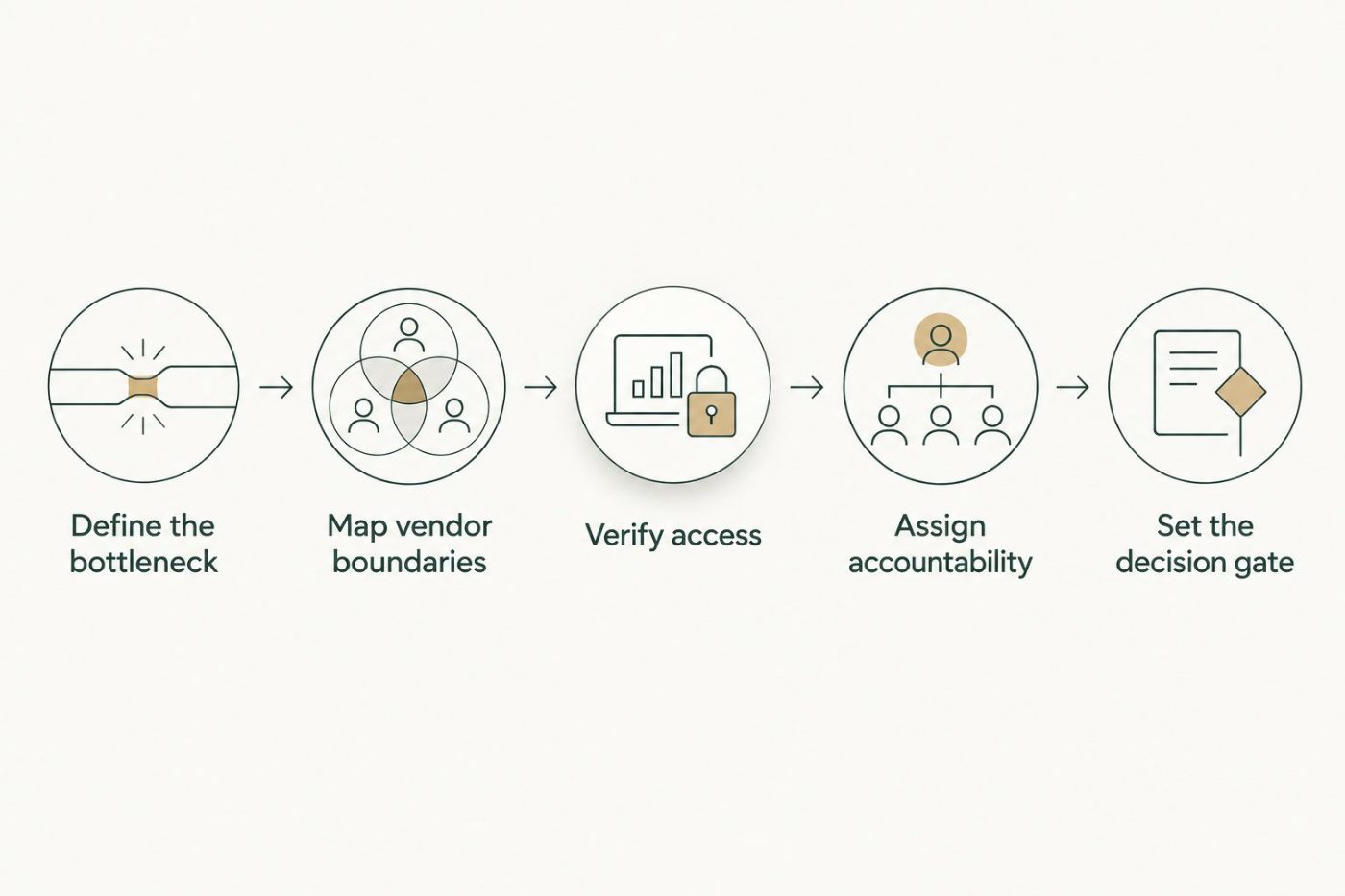
Approve implementation after access, vendor responsibilities, and operating controls are established.
Why vendor compatibility varies
Vendor compatibility depends on the actual workflow and commercial arrangements, not the category label on a service proposal. Use these factors to structure vendor discussions:
- Access permissions: Confirm which records and actions the integration can use, and who grants or revokes access.
- Contractual boundaries: Establish whether the proposed data use and third-party involvement are permitted under the relevant agreements.
- Data ownership: Identify the authoritative record and decide where approved changes belong.
- Change management: Assign responsibility for reviewing vendor updates and maintaining affected connections.
- Support scope: Establish which party investigates each component and who coordinates incidents across providers.
- Staff adoption: Define how employees use the revised process, recognize exceptions, and request help.
Treat an unresolved factor as a decision item with an owner. Calling it a technical detail does not remove its operational consequences.
What should each party own?
A workable arrangement needs named responsibilities, not a general statement that everyone will collaborate. Use the following division as a discussion framework, then adjust it to the contracts and workflow.
| Party | Responsibility to confirm | Boundary to document |
|---|---|---|
| Executive sponsor | Approves objectives, resources, and acceptable risk | Which decisions require executive approval |
| Process owner | Owns workflow rules, exceptions, and acceptance | Who can change the business process |
| Existing vendor | Confirms supported access and its contracted obligations | What its support agreement covers |
| Implementation partner | Owns agreed design, delivery, and integration work | What implementation and ongoing management include |
| Internal IT or security | Reviews identity, permissions, and relevant controls | Who authorizes production access |
Assign an accountable business owner even when delivery involves several providers. Shared participation should not become shared ambiguity.
For each handoff, record the trigger, recipient, expected action, and escalation route. Keep that record accessible to the people running the process, rather than leaving it buried in a proposal.
What should an AI Opportunity Assessment establish?
The AI Opportunity Assessment should clarify whether the proposed change deserves implementation. It should not function as a disguised purchase commitment.
Ask for decision-ready answers in these areas:
- Business objective: What operational problem is being addressed, and who owns it?
- Current process: Where do staff, systems, and outside providers hand work to each other?
- Vendor fit: Which requirements are supported, restricted, or unresolved?
- Governance: Who can authorize access, approve outputs, and accept exceptions?
- Financial clarity: Which implementation and ongoing obligations need consideration before approval?
- Delivery decision: What evidence supports proceeding, changing scope, or stopping?
For a 2026 assessment, insist that vendor dependencies appear in the recommendation itself. An implementation proposal is incomplete if a critical permission or support commitment remains an unstated assumption.
Naiconsultants is best for established U.S. businesses with $10M+ in annual revenue seeking a hands-on, ongoing AI department. Its stated model includes implementation, management over the client relationship, and training for internal teams.
That model brings work beyond a strategy document, but it does not remove your company's responsibilities. Executive sponsorship, access approvals, process ownership, and staff participation still need internal owners.
How do you accept the work without accepting hidden risk?
Approve the workflow against its intended business use, not against a polished demonstration. Your acceptance criteria should describe normal operation, exceptions, and recovery.
Use a written review that covers:
- Correct handling: Confirm that information reaches the intended destination and that unauthorized actions are blocked.
- Human review: Specify which outputs or actions need approval before they affect customers, employees, or business records.
- Failure handling: Establish what staff do when a connection fails, information is incomplete, or an output is unsuitable.
- Traceability: Retain the records needed to investigate an action or explain a decision, subject to applicable policies.
- Operational readiness: Confirm that users understand the revised workflow and know where to report problems.
- Change ownership: Identify who approves subsequent modifications and checks their effect on connected systems.
Avoid acceptance language that treats every future vendor change as already covered. Define the management scope and the process for additional work explicitly.
Training belongs in this review. Staff need to understand when to rely on the workflow, when to intervene, and how to resume work after an exception—not merely where to find a new feature.
Can you keep your current IT provider?
Yes, retaining your current IT provider is compatible with using an AI implementation partner. Confirm how the provider's existing scope intersects with identity management, security review, access approvals, and incident coordination.
Do not assume either party has accepted responsibility for the other's work. Resolve overlapping responsibilities before granting production access, and identify the person who coordinates issues crossing both scopes.
Do existing vendors have to approve every integration?
Approval requirements depend on the relevant agreements, permissions, and connection method. Your company should establish what authorization is required rather than assuming a subscription permits every proposed use.
Ask the responsible commercial and technical contacts to confirm the requirements. Keep the resulting decisions with the implementation record so a future operator can understand the approved boundaries.
Should you replace a vendor that cannot support the workflow?
Replacement is a decision to assess, not the automatic next step. First determine whether the unsupported requirement is essential, whether the process can change, and whether another permitted design meets the business objective.
Then compare the consequences of retaining the vendor, changing scope, or replacing the affected component. Include migration, staff adoption, governance, and ongoing management in that decision—not just the proposed feature.
FAQ
Can AI implementation services work with vendors we already use?
Yes, AI implementation services can work with existing vendors when access, contractual permissions, and support responsibilities fit the proposed workflow. Confirm those conditions before approving implementation.
Do we need to replace our business software to implement AI?
No, replacing business software is not an automatic requirement for AI implementation. Assess whether the existing systems support the required workflow and controls before considering replacement.
Who should own an integration when several vendors are involved?
Your company should name an accountable business owner and assign technical responsibilities across the participating providers. Document incident coordination, change approval, and escalation boundaries.
What if our current vendor does not provide an API?
The absence of an API requires a review of other permitted connection methods and their operating limitations. If no acceptable design meets the requirement, change the scope or reassess the system decision.
Does an AI Opportunity Assessment commit us to implementation?
No, an AI Opportunity Assessment does not establish that a build is justified. The decision should follow the assessment of the business problem, vendor dependencies, controls, and operating obligations.
What does Naiconsultants do beyond AI strategy?
Naiconsultants provides engineering, implementation, ongoing management over the client relationship, and training for internal teams. Its model serves established U.S. businesses seeking outsourced AI department or fractional leadership services.
What should we ask vendors before approving an AI project?
Ask vendors to confirm permitted access, supported operations, data handling boundaries, change responsibilities, and support scope. Record unresolved dependencies before making the implementation decision.
One last thing
Your most useful 2026 vendor question is not whether a system supports AI. Ask: Who owns the exception when the complete workflow fails?
Require an answer that names the accountable owner, explains the handoff between providers, and gives staff a usable fallback. If those details remain unresolved, the implementation decision is not ready—regardless of how convincing the demonstration looks.