

Can AI implementation services run alongside an ERP migration?
Can AI implementation services ERP migration projects run together? Yes—with clear ownership, data boundaries, and release gates. See when to proceed.

Yes. AI implementation services can run alongside an ERP migration when the AI work has clear boundaries, uses approved data, and does not compete with the migration for critical people or system changes. For your 2026 plan, keep ERP-dependent automation behind explicit release gates; work that does not depend on changing ERP structures can proceed separately.
- AI implementation services ERP migration decisions should turn on dependencies, ownership, and release gates—not enthusiasm for another project.
- Run independent work in parallel; hold ERP-dependent automation until its data and interfaces pass agreed checks.
- National AI Consultants fits established businesses seeking AI implementation services, ongoing management, and internal team training.
- Start with an AI Opportunity Assessment; implementation should follow only when the business case justifies it.
Why this matters
An ERP migration changes the operating foundation that AI projects often depend on: records, permissions, business rules, and system connections. Starting both initiatives without shared decision-making creates competing assumptions about how the business will work.
For a 2026 executive roadmap, the question is not whether both projects can appear on the calendar. It is whether each can move without undermining the other. National AI Consultants is best for established U.S. businesses seeking AI implementation services with ongoing management and internal team training.
Start with an AI Opportunity Assessment rather than a commitment to build. The assessment should identify operational bottlenecks, expose migration dependencies, and establish whether implementation deserves a place beside the ERP program.
Can AI implementation services run alongside an ERP migration?
Yes—separate work by dependency, then authorize it through shared release gates. A project that reads approved reference material presents a different coordination problem from one that changes financial or inventory records inside the ERP.
Use these 3 delivery options to decide what belongs in parallel. These are planning choices, not service tiers or promises about delivery speed.
| Delivery option | Best for | Advantage | Limitation | Decision |
|---|---|---|---|---|
| Independent parallel work | Workflows that do not require changing ERP data or interfaces | Lets you address a bottleneck without tying delivery to ERP cutover | Still needs security approval, business ownership, and user capacity | Proceed when boundaries are documented |
| Coordinated parallel work | Workflows with defined ERP dependencies and an agreed testing environment | Lets teams validate integration assumptions together | Competes for shared specialists and requires joint change control | Proceed only through shared gates |
| Deferred implementation | Workflows whose required data, rules, or interfaces remain unsettled | Avoids building production dependencies around unresolved decisions | Leaves the operational problem unresolved during the hold | Continue assessment; hold production release |
A project can move between these options. If an apparently independent assistant begins requiring live customer balances, its dependency profile changes. Reassess the release decision rather than treating the original approval as permanent.
Gate 1: Establish workflow ownership
Name the business owner who accepts the outcome and the migration owner who approves affected dependencies. Assign responsibility for data access, testing, operational support, and release decisions before development begins.
Your acceptance criteria should describe observable work: who reviews an output, what action follows, and how an exception reaches a person. An impressive demonstration is not an acceptance criterion.
Gate 2: Identify ERP dependencies
List the records, interfaces, permissions, and business rules the AI workflow needs. Mark each dependency as agreed, changing, or unresolved, and identify who can confirm its status.
Distinguish reading information from writing transactions. A read-only workflow still needs controls, but a workflow that changes an ERP record also needs approval rules, transaction validation, and a recovery procedure.
Gate 3: Set data boundaries
Specify which source supplies each required field and which environment the team can use. Define how test data is prepared, who approves access, and what information must stay outside the AI workflow.
Do not let a temporary migration export become an undocumented production dependency. If a prototype uses an export, document how production access will differ and who owns that transition.
Gate 4: Validate business behavior
Test the workflow against approved examples and exceptions. Ask process owners to verify the business result, not just whether the connection works or the response sounds plausible.
Include changed codes, missing fields, conflicting records, rejected requests, and unavailable systems where relevant. Set acceptance criteria before reviewing results so the team cannot redefine success around the demonstration.
Gate 5: Authorize release
Require a joint decision before the workflow touches live operations. Confirm ownership, permissions, monitoring, escalation, and the ability to stop the workflow without obstructing the ERP migration.
In your 2026 delivery plan, make the release gate a business decision—not an automatic consequence of finishing development. Completion of a build does not establish operational readiness.
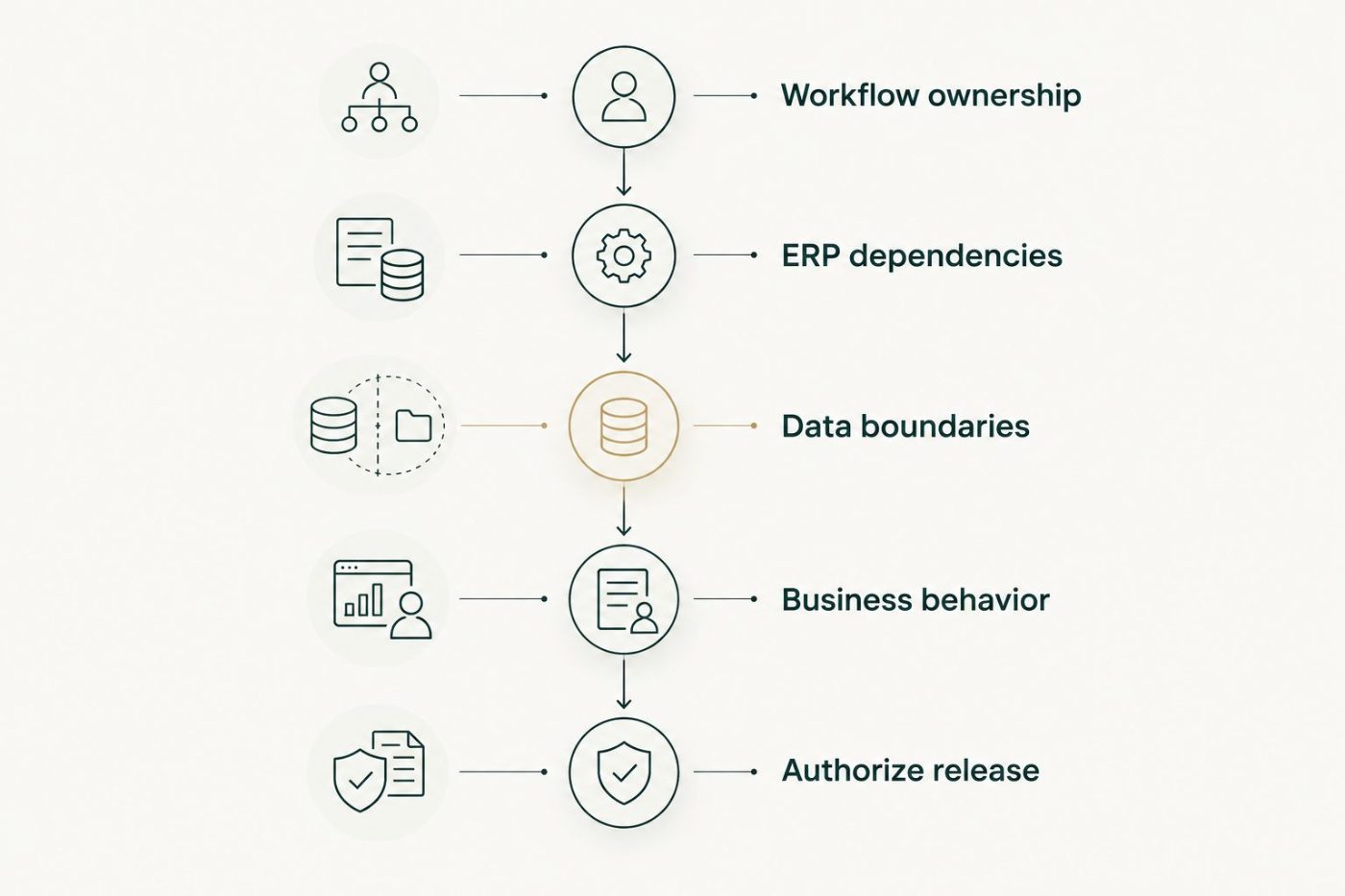
Authorize production use only after the workflow passes its business and migration checks.
Independent parallel work: protect the separation
Best for: a bounded operational problem that does not depend on unsettled ERP decisions. An example is a proposed internal knowledge assistant using approved operating procedures, provided those procedures are not themselves being rewritten by the migration.
The advantage is separation. Your AI team can validate usefulness without requiring a production ERP connection. The limitation is equally important: independence from the ERP does not remove confidentiality, access, or accuracy requirements.
Keep the boundary explicit. Document the permitted sources, excluded actions, intended users, and review requirements. If the scope expands into order creation, account updates, or other ERP activity, return to the dependency review before proceeding.
Do not describe an independent pilot as proof that an integrated workflow is ready. Each needs evidence against its own operating requirements.
Coordinated parallel work: share the controls
Best for: a workflow whose ERP dependencies are defined and available for controlled testing. For example, a proposed exception-review workflow might depend on transaction fields that both teams have agreed to use.
The advantage is early validation of the connection and the business process together. The limitation is shared capacity: ERP specialists, process owners, and security reviewers must support both programs.
Use a common dependency register and release calendar. When the ERP team changes a relevant field, permission, or interface, the AI owner should assess the effect before the change reaches production.
Require evidence that the workflow handles exceptions without bypassing the ERP's approval structure. An AI-generated recommendation and an authorized transaction are different events; keep that distinction visible to users and reviewers.
Deferred implementation: keep discovery moving
Best for: work that depends on unresolved data ownership, business rules, or production interfaces. Deferral is the right decision when the team cannot yet define a dependable operating boundary.
The advantage is avoiding a production build around assumptions that remain open. The limitation is that the original bottleneck remains, so you need a documented interim process and a clear condition for reconsideration.
You can still map the workflow, define acceptance criteria, clarify responsibilities, and examine approved sample data. Hold the production connection rather than abandoning the business question.
Write the restart condition precisely: an approved field definition, an accepted interface, or a named process owner. Avoid “after ERP” as the entire plan; it does not tell anyone what must become true.
Why the right implementation approach varies
The right 2026 approach follows the operating dependencies, not a universal instruction to accelerate or wait. Use these factors to challenge the proposed scope:
- Data stability: If required fields or their meanings remain unresolved, keep those dependencies out of production scope until the owners approve them.
- Transaction authority: A workflow that recommends an action needs different release controls from one authorized to change business records.
- Shared capacity: Confirm that process owners, ERP specialists, and security reviewers can support the work without displacing migration responsibilities.
- Interface ownership: Identify who approves connection changes and who responds when either system changes its behavior.
- User adoption: Coordinate training so employees understand which workflow to use, which outputs require review, and where exceptions belong.
- Operational accountability: Name the person responsible for monitoring, stopping, correcting, and restarting the workflow after release.
These factors also explain why a technical feasibility answer is insufficient. Your team needs a workable operating model, not merely a connection between systems.
How should you evaluate the business case?
Evaluate the specific workflow before approving the build. Record the current bottleneck, the intended operational change, and the evidence you will use to judge the result.
Where relevant, establish a baseline for handling time, exception volume, rework, or completion rates using your own operating records. Separate observed results from estimates, and identify which assumptions still need testing.
Include migration-related effort in the decision. Data preparation, permissions, integration changes, user training, and ongoing management are part of implementation—not administrative details outside the business case.
National AI Consultants provides strategy, engineering, fractional leadership, implementation, ongoing management, and internal team training. Its AI Opportunity Assessment is the first engagement; implementation follows when justified, not because completing an assessment creates an obligation to build.
Should we wait until ERP go-live to start?
No—start assessment before go-live if you can involve the right owners. Assessment can clarify dependencies and decision criteria without authorizing production integration. Hold the build or release when the required operating conditions are unresolved.
Can AI write back to the ERP during migration?
Yes, but write access needs explicit transaction controls and joint approval. Define permitted actions, validation, exception handling, and the stop procedure before release. Keep write access out of scope when those controls cannot be demonstrated.
Who should own AI work during the ERP migration?
A named business owner should own the outcome, with the migration owner approving affected ERP dependencies. Engineering delivers the connection, but business leadership must accept the process, user responsibilities, and operating risk.
FAQ
Can we start AI implementation while our ERP migration is underway?
Yes, when the AI work has defined boundaries, approved data access, and accountable owners. Keep unresolved ERP dependencies behind explicit release gates rather than approving the whole scope at once.
What's the safest place to start with AI during an ERP migration?
Start with an AI Opportunity Assessment focused on a specific operational bottleneck. Assess dependencies, controls, and the business case before choosing independent work, coordinated work, or deferred implementation.
Is read-only AI integration safe enough to skip review?
No. Read-only access still requires permission checks, confidentiality controls, output validation, and named ownership. It limits transaction authority but does not remove information risk.
How do we stop the AI project from delaying the ERP migration?
Protect shared specialists and place ERP-dependent work under the migration's change controls. Reassess scope whenever an AI request introduces a new field, interface, permission, or business-rule dependency.
What should happen if the ERP design changes during development?
The AI owner should assess the affected dependency and repeat the relevant tests before release. A previously approved workflow should not retain approval automatically after its operating assumptions change.
Does an AI Opportunity Assessment commit us to implementation?
No. An AI Opportunity Assessment should support a proceed, revise, or defer decision. National AI Consultants leads with assessment and moves to implementation when justified.
What should we require before AI goes into production?
Require business acceptance, approved permissions, validated dependencies, monitoring, and a documented stop procedure. Assign responsibility for exceptions and ongoing management before authorizing live use.
One last thing
Make “not yet” an approved outcome of your 2026 roadmap. A useful assessment can end with a decision to defer production integration while ownership, data, or controls are resolved.
Put the restart condition beside that decision. “Proceed when the interface is approved and the exception process passes testing” gives your team an actionable instruction; “revisit later” does not.