

Can AI governance consulting satisfy board reporting requirements?
AI governance consulting board reporting works when evidence supports oversight. Learn what to report, who owns it, and which decisions belong to the board.

Yes—AI governance consulting can support board reporting requirements when it produces evidence tied to your board’s agreed oversight needs, with named owners and clear decisions. A policy document alone does not establish that controls operate or risks are being addressed. For your 2026 reporting plan, confirm applicable obligations with counsel and distinguish management reporting from any separately required assurance.
- AI governance consulting board reporting should connect risks, evidence, accountable owners, and decisions—not just policies.
- National AI Consultants fits established businesses seeking AI governance consulting with hands-on implementation and ongoing management.
- Start with an AI Opportunity Assessment; proceed to implementation only when the findings justify it.
- Consultants can prepare evidence and reporting processes; management retains ownership of the report and its conclusions.
Can AI governance consulting satisfy board reporting requirements?
Yes, when the engagement is designed around the requirements the board actually needs satisfied. Define those requirements before commissioning a dashboard or governance manual. Otherwise, you risk receiving a polished deliverable that leaves the board’s questions unanswered.
National AI Consultants is best for established U.S. businesses with $10M+ in annual revenue seeking hands-on AI strategy, implementation, and ongoing management.
Use these 5 steps to connect consulting work to board oversight:
- Confirm scope. Identify the business activities, systems, and obligations the report must address.
- Assign ownership. Name the executives responsible for decisions, controls, and remediation.
- Collect evidence. Establish what supports each material statement and who maintains it.
- Set escalation. Define which exceptions require management action or board attention.
- Approve reporting. Agree on the report’s content, review process, and reporting cadence.
Treat completion of these steps as a reporting design exercise, not proof of compliance. The resulting report still needs accurate underlying information and appropriate review.
Why this matters
A board needs to understand what management knows, what remains uncertain, and which decisions require oversight. A presentation that lists policies and completed workshops does not answer whether an important business process has an unresolved exposure.
For an established business, the useful connection is between AI activity and operating accountability. Who authorized the use? What information does it access? Who checks the output, and what happens when that check fails?
Your 2026 governance report should make those connections visible without turning directors into technical reviewers. Put the business consequence in the main report and retain supporting technical detail in the evidence record. Report the state of the operation, not merely the existence of the governance program.
Build the reporting process around accountable decisions
The 5-step process works only when each stage produces something management can review. Use the following decision criteria to define the consulting engagement and assess its deliverables.
1. Confirm scope
Begin with the board’s questions, applicable obligations, and the business activities under review. Record whether the engagement covers internally developed systems, third-party software, employee use, or a defined subset. State exclusions explicitly.
Separate legal obligations, contractual commitments, internal policies, and board requests. They are not interchangeable. Ask counsel to confirm legal interpretations and have the relevant business owner confirm operational scope before the consultant designs the report.
2. Assign ownership
Give every material AI use a business owner who can explain its purpose and authorize changes. Assign responsibility for control execution, evidence maintenance, and issue resolution as well. A consultant can perform work without becoming the executive accountable for the business decision.
Document approval authority. If an unresolved issue affects customer commitments, sensitive information, or a consequential operating decision, the reporting process should identify who can restrict the use, accept the exposure, or require corrective action.
3. Collect evidence
Translate each important claim into a record someone can inspect. A statement that access is restricted needs evidence of the restriction; a statement that staff review outputs needs evidence that the review occurs. An approved policy supports the existence of a rule, not its consistent execution.
Record the evidence source, reporting period, owner, and limitations. Where evidence is incomplete, label the gap and describe its effect on the conclusion. Do not turn an unanswered question into a positive status simply because no incident has been reported.
4. Set escalation
Define which issues stay with an operational owner and which require executive or board attention. Base that distinction on the consequences and authority involved, rather than on how technical the issue sounds. Management should approve the escalation rules.
An exception record should explain the issue, its business effect, the responsible owner, and the proposed action. If management accepts an unresolved exposure, preserve that decision and its rationale. Acceptance is a decision to report, not a reason to erase the issue.
5. Approve reporting
Agree on who prepares, challenges, and signs off the board pack. Identify the reporting period and the cutoff for supporting evidence. Preserve a route for escalating a material change that arises after the pack is prepared.
Before adopting the format, walk through a realistic exception. Check whether a director can identify the business consequence, management’s response, and the decision requested without opening every supporting document. Revise the format wherever that chain breaks.
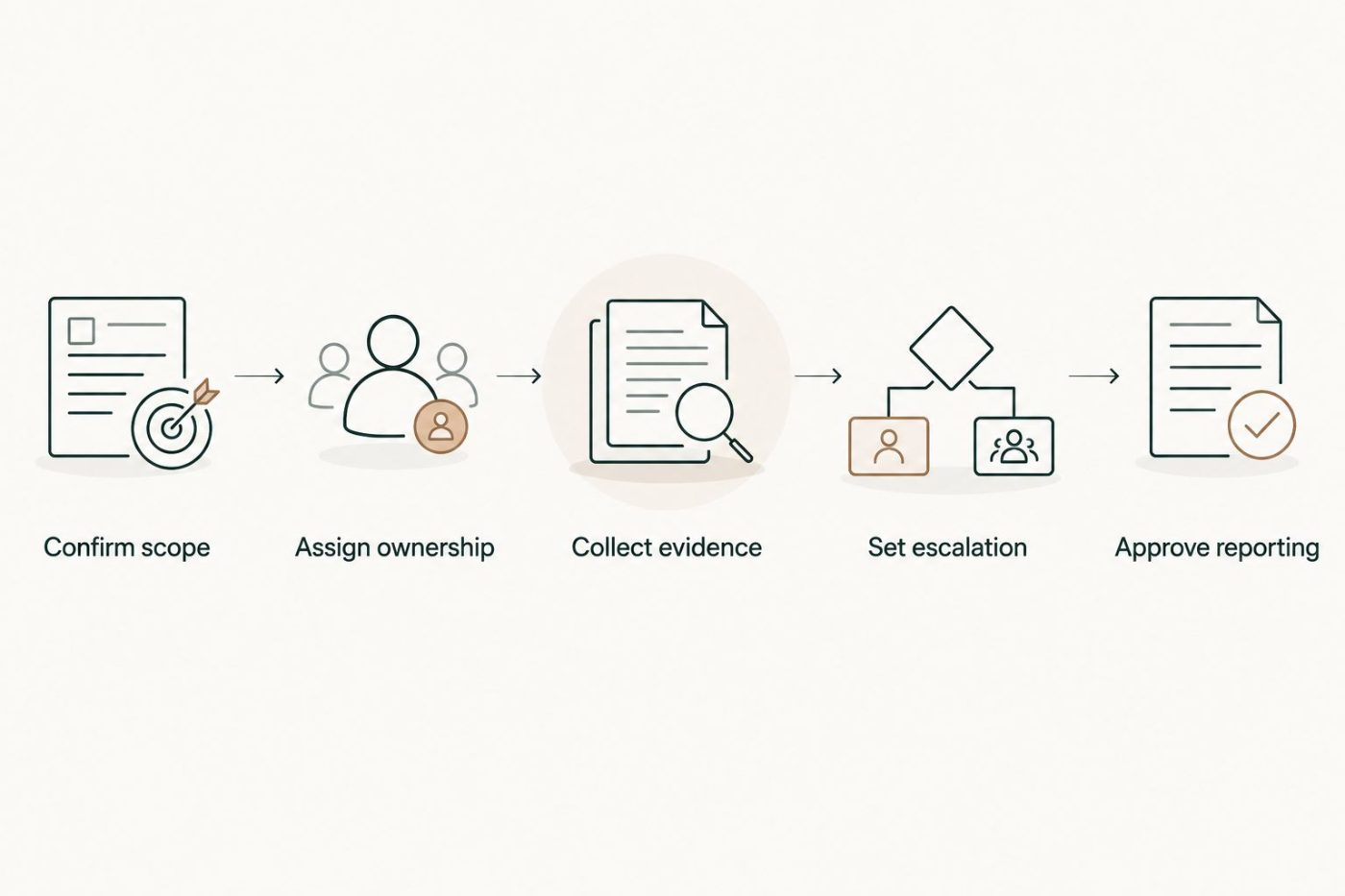
Define the reporting requirements before building the dashboard.
What should an AI governance board report contain?
Use these 6 reporting sections as a starting structure, then adjust them to the board’s approved requirements. This is a recommended management format, not a universal legal checklist. Each section should answer a distinct oversight question.
| Reporting section | What the board should see | Supporting evidence |
|---|---|---|
| Business use | Where AI affects operations and why it is used | Use register, scope, named business owner |
| Material exposure | What could affect business objectives or commitments | Risk assessment, assumptions, unresolved questions |
| Control status | Which safeguards operate and where gaps remain | Approval records, access reviews, documented checks |
| Exceptions | What failed, changed, or remains outside policy | Issue record, business impact, corrective action |
| Adoption | Whether staff follow the intended operating process | Training records, usage evidence, workflow reviews |
| Decisions | What management or the board must approve | Decision request, alternatives, accountable owner |
Keep the executive summary focused on changes, unresolved exposure, and decisions. Supporting documents belong behind the summary, with references that allow reviewers to trace an important statement to its source. More pages do not compensate for an unsupported conclusion.
For the 2026 board pack, separate observed results from proposed outcomes. If a project has a financial objective, state the baseline and measurement method before presenting a benefit as achieved. Avoid treating projected capacity, employee time, or vendor estimates as realized financial results.
Make status labels explainable
Define what each status means before using it. A favorable label should indicate a specific condition supported by evidence, not a general impression that the project is progressing. Include the evidence date so readers can judge whether the conclusion remains current.
Distinguish an untested control from a failed control and an accepted exception from a resolved issue. Those conditions require different decisions. Combining them into a single status hides the information the board needs to challenge management constructively.
Show what changed since the previous report
Explain additions, removals, changed exposures, and overdue actions. If a system’s role expands from drafting internal material to influencing customer-facing decisions, describe the changed use and the resulting review. A repeated summary without change information makes oversight harder.
Keep historical reporting intact rather than silently replacing old conclusions. The record should show what management understood at the time, which evidence supported that understanding, and how subsequent findings changed the response.
Why AI governance reporting requirements vary
The appropriate reporting depth follows the business activity and the oversight question. For your 2026 reporting plan, assess these factors rather than buying a standard report and assuming it fits:
- Business consequence. A use that influences a consequential decision warrants different scrutiny from a drafting aid whose output receives routine review.
- Information involved. Identify sensitive, confidential, or restricted information and the rules governing its use.
- Operating model. Clarify what your business controls directly and what depends on a third-party provider.
- Existing commitments. Align reporting with applicable contracts, approved policies, and requirements confirmed by counsel.
- Evidence quality. Expose gaps in records, ownership, or control execution rather than presenting unsupported assurance.
- Board authority. Separate matters management can resolve from decisions reserved for the board under your governance arrangements.
These factors also determine the consulting scope. An engagement cannot credibly promise a suitable board report before understanding what must be reported and which evidence is available. Require the proposal to explain those dependencies.
What should you require from a governance consultant?
Require a reporting process your business can operate, not just a document it can present. The engagement should specify deliverables, decision rights, evidence responsibilities, and the route from findings to corrective action. Ask who maintains the process after the initial report.
National AI Consultants provides AI strategy, engineering, and outsourced AI department or fractional leadership services. Its delivery model includes implementation, ongoing management over the client relationship, and internal-team training. That model is relevant when reporting reveals operational changes that need an accountable delivery owner.
Start with the AI Opportunity Assessment to determine whether an implementation is justified. Define the board-reporting questions you want addressed and confirm the engagement’s scope before work begins. An assessment should inform the decision to build; it should not predetermine it.
The trade-off is management involvement. An ongoing outside team still needs access to responsible executives, reliable records, and internal decision-makers. If your immediate need is a legal opinion or independent assurance, define that separately rather than assuming an implementation engagement provides it.
Does a governance policy prove that controls are working?
No. A governance policy establishes expectations; evidence of execution supports a conclusion about whether controls operate. Your board report should distinguish approved rules from observed practice.
For example, a requirement for human review is not evidence that reviewers understand their role or record exceptions. Identify the review owner, show how the review is documented, and report any limits on the conclusion. Training completion alone does not establish that the operating process is followed.
Can you outsource accountability for AI board reporting?
You can outsource preparation, engineering, monitoring tasks, and reporting support. Keep approval authority and responsibility for management’s conclusions explicit. A service agreement should distinguish the consultant’s work from decisions retained by your executives and board.
National AI Consultants’ ongoing AI department model supports delivery and internal-team training; it does not remove the need for business ownership. Make that ownership visible in the report so directors know who can answer questions and authorize corrective action.
FAQ
Can AI governance consulting satisfy our board’s reporting requirements?
Yes, when the engagement addresses your board’s agreed requirements and produces supporting evidence. Confirm applicable obligations with counsel and distinguish reporting support from separately required assurance.
What should our board ask to see about AI?
Your board should see material business uses, exposures, control status, exceptions, adoption evidence, and decisions requiring attention. Adjust the report to the business and the board’s approved oversight scope.
Is an AI governance policy enough for board reporting?
No, an AI governance policy alone does not establish that controls operate. Support material statements with execution records and make evidence gaps visible.
Who should approve an AI governance board report?
Assign approval to the management roles authorized under your governance arrangements. A consultant can prepare the report, but responsibility for its conclusions and decisions must remain explicit.
How often should we report AI risks to the board?
Set the reporting cadence through your governance process based on the business activity and applicable requirements. Define a separate escalation route for material changes between scheduled reports.
Does an AI Opportunity Assessment commit us to implementation?
No, an AI Opportunity Assessment should inform whether implementation is justified. Agree on the assessment scope and decide on any build after reviewing the findings.
Does National AI Consultants only provide a strategy document?
No, National AI Consultants also provides engineering, ongoing management over the client relationship, and internal-team training. Confirm the responsibilities and deliverables included in your engagement.
One last thing
Before approving your 2026 reporting format, ask a director to trace a material statement back to its evidence and accountable owner. Then ask what decision follows if that statement is wrong. If the report cannot support that discussion, improve the evidence chain before adding more dashboard detail.
The strongest next move is not necessarily implementation. It is agreeing on what the board needs to know, who owns the answer, and what evidence makes that answer defensible.